
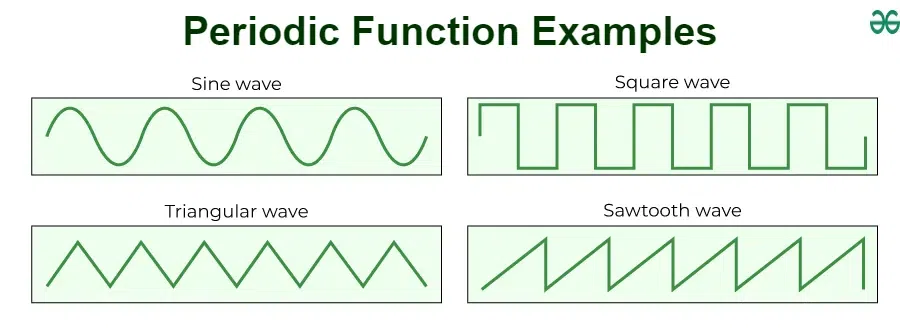
A periodic function is a mathematical function that repeats its values at consistent intervals, known as the period. Specifically, a function f(x) is periodic if there exists a positive constant T such that:
f(x + T) = f(x); for all real numbers 𝒙
- The smallest positive value of T for which this condition holds is called the fundamental period of the function.
- The domain of a periodic function is typically all real numbers, while its range is determined within one complete cycle.
How to Determine Period of a Function?
The period of a function is found using the steps added below:
Step 1: A periodic function is defined as a function that repeats itself at regular intervals or periods.
Step 2: It is represented as f(x + T) = f(x), where "T" is the period of the function, T ∈ R.
Step 3: Period means the time interval between the two occurrences of the wave.
Periods of Trigonometric Functions
Trigonometric Functions are periodic functions, and the periods of Trigonometric Functions are as follows:
- Period of Sin x and Cos x is 2π
i.e. sin(x + 2π) = sin x and cos(x + 2π) = cos x
- Period of Tan x and Cot x is π
i.e. tan(x + π) = tan x and cot(x + π) = cot x
- Period of Sec x and Cosec x is 2π
i.e. sec(x + 2π) = sec x and cosec(x + 2π) = cosec x
Amplitude
Amplitude is defined as the maximum displacement of a particle in a wave from equilibrium. In simple words, it is the distance between the highest or lowest point and the middle point on the graph of a function.
In trigonometry, there are three fundamental functions, namely, sin, cos, and tan, whose periods are 2π, 2π, and π periods, respectively. The starting point of the graph of any trigonometric function is taken as x = 0.
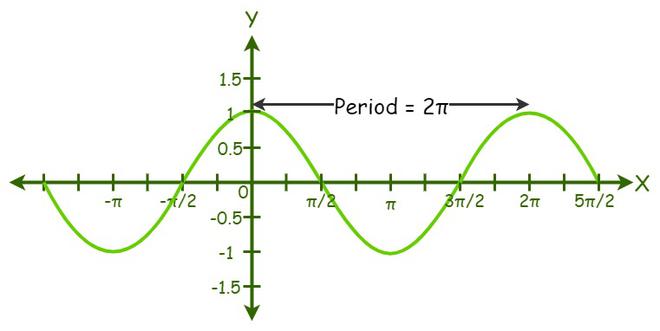
For example, if we observe the cosine graph given below, we can see that the distance between two occurrences is 2π, i.e., the period of the cosine function is 2π. Its amplitude is 1.
Periodic Formulae
- If "T" is the period of the periodic function f (x), then 1/f (x) is also a periodic function and will have the same fundamental period of T as f(x).
If f (x + T) = f (x),
F (x) = 1/f (x), then F (x + p) = F (x).
- If "T" is the period of the periodic function f(x), then f (ax + b), a>0, is also a periodic function with a period of T/|a|.
- Period of Sin (ax + b) and Cos (ax + b) is 2π/|a|.
- Period of Tan (ax + b) and Cot (ax + b) is π/|a|.
- Period of Sec (ax + b) and Cosec (ax + b) is 2π/|a|.
- If "T" is the period of the periodic function f(x), then af(x) + b, a>0, is also a periodic function with a period of T.
- Period of [a Sin x + b] and [a Cos x + b] is 2π.
- Period of [a Tan x + b] and [a Cot x + b] is π.
- Period of [a Sec x + b] and [a Cosec x + b] is 2π.
Practice Problems based on Periodic Function
Problem 1: Determine the period of the periodic function cos(5x + 4).
Solution:
Given function: cos (5x + 4)
Coefficient of x => a = 5
We know that,
Period of cos x is 2π
So, period of cos(5x + 4) is 2π/ |a| = 2π/5.
Hence, period of cos(5x + 4) is 2π/5.
Problem 2: Find the period of f(x) = cot 4x + sin (3x/2).
Solution:
Given periodic function: f(x) = cot 4x + sin 3x/2
We know that,
Period of cot x is π and the period of sin x is 2π.
So, period of cot 4x is π/4.
So, period of sin 3x/2 is 2π/(3/2) = 4π/3.
Now, calculation of the period of the function f(x) = cot 4x + sin 3x/2 is,
Period of f(x) = (LCM of π and 4π)/(HCF of 3 and 4) = 4π/1 = 4π.
Therefore, period of cot 4x + sin 3x/2 is 4π.
Problem 3: Sketch the graph of y = 3 sin 3x+ 5.
Solution:
Given, y = 3 sin 3x + 5
Given wave is in the form of y = a sin bx + c
From the above graph, we can write the following:
- Period = 2π/|b| = 2π/3
- Axis: y = 0 [x-axis ]
- Amplitude: 3
- Maximum value = (3 × 1) + 5 = 8
- Minimum value = (3 × -1) + 5 = 2
- Domain: { x: x ∈ R }
- Range = [ 8, 2]

Problem 4: Determine the period of the given periodic function 5 sin(2x + 3).
Solution:
Given function: 5 sin(2x + 3)
Coefficient of x => a = 2
We know that,
Period of cos x is 2π
So, period of 5 sin(2x + 3) is
2π/ |a| = 2π/2
= π
Hence, period of 5 sin(2x + 3) is π
Problem 5: Find the period of f (x) = tan 3x + cos 5x.
Solution:
Given periodic function: f(x) = tan 3x + cos 5x.
We know that,
Period of tan x is π and the period of cos x is 2π
So, period of tan 3x is π/3
So, period of cos 5x is 2π/5
Now, the calculation of the period of the function f(x) = tan 3x + cos 5x is,
Period of f(x) = (LCM of π and 2π)/(HCF of 3 and 5) = 2π/1 = 2π
Therefore, the period of f (x) = tan 3x + cos 5x is 2π
Practice Problem Based on Periodic Function
Question 1. Determine the period of the function f(x) = cos(4x).
Question 2. Find the period of f(x) = sin(3x−2).
Question 3. Determine the period of f(x) = cot(2x) + sin(x).
Question 4. Find the period of f(x) = 3sin(2x + 1) + 4.
Applications of Periodic Functions
Electrical Power (AC Current)
- Alternating current (AC) is defined in terms of sine and cosine functions.
- In India, AC has a frequency of 50 Hz (50 cycles per second), while in the US it is 60 Hz.
Sound and Music
- Sound waves from musical instruments are treated as sine and cosine functions.
- Periodic wave analysis finds application in sound engineering, audio compression (such as MP3), and noise cancellation.
Economics and Climate Cycles
- Stock market behavior occasionally exhibits periodic trends (weeklies or seasonal cycles).
- Climate observations (such as monsoon rainfall) also exhibit periodic patterns over years or months.
Signal Processing and Communications
- Radio, Wi-Fi, and mobile networks depend on periodic waves.
- Carrier signals are sinusoidal in form and are modulated (AM, FM, PM) for data transmission.
- Without periodic waveforms, there would be no contemporary communication systems.
Mechanical Vibrations and Engineering Design
- Bridges, structures, and aircraft are exposed to resonance frequencies (periodic oscillations).
- Example: Suspension bridges are designed to withstand wind-induced vibrations, which are periodic.
Medical Industry
- ECG (electrocardiogram) and EEG (brain wave) signals are periodic functions.
- Physicians use these recurring waveforms to diagnose heart and brain ailments.