
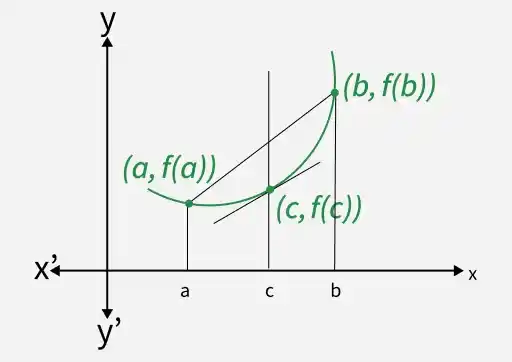
It states that for a curve passing through two points, there exists at least one point on the curve where the tangent is parallel to the secant through those two points.
For a function f(x) defined on [a, b], if:
- f(x) is continuous over [a, b].
- f(x) is differentiable over (a, b).
Then, there exists a point c in the interval (a, b) such that
f'(c) = \frac{f(b) - f(a)}{b - a}
Mean Value Theorem Proof
Statement: If a function f(x) is continuous over the closed interval [a, b], and differentiable over the open interval (a, b), then there exists at least one point c in the interval (a, b) such that f '(c) is zero, i.e. the tangent to the curve at point [c, f(c)] is parallel to the x-axis.
Proof:
We know that the secant line to f(x) passes through [a, f(a)] and [b, f(b)].
Now, the equation of the line passing through two given points (x1, y1) and (x2, y2) is y - y1 = [(y2 - y1)/(x2 - x1)](x - x1)
The equation of the secant line is,
F(x) - f(a) = [f(b) - f(a)] / (b - a) (x-a)
F(x) = [ f(b) - f(a) ] / (b - a) (x-a) + f(a) ...(i)
Let, h(x) be F(x) - g(x)
h(x) = F(x) - [[ f(b) - f(a) ] / (b - a) (x-a) + f(a)] (From (i))
As, h(x) is continuous on [a, b] and differentiable on (a, b) and h(a) = h(b) = 0
Applying, Rolle's theorem, we get an
x = c in (a, b) such that h'(c) = 0
Now,
h'(x) = f'(x) - [ f(b) - f(a) ] / (b - a)
h'(c) = f'(c) - [ f(b) - f(a) ] / (b - a) = 0
f'(c) = [ f(b) - f(a) ] / (b - a)
Thus the Mean Value Theorem is verified.
This result is true only for the function f(x) which is continuous and differentiable on the interval (a, b)
Graphical Representation
Graphically, MVT states that for any function f(x) continuous on [a, b] and differentiable on (a, b), there exists a point c in (a, b) such that the tangent at [c, f(c)] is parallel to the secant through [a, f(a)] and [b, f(b)].
Since parallel lines have equal slopes:
Slope of Tangent = Slope of Secant
f'(c) = \frac{f(b) - f(a)}{b - a}
Applications of Mean Value Theorem
- For any two functions f(x) and g(x) if they are continuous in interval [a, b] and differentiable on the interval (a, b), f'(c) = g'(c), c ∈ (a, b), then f(x) – g(x) is constant in [a, b]
- It is used in physical interpretation (like speed analysis).
- If the derivative of the function f(x) is greater than zero then f(x) is strictly an Increasing function.
- If the derivative of the function f(x) is less than zero then f(x) is strictly a decreasing function.
- Taylor Series and Number Theory use Mean Value Theorem
Solved Examples
Example 1: f(x) = (x - 1)(x - 2)(x - 3), x ∈ [0, 4]. Find c if the Mean value theorem is applied to f(x)
Solution:
f(x) = (x - 1)(x - 2)(x - 3),
x ∈ [0, 4]
f(x) = x3 - 6x2 + 11x - 6
As f(x) is Polynomial in x
- f(x) is continuous on [0. 4]
- f(x) is differentiable on (0, 4)
Thus, all the conditions of Mean Value theorem are satisfied.
To verify theorem we have to find c ∈ (0, 4) such that
f’(c) = (f(4) - f(0))/(4 - 0) …(1)
Now, f(4) = (4 - 1)(4 - 2)(4 - 3) = 6
f(0) = (0 - 1)(0 - 2)(0 - 3) = - 6 and
f'(x) = 3x2 - 12x + 11
f'(c) = 3c2 - 12c + 11
(f(4) - f(0))/(4 - 0) = 3c2 - 12c + 11 [From 1]
3 = 3c2 - 12c + 11
3c2 - 12c + 8 = 0
c = 2 ± 2/√3
Both values of c lie between 0 and 4.
Example 2: Verify LaGrange's mean value theorem for the function f(x) = log(x) on [1, e]
Solution:
f(x) = log(x)
f(x) is continuous on [1, e]
f(x) is differentiable on (1, e), Thus all the conditions of Mean Value theorem are satisfied.
We want to find c ∈ (1, e) such that
f(e) - f(1) = f'(c) {e - 1} … from (1) [By mean value theorem]
log e -log 1 = f'(c) {e - 1}
1 - 0 = f'(c) {e - 1}
f'(c) = 1/(e - 1) …[2]
Now,
f(x) = log(x)
Hence, f'(x) = 1/x
f'(c) = 1/c …[3]
From [2] and [3]
1/(e - 1) = 1/c
Hence, c = e - 1 which is lies in interval (1, e)
Thus, Lagrange's mean value theorem verified.
Example 3: Test whether the following function is increasing or not. f(x) = x3 - 3x2 + 3x - 100, x ∈ R
Solution:
f(x) = x3 - 3x2 + 3x - 100, x ∈ R
Differentiating with respect to x
f'(x) = 3x2 - 6x + 3
= 3(x - 1)2
Since (x - 1)2 is always positive x ≠1
f'(x) >0, for all x ∈ R.
Hence, f(x) is an increasing function, for all x ∈ R.
Example 4: Find the value of x for which the function f(x) = x3+12x2+36x+6, x is increasing.
Solution:
f(x) = x3 + 12x2 + 36x + 6
f'(x) = 3x2 + 24x + 36 = 3(x + 2)(x + 6)
Now, f'(x) > 0, as f(x) is increasing
3(x + 2)(x + 6) > 0
The above condition is true in two cases
Case 1: Both multiples are positive
x + 2 > 0 and x + 6 > 0
x > -2 and x > -6
x ∈ (-2, ∞)
Case 2: Both multiples are negative
x + 2 < 0 and x + 6 > 0
x < -2 and x < -6
x ∈ (-∞, -6)
Thus, f(x) = x3 + 12x2 + 36x + 6 is increasing in the interval, x∈ (-∞, -6) U (-2, ∞)
Example 5: For the function f(x) = 2x3 + 2, find all the values of c that satisfy the mean value theorem, in the interval [-2, 2].
Solution:
f(x) = 2x3 + 2 is a polynomial function and hence it is continuous and differentiable over the interval [-2, 2]
f'(x) = 6x
f(2) =2(2)3 + 2 = 18
f(-2) = 2(-2)3 + 2 = -14
f'(c) = [ f(2) - f(-2)] / (2 - (-2)) = [18 - (-14)] /4 =8
Let us find c in (-2, 2) such that f'(c) = 8
f'(c) = 6c
According to Mean Value Theorem
6c = 8
c = 8/6 = 1.33
Thus, c belongs to the interval [-2, 2].
Practice Problems
Q 1. Find the value of c guaranteed by the Mean Value Theorem for the function f(x) = 2x2 - 3x + 1 on the interval [1, 3].
Q 2. Find the value of c guaranteed by the Mean Value Theorem for the function g(x) =x on the interval [1, 9].
Q 3. Find the value of c guaranteed by the Mean Value Theorem for the function h(x) = ln x on the interval [1, e].
Q 4. Find the value of c guaranteed by the Mean Value Theorem for the function f(x) = x3- 3x on the interval [-1, 2].