
Logarithm rules are used to simplify and work with logarithmic expressions. They help relate logarithms to exponents and make complex calculations easier. Out of all these log rules, three of the most common are product, quotient, and power rules.
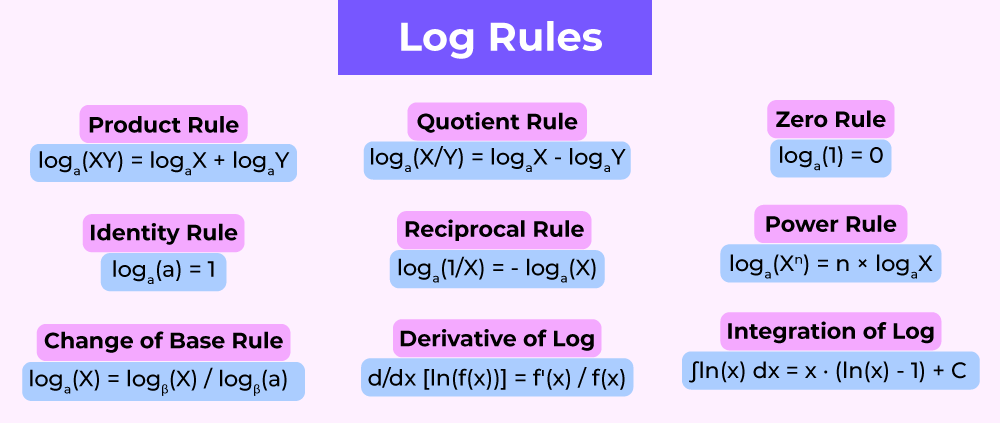
These laws are crucial in many mathematical and scientific applications, making logarithms a valuable tool for solving equations, modeling exponential growth, and analyzing large amounts of data.
Product Rule of Log
According to the product rule, the logarithm of a product is the sum of the logarithms of its elements.
Formula: loga(XY) = logaX + logaY
Example: log2(3 × 5) = log2(3) + log2(5)
Quotient Rule of Log
The quotient rule asserts that the logarithm of a quotient equals the difference between the numerator and denominator logarithms.
Formula: loga(X/Y) = logaX - logaY
Example: log3(9 / 3) = log3(9) - log3(3)
Zero Rule of Log
According to the zero rule, the logarithm of 1 to any base is always 0.
Formula: loga(1) = 0
Example: log4(1) = 0
Identity Rule of Log
According to the identity rule, the logarithm of a base to itself is always 1.
Formula: loga(a) = 1
Example: log7(7) = 1
Reciprocal Rule
According to the reciprocal rule of logarithms, the logarithm of a number's reciprocal (1 divided by that number) is equal to the negative of the logarithm of the original number. In mathematical notation:
Formula: loga(1/X) = - loga(X)
Example: loga(1/2) = - loga(2)
Power Rule or Exponential Rule of Log
According to the power rule, the logarithm of a number raised to an exponent equals the exponent multiplied by the logarithm of the base.
Formula: loga(Xn) = n × logaX
Example: log5(92) = 2 × log5(9)
Change of Base Rule of Log
The change of base rule enables you to calculate the logarithm of a number in a different base by employing a common logarithm (typically base 10 or base e). The change of Base Rule is also called the Base Switch Rule.
Formula: loga(X) = logᵦ(X) / logᵦ(a)
Example: log3(7) = log10(7) / log10(3)
Logarithm Inverse Property
The logarithm inverse property asserts that calculating the logarithm of an exponentiated value yields the original exponent.
Formula: loga(aⁿ) = n
Example: log₄(4²) = 2
Derivative of Log
The derivative of a function's natural logarithm is the reciprocal of the function multiplied by the derivative of the function.
Formula: d/dx [ln(f(x))] = f'(x) / f(x)
Example: If y = ln(x2), then dy/dx = 2x / x2 = 2/x
Integration of Log
Other than differentiation, we can also calculate the integral of the logarithm. The integral of the Log function is given as follows:
Formula: ∫ln(x) dx = x · ln(x) - x + C = x · (ln(x) - 1) + C
Note: As natural log and common both logs have only a difference of base, thus the rules for natural logs are the same as common log.
Related Topics:
Solved examples of Log Rules
Example 1: Simplify log2(4 × 8).
Solution:
Using the product rule, we split the product into a sum of logarithms:
log2(4 × 8) = log2(4) + log2(8) = 2 + 3 = 5.
Example 2: Simplify log4(16 / 2).
Solution:
Using the quotient rule, we divide the quotient into a difference of logarithms:
log4(16 / 2) = log4(16) - log4(2) = 2 - 0.5 = 1.5.
Example 3: Simplify log5(253).
Solution:
Using the power rule, we can bring down the exponent as a coefficient:
log5(253) = 3 × log5(25) = 3 × 2 = 6.
Example 4: Convert log3(7) into an expression with base 10.
Solution:
Using the base switch rule, we divide by the logarithm of the new base:
log3(7) = log₁₀(7) / log₁₀(3) ≈ 1.7712
Example 5: Evaluate log7(49) using the change of base rule with base 2.
Solution:
Using the change of base rule with base 2:
log7(49) = log2(49) / log2(7) = 5 / 1.807 = 2.77 (approx).