
The direct substitution method for limits is a technique in which the value that the variable approaches is directly substituted into the function to find the limit, if the function is defined at that value.
Geometrically speaking, the limit of a function at a particular point can be easily estimated through its graph. For example, in the graph given below, at x = 3. The function seems to be taking on the value of 1. In this case, it does not matter from which side we approach — the left-hand side or the right-hand side.
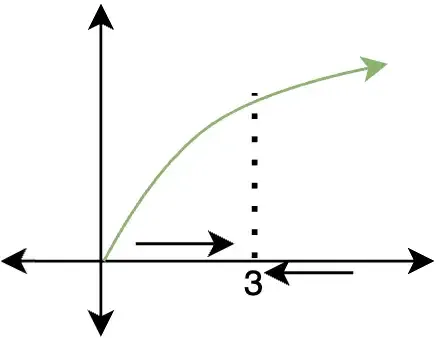
For the function f(x), the limit at x = a is denoted by
\lim_{x \to a} f(x)
How to Find Limits Using the Direct Substitution Method
The substitution rule for calculating limits is a method of finding limits by simply substituting the value of x with the point at which we want to calculate the limit. Consider a function f(x). The goal is to find the limit of the function at x = a. In this method, x is simply substituted with “a” in the expression for the function f(x).
\lim_{x \to a}f(x) = f(a)
Let's look at this method through an example,
Considering f(x) = x2,
\lim_{x \to 1}f(x) = f(1) ⇒
\lim_{x \to 1}x^2 = f(1) ⇒ 12 = f(1)
⇒ 1 = f(1)
or
f(1)=1
Often it is possible to calculate the limits for the function with this rule, to state this formally.
If f(x) is an expression built from the polynomials, roots, absolute values, exponential, logarithms, trigonometric functions, and/or inverse trigonometric functions by using composition of functions and the operations such as x, +, -, / then for any a for which f(a) is defined,
\lim_{x \to a}f(x) = f(a)
Undefined limits by Direct Substitution
There are certain limits which cannot be calculated by this method. For example, consider a function f(x) =
⇒
⇒
⇒
This limit is undefined as
Limits of Trigonometric Function
Direct substitution can sometimes be used to calculate the limits for functions involving trigonometric functions. For example, let's say we have a function f(x) and we want to calculate the limits for that function at x = 0. Let's see this with an example.
Example: Calculate the
f(x) = sin(x) + sin(x)cos(x)
Solution:
\lim_{x \to 0}f(x) ⇒
\lim_{x \to 0}(sin(x) + sin(x)cos(x)) ---taking sin(x) in common⇒
\lim_{x \to 0}(sin(x)(1 + cos(x)) ⇒
\lim_{x \to 0}sin(x) \times \lim_{x \to 0}(1 + cos(x)) ⇒0 × (1 + 1)
⇒ 0
Limits of Piecewise Function
When working with piecewise functions, the substitution rule generally does not work at the places where the definition of the function is changing. It is used in a slightly modified way for such functions.
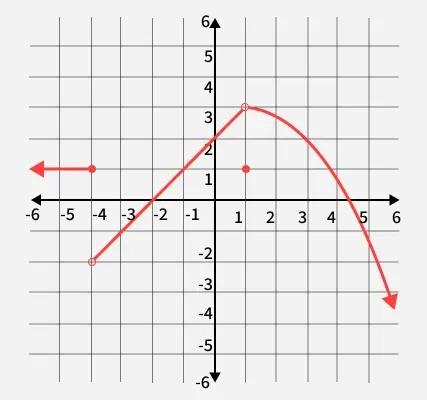
Example: Calculate the value of
Solution:
At x = 1, the function definition is changing. So it is not advised to directly apply the rule. In such functions, one should look for the limit from both sides.
Left-hand Side Limit
\lim_{x \to 1^{-}}f(x) ⇒
\lim_{x \to 1^-} x ⇒1
Right-hand Side Limit
\lim_{x \to 1^{+}}f(x) ⇒
\lim_{x \to 1^+} x^2-1 ⇒0
In this case, limits from both sides are different.
Related Articles
Sample Problems
Question 1: Calculate the
f(x) = x2 + x + 1
Solution:
\lim_{x \to 0}f(x) ⇒
\lim_{x \to 0}(x^2 + x + 1) ⇒
(0^2 + 0 + 1) ⇒ 1
Question 2: Calculate the
f(x) =
Solution:
\lim_{x \to 1}\frac{x^2 + x + 1}{x + 1} ⇒ \
\frac{\lim_{x \to 1}x^2 + x + 1}{\lim_{x \to 1}x + 1} ⇒
\frac{1^2 + 1 + 1}{1 + 1} ⇒
\frac{3}{2}
Question 3: Calculate the value of
Solution:
At x = 1, the function definition is changing. So it is not advised to directly apply the rule. In such functions, one should look for the limit from both sides.
Left-hand Side Limit
\lim_{x \to 1^{-}}cos(x) ⇒
cos(1) Right-hand Side Limit
\lim_{x \to 1^{+}}sin(x) ⇒
sin(1) In this case, limits from both sides are different.
Question 4: Calculate the
f(x) =
Solution:
\lim_{x \to 1}\frac{e^x + x + 1}{log(x) + 1} ⇒ \
\frac{\lim_{x \to 1}e^x + x + 1}{\lim_{x \to 1}log(x) + 1} ⇒
\frac{e^1 + 1 + 1}{log(1) + 1} ⇒
\frac{e^1 + 2}{0 + 1} ⇒ e + 2
Question 5: Calculate the
f(x) =
Solution:
\lim_{x \to 1}\frac{e^{sin(x)} + tan(x) + 1}{log(x) + 1} Since all the functions involved are continuous at x = 1, we can directly substitute x = 1:
⇒
\frac{e^{sin(x)} + tan(1) + 1}{log(1) + 1} Now, evaluate each term:
⇒
sin(1) = sin(1), tan(1) = tan(1), log(1) = 0 ⇒
\frac{e^{sin(1)} + tan(1) + 1}{0 + 1} ⇒
{e^{sin(1)} + tan(1) + 1} ⇒
\lim_{x \to 1}f(x) = {e^{sin(1)} + tan(1) + 1}
Question 6: Calculate the
f(x) =
Solution:
\lim_{x \to 0}\frac{sin^2(x) + cos(x) - 1}{1 - cos(x)} ⇒ \
\frac{\lim_{x \to 0}sin^2(x) + cos(x) - 1}{\lim_{x \to 0}1 - cos(x)} ⇒
\frac{sin^2(0) + cos(0) - 1}{1 - cos(0)}
\frac{0^2+1-1}{1-1} = \frac{0}{0} This is 0/0 form, so the limit is undefined. The substitution rule cannot be used here.
Question 7: Calculate the value of
Solution:
At x = 1, the function definition is changing. So it is not advised to directly apply the rule. In such functions, one should look for the limit from both sides.
Left-hand Side Limit
\lim_{x \to 1^{-}}e^{-x} ⇒
\frac{1}{e} Right-hand Side Limit
\lim_{x \to 1^{+}}e^{x} ⇒
e In this case also, limits from both sides are different.
Practice Problems
1. Calculate the
2. Calculate the
3. Calculate the
4. Calculate the
5. Calculate the
6. Calculate the
7. Calculate the
8. Calculate the
9. Calculate the
10. Calculate the