
Length, width, and height are the three main dimensions of a shape. Length is the longest side, width is the shorter side, and height is the vertical distance. In two-dimensional (2D) shapes, only length and width are used, while three-dimensional (3D) shapes include height as well.
These dimensions help describe the size of an object and are used to calculate area, surface area, and volume.
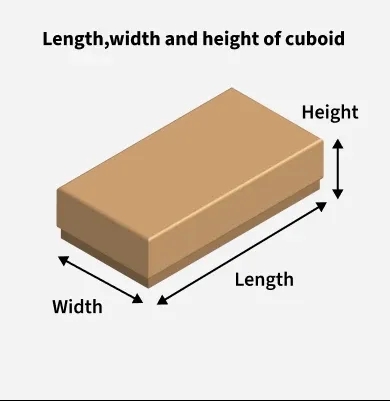
Length
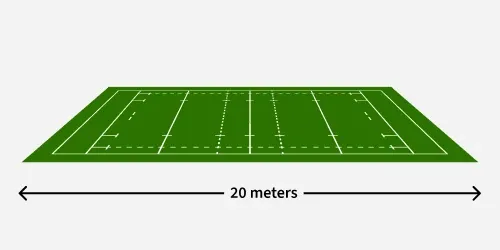
Length refers to the measurement of the longest side of a figure. It is a linear measurement that represents the distance between two points. Length is used to determine how long an object or space is and is measured in units such as meters, kilometers, centimeters, inches, and more.
- As an example of length, we can say the length of the pitch of a cricket ground is 20 meters long.
Width
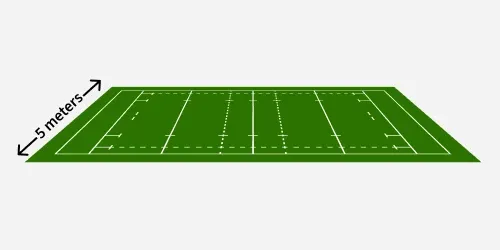
Width refers to the measurement of the shorter side of an object or figure. Like length, width is measured in units such as meters, kilometers, centimeters, inches, and others.
- As an example of width, we can say, width of the pitch of a cricket ground is 5 metre long.
Height
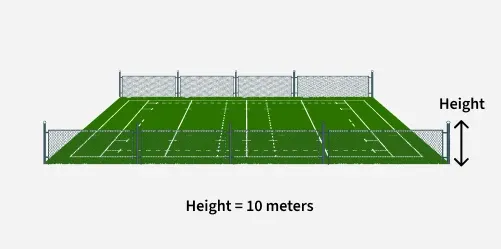
Height (also referred to as depth in some contexts) is the third dimension of a 3D object, representing its vertical measurement. It indicates how tall (or in some cases, how deep) an object is from its base to its top or bottom. Height is measured in standard units such as meters, kilometers, centimeters, inches, and others.
- As an example of height, The height of the fence around the pitch is 10 meters. This means the vertical distance from the ground to the top of the pitch is 10 meters.
Length × Width × Height
When all three dimensions are multiplied together, we get the volume of a geometrical shape. Volume is defined as the quantity of space occupied by a geometrical shape. The volume of a cuboid is equal to the multiplication of its length, breadth, and height. In other words, if we multiply all three dimensions together, we get the volume of a cuboid or any rectangular box.
Mathematically, the Volume of a Rectangular Prism (cuboid) or a Box = Length × Width × Height.
For example, if length, width, and height of a rectangular prism is 5, 8 and 10 units respectively, then its volume (V) is,
V = 5 × 8 × 10
V = 400 cube units
Length vs Width
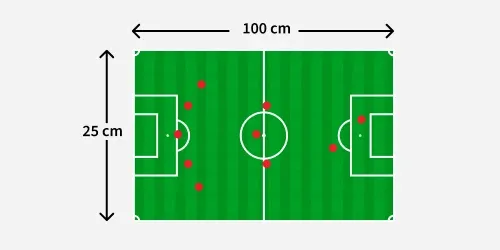
Length and width both are used to measure distance or dimension of a side but there is a remarkable difference between these two. Length is the longest dimension whereas width is the shortest dimension. Length is always larger than the width. In other words, length denotes a figure’s longer side, while width denotes its shorter side. Width (breadth) gives the wide nature of a geometrical shape while the length tells how long a shape is.
For example, if a cricket pitch has two measurements, 100 meters, and 25 meters, we can identify 100 meters as the length and 25 meters as the width since the pitch is longer from end to end and shorter from side to side.
Formula
Length, Width, and Height are used to calculate the volume and surface area of a rectangular prism by using certain formulas. These formulas are given below,
Volume of Rectangular Prism Formula
Volume of Rectangular Prism = length × width × height
Surface Area of Rectangular Prism Formula
Lateral Surface Area = 2 × height × (length + width)
Total Surface Area of Rectangular Prism = 2 [(length × width) + (width × height) + (length × height)]
Perimeter of a Rectangle
Perimeter = 2 × ( Length + Width)
Related Articles
Length, Width, and Height of a Box
Length, width, and height of a box can be expressed easily by looking at its shape. Because we know that the length of the box is generally the longest side, its width is the shorter side, and its height is the dimension in the vertical dimension.
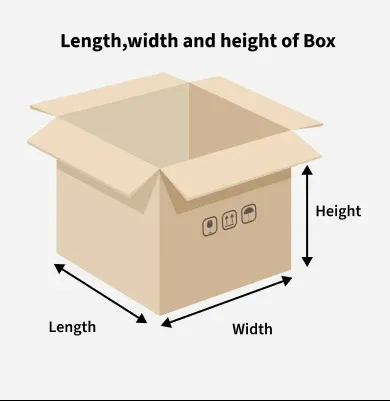
Generally, any 3-D-shaped dimensions are written as Length, followed by Width or Breadth, and Height. It means that if a box’s dimensions are to be measured, then it should be stated as length, width, and height. For instance, 10 meters, 5 meters, and 8 meters denotes,
- Length of Box = 10 meters
- Width of Box = 5 meters
- Height of Box = 8 meter
Solved Questions
Question 1: The rectangular dimensions of a 2D garden are 50 meters and 35 meters. What are the length and width?
Solution:
As we know,
The longer side is generally considered the length, and the shorter side is the width.So,
Length = 50 meters
Width = 35 meters
Question 2: A cupboard is 2 meters tall. What do 2 meters represent?
It represents the height of the cupboard.
Question 3: If the dimensions of a rectangular box are 26 m, 22 m, and 24 m, respectively. What will be the value of the height of this rectangular box?
Solution:
As we know, dimensions in a 3D shape is expressed in order of length, width, and height.
Given dimensions,
- Length = 26 m
- Width = 22 m
- Height = 24 m
So, Height is 24 meter
Question 4: The Length, Width, and Height of a rectangular prism are given as 6 cm, 4 cm, and 5 cm. Determine its volume.
Solution:
Given,
- Length = 6 cm
- Width = 4 cm
- Height = 5 cm
Volume = length × width × height
Volume = 6 × 4 × 5
Volume = 120 cm³
Practice Questions on Length, Width , and Height
Some practice questions on Length, Width, and Height are,
Question 1: Find the volume of a cuboid having length, width, and height as length = 12 cm, width = 8 cm, height = 4 cm.
Question 2: Find the volume of a cuboid having length, width, and height as length = 18 m, width = 9 m, height = 3 m.
Question 3: Find the total surface area (TSA) of a cuboid with dimensions: length = 42 cm, width = 28 cm, and height = 14 cm.
Question 4: Find LSA of a cuboid having length, width and height as, length = 7 cm, width = 5 cm, height = 6 cm.