
Polynomials are algebraic expressions made using numbers and variables, combined through addition, subtraction, and multiplication, where the variables have only non-negative whole number powers.
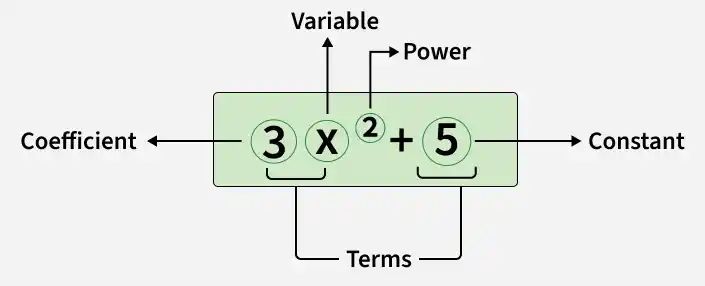
The above image shows the parts of a polynomial (3x² + 5), including the coefficient, variable, exponent (power), constant, and terms.
Standard Form of a Polynomial
P(x) = anxn + an−1 xn−1 + ⋯ + a1 x + a0
- an, an−1, …, a1, a0 are coefficients (which can be real or complex numbers).
- x is the variable.
- n is a non-negative integer representing the degree of the polynomial.
- an is the leading coefficient, and a0 is the constant term.
Each term consists of a variable raised to a non-negative whole number power, multiplied by a number.
Degree of a Polynomial
The degree of a polynomial is the highest power of the variable in it. For polynomials with more than one variable, the degree is the highest sum of powers in any term.
Example: In 3x⁴ + 7, the highest power of x is 4, so the degree is 4.
Types of Polynomials
Polynomials can be categorised into several types based on the number of terms they contain or their degree.
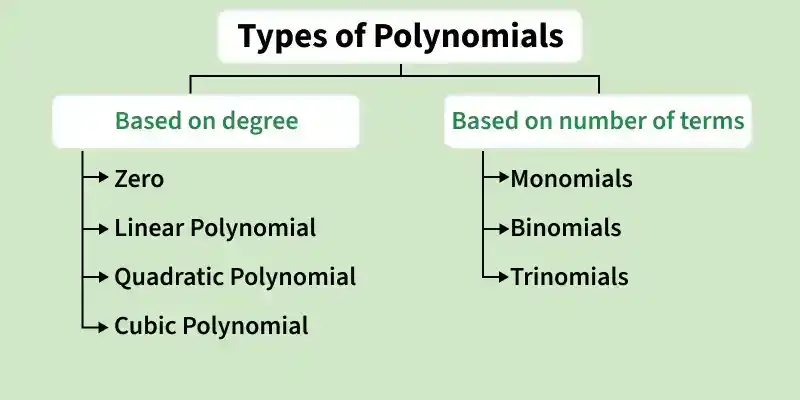
Based on the Number of Terms:
- Monomial: A polynomial with just one term. For example, 7x3 or −4.
- Binomial: A polynomial with two terms. For example, x2 − 5x.
- Trinomial: A polynomial with three terms. For example, 2x2 − 3x + 4.
- Multinomial: A polynomial with more than three terms. For example, x4 − 2x3 + 3x2 − x + 1.
Based on Degree:
- Constant Polynomial: A polynomial of degree 0. It has no variable terms, just a constant. For example, 5 or −3.
- Linear Polynomial: A polynomial of degree 1. It forms a straight line when graphed. For example, 3x + 2.
- Quadratic Polynomial: A polynomial of degree 2. It forms a parabolic shape when graphed. For example, x2 − 4x + 4.
- Cubic Polynomial: A polynomial of degree 3. It can have points of inflexion and typically has the shape of an S-curve when graphed. For example, x3 − 6x2 + 11x − 6.
Properties and Theorems of Polynomials
Polynomials follow some important rules and theorems that make them easier to understand and solve:
- Degree Rule: The degree of the sum or difference of two polynomials is at most the highest degree among them, while the degree of their product is the sum of their degrees.
- deg(A ± B) ≤ max(deg A, deg B)
- deg(A × B) = deg A + deg B
- Division Algorithm: For any polynomials A and B (where B ≠ 0), we can write:
A = BQ + R, where the degree of R is less than the degree of B.
- Factor Theorem: A polynomial P(x) is divisible by (x − a) if and only if P(a) = 0.
- Remainder Theorem: When a polynomial f(x) is divided by (x − a), the remainder is f(a).
- Number of Zeros: A polynomial of degree n can have at most n zeros.
- Zeros Property: If a polynomial P is divisible by another polynomial Q, then every zero of Q is also a zero of P.
Related Articles:
Solved Examples
Question 1: Find the value of x in the polynomial equation 2x2 - 5x + 3 = 0.
Solution:
We can solve this quadratic equation using the quadratic formula:
x = (-b ± √(b2 - 4ac)) / 2awhere a = 2, b = -5, and c = 3.
Substituting the values:
x = (5 ± √(25 - 423)) / 2*2
x = (5 ± √(25 - 24)) / 4
x = (5 ± √1) / 4So, the solutions are:
x = (5 + 1) / 4 = 6 / 4 = 3/2 and x = (5 - 1) / 4 = 4 / 4 = 1.
Question 2: Factorize the polynomial x2 - 4x + 4.
Solution:
We observe that the given polynomial is a perfect square trinomial.
It can be written as (x - 2)2.So, the factored form is (x - 2)(x - 2) or (x - 2)2.
Question 3: Given the polynomial 3x4 - 7x3 + 2x2 - 5x + 1, find its degree and leading coefficient.
Solution:
The degree of a polynomial is the highest power of the variable present. In this case, the degree is 4. The leading coefficient is the coefficient of the term with the highest power of the variable. Here, the leading coefficient is 3.
Question 4: Simplify the expression (2x2 - 3x + 1)(x2 + 4x - 2).
Solution:
We use the distributive property to expand the expression:
(2x2 - 3x + 1)(x2 + 4x - 2) = 2x2(x2 + 4x − 2) − 3x(x2 + 4x − 2) + 1(x2 + 4x − 2)
= 2x4 + 8x3 − 4x2 − 3x3 − 12x2 + 6x + x2 + 4x − 2
= 2x4 + 5x3 - 15x2 + 10x - 2