
Improper integrals are definite integrals with infinite limits or vertical asymptotes, evaluated using limits. Occur when:
- Limits are
∞ - Function has a vertical asymptote in [a, b]
For a function f(x), the area under the curve enclosed by the x-axis between the limits x = a and x = b is denoted as,
\int^{b}_{a}f(x)dx
Since both limits here are finite, this is called a proper integral. A proper integral with one infinite bound will be denoted as,
\int^{\infty}_{a}f(x)dx or\int^{a}_{-\infty}f(x)dx
Example: Compute the following definite integral.
Solution:
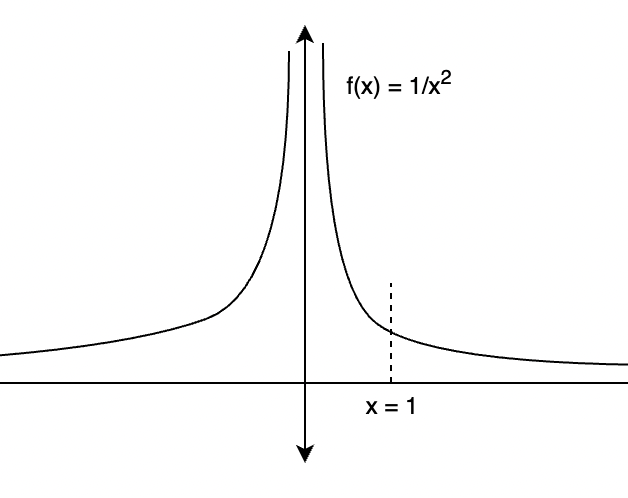
We need to calculate the mentioned area.
Notice that the area is not diverging as the function is going towards zero asymptotically.
\int^{\infty}_{1}\frac{1}{x^2}dx This can be re-written as,
\lim_{n \to \infty}\int^{n}_{1}\frac{1}{x^2}dx Now this is just a definite integral, to solve this second part of fundamental theorem of calculus can be used.
\lim_{n \to \infty}[-\frac{1}{x}]^{n}_{1} \\ = \lim_{n \to \infty}[1 - \frac{1}{n}] \\ = 1
Sometimes integrals have both their limits bounds as infinity. Such integrals are called improper integrals with two infinite bounds.
\int^{\infty}_{-\infty}f(x)dx
Divergent Improper Integral
In some cases, the integrals do not converge to a finite value. Intuitively, this means that the area enclosed under the curve is not finite.
Example: Compute the following integral.
Solution:
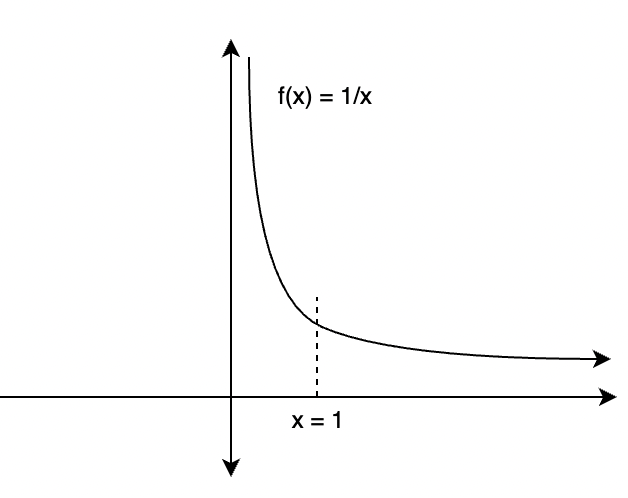
The graph of this function is given below.
Let's compute the area under this curve using the same method as above.
\int^{\infty}_{1}\frac{1}{x}dx Rewriting the given integral.
\lim_{n \to \infty}\int^{n}_{1}\frac{1}{x}dx To solve this second part of fundamental theorem of calculus can be used.
\lim_{n \to \infty}[ln(x)]^{n}_{1} \\ = \lim_{n \to \infty}[ln(n) - ln(1)] \\ = \lim_{n \to \infty} ln(n) = \infty Since this limit diverges. The area under the curve is infinite.
Solved Examples
Question 1: Compute the following definite integral.
Solution:
\int^{\infty}_{1}\frac{1}{x^3}dx This can be re-written as,
\lim_{n \to \infty}\int^{n}_{1}\frac{1}{x^3}dx Now this is just a definite integral, to solve this second part of the fundamental theorem of calculus can be used.
\lim_{n \to \infty}[-\frac{1}{2x^2}]^{n}_{1} \\ = \lim_{n \to \infty}[\frac{1}{2} - \frac{1}{n}] \\ = \frac{1}{2}
Question 2: Compute the following definite integral.
Solution:
\int^{\infty}_{2}\frac{x + 1}{x^2}dx This can be re-written as,
\lim_{n \to \infty}\int^{n}_{2}\frac{x + 1}{x^2}dx Now this is just a definite integral, to solve this second part of fundamental theorem of calculus can be used.
\lim_{n \to \infty}\int^{n}_{2}\frac{x + 1}{x^2}dx \\ = \lim_{n \to \infty}\int^{n}_{2}\frac{1}{x} + \frac{1}{x^2}dx \\ = \lim_{n \to \infty}[\ln(x)]^n_2 + [\frac{-1}{x}]^n_{2} \\ = \lim_{n \to \infty}[\ln(\infty) - \ln(2)] + 1 This limit evaluates to infinity. Thus, the area under the curve is infinite.
Question 3: Compute the following definite integral.
Solution:
\int^{\infty}_{1}\frac{x + 1}{x^3}dx This can be re-written as,
\lim_{n \to \infty}\int^{n}_{1}\frac{x + 1}{x^3}dx Now this is just a definite integral, to solve this second part of the fundamental theorem of calculus can be used.
\lim_{n \to \infty}\int^{n}_{1}\frac{x + 1}{x^3}dx \\ = \lim_{n \to \infty}\int^{n}_{1}\frac{1}{x^2} + \frac{1}{x^3}dx \\ = \lim_{n \to \infty}[\frac{-1}{x}]^n_1 + [\frac{-1}{2x^2}]^n_{1} \\ = \lim_{n \to \infty}[1 - \frac{1}{n}] + [\frac{1}{2} - \frac{1}{n}] \\ = 1 + \frac{1}{2} \\ = \frac{3}{2} This limit evaluates to infinity. Thus, the area under the curve is infinite.
Question 4: Compute the following definite integral.
Solution:
\int^{\infty}_{1}\frac{1}{\sqrt{x}}dx This can be re-written as,
\lim_{n \to \infty}\int^{n}_{1}\frac{1}{\sqrt{x}}dx Now this is just a definite integral, to solve this second part of fundamental theorem of calculus can be used.
\lim_{n \to \infty}[\frac{\sqrt{x}}{2}]^{n}_{1} \\ = \lim_{n \to \infty}[\frac{\sqrt{n}}{2} - \frac{1}{2}] \\ = \infty This area cannot be calculated. This is infinite.
Question 5: Compute the following definite integral.
Solution:
\int^{\infty}_{1}\frac{1}{\sqrt{x + 3}}dx This can be re-written as,
\lim_{n \to \infty}\int^{n}_{1}\frac{1}{\sqrt{x + 3}}dx Now this is just a definite integral, to solve this second part of fundamental theorem of calculus can be used.
\lim_{n \to \infty}[\frac{\sqrt{x + 3}}{2}]^{n}_{1} \\ = \lim_{n \to \infty}[\frac{\sqrt{n + 3}}{2} - \frac{1}{2}] \\ = \infty This area cannot be calculated. This is infinite.
Question 6: Determine whether this improper integral is convergent or divergent.
Solution:
\int^{\infty}_{1}cos(x)dx This can be re-written as,
\lim_{n \to \infty}\int^{n}_{1}\cos(x)dx Now this is just a definite integral, to solve this second part of fundamental theorem of calculus can be used.
\lim_{n \to \infty}[\sin(x)]^{n}_{1} \\ = \lim_{n \to \infty}[\sin(n)- \sin(1)] The limit is not defined, thus this integral is divergent.
Question 7: Determine whether this improper integral is convergent or divergent.
Solution:
\int^{\infty}_{1}e^{-x} dx This can be re-written as,
\lim_{n \to \infty}\int^{n}_{1}e^{-x}dx Now this is just a definite integral, to solve this second part of fundamental theorem of calculus can be used.
\lim_{n \to \infty}[-e^{-x}]^{n}_{1} \\ = \lim_{n \to \infty}[e- e^{-n}] \\ = e
Related Articels