
Answer: To find the turning point of a parabola (the vertex), use the formula for the x-coordinate:
x = \dfrac{-b}{2a}
where a and b are the coefficients from the quadratic equation y = ax2 + bx + c.
Then, substitute this value of x back into the equation to find the y-coordinate of the vertex:
y =
a\left(\frac{-b}{2a}\right)^2 + b\left(\frac{-b}{2a}\right) + c
So the turning point (vertex) is at (x, y).
When a quadratic equation is represented graphically with a U-shape, it is called a parabola. A parabola can also be defined as a plane curve where any point on that curve is equidistant from a fixed point, the focus. The turning point of any curve or parabola is the point at which its direction changes from upward to downward or vice versa. The turning point of a parabola is called the vertex. The standard form of the parabola is y = ax2 + bx + c. The vertex form of the parabola with Vertex (h, k) is y = a(x-h)2 + k.
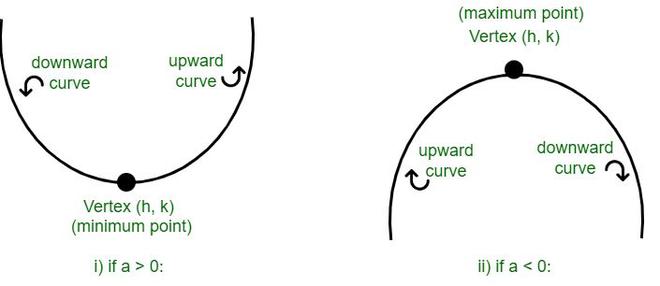
Turning Point of the Parabola
Turning points are locations on a graph where the curve changes direction-from increasing to decreasing (a maximum) or from decreasing to increasing (a minimum)
To obtain the turning point or vertex (h, k) of the parabola, we can transform this equation to the vertex form of the parabola: y = a(x - h)2 + k. We can perform this by using the "Completing the Squares" method.
- Subtract c from LHS and RHS.
y - c = ax2 + bx
- Take "a" as a common factor on the RHS.
y - c = a(x2 + (b/a)x)
- Add the term a(b / 2a)2 to both RHS and LHS.
y - c + (b2/4a) = a(x2 + (b/a)x + (b /2a)2)
- Now the equation on RHS is of the form (m + n)2.
y - (c + (b2/4a)) = a(x + (b/2a)2)
By comparing this equation with the vertex form of the parabola, we can observe the following relation between the values of a, b, c, and h, k.
Vertex (h, k) = (-b/2a, c - (b2/4a))
- The x-coordinate of the vertex is h = −b/2a
- The y-coordinate of the vertex is k = c −b2/4a
Here's the Summary Table with descriptions for each step:
Step | Description |
|---|---|
Find first derivative | f′'(x) |
Set derivative to zero | Solve f′(x) = 0 for x |
Check second derivative | f′′(x) > 0: min, f′′(x) < : max |
Substitute to get coordinates | Find f(x) at critical points |
Solved Question - How to find the turning point of a parabola?
Question 1: Find the turning point of a parabola defined by the equation y = 5x2 + 3x + 2.
Solution:
Given, y = 5x2 + 3x + 2: a = 5 b = 3 c = 2
Using the formula mentioned above, (h, k) = (-b/2a, c - (b2/4a))
⇒ h = -3/(2 × 5) = -3/10 = 0.3
⇒ k = 2 - (3 × 3)/(4 × 5) = 2 - (9/20) = 1.55So, (h, k) = (0.3, 1.55)
Question 2: Given the function F(x) = 7x2 + 5x + 8, find the value of x for which it is increasing.
Solution:
The equation, 7x2 + 5x + 8 is in the form of a parabola.
Where, a = 7, b = 5 and c = 8
We know that for a > 0, the parabola has an upward or increasing direction for x > h.
Using the formula mentioned above, (h, k) = (-b/2a, c - (b2/4a))
⇒ h = -5/(2 × 7) = -5/14 = -0.357So, the function is increasing for (x > -0.357)
Question 3: What is the minimum value of the function y = 3x2 + 8x + 1?
Solution:
The equation y = 3x2 + 8x + 1 is of the form of a parabola.
Where, a = 3, b = 8 and c = 1
We know that for a > 0, the parabola has its minimum value at its Vertex.
Using the formula mentioned above, Vertex V (h, k) = (-b/2a, c - (b2/4a))
⇒ h = -8/(2 × 3) = -8/6 = -1.33
⇒ k = 1 - (8 × 8/(4 × 3)) = 1 - (64/12) = -4.33Therefore, the minimum value of the function is at (-1.33, -4.33).
Question 4: Find the turning point of a parabola defined by the equation y = 1x2 + 2x + 3.
Solution:
Given, y = 1x2 + 2x + 3,
a = 1 ,b = 2,c = 3Using the formula mentioned above, the turning point or the vertex is,
(h, k) = (-b/2a, c - (b2/4a))
⇒ h = -2/(2 × 1) = -1
⇒ k = 3 - (2 × 2/4) = 2So, (h, k) = (-1, 2)
Question 5: Given the function F(x) = -2x2 + 2x + 1, find the value of x for which it is decreasing.
Solution:
The equation, -2x2 + 2x + 1 is of the form of a parabola.
Where, a = -2, b = 2 and c = 1
We know that for a < 0, the parabola has a downward or decreasing direction for x > h.
Using the formula mentioned above,
(h, k) = (-b/2a, c - (b2/4a))
⇒ h = -2/(2 × (-2)) = 1/2 = 0.5So, the function is increasing for (x > 0.5).
Question 6: What is the vertex of the parabola y = -8x2 + 8x + 1.
Solution:
Given y = -8x2 + 8x + 1:
a = -8, b = 8 , c = 1
Using the formula mentioned above,(h, k) = (-b/2a, c - (b2/4a))
⇒ h = -8/(2 × (-8)) = 1/2 = 0.5
⇒ k = 1 - (8 × 8/(4 × (-8))) = 1 + (64/32) = 3So, (h, k) = (0.5, 3)
Question 7: Given the function y = -9x2 + 2x + 5, find the maximum point of the curve.
Solution:
The equation y = -9x2 + 2x + 5 is of the form of a parabola.
Where, a = -9, b = 2 and c = 5
We know that for a < 0, the maximum point of the parabola is at (h, k).
Using the formula mentioned above,(h, k) = (-b/2a, c - (b2/4a))
⇒ h = -2/(2 × (-9)) = 1/9 = 0.11
So, the function is increasing for (x > 0.5)
Related Articles:
- Vertex of a Parabola Formula with Examples
- Focus and Directrix of a Parabola
- Graph, Properties, Examples & Equation of Parabola
- Eccentricity of Parabola
Conclusion
Finding the turning point of a parabola is crucial for the understanding its graphical representation and properties. The turning point or vertex represents the maximum or minimum value of the quadratic function and is a key feature in the various applications including the optimization problems in economics, engineering and physics.