
Homogeneous Differential Equations are differential equations in which the functions involved are homogeneous functions. These equations contain a differentiation operator along with functions of two variables.
The general form of a homogeneous differential equation is:
f(x, y)dx + g(x, y)dy = 0
where f(x, y) and g(x, y) are homogeneous functions of the same degree.
Homogeneous Function
A function f(x, y) in x and y is said to be a homogeneous function if the degree of each term in the function is constant (say p).
For example, f(x, y) = (x2 + y2 - xy) is a homogeneous function of degree 2 where p = 2. Similarly, g(x, y) = (x3 - 3xy2 + 3x2y + y3) is a homogeneous function of degree 3 where p = 3.
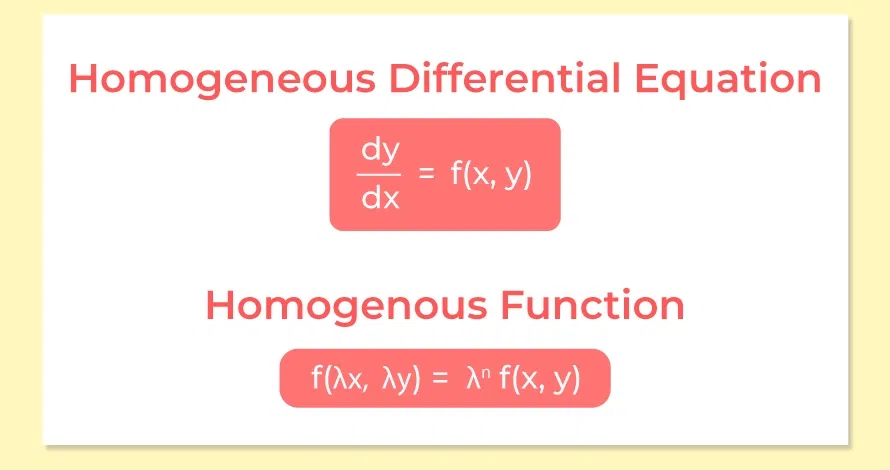
In general, a homogeneous function ƒ(x, y) of degree n is expressible as:
ƒ(λx, λy) = λn ƒ(x, y).
Homogeneous function and Homogeneous differential equation are represented in the image below,
All the equations of the following form are Homogeneous Differential Equations.
dy/dx = f(x, y)/g(x, y)
where,
f(x, y) and g(x, y) are homogeneous functions of the degree n.
In simple words, a differential equation in which all the functions are of the same degree is called a homogeneous differential equation. For example, dy/dx = (x2 - y2)/xy is a homogeneous differential equation.
Examples of Homogeneous Differential Equations
Some more examples of the Homogeneous differential equation are,
- dy/dx = (2x + 3y)/(7x - y)
- dy/dx = 3x(x - y)/2y2
- dy/dx = (2x3 + 2xy2)/(y3 + 3yx2)
- dy/dx = (11x2 + xy)/2y2
In the above example, the degree of each term in the function is constant and hence, they are differential equations.
How to Solve Homogeneous Differential Equations?
Homogeneous differential equations are equations that contain a Homogeneous function. We can solve a homogeneous differential equation of the form dx/dy = f(x, y) where, f(x, y) is a homogeneous function, by simply replacing x/y to v or putting y = vx. Then after solving the differential equation, we put back the value of v to get the final solution. The detailed step for solving the Homogeneous Differential Equation i.e., dy/dx = y/x.
Step 1: Put y = vx in the given differential equation.
Now, if y = vx
then, dy/dx = v + xdv/dx
Substituting these values in the given D.E
Step 2: Simplify and then separate the independent variable and the differentiation variable on either side of the equal to.
v + xdv/dx = vx/x
⇒ v + xdv/dx = v
⇒ xdv/dx = 0
⇒ dv = 0
Step 3: Integrate the differential equation so obtained and find the general solution in v and x.
Integrating both sides,
∫dv = 0
⇒ v = c
Step 4: Put back the value of v to get the final solution in x and y.
Substituting y/x = v
⇒ y/x = c
⇒ y = cx
This is the required solution of the given homogeneous differential equation
Non-Homogeneous Differential Equation
Any differential equation which is not Homogeneous is called a Non-Homogeneous Differential Equation. The general form of the linear non-homogeneous differential equation of second order is,
y”+a(t)y’+b(t)y = c(t)
Where,
- y" represents the second-degree differentiation of y, and
- c(t) is a non-zero function.
The above non-Homogeneous differential equation can be converted to a homogeneous differential equation and the related DE is,
y”+a(t)y’+b(t)y = 0
This equation is also called the complementary equation to the given non-homogeneous differential equation.
Examples on Homogeneous Differential Equations
Example 1: Solve dy/dx = y2 - x2/2xy
Solution:
Clearly, since each of the functions (y2 - x2) and 2xy is a homogeneous function of degree 2, the given equation is homogeneous.
Putting y = vx and dy/dx = v + x dy/dx, the given equation becomes
⇒ v + x dv/dx = (v2x2 - x2)/2vx2
⇒ v + x dv/dx = v2 - 1/2v [after dividing (v2x2/2vx2 - x2/2vx2)]
⇒ x dv/dx = ((v2 - 1/2v) - v)
⇒ x dv/dx = -(1 + v2)/2v
⇒ 2v/(1 + v2)dv = -1/x dx
⇒ ∫2v/(1 + v2)dv = -∫1/x dx [Integrating both the sides]
⇒ log | 1 + v2 | = -log | x | + log C
⇒ log | 1 + v2 | + log | x | = log C
⇒ log | x(1 + v2) | = log C
⇒ x(1 + v2) = ±C
⇒ x(1 + v2) = C1
⇒ x(1 + y2/x2) = C1 [Putting the original value of v = y/x]
⇒ x2 + y2 = xC1, which is the required solution
Example 2: Solve x dy/dx - y = √(x2 + y2)
Solution:
The given equation may be written as dy/dx = {y + √(x2 + y2)}/x ,which is clearly homogeneous.
Putting y = vx and dy/dx = v + x dv/dx in it, we get
⇒ v + x dv/dx = {vx + √(x2 + v2x2)}/x
⇒ v + x dv/dx = v + √(1+v2) [After dividing the {vx + √(x2 + v2x2)}/x]
⇒ x dv/dx = √(1 + v2) [v on the both sides gets cancelled]
⇒ dv/√(1+v2) = 1/x dx [after rearranging]
⇒ ∫dv/√(1+v2) = ∫1/x dx [integrating both sides]
⇒ log | v | + √(1 + v2) | = log | x | + log C
⇒ log | {v + √(1 + v2)}/x | = log | C |
⇒ {v + √(1 + v2)}/x = ±C
⇒ v + √(1 + v2) = C1x, where C1 = ±C
⇒ y + √(x2 + y2) = C1x2, which is the required solution after putting the value of v = y/x
Example 3: Solve (x√(x2 + y2) - y2)dx + xy dy = 0
Solution:
The given equation may be written as
dy/dx = y2 - x√(x2 + y2)/xy, which is clearly homogeneous
Putting y = vx and dy/dx = v + x dv/dx in it, we get
⇒ v + x dv/dx = {v2x2 - x√(x2 + v2y2)}/vx2
⇒ x dv/dx = [{v2 - √(1 + v2)}/v - v]
⇒ x dv/dx = -√(1 + v2)/v
⇒ ∫v/√(1 + v2)dv = -∫dx/xc [Integrating both the sides]
⇒ √(1 + v2) = -log | x | + C
⇒ √(x2 + y2) + x log | x | = Cx, which is the required solution after putting the value of v = y/x.
Example 4: Solve (x cos(y/x))(y dx + x dy) = y sin(y/x)(x dy - y dx)
Solution:
The given equation may be written as
(x cos(y/x) + y sin(y/x))y - (y sin(y/x) - x cos (y/x)) x . dy/dx = 0
⇒ dy/dx = {x cos (y/x) + y sin(y/x)}y / {y sin(y/x) - x cos(y/x)}x
⇒ dy/dx = {cos (y/x) + (y/x)sin(y/x)}(y/x) / {(y/x)sin(y/x) - cos(y/x)} [Dividing numerator and denominator by x2], which is clearly homogeneous ,being a function of (y/x).
Putting y = vx and dy/dx = (v + x dv/dx) in it, we get
⇒ v + x dv/dx = v(cos v + sin v)/(v sin v - cos v)
⇒ x dv/dx = [v(cos v + sin v)/(v sin v - cos v) -v]
⇒ x dv/dx = 2vcos v/(v sin v - cos v)
⇒ ∫{(v sin v - cos v)/2vcos v}dv = ∫x dx [Integrating both sides]
⇒ ∫tan v dv - ∫ dv/v = ∫ 2/x dx
⇒ -log | cos v | - log | v | + log C = 2 log | x |
⇒ log | cos v | + log | v | + 2log | x | = log | C |
⇒ log | x2v cos v | = log | C |
⇒ | x2v cos v | = C [After cancelling log on the both sides]
⇒ x2v cos v = ± C
⇒ x2v cos v = C1 [here we taking ±C = C1]
⇒ xy cos(y/x) = C1, which is the required solution after putting the actual value of v = y/x