
Group theory is a branch of abstract algebra that studies groups, which are sets of elements combined with an operation such that the result of the operation between any two elements also belongs to the same set.
Group
A group is a set G together with a binary operation (*) that satisfies the following four properties:
- Closure: For all a, b in G, a * b is also in G.
- Associativity: For all a, b, c in G, (a * b) * c = a * (b * c).
- Identity: There exists an element e in G such that a * e = e * a = a for all a in G.
- Inverse: For every element a in G, there exists an element b in G such that a * b = b * a = e.
Example: The set of integers Z under addition (+) forms a group because:
- The sum of two integers is an integer (closure).
- Addition is associative.
- 0 is the identity element.
- Every integer a has an inverse −a such that a + (−a) = 0.
Types of Groups
In group theory, groups are classified into different types based on their properties and structure. Some common types of groups are:
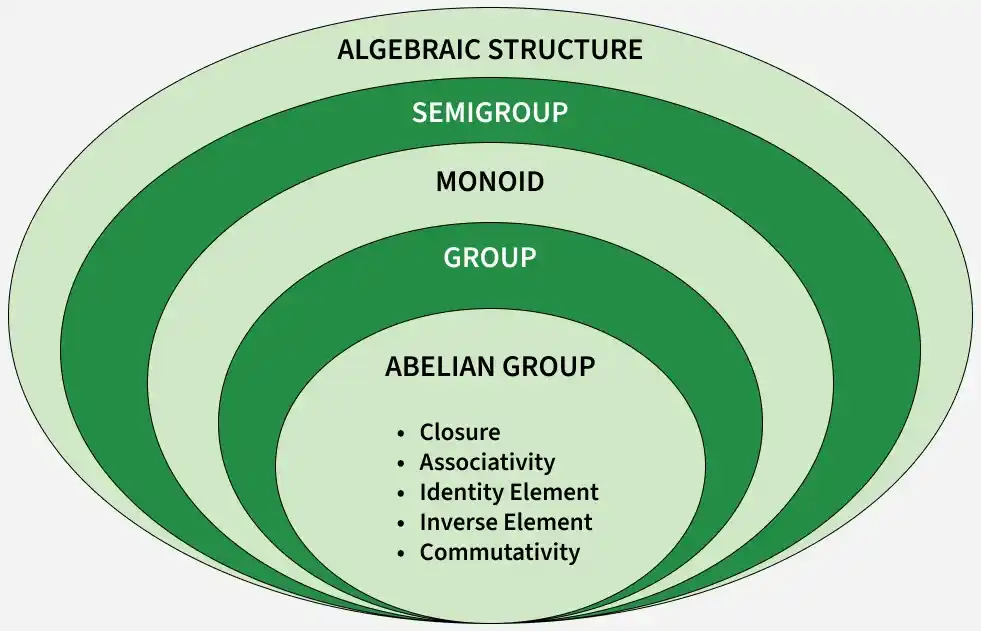
- Abelian Group: A group is called Abelian (or commutative) if the operation satisfies a * b = b * a for all elements a and b in the group.
- Cyclic Group: A group is cyclic if all its elements can be generated by a single element called a generator.
- Finite Group: A group is finite if it contains a finite number of elements.
- Infinite Group: A group is infinite if it contains an infinite number of elements.
- Simple Group: A group is simple if it has no normal subgroups other than the trivial group and the group itself.
- Symmetric Group: The symmetric group Sₙ is the group of all permutations of n elements.
Properties of Groups
Group theory has several important properties that are used to classify and analyse groups. These properties include:
- Commutativity: When the operation is commutative, and so when a * b is equal to b * a for all a, b in G, we say that the group is commutative.
- Associativity: The set G is said to be associative when the binary operation is associative, meaning that (a * b) * c = a * (b * c) for all a, b belonging to G.
- Distributivity: An element group is said to be distributive if the binary operation distributes over it, i.e., a * (b + c) = a * b + a * c for elements a, b, c of G.
- Cancellation: If a, b, and c are elements of G, and they satisfy that a * b = a * c, then this group has the cancellation property, and it is b = c.
Theorems in Group Theory
Theorem 1: If G is a group and a, b ∈ G, then (a × b)⁻¹ = b⁻¹ × a⁻¹.
To prove: (a × b) × b⁻¹ × a⁻¹ = I, where I is the identity element of group G.
Proof:
Consider the L.H.S:
L.H.S = (a × b) × b⁻¹ × a⁻¹
⇒ a × (b × b⁻¹) × a⁻¹
⇒ a × I × a⁻¹ (since b × b⁻¹ = I)
⇒ (a × I) × a⁻¹
⇒ a × a⁻¹
⇒ I
⇒ R.H.SHence, proved.
Theorem 2: If G is a group and x, y, z are elements of G such that x * y = z * y, then x = z.
Proof:
Assume that, x × y = z × y ...(1)
Since y is an element of group G, there exists an inverse of y denoted by y⁻¹ such that
y × y⁻¹ = I ...(2)
Multiply both sides of equation (1) by y⁻¹:
x × y × y⁻¹ = z × y × y⁻¹
Using associativity, x × (y × y⁻¹) = z × (y × y⁻¹)
Using equation (2),
x × I = z × I
x = z
This result is called the Cancellation Law.
Hence, proved.
Subgroup
A subgroup is a subset of a group that itself forms a group under the same binary operation. A subgroup H of a group G satisfies the following properties:
Closure: For all a, b in H, a * b is also in H.
Associativity: For all a, b, c in H, (a * b) * c = a * (b * c).
Identity: The identity element of G is also in H.
Inverse: For every element a in H, the inverse of a is also in H.
Group Theory Applications
Group theory has numerous applications in various fields, including:
- Physics: Group theory is used to study symmetry in physical systems and plays an important role in understanding structures such as crystals and patterns in space and time.
- Computer Science: In computer science, group theory helps in designing algorithms and solving computational problems, including problems related to graphs and networks.
- Cryptography: Group theory is used in cryptography to develop secure encryption systems, such as the Diffie–Hellman key exchange algorithm.