
The factorial of a number is the product of all positive integers from that number down to 1. It plays a key role in many mathematical concepts, such as permutations, combinations, probability, and more.
For a positive integer n: n! = n x (n-1) x (n - 2) x ..... x 1
The factorial of a natural number n indicates the number of ways n items can be arranged.
Notation
The notation of the factorial function is "!". If we have to find the factorial of the number n, then it is written as n!. Let's understand it with some examples:
- 0! = 1 (Value of Factorial 0 is 1 because it shows the number of possible ways to arrange a data set with no value in it is 1)
- 1! = 1
- 2! = 2 × 1 = 2
- 3! = 3 × 2 × 1 = 6
- 4! = 4 × 3 × 2 × 1 = 24
- 5! = 5 × 4 × 3 × 2 × 1 = 120
Why is 0! (Factorial of 0) equal to 1?
When you're counting groups of things or arranging objects, multiplying by 1 doesn’t change the total number. In math, the factorial of 0 is defined as 1 to keep the pattern consistent with larger numbers. It's like saying, "If you have nothing to arrange, there's only one way to do nothing." So, we assign 0! the value of 1 to make the math rules work smoothly.
Thus, the factorial of 0 is defined as 1 and is represented as 0!
Factorial Formula
The Factorial Formula can be expressed as:
n! = n × (n -1) × (n - 2) ... 3 × 2 × 1
Calculating Factorial
Calculating factorials is a fundamental operation in mathematics, especially in combinatorics. The factorial of a non-negative integer n is denoted as n! and is defined as the product of all positive integers less than or equal to n.
How to Find Factorial of a Number?
To find the factorial of a number we apply following steps:
- First, check if the given number whose factorial is to be evaluated is positive or negative.
- If the number is negative the factorial of negative number is undefined.
- If the number is positive, find the factorial of the number using the above factorial formulas.
Factorial Examples
As we can calculate the factorials for any non-negative numbers, thus there can be infinitely many examples of factorials. Let's consider some of those examples as follows:
Factorial of 5
The Factorial of 5 is obtained by multiplying numbers from 1 to 5.
Factorial of 5 = 5! = 5 × 4 × 3 × 2 × 1 = 120
Factorial of 10
The Factorial of 10 is obtained by multiplying numbers from 1 to 10.
Factorial of 10 = 10! = 10 × 9 × 8 × 7 × 6 × 5 × 4 × 3 × 2 × 1 = 3628800
Factorial of 100
The Factorial of 100 is obtained by multiplying numbers from 1 to 100.
Factorial of 100 = 100! = 100 × 99 × 98 × 97 × 96 × . . . × 5 × 4 × 3 × 2 × 1 = 9.33262154 × 10157
List of Factorials of Numbers 1 to 15
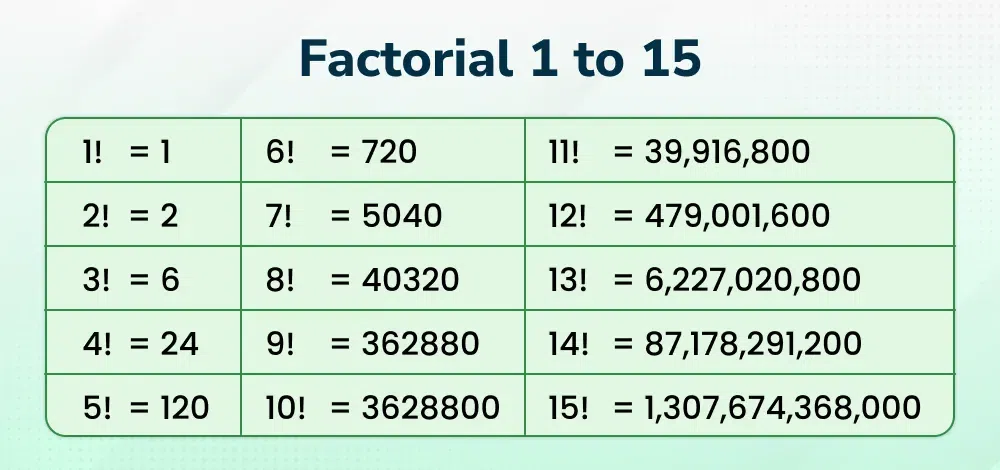
Properties of Factorial
Some of the properties of factorial are:
1) For any non-negative integer n, n! = n × (n - 1) × (n - 2) × ... × 3 × 2 × 1
2) Factorial can be defined recursively as follows: n! = n(n - 1)! [ Where 0! = 1]
3) 0! is defined to be 1 by convention.
4) For any non-negative integer n, n! is always an integer.
4) As ∏ is used to represent product of terms in sequence, thus factorial of n can also be represented as: n! = ∏(i = 1 to n) i.
5) Factorial of negative numbers are undefined.
Applications of Factorial
There are various applications of the factorial. Some of the applications of factorials are listed below:
1. Combinatorics: Factorials are essential in combinatorics, which is the study of counting, arrangement, and combination of objects. They are used to calculate:
- Permutations
- Combinations
2. Probability: In probability, factorials are used to determine the number of possible outcomes in experiments. For example:
- The probability of drawing a specific hand of cards from a deck can be calculated using combinations, which involve factorials.
- Factorials are also used in calculating probabilities in binomial distributions, where the number of ways to achieve a certain number of successes in trials is calculated using factorials.
3. Statistics: Factorials are used in various statistical formulas, including:
4. Mathematical Series: Factorials are utilized in the expansion of power series, such as the Taylor and Maclaurin series. These series represent functions as infinite sums of terms calculated from the derivatives of functions at a single point, where factorials appear in the denominators.
5. Games and Puzzles: Factorials are used in games that involve arranging items or characters in specific orders, such as in board games and card games. The number of possible arrangements can often be calculated using factorials.
6. Computer Programming: Factorials are commonly implemented in programming for various applications such as:
- Generating permutations and combinations.
- Solving mathematical problems that require combinatorial logic.
Factorials in Combinatorics (Permutations And Combinations)
In calculation of both permutation and combination is used as the formula for both involves the factorials. Let's see Permutation Formula and Combination Formula along with their examples.
Example 1. Evaluate the value of 5P3.
Solution:
By permutation formula
nPr = n! / (n - r)!
⇒ 5P3 = 5! / (5 - 3)!
⇒ 5P3 = 5! / 2!
⇒ 5P3 = 120 / 2
⇒ 5P3 = 60
Example 2. Find the value of 4C2.
Solution:
By combination formula
nCr = n! / [r! × (n - r)!]
⇒ 4C2 = 4! / [2! × (4 - 2)!]
⇒ 4C2 = 4! / [2! × 2!]
⇒ 4C2 = 24 / [2 × 2]
⇒ 4C2 = 24 / 4
⇒ 4C2 = 6
Factorial in Statistics and Probability
Factorials are used in multiple formulas in probability, as factorials help us calculate the number of ways of things with the help of principle of counting, permutation, and combination. Let's consider an example of Probability where we calculate the probability of any event with the help of factorials.
Example. A box contains different colored balls. There is 15% chance of getting a red ball. What is the probability that exactly 4 balls are red out of 10.
Solution:
Applying binomial distribution
P(X = r) = nCr pr qn-r
n = 10, p = 0.15, q = 0.85, r = 4
⇒ P(X = 4) = 10C4 (0.15)4 (0.85)6
⇒ P(X = 4) = [10! / {4! × 6!}] (0.15)4 (0.85)6
⇒ P(X =4) = [{10× 9 × 8 × 7} / 24] (0.15)4 (0.85)6
⇒ P(X = 4) = 0.04
Solved Questions on Factorial Function
Question 1. Evaluate the following.
- Factorial of 1
- Factorial of 3
- Factorial of 4
- Factorial of 6
- Factorial of 7
- Factorial of 8
- Factorial of 9
Solution:
Factorial of 1 = 1! = 1
Factorial of 3 = 3! = 3 × 2 × 1 = 6
Factorial of 4 = 4! = 4 × 3 × 2 × 1 = 24
Factorial of 6 = 6! = 6 × 5 × 4 × 3 × 2 × 1 = 720
Factorial of 7 = 7! = 7 × 6 × 5 × 4 × 3 × 2 × 1 = 5040
Factorial of 8 = 8! = 8 × 7 × 6 × 5 × 4 × 3 × 2 × 1 = 40320
Factorial of 9 = 9! = 9 × 8 × 7 × 6 × 5 × 4 × 3 × 2 × 1 =362880
Question 2. What is the value of factorial: 14! / (11! × 4!)
Solution:
14! / (11! × 4!) = (14 × 13 × 12 × 11!) / (11! × 4!)
⇒ 14! / (11! × 4!) = (14 × 13 × 12) / 4!
⇒ 14! / (11! × 4!) = (14 × 13 × 12) / (4 × 3 × 2 × 1!)
⇒ 14! / (11! × 4!) = (14 × 13 × 12) / (12 × 2 )
⇒ 14! / (11! × 4!) = (7 × 13)
⇒ 14! / (11! × 4!) = 91
Question 3. Evaluate the expression 6! - 3!
Solution:
6! - 3! = (6 × 5 × 4 × 3!) - 3!
⇒ 6! - 3! = (6 × 5 × 4 × 3!) - 3!
⇒ 6! - 3! = (120 × 3!) - 3!
⇒ 6! - 3! = 3![120 - 1]
⇒ 6! - 3! = 6 × 119
⇒ 6! - 3! = 714
Question 4. If (1 / 6!) = (x / 8!) - (1 / 7!), then find the value of x.
Solution:
(1 / 6!) = (x / 8!) - (1 / 7!)
⇒ (1 / 6!) = (x / 8 × 7!) - (1 / 7!)
⇒ (1 / 6!) = (1 / 7!)[(x / 8) - 1]
⇒ (1 / 6!) = {1 / (7 ×6!)}[(x / 8) - 1]
⇒ (1 / 6!) = (1 / 6!)(1 / 7 )[(x / 8) - 1]
⇒ 1 = (1 / 7 )[(x / 8) - 1]
⇒ 7 = (x / 8) - 1
⇒ (x / 8) = 7 + 1
⇒ (x / 8) = 8
⇒ x = 64
Question 5. How many 4-digit numbers can be formed using the digits 4,6,7,9 in each of which no digit is repeated?
Solution:
Given:
Digits: 4, 6, 7, and 9
Number of digits = 4
We have to arrange these digits to form a 4-digit number.
The number of ways for arranging these digits to form a 4-digit number is 4!
and 4! = 4 × 3 × 2 × 1 = 24
Thus, there are 24 ways in which a 4 digit number can be formed without repeating the digits.
Question 6. Evaluate the expression 3! (2! × 0!)
Solution:
3! (2! × 0!) = (3 × 2 × 1) (2 × 1 × 1) [By using factorial formula and 0! = 1]
⇒ 3! (2! × 0!) = 6 × 2
⇒ 3! (2! × 0!) = 12
Factorial Practice Questions
Problem 1: Evaluate.
- (8! × 7!) / 6!
- 7! / 4!
- 10! − 9!
Problem 2: Simplify.
- (7 + 3)! / 2!
- 6! / (4! × 2!)
- (9!) / [(7!) × (2!)]
- (6!) / [(5!) × (3!)]
- (12!) / [(11!) × (10!)]
Problem 3: Find the Value of n if
- n! = 120
- (n − 1)! = 24
- (n + 2)! = 720
- (n − 2)! = 120
Problem 4: If n! / (n−3)! = 120, find the value of n.
Problem 5: Prove that n! is divisible by (n−k)! for all integers n and k such that 0 ≤ k ≤ n.