
Equal vectors are vectors that have the same magnitude and direction. In simple words, two vectors are said to be equal if they have the same length and direction; otherwise, they are unequal vectors.

Equal vectors may or may not start from the same point; that is, they may have different initial points. Generally, equal vectors have the same coordinates. It is important to note that since equal vectors always have the same magnitude and direction, they are always collinear and parallel to each other, but the reverse may or may not be true.
For example, here are two vectors which are equal
Equal Vector Formula
For Two Vectors A and B to be equal, the following two conditions must be met:
- Same Magnitude: Length of A must be equal to the length of B.
- Same Direction: Direction of A must be the same as the direction of B.
Equal vectors must have equal components in all directions, so if
For example, the two Vectors A = 3i + 4j -k and B = xi + 4j - zk will be equal if and only if x = 3 and z = -1.
Angle Between Equal Vectors
Since Equal vector always have same magnitude and direction so angle between two equal vectors must be zero, this can be proved using the dot product of two vectors. Let two Equal Vectors A = xi + yj + zk and B = xi + yj + zk such that angle between them is θ.
So, A.B (A dot B ) = |A| |B| Cosθ
where,
- A.B = (xi + yj + zk ). (xi + yj + zk ) = x2 + y2+ z2
- |A| = √x2 + y2 + z2
- |B| = √x2 + y2 + z2
So, Cos θ = A.B / |A| |B|
= x2 + y2 + z2 / (√x2 + y2 + z2)(√x2 + y2 + z2)
= 1
θ = 0°
Properties of Equal Vector
Various properties of equal vectors are:
- If Two vectors A and B have same length and point in the same direction they are said to be equal else they would be unequal.
- Equal Vectors are vectors with equal coordinates and same signs so equal vectors can be called as parallel vectors but the reverse may or may not be true.
- Equal vectors have same components.
- Position of the vectors does not affect the equality of vectors, Vectors are considered equal as long as their magnitude and direction matches, irrespective of where they are located in the coordinate system.
- Equal Vector will still be equal if we add / subtract / divide / multiply both the vectors with the same quantity (can be scalar or vector ). For example say A = B and C is another vector then A - C = B - C.
Applications of Equal Vectors
Various applications of equal vectors are:
In Physics
- Equal vectors can be used to represent equal forces. This is highly used in Statics, where the equilibrium of forces is analyzed
- Equal Vectors can be used to represent Equal Velocity, Equal Acceleration or Equal displacement.
In Engineering
- Engineers use equal vectors to model loads and stresses in structures. Equal force vectors can simplify the analysis of complex structures by grouping similar forces.
- In robotics equal vector represents identical movement of component which is highly useful in precise control and programming.
In Computer Science
- Equal Vectors are useful in certain machine learning and computer vision algorithms to identify and group similar data points.
- Equal vectors are also useful while representing multidimensional data for accurate comparisons and analyses.
In Mathematics and Vector Calculus
- Equal Vectors can be used to represent uniform fields such as gravitational or electric fields.
- Equal vectors are highly useful in transformation, so that vector remains consistent while switching between different coordinate systems.
In Aviation and Aerospace
- In aviation equal vectors are used to represent flight paths and velocities and accelerations that are helpful for flight planning and control
- Equal Vectors are used in satellite navigation so as to track the satellite movements precisely.
Also Check
Solved Questions on Equal Vectors
Question 1: Take a Look at the Image Below and determine which of the vectors (out of a, b, c ) are equal to each other?
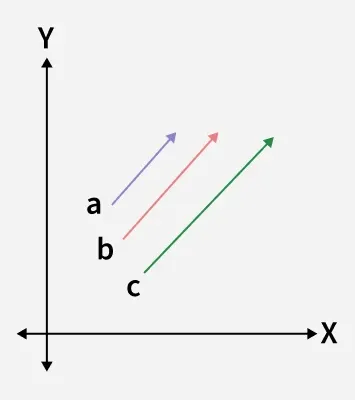
Solution:
Out of the given vectors a, b and c, a and b are the vectors which are in the same direction and have equal magnitude.
So we can say that a and b are equal to each other while a / b and c both are acting in same direction but neither a and c nor b and c have equal length , they are of different magnitudes , So neither a equals to c nor b equals to c.
Question 2: Determine which of the following vectors are equal to each other A = i + j, B = i + j, C = i - j?
Solution:
Given vectors are A = i + j, B = i + j, C = i - j
where,
- |A | = √1 + 1 = √2
- |B|=√1 + 1 = √2
- |C| = √1 + 1 = √2
Here all the three vectors have same magnitude but only A = B, because only A and B are acting in the same direction.
Vectors A and C ( & B and C ) have same magnitude but are acting in different direction or opposite direction, so they are unequal Vectors.
Question 3: Find the Value of x for which the following two vectors are equal to each other A = 2i + 5j + 7k, B = 2i + xj + 7k.
Solution:
Given vectors are A = 2i + 5j + 7k and B = 2i + xj + 7k
Since equal Vectors have equal magnitude, equal direction and equal component vectors in all direction.
So we can say that x component of both vectors should be equal, similarly y and z component of both the vectors should be equal.
By Comparing the y component of both the vectors we can say that value of x should be 5, so as to make both the vectors equal.
Question 4: Find whether the two vectors are equal to each other or not if Yes find the Value of x, Where A = 7i + 9j - 5k and B = -7i -9j + xk.
Solution:
Given vectors are A = 7i + 9j - 5k and B = -7i -9j + xk.
Vectors can have same magnitude for x = -5, But the two Vectors can never act in the same direction as their component vectors are acting in opposite directions.
So we can say that No value of x can make both the vectors equal to each other.
Question 5: Two Equal forces of 5N are acting on an object which displaces the object by a distance of 2 meter. Find the total work done by the forces on the object.
Solution:
Given that their are two equal force of magnitude 5N. Since both the forces are equal so they will be acting in the same direction and of same magnitude. So the Net resultant force can be given as
F = 5 + 5 = 10
i.e. Since both the forces are acting in the same direction so we can directly add up their magnitude to get the resultant vector's magnitude.
Now Total work done by the resultant of the two forces can be calculated as:
W = Force. displacement
So
W = 10 × 2 = 20 J (Joule)
Question 6: Determine a vector A equal in magnitude to the vector B = 3i + 4j and in the direction of the Vector C = 12 i + 5j.
Solution:
Given that magnitude of A is equal to magnitude of B
So
|A| = |B| = √32 + 42 = √ 9 + 16 = √ 25 = 5.
Also
A vectors is in the direction of Vector C, So direction of Vector A can be found by calculating the unit Vector of Vector
Unit Vector of C = C / |C|.
where |C| = √ 122 + 52 = √ 144 + 25 + √169 = 13
So unit Vector of C = 12 / 13 i + 5/13 j.
So the Vector A with magnitude equal to magnitude of B and in the direction of C is given as:
A = |B|.C / |C|
Substituting the required Values
A = 5 × {(12 / 13)i + (5/13)j}