
Direct and inverse proportions are mathematical concepts used to describe the relationship between two variables. Let's say if you drive faster you will reach your destination in less time, similarly if a laborer works for more hours he will earn more. Understanding these relationships helps in solving real-world problems where quantities are interdependent.
- In direct proportion, as one variables increases, the other also increases at a constant rate. This relationship is often expressed as y = kx where y and x are the variables and k is a constant factor.
- In inverse proportion, as one variable increases, the other decreases such that the product of the two variables is a constant. This is expressed as xy = k, where where y and x are the variables and k is a constant factor.
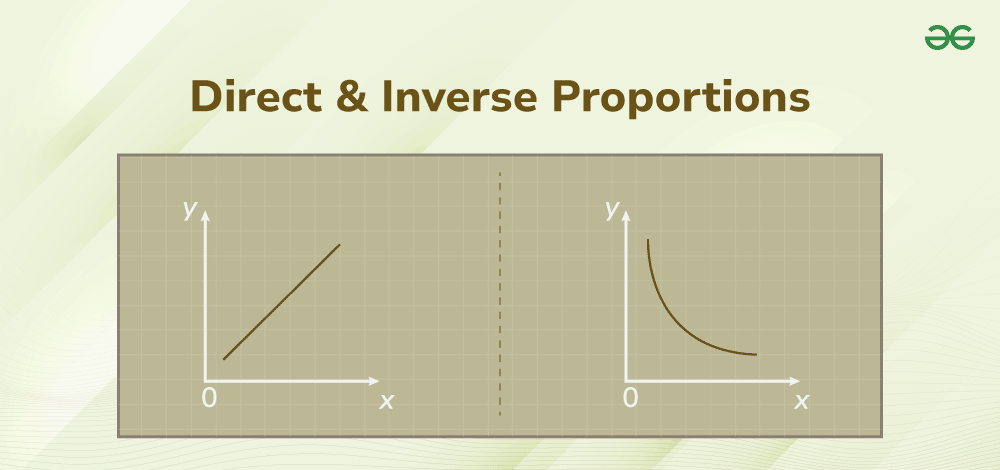
Table of Content
Direct Proportion
If x and y are any two quantities such that both of them increase or decrease together and x/y remains constant (say k), then we say that x and y are in Direct Proportion. This is written as x ∝ y and read as x is directly proportional to y.
Direct Proportion Formula
x ∝ y
(x/y) = k ⇒ x = kyWhere k is constant of proportion.
Similarly, if y1 and y2 are the values of y corresponding to the values of x1 and x2 of x respectively, then
\bold{\frac{x_1}{y_1} = \frac{x_2}{y_2} = k}
OR\bold{x_1y_2 = x_2 y_1 = \text{Constant}}
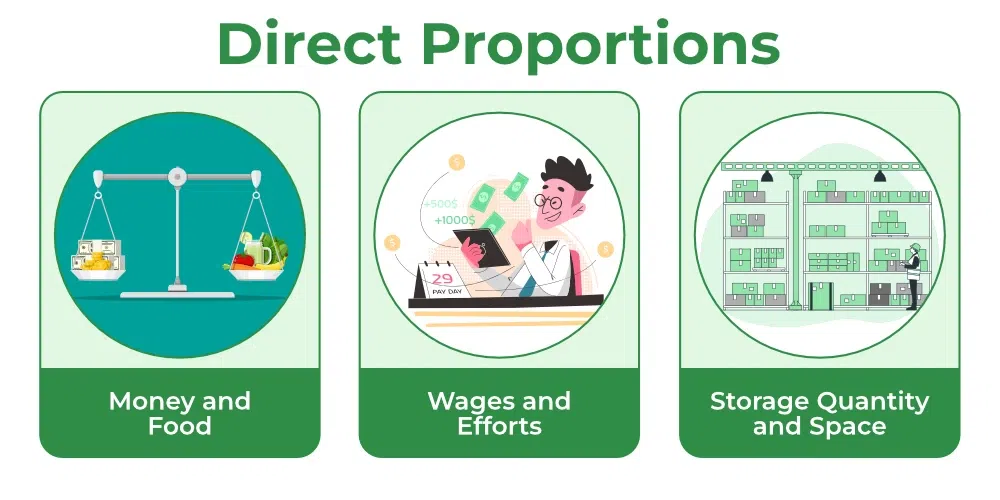
Examples of Direct Proportion
On the occasion of the School Anniversary, the Head Master of the school decided to take up a plantation of saplings. The number of students in each class is given below in the form of a table. Each student has to plant two saplings.
Class | VI | VII | VIII | IX | X |
|---|---|---|---|---|---|
Number of Students | 7 | 10 | 11 | 14 | 17 |
Number of Saplings required | 14 | 20 | 22 | 28 | 34 |
What can you say regarding the number of saplings required? What kind of change do Here you clearly observe that the number of saplings id directly proportional to the number of students.
Inverse Proportion
Two quantities change in such a manner that, if one quantity increases, the other quantity decreases in the same proportion and vice versa, then it is called Inverse Proportion.
Inverse Proportion Formula
In the above example, the number of persons engaged and the number of days are inversely proportional to each other. Symbolically, this is represented as
If x and y are in inverse proportion, then x ∝ (1 / y)
x = k/y ⇒ xy = k
Where, k is the constant of proportionality.
For two cases of each variable, let's consider y1 and y2 are the values of y corresponding to the values of x1 and x2 of x respectively then
\bold{x_1y_1 = k = x_2 y_2}
OR\bold{\frac{x_1}{x_2} = \frac{y_1}{y_2}}

Examples of Inverse Proportion
A Parcel company has a certain number of parcels to deliver. If the company engages 36 persons, it takes 12 days. If there are only 18 people, it will take 24 days to finish the task. You see as the number of persons is the halved time taken is doubled if the company engages 72 people, will the time taken be half? Yes, it is. Let's have a look at the table
Number of Persons | 36 | 18 | 9 | 72 | 108 |
|---|---|---|---|---|---|
Time Taken | 12 | 24 | 48 | 6 | 4 |
How many persons shall a company engage if it wants to deliver the parcels within a day? This question can be answered using the inverse proportions as
\bold{\text{ Number of days required } \propto \frac{1}{\text{Numbers of persons engaged}} }
Difference between Direct and Inverse Proportions
The key difference between direct and Inverse Proportions is as follows:
Property | Direct Proportion | Inverse Proportion |
|---|---|---|
| Relationship | When two variables change in the same direction | When two variables change in opposite directions |
| Formula | y = kx (where k is a constant) | y = k/x (where k is a constant) |
| Graph | A straight line passes through the origin (0,0) | A hyperbola |
| Example | The more hours you work, the more money you earn | The more people sharing a pizza, the smaller the slice each person gets |
| Symbol | ∝ (proportional to) E.g. a ∝ b | ∝ (inversely proportional to) E.g. a ∝ 1/b |
| Equation | y = kx | xy = k |
Note: In direct proportion, as one variable increases, the other variable increases proportionally. In inverse proportion, as one variable increases, the other variable decreases proportionally.

Solved Examples on Direct and Inverse Proportions
Direct Proportions:
Problem 1: A vertical pole of 10 m height casts a 20 m long shadow. Find the height of another pole that casts an 80m long shadow under similar conditions.
Solution:
The length of the Shadow is directly proportional to the height of the pole.
Height of Pole | 10 | ? |
|---|---|---|
Length of Shadow | 20 | 80 |
So, (x1 / y1) = (x2 / y2). Here, x1 = 10m y1 = 20m x2 = ? and y2 = 80m.
Upon substituting the values,
(10 / 20) = (x2 / 80)
x2 = (10 x 80) / 20
x2 = 40m
Therefore, the height of another pole is x2 = 40m.
Problem 2: Following are the vehicle parking charges near a Bus Station.
Number of Hours (x) | Parking Charges (y) |
|---|---|
up-to 4 hours | Rs.40 |
up-to 8 hours | Rs.80 |
up-to 12 hours | Rs.120 |
up-to 24 hours | Rs.240 |
Check if the parking charges and parking hours are in direct proportion.
Solution:
We can observe that the parking charges (y) increase with the increase in the number of hours (x). Let's calculate the value of (x / y). If it is a constant, then they are in direct proportion. Otherwise, they are not in direct proportion.
x /y = 4/40 = 8/80 = 12/120 = 24/240 = 1/10
Here, (1/10) is constant and is called the constant of proportion. You can easily observe that all these ratios are equal. So they are in Direct Proportion.
Inverse Proportions:
Problem 1: If 36 workers can build a wall in 12 days, how many days will 16 workers take to build the same wall? (assuming the number of working hours per day is constant)
Solution:
If the number of workers decreases, the time to take built the wall increases in the same proportion. Clearly, the number of workers varies inversely to the number of days.
So here, x1 y1 = x2 y2
Where x1 = 36 workers, x2 = 16 workers, and y1 = 12 days and y2 = (?) days
No. of Workers
No. of days
36
12
16
y2
Since the number of workers are decreasing
36 ÷ x = 16
⇒ x = 36 / 16So the number of days will increase in the same proportion i.e,
⇒ (36 / 16) × 12 = 27 daysSubstitute, (36/16) = (y2/12)
⇒ y2 = (12 × 36)/16 = 27 days.Therefore 16 workers will build the same wall in 27 days.
Problem 2: A car takes 4 hours to reach the destination by traveling at a speed of 60 km/h. How long will it take if the car travels at a speed of 80 Km/h?
Solution:
Method 1: As speed increases, time is taken decreases in the same proportion. So the time is taken and varies inversely to the speed of the vehicle, for the same distance.
Speed
Time
60
4
80
x
(60 / 80) = (x / 4)
60 x 4 = (80 x x)
x = (60 x 4) / 80 = 3hrs.the time taken to cover the distance at a speed of 80 Km/h is 3hrs.
Read More