
Permutations and combinations are key concepts in mathematics used for counting arrangements and selections. The main difference is that order matters in permutations, while it does not matter in combinations.
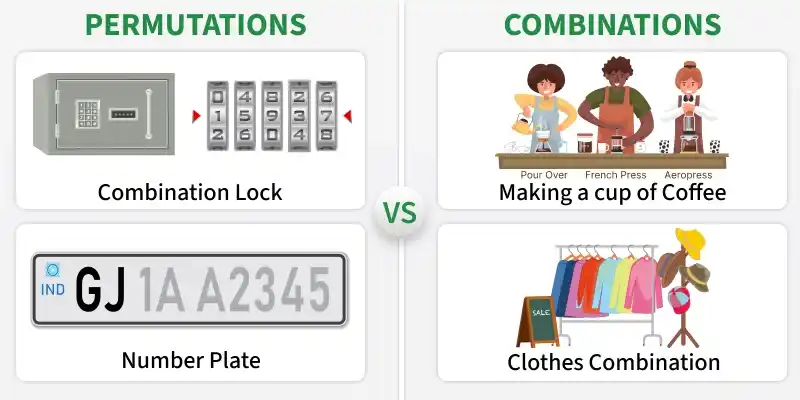
Permutation: Permutation is a concept that means to arrange a given set of elements in a particular order.
Example: If we take three English alphabets — p, q, and r and arrange them, the possible orders are:
(p, q, r), (p, r, q), (q, p, r), (q, r, p), (r, p, q), and (r, q, p).There are only six different arrangements. Each arrangement is called a permutation, because the order of letters matters.
Combination: A Combination is a concept that is concerned with the selection of some elements from a given set of elements.
Example: The selection of 11 players from a wide number of players for a cricket team comes under combination (that’s it, only selection) but which player will bat first, which will bat second, and so on, this arrangement of players comes under permutation.
The key differences are shown in the table below:
| Basis of Comparison | Permutation | Combination |
|---|---|---|
| Meaning | Arrangement of objects in a specific order. | Selection of objects without considering order. |
| Order | Order matters. | Order does not matter. |
| Focus | Concerned with arranging items. | Concerned with choosing items. |
| Formula | ||
| Example (a, b, c) | ab and ba are different. | ab and ba are the same. |
| Used In | Rankings, seating arrangements, passwords, codes. | Forming teams, committees, lotteries, and selections. |
Note: For given values of n and r, the value of the permutation is always greater than the value of the combination (when r > 1). This is because permutations count different arrangements where order matters, while combinations count only selections where order does not matter. Hence, permutation is always greater than combination.

Related Articles:
Sample Problems
Question 1: In how many ways can you arrange the letters of the word ARTICLE, taking 4 letters at a time, without repetition, to form words with or without meaning?
Solution:
Here from 7 letters of the word ARTICLE, we have to arrange any 4 letters to form different words.
So, n = 7 and r = 4.Using permutation formula nrP = n! / (n - r)!
47P = 7! / (7 - 4)!
= 7!/3!
= (7 × 6 × 5 × 4 × 3!) / 3! = 7 × 6 × 5 × 4 = 840Thus there are 840 different ways in which we can arrange 4 letters out of the 7 letters of ARTICLE to form different words.
Question 2: How many 6 digit pin codes can be formed from the digits 0 to 9 if each pin code starts with 48 and no digit is repeated?
Solution:
Here arrange 6 digits from 0 to 9 but the first two digits of the pin code has been already decided (4 and 8).
So we have to now arrange only 4 digits out of the remaining 8 digits (0, 1, 2, 3, 5, 6, 7, 9).
So, n = 8 and r = 4,84P = 8! / (8 - 4)!
= 8! / 4!
= (8 × 7 × 6 × 5 × 4!) / 4!
= 8 × 7 × 6 × 5
= 1680Thus, 1680 different permutation in which 6 digit pin codes can be formed.
Question 3: Out of 10 students, 4 are to be selected for a trip. In how many ways can the selection be made?
Solution:
In this question select 4 students out of given 10. So combination will be used here to find the answer.
n = 10 and r = 4,104C = 10! / 4!(10 - 4)!
= 10! / 4!6!
= (10 × 9 × 8 × 7 × 6!) / (4 × 3 × 2 × 1 × 6!)
= (10 × 9 × 8 × 7)/(4 × 3 × 2 × 1)
= 210Thus there are 210 different ways of selecting 4 students out of 10.
Question 4: A bag contains 3 red, 5 black, and 4 blue balls. How many ways are there to take out three balls so that each of the colours is taken out?
Solution:
Here take out three balls of each colour. The order in which the balls are taken out does not matter. So use combination to find the answer.
Number of ways of selecting one red ball out of 3 red balls = 31C
Number of ways of selecting one black ball out of 5 back balls = 51C
Number of ways of selecting one blue ball out of 4 blue balls = 41C
Total number of ways of selecting three balls of each colour = 31C × 51C × 41C= 3 × 5 × 4
= 60Thus there are 60 ways of selecting three balls of each colour.