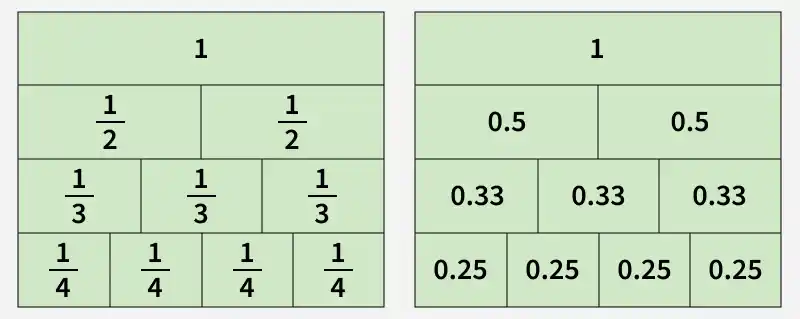
Converting fractions to decimals is a process of converting a number represented in the form of \frac{p}{q} where q\neq 0 to decimal form.
Example : 5/4 in fractions can be written as 1.25 in decimal
Fraction to Decimal Conversion Methods
There are two main methods to convert fractions to decimals:
Long Division Method
Denominator Adjustment Method (for powers of 10)
Long Division
In this method, the numerator is divided by the denominator using long division. The denominator acts as the divisor and the numerator as the dividend. The result may be a terminating decimal (remainder 0) or a repeating decimal (repeating remainder).
Steps for long division to convert a decimal to a fraction:
Write the fraction with the denominator (bottom number) as the divisor outside the division bracket.
Write the numerator (top number) as the dividend inside the bracket.
Since we're dealing with decimals, add a decimal point and a zero (or more zeros if needed) to the dividend. This makes the division process easier.
Perform division like normal (if at any point the dividend becomes smaller than the divisor, you can add as many zeroes as required to the dividend by placing a decimal point in the quotient).
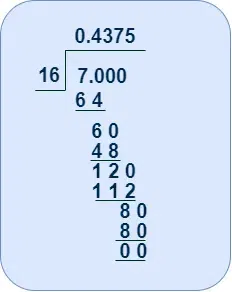
Example:Convert 7/16 to decimal by using long division.
Solution: Set up long division:
Performing the division. We get a remainder of 0, so the decimal terminates.
Hence, 7/16 = 0.4375
Denominator Adjustment Method (for powers of 10)
In this method, multiply both the numerator and denominator by a suitable number to make the denominator a power of 10 (such as 10, 100, or 1000). Once the denominator becomes a power of 10, the fraction can be easily written in decimal form by placing the decimal point according to the number of zeros. This method works best when the denominator can be converted into a power of 10. It is not suitable for fractions whose denominators cannot be changed into a power of 10 easily.
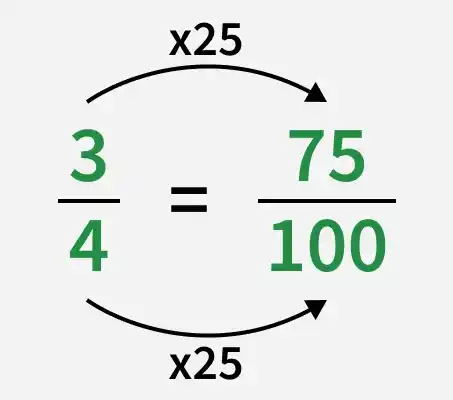
Example:Let's convert 3/4 to decimal using this method.
Solution:
\frac{3}{4} Denominator is not a power of 10 \frac{3}{4} \times \frac{25}{25} = \frac{75}{100} (Multiplying both numerator and denominator with 25 to convert to power of 10) \frac{75}{100}=0.75 (Convert into Decimal)
Fraction to Decimal Chart
A fraction-to-decimal chart is a reference for common conversions.
Fraction
Decimal
1/2
0.5
1/4
0.25
3/4
0.75
1/5
0.2
2/5
0.4
1/8
0.125
3/8
0.375
5/8
0.625
1/10
0.1
1/100
0.01
Examples on Fraction to Decimal Conversion
Example 1: Denominator Adjustment (Power of 10)Convert 3/20 to decimal.
Solution:
Denominator (20) is not a power of 10, but we can multiply by 5 (because 5 x 20 = 100).
So, convert (3 x 5) / (20 x 5) = 15/100.
Now, 15 divided by 100 is 0.15.
3/20 = 0.15
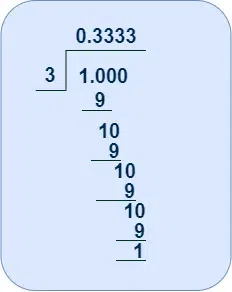
Example 2: Long Division (Repeating Decimal). Convert 1/3 to a decimal.
Set up long division:
We keep dividing and get a remainder of 1 repeatedly. This indicates a repeating decimal.
Answer: 1/3 = 0.3333... (repeating)
Example 3: Convert 9/80 to a decimal using denominator adjustment.
Solution:
Denominator (80) is not a power of 10, but we can multiply by 125 (because 80 x 125 = 10000).
So, convert (9x 125) / (80 x 125) = 1125/10000.
Now, 1125 divided by 10000 is 0.1125.
so, 9/80 = 0.1125
Example 4: Simplifying Before Conversion. Convert 12/24 to decimal.
Solution:
Before converting, we can simplify the fraction by dividing both numerator and denominator by 12 (their greatest common divisor). This gives us 1/2. Now, converting 1/2 to decimal is easy: 1 divided by 2 is 0.5.