
Continuity and discontinuity are fundamental concepts in calculus and mathematical analysis that describe the behavior of functions. A function is continuous at a point if you can draw the graph of the function at that point without lifting your pen from the paper. A function is discontinuous at a point x = c if it fails to be continuous at that point.
Continuity
A function is said to be continuous if one can sketch its curve on a graph without lifting the pen even once.
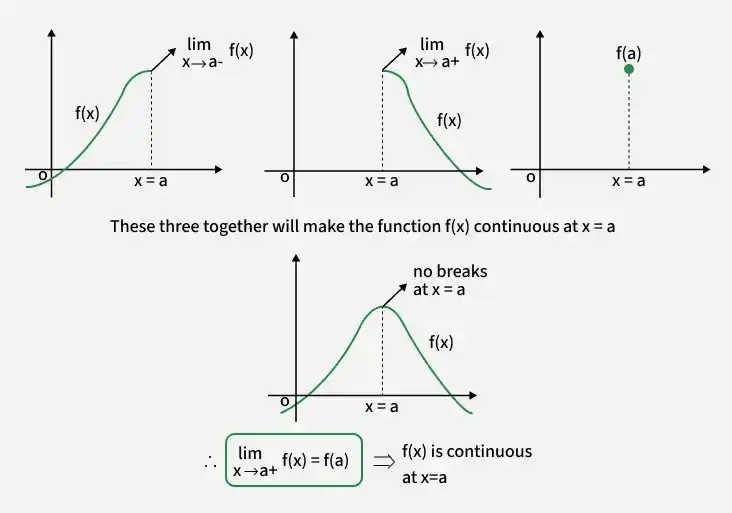
A function is said to be continuous at x = a if and only if the three following conditions are satisfied:
The function is defined at x = a.
The limit of the function as x approaches a exists.
The limit of the function as x approaches a is equal to the function value at x = a.
Continuity on an Open Interval (a,b)
A function f(x) is said to be continuous on the open interval (a,b) if it is continuous at every point in the interval.
That is, for every c∈(a,b):
Continuity on a Closed Interval [a,b]
A function f(x) is said to be continuous on the closed interval [a,b] if:
- It is continuous at every point in the open interval (a,b), and
- It satisfies one-sided continuity at the endpoints: At x=a: limx⇢a f(x) = f(a) and x=b: limx⇢b f(x) = f(b)
Example 1: Prove that the function f(x) = 5x - 3 is continuous at x = 0.
Given, f(x) = 5x - 3
At x = 0 , f(0) = (5 × 0) - 3 = -3
limx⇢0 f(x) = limx⇢0 (5x - 3) = (5 × 0) - 3 = -3
limx⇢0 f(x) = f(0)
Therefore, f(x) is continuous at x = 0.
Example 2: Examine the function f(x) = |x - 5|, for continuity.
Given function, f(x) = |x - 5|
Domain of f(x) is real and infinite for all real x
Here , f(x) = |x - 5| is a modulus function
As , every modulus function is continuous
Therefore , f(x) is continuous in its domain R.
Example 3: Is the function f(x) = x - sinx + 5 is continuous at x = π.
Given function is f(x) = x - sinx + 5
L.H.L = limx⇢π- (x - sinx + 5) = limx⇢π- [(π - h) - sin(π - h) + 5] = π + 5
R.H.L = limx⇢π+ (x - sinx + 5) = limx⇢π+ [(π + h) - sin(π + h) + 5] = π + 5
And, f(π) = π - sinπ + 5 = π + 5Since , L.H.L = R.H.L = f(π)
Therefore , f(x) is continuous at x = π
Example 4: Examine the continuity of the function f(x) = 2x - 1 at x = 3.
Given f(x) = 2x - 1
At x = 3, f(x) = (2 × 3) - 1 = 5
limx⇢3 f(x) = limx⇢3 f(x) = (2×3) - 1 = 5
limx⇢3 f(x) = f(3)
Therefore, f(x) is continuous at x = 3
Example 5: Examine the function is continuous or not?
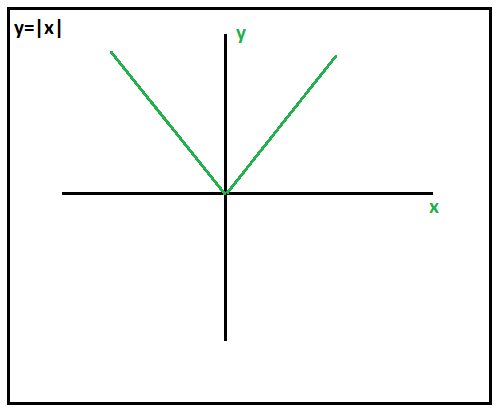
For x > 0, y = x and x < 0, y = -x
So, We Know it is continuous for x > 0 and x < 0. To check if it is continuous at x = 0 , check the limit:
limx⇢0- |x| = limx⇢0- (-x) = 0
limx⇢0+ |x| = limx⇢0+ (x) = 0
So, limx⇢0 |x| = 0 , which is equal to the value of the function at 0. Therefore, It is continuous everywhere.
Discontinuity
A function is discontinuous at a point x = a if the function is not continuous at a. The function "f" is said to be discontinuous at x = a in any of the following cases:
- f(a) is not defined
- limx⇢a+ f(x) and limx⇢a- f(x) exists, but are not equal.
- limx⇢a+ f(x) and limx⇢a- f(x) exists and are equal but not equal to f(a).
Types of Discontinuity
There are three basic types of discontinuities
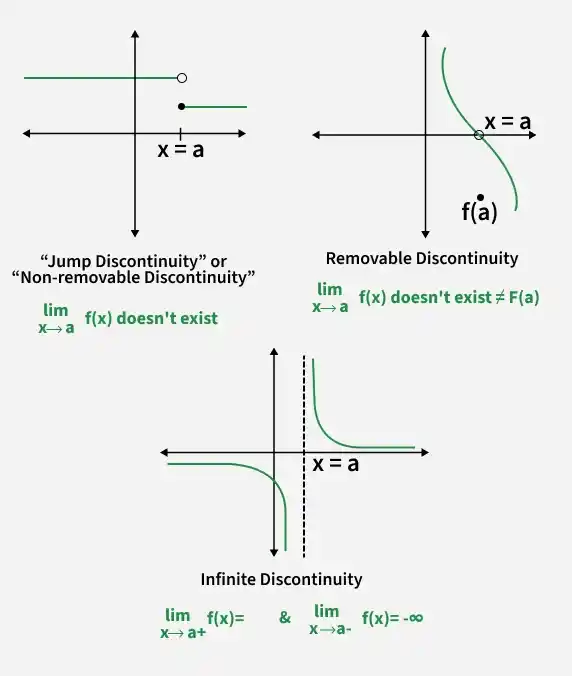
1. Removable(point) Discontinuity: The graph has a hole at a single x-value. Imagine you're walking down the road, and someone has removed a manhole cover. This is a category of discontinuity in which the function has a well defined two-sided limit at x = a, but either f(a) is not defined or f(a) is not equal to its limit.
- limx⇢a f(x) ≠ f(a)
- f(a) = limx⇢a f(x)
2. Infinite Discontinuity: The function goes toward positive or negative infinity. Imagine a road getting closer and closer to a river with no bridge to the other side. The function diverges at x = a to give it a discontinuous nature here. That is to say, f(a) is not defined. Since the value of the function at x = a tends to infinity or doesn’t approach a particular finite value, the limits of the function as x → a are also not defined.
3. Jump Discontinuity: The graph jumps from one place to another. Imagine a superhero going for a walk, he reaches a dead end and, because he can, flies to another road. In this type of discontinuity, the right-hand limit and the left-hand limit for the function at x = a exists; but the two are not equal to each other.
- limx⇢a+ f(x) ≠ limx⇢a- f(x)
Solved Examples
Example 1: Find all the points of discontinuity of the function f defined by f(x) = |x| - |x+1|.
Given function = |x| - |x+1|
From the function the critical points are x=0 and x=-1
For x< -1 , f(x) = -x - (-x-1) = 1
For -1<=x<0 , f(x) = -x-(x+1) = -2x-1
For x>= 0 , f(x) = x - (x+1) = -1
Checking the Discontinuity :
At x = -1
Left limit: limx⇢-1-f(x) = 1
Right limit: limx⇢-1+ f(x) = -2(-1)-1 = 1
Function value: f(-1) = 1
Continuous at x = -1 (limits and function value are equal )
At x = 0
Left limit: limx⇢-0-f(x) = -2(0) -1 = -1
Right limit: limx⇢-0+ f(x) = -1
Function value: f(0) = -1
Continuous at x = 0 (limits and function value are equal )
Since the function is continuous at x = -1 and x = 0, there are no points of discontinuity. Thus, f(x) is continuous everywhere.
Example 2: Show that the function defined by g (x) = x – [x] is discontinuous at all integral points. Here [x] denotes the greatest integer less than or equal to x
For x approaching an integer n from the left (x→ n- ) : lim x⇢n- g(x) = 1
because [x] = n - 1
For x approaching n from the right (x→n+): lim x⇢n+ g(x) = 0
because [x] = n
Since the left-hand limit and the right-hand limit are not equal at any integer n, g(x) is discontinuous at all integers.