
Co-initial vectors are vectors that start from the same initial point (same tail). They may point in any direction and have any magnitude, but their starting point is common.
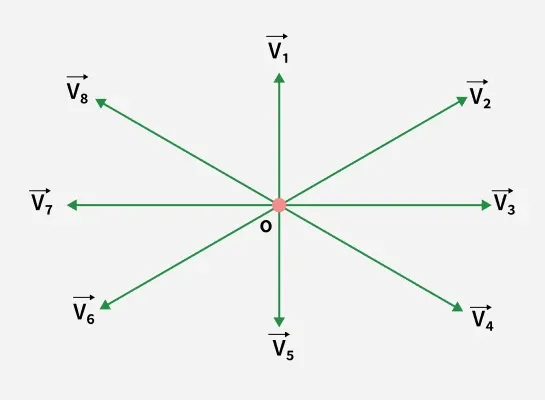
When vectors share the same starting point, they can be conveniently analyzed together, especially when studying geometric properties or performing vector operations like addition or subtraction.
Mathematically, let v1, v2, v3, ....., vn be a set of vectors in a vector space V. These vectors are co-initial if they all originate from the same point O.
This concept is particularly relevant in geometric and graphical representations of vectors, where it helps to analyze their relationships and operations.
Properties of Co-Initial Vectors
Some important properties of co-initial vectors are:
Same Initial Point: Co-initial vectors originate from the same initial point or starting position.
Different Directions and Magnitudes: Coinitial vectors can have different directions and magnitudes.
Addition and Subtraction: Coinitial vectors can be added or subtracted by performing vector addition or subtraction. When adding coinitial vectors, you align them tail to head and sum up the resultant vector. When subtracting, you reverse the direction of the vector being subtracted and then add it.
Resultant Vector: The sum of coinitial vectors is called the resultant vector. It represents the combined effect of all the individual vectors.
Parallel Vectors: If coinitial vectors have the same direction or opposite direction, they are considered parallel or antiparallel, respectively.
Collinear Vectors: Coinitial vectors lying along the same straight line are called collinear vectors. They have the same or opposite directions.
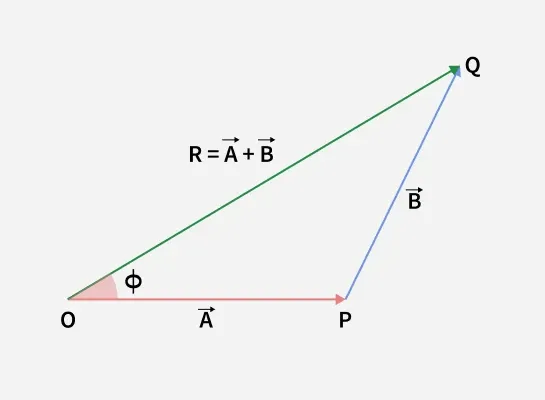
Triangle Law of Vector Addition: if you have two vectors, you can add them together by placing the tail of the second vector at the head of the first vector. The resultant vector, representing the sum of the two vectors, is the line drawn from the tail of the first vector to the head of the second vector.
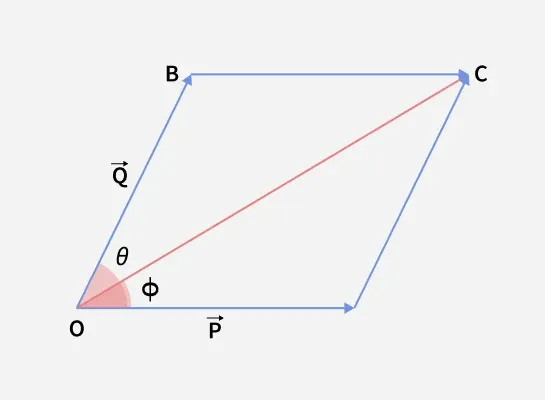
Parallelogram Law of Vector Addition: Another method of adding vectors is by forming a parallelogram with the vectors as sides. The diagonal of the parallelogram passing through the initial point of the vectors represents the resultant vector.
Co-initial Vectors vs Collinear Vectors
The difference between co-initial and collinear vectors are:
Co-initial Vectors | Collinear Vectors |
|---|---|
Vectors that start from the same point. | Vectors that lie on the same line or are parallel. |
Can have different directions. | Have the same or opposite directions. |
Can have different magnitudes. | Have the same or proportional magnitude. |
Originate from a common point. | May or may not originate from the origin. |
May or may not be parallel. | Are always parallel. |
Not necessarily a scalar multiple of each other. | Always scalar multiples of each other. |
Vectors originating from the same point but pointing in different directions. | Vectors representing different magnitudes of the same direction. |
Solved Questions on Co-Initial Vectors
Question 1: Three vectors A, B, and C have magnitudes 5, 7, and 3 respectively. They are co-initial and their directions are inclined at angles of 30, 45 , and 60 respectively with the positive direction of the x-axis. Find the magnitude and direction of their resultant vector.
A= (5 cos30)i +(5sin30)j
B=(7 cos45)i+(7 sin45)j
C=(3 cos60)i + (3 sin60)j
now, we add up the x-component and y-component separately,
sum of x-components = (5 cos30) + (7 cos 45) + (3 cos60) = ( 5. √3/2) + (7. √2/2) + (3. 1/2)
sum of x-components = (5√3 + 7√2 + 3)/2
sum of y-components = (5 sin30) + (7 sin45) + (3 sin60) = (5. 1/2)+(7 . √2/2)+(3.√3/2)
sum of y-components = (5 + 7√2 + 3√3) / 2
Now, the magnitude of the resultant vector R is given by:
R=√(sum of x-components)2 + (sum of y-components)2
=√((5√3 + 7√2 + 3)/2)2 + ((5 + 7√2 + 3√3)/2)2 = √ 137/4 + 7√3/2 + 21√2/4 + 5√6/2
Now , let's find the direction of the resultant vector R,
tanθ= sum of y-components/sum of x-components = (5 + 7√2 + 3√3)/(5√3 + 7√2+3).
Question 2: Two vectors P and Q are co-initial. The magnitude of P is 8 units and the magnitude of Q is 5 units. If the angle between them is 60 , find the magnitude and direction of their resultant vector.
Given that P and Q are co-initial vectors with magnitudes ∣ P∣=8 units and ∣ Q∣=5 units, and the angle between them is 60 .
To find the resultant vector, we can use the law of cosines. The magnitude of the resultant vector can be calculated as:∣R∣2=∣P∣2+∣Q∣2 −2∣P∣∣Q∣ cos(θ)
Where:
- ∣P∣ and ∣Q∣ are the magnitudes of vectors P and Q respectively.
- θ is the angle between vectors P and Q.
Substituting the given values, we get:
∣R∣2 = (8)2+(5)2 - 2(8)(5)cos(60)
∣R∣2= 64+25−80×1/2
∣R∣2 = 64+25−40
∣R∣2 = 89−40
∣R∣2 = 49
∣R∣ = √49
∣R∣ = 7.
So, the magnitude of the resultant vector is ∣R∣=7 units.
Now, to find the direction of the resultant vector, we can use trigonometry. The direction θR of the resultant vector with respect to vector P can be calculated using the law of sines:
sin(θr) = |Q|sin(θ)/|R|
Substituting the given values, we get:
sin(θr) = 5sin(60)/7
sin(θr) = (5×√3/2)/7
sin(θr) = 5√3/14
θr = sin-1(5√3/14)
θr ≈ 53.13
So, the direction of the resultant vector with respect to vector P is approximately 53.13 .
Therefore, the magnitude of the resultant vector is 7 units and its direction with respect to vector P is approximately 53.13.