
In geometry, equations are not just abstract mathematical expressions; they have tangible geometric meanings that can be visualized in different ways. Representing equations on the number line or the Cartesian plane transforms them into visual objects like points, lines, and curves, making it easier to understand their properties and relationships. This approach provides a clear geometric interpretation of algebraic solutions, helping to bridge the gap between algebra and geometry. Whether it's a simple equation in one variable or a more complex equation involving two variables, these representations offer valuable insights into the behaviour and characteristics of the equations.
Geometric Representations of Equations
Geometric representations help us visualize equations more clearly. Key concepts include:
- Number Line Representation: For equations involving one variable, such as x=a, the solution is shown as a point on the number line at x=a.
- Cartesian Plane Representation:
- For equations like y=by=b, the representation is a horizontal line where y is constant.
- For linear equations in two variables, such as Ax+By+C=0, the representation is a straight line. The slope-intercept form y=mx+c shows the slope of the line and where it crosses the y-axis.
Geometric Representations of Equations
Geometric Representations of Equations on the Number Line
Understanding the representation of equations on the number line allows us to visualize solutions for linear equations in one variable, highlighting their specific positions.
Geometric Representations of Equations on the Cartesian Plane
The Cartesian plane helps in visualizing equations in two dimensions, showcasing lines, curves, and their intersections based on the given algebraic expressions.
Geometric Representation of Linear Equations in Two Variables
Linear equations in two variables can be graphically represented as straight lines on the Cartesian plane, providing insights into their slopes and intersections with axes.
Question 1: Give the geometric representations of the following equations
(a) on the number line (b) on the Cartesian plane:
(i) x = 2
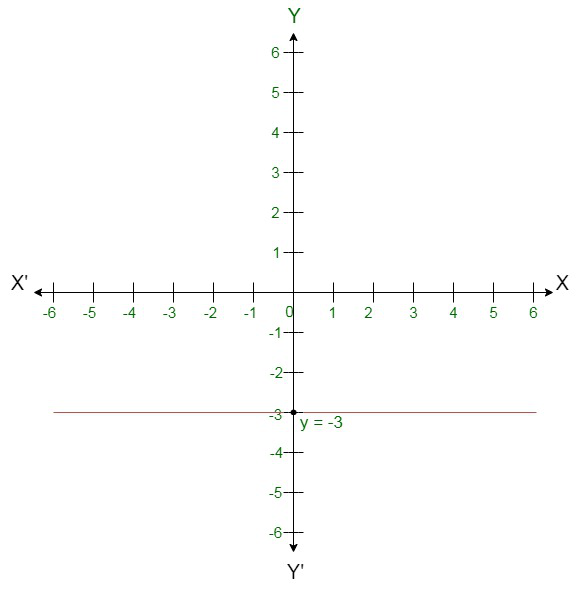
(ii) y + 3 = 0
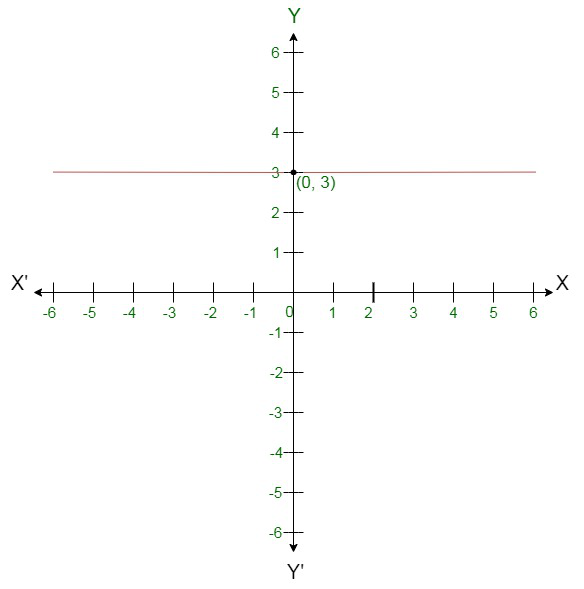
(iii) y = 3
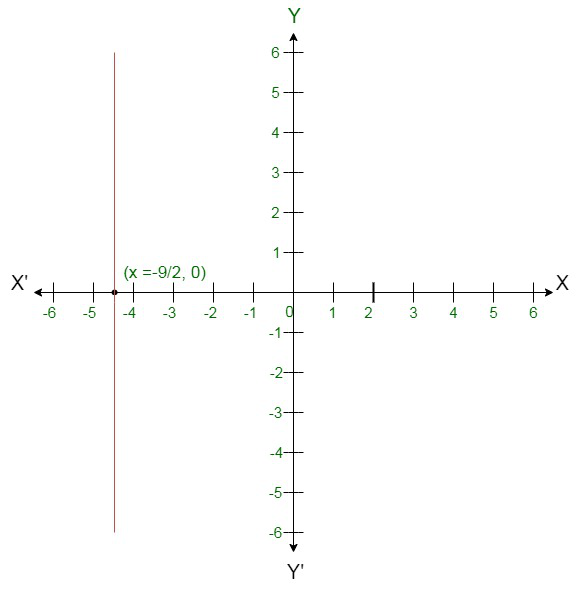
(iv) 2x + 9 = 0
(v) 3x – 5 = 0
Solution:
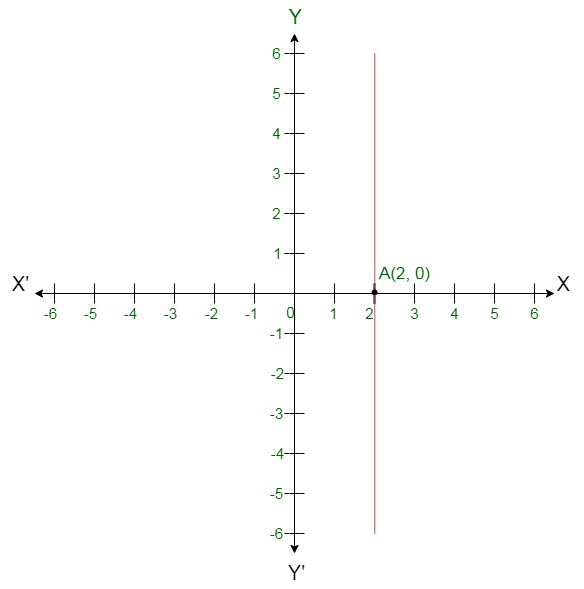
(i) x = 2
The representation of equation on the number line:

The representation of equation on the Cartesian plane:
(ii) y + 3 = 0
or y = -3
The representation of the equation on the number line:

The representation of the equation on the Cartesian plane:
(iii) y = 3
The representation of equation on the number line:

The representation of equation on the Cartesian plane:
(iv) 2x + 9 = 0
or x = -9
2
The representation of equation on the number line:

The representation of equation on the Cartesian plane:
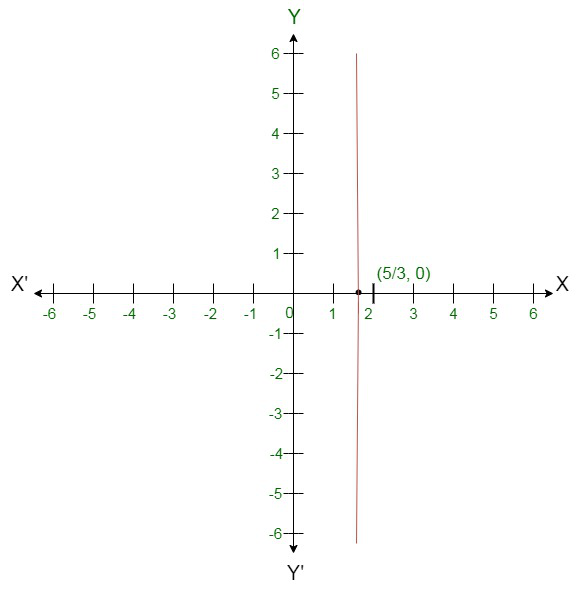
(v) 3x – 5 = 0
or x = 5
3
The representation of equation on the number line:

The representation of equation on the Cartesian plane:
Question 2: Give the geometrical representation of 2x + 13 = 0 as an equation in
(i) one variable
(ii) two variables
Solution:
2x + 13 = 0
(i) Isolate given equation in x
Subtract 13 from both the sides
2x + 13 – 13 = 0 – 13
2x = -13
Divide each side by 2
x = - 13 = -6.5
2
Which is an equation in one variable.

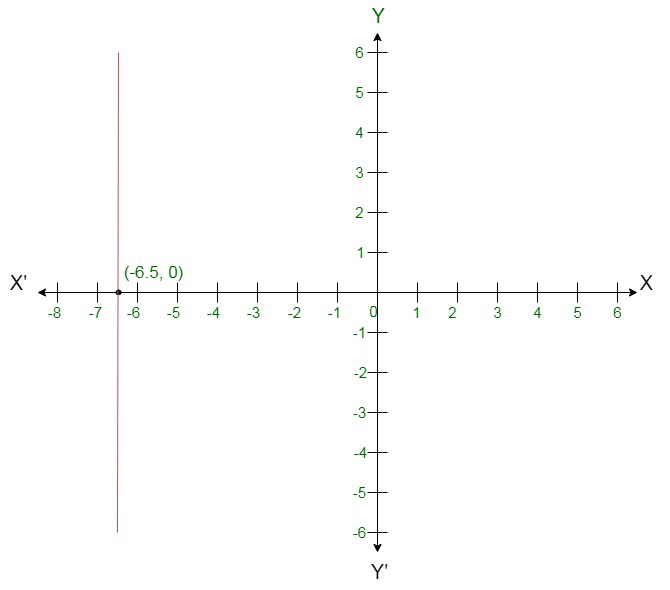
(ii) 2x + 13 = 0 can be written as 2x + 0y + 13 = 0
The representation of the solution on the Cartesian plane: A line parallel to y axis passing through the point (-13 , 0):
2
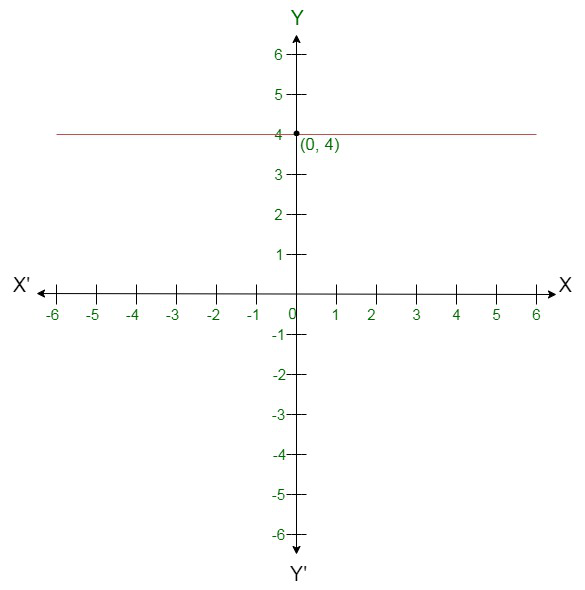
Question 3: Write the equation of a line passing through the point (0, 4) and parallel to x-axis.
Solution:
Here, x-coordinate is 0 and y-coordinate is 4, so equation of the line passing through the point (0, 4) is y = 4.
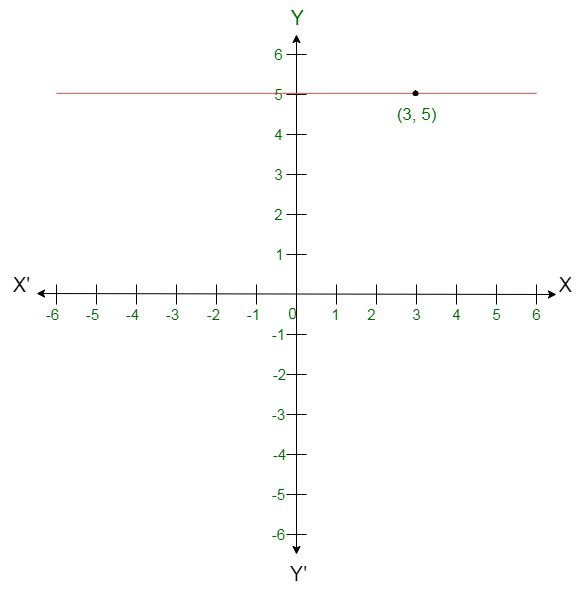
Question 4: Write the equation of a line passing through the point (3, 5) and parallel to x-axis.
Solution:
Here x-coordinate = 3 and y-coordinate = 5
Since required line is parallel to x-axis, so equation of line is y = 5.
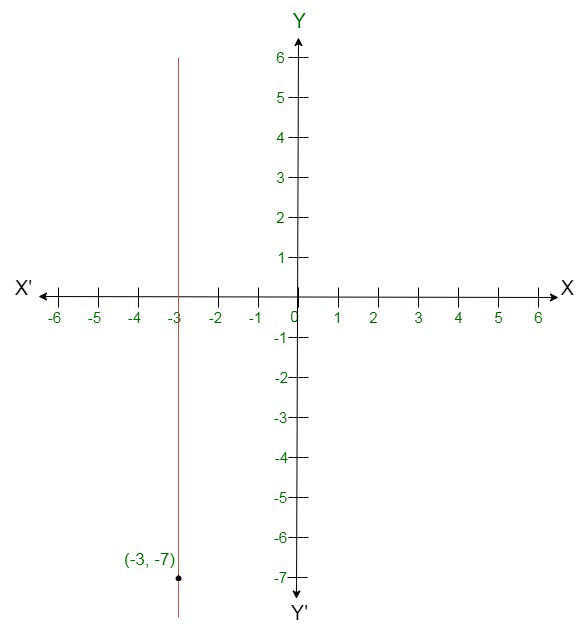
Question 5: Write the equation of a line parallel to y-axis and passing through the point (-3, -7)
Solution:
Here x-coordinate = -3 and y-coordinate = -7
Since required line is parallel to y-axis, so equation of line is x = -3.
Related Articles,
Conclusion
Understanding how to geometrically represent equations allows us to bridge the abstract nature of algebra with the visual intuitiveness of geometry. By plotting equations on the number line or Cartesian plane, we can easily interpret their solutions and relationships, enhancing our comprehension of algebraic concepts through visual aids.