
Bernoulli trials and the binomial distribution are used to model situations where outcomes can be categorised as success or failure.
- Bernoulli's Trials are experiments in probability where only two possible outcomes are possible: Success or Failure, True or False, Yes or No. Due to the fact of two possible outcomes, it is also called the Binomial Trial.
- Binomial Distribution describes the probability of achieving a specific number of successes in a fixed number of independent Bernoulli trials.
In other words, the binomial distribution results from repeating Bernoulli trials multiple times and counting how many successes occur.
The image illustrates the Binomial Distribution probability mass function (PMF) for 10 Bernoulli trials.
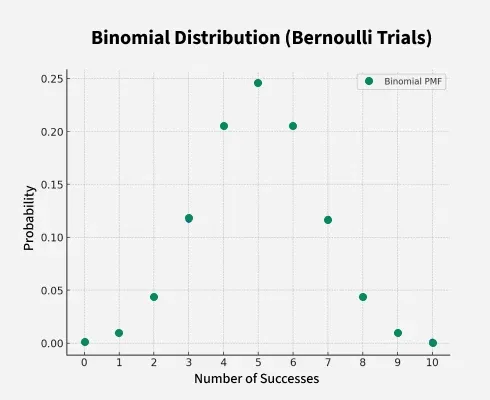
- Assumes a success probability of approximately 0.5.
- Displays probabilities for getting 0 to 10 successes.
- The peak occurs around 5 successes, indicating the most likely outcome.
- The distribution is symmetric, typical of fair coin tosses.
Bernoulli's Trials
Bernoulli’s trials refer to repeated, independent experiments where each trial has the same probability of a specific outcome, called event A. Each trial results in only two possible outcomes: event A occurs (success) or it does not (failure).
A random experiment is called a Bernoulli trial if it follows the given condition:
- The experiment should have only two possible outcomes: success or failure (true or false).
- The probability of success remains constant in each trial.
- The trials are independent of each other.
Example: Tossing a coin 2 or n number of times. In this case, each trial is independent, there are only two possible outcomes (head or tail), and the probability of success remains constant, i.e.
Other Examples of Bernoulli's Trials:
- Rolling a die for a specific number: Getting the desired number is success; any other result is failure.
- Checking for a specific email: The event “email arrived” is either true (success) or false (failure) each time you check.
- Flipping a light switch: Success if the light turns on; failure if it doesn’t.
Bernoulli's Trials Theorem
The following theorem gives the probability of success r number of times in n number of trials, and its statement is as follows:
Statement: If the probability of occurrence of an event (probability of success) in a single trial of Bernoulli's experiment is p, then the probability that the event occurs exactly r times out of n independent trials is equal to nCr pr qn - r , where q = 1 - p, the probability of failure of the event.
To summarize the above theorem,
Probability of r success in n Trials = nCr prqn - r
where,
- p is the Probability of Success,
- q = 1 - p is the Probability of Failure,
- n is the Number of Independent trials, and
- r is the number of times an event occurred.
Proof:
Getting exactly r successes means getting r successes and (n - r) failures simultaneously.
∴ P(getting r successes and n - r failures) = qn - r pr (since the n trials are independent) [By Multiplication Theorem]
The trials, from which the successes are obtained, are not specified. There are nCr ways of choosing r trials for successes. Once the r trials are chosen for successes, the remaining (n - r) trials should result in failures. These nCr ways are mutually exclusive. In each of these nCr ways, P(getting exactly r successes) = qn - r pr
Therefore, by the addition theorem, the required probability = nCr qn - r pr
Example: A coin is tossed 4 times. What is the probability of getting exactly 2 heads?
- Here, n = 4, r = 2, p = 0.5
Solution:
P(X = r) = \binom{n}{r} p^r q^{n-r}
Substituting the given values:P(X = 2) = \binom{4}{2} (0.5)^2 (0.5)^{4-2} = \binom{4}{2} (0.5)^2 (0.5)^2 = 6 \times (0.25) \times (0.25) = 6 \times 0.0625= 0.375
Binomial Distribution Definition
Binomial Distribution is a probability distribution that describes the number of successes in a fixed number of independent binomial trials i.e., each trial can only result in either a success or a failure.
Examples of Binomial Distribution
- Email Marketing: Suppose a company sends out 1000 emails and the probability for a recipient to open that email is 0.2. Then the number of people who open the emails can be modelled by a binomial distribution with n = 1000 and p = 0.2
- Coin Tossing: Suppose you toss a fair coin 10 times and you want to know the probability of getting exactly 5 heads. This is situation follows a binomial distribution with n = 10 (number of trials) and p = 0.5 (probability of success).
- Survey Responses: Suppose you survey 1000 people and ask them whether they support a certain candidate. If the probability of someone supporting the candidate is 0.6, you can model the number of people who support the candidate using a binomial distribution with n = 1000 and p = 0.6.
Formula for Probability in Binomial Distribution
Let A be some event associated with a random experiment E, such that P(A) = p and P(A') = q = 1 - p.
Assuming that p remains the same for all repetitions, if we consider n independent repetitions ( or trials ) of E and if the random variable (RV) X denotes the number of times the event A has occurred then X is called a binomial random variable with parameters n and p or we can say that X follows a binomial distribution with parameters n and p, or symbolically BThesly, the possible values that X can take, are 0, 1, 2,...., n. Then the probability mass function of a binomial random variable is given by
P(X = r) = nCr prqn - r
where,
- P(X = r) is the probability of getting exactly r successes,
- n is the number of total trials,
- r is the number of successes in n Trials,
- p is the probability of success,
- q is the probability of failure, and
- p + q = 1 and r = 0, 1, 2, ..., n
Proof for Binomial Distribution
The binomial distribution counts successes in n independent Bernoulli trials.
Sequence Probability: For any specific sequence with x successes and n−x failures:
Probability Mass Function (PMF):P(X = r) = \binom{n}{r} p^r (1 - p)^{n - r} Derivation of the PMF:
P(\text{Sequence}) = p^r (1 - p)^{n - r} The number of such sequences is:
\binom{n}{r} = \frac{n!}{r!(n - r)!} Multiply the number of sequences by their probability:
P(X = r) = \binom{n}{r} p^r (1 - p)^{n - r} Mean and Variance
X = \sum_{i=1}^n X_i \implies E[X] = \sum_{i=1}^n E[X_i] = n p
\text{Var}(X) = \sum_{i=1}^n \text{Var}(X_i) = n p(1 - p) Probability-Generating Function (PGF)
G_X(z) = \sum_{r=0}^n P(X = r) z^r = (1 - p + p z)^n
G_X(z) = \sum_{r=0}^n \binom{n}{r} (p z)^r (1 - p)^{n - r} = (1 - p + p z)^n Normalization Check
\sum_{r=0}^n P(X = r) = \sum_{r=0}^n \binom{n}{r} p^r (1 - p)^{n - r} = (p + (1 - p))^n = 1
Example: Calculate the probability of getting exactly five heads when a coin is tossed 10 times.
Solution:
As we know, P(X = r) = nCr × pr × (1-p)n-r
Number of success(r)=5
Total number of trials(n)=10
Probability of success i.e getting head(p)=0.5
n = 10, r = 5, and p = 0.5
Plugging in the values, you get:
P(X = 5) = 10C5 × (0.5)5 × (1-0.5)10 - 5
⇒ P(X = 5) = 252 × 0.03125 × 0.03125
⇒ P(X = 5) = 0.24609375 ≈ 0.246
So the probability of getting exactly five heads when flipping a fair coin ten times is about 0.246, or 24.6%.
Mean and Variance of Binomial Distribution
Mean or Expected value of a binomial distribution is given by the following formula:
Mean = μ = np
and variance or measure of a binomial distribution is given by the following formula:
Variance = σ2 = np(1-p)
where, the
- n is Total Number of Trials
- p is Probability of Success
Points to Remember
There are some important things related to the binomial distribution to which we need to pay more attention. Some of those things are as follows:
- Binomial distribution is a legitimate probability distribution since
- Mean of the Binomial Distribution is given by:
and
- Variance of the Binomial Distribution is given by:
Generalization of Bernoulli's Distribution: Multinomial Distribution
If A1, A2, . . , Ak are exhaustive and mutually exclusive events associated with a random experiment such that, P(Ai occurs) = pi where,
p1 + ...2 . . + pk = 1, and if the experiment is repeated n times, then the probability A1 occurs r1 times, A2 occurs r2 times, . . . . , Ak occurs rk times is given by:
Pn(r1, r2, . . . , rk) =
where,
- r1 + r2 + ...+ rk = n
Proof:
r1 trials in which the event A1 occurs can be chosen from the n trials nCr ways. The remaining (n - r1) trials are left over for the other events.
r2 trials in which the event A2 occurs can be chosen from the (n - r1) trials in (n - r1)Cr2 ways.
r3 trials in which the event A3 occurs can be chosen from the (n - r1 - r2) trials in (n - r1 - r2)Cr3 ways, and so on.
Therefore, the number of ways in which the events A1, A2, ..., Ak can happen:
nCr1 × (n − r1)Cr2 × (n −r1 − r2)Cr3 × (n−r1 − r1 - ...− rk − 1)Crk = n!/(r1!r2! . . . r3!)
Consider any one of the above ways in which the events A1, A2, . . ., Ak occurs
Since, n trials are independent, r1 + r2 + . . . +rk trials are also independent.
∴ P(A1 occurs r1 times, A2 occurs r2 times, . . . , Ak occurs rk times) = p1 r1 × p2r2 × . . . × pk rk
Since the ways in which the events happen are mutually exclusive, the required probability is given by
Pn (r1 , r2 , . . . , rk ) =
\frac{n!}{r_{1}! r_{2}! . . . r_{k}!}\times \ p_{1} ^{r_{1}}\times p_{2}^{r_{2}}\times... \times p_{k}^{r_{k}}
Related Articles:
Solved Question on Bernoulli Trials and Binomial Distribution
Question 1: A coin is tossed an infinite number of times. If the probability of a head in a single toss is p, show that the probability that the kth head is obtained at the nth tossing, but not earlier is (n−1)Ck−1pkqn−k, where q = 1 - p.
Solution:
K heads should be obtained at the nth tossing, but not earlier.
Therefore, (k - 1) heads must be obtained in the first (n - 1) tosses and 1 head must be obtained at the nth toss.Required Probability = P[(k - 1) heads in (n - 1) tosses] × P(1 head in 1 toss)]
= (n−1)Ck−1pk-1qn−k x p
Question 2: If at least 1 child in a family with 2 children, is a boy then what is the probability that both children are boys?
Solution:
p = Probability that a child is a boy = 1/2.
∴ q = 1 - p = 1/2 and n = 2
⇒ P (at least one boy) = p (exactly 1 boy) + p (exactly 2 boys)
⇒ P (at least one boy) =2C_{1}\frac{1}{2}^2 + 2C_{2}\frac{1}{2}^2
⇒ P (at least one boy) = 3/4∴ Required probability = P (both are boys)/P (at least 1 boy)
⇒ Required probability = (1/4)/(3/4) = 1/3
Question 3: Out of 800 families with 4 children each, how many families would be expected to have
(i) 2 boys and 2 girls,
(ii) at least 1 boy,
(iii) at most 2 girls,
(iv) children of both sexes.
(Assume equal probabilities for boys and girls.)
Solution:
Considering each child as a trial, n = 4. Assuming that birth of a boy is a success, p = 1/2, and q = 1/2. Let X denote the number of successes(boys).
(i) P (2 boys and 2 girls) = P (X = 2)
⇒ P (X = 2) =4C_{2} \times (\frac{1}{2})^2 \times (\frac{1}{2})^{4-2}
⇒ P (X = 2)=6 \times(\frac{1}{2})^4=\frac{3}{8} Thus, No. of families having 2 boys and 2 girls = N×P(X = 2)
[Where, N is the total no. of families considered]
⇒ Required No. of Families =
800 \times \frac{3}{8}=300 (ii) P (at least 1 boy) = P (X ≥ 1)
⇒ P (X ≥ 1) = P (X = 1) + P ( X = 2) + P (X = 3) + P (X = 4)
⇒ P (X ≥ 1) = 1 - P (X = 0)
⇒ P (X ≥ 1) =1-4C_{0} \times(\frac{1}{2})^0\times(\frac{1}{2})^4=1-\frac{1}{16}=\frac{15}{16} Thus, No. of families having at least 1 boy = N×P(X ≥ 1)
⇒ Required No. of Families =
800 \times \frac{15}{16}=750 (iii) P (at most 2 girls) = P (exactly 0 girl, 1 girl or 2 girls)
⇒ P (at most 2 girls) = P (X = 4, X = 3 or X = 2)
⇒ P (at most 2 girls) =1-(4C_{0} \times (\frac{1}{2})^4+4C_{1} \times(\frac{1}{2})^4)=\frac{11}{16} Thus, No. of families having at most 2 girls =
800 \times \frac{11}{16}=550 (iv) P(children of both sexes)
⇒ P (children of both sexes) = 1 - P (children of same sex)
⇒ P (children of both sexes) = 1 - {P (all are boys) + P (all are girls)}
⇒ P (children of both sexes) = 1 - {P (X = 4) + P (X = 0)}
⇒ P (children of both sexes) =1-(4C_{4} \times(\frac{1}{2})^4 + 4C_{0}\times(\frac{1}{2})^4)
⇒ P (children of both sexes) =1-\frac{1}{8} = \frac{7}{8} Thus, No. of families having children of both sexes =
800\times\frac{7}{8} = 700
Question 4: Ten coins are thrown simultaneously. Find the probability of getting at least seven heads?
Solution:
Given:
- p = Probability of getting a head = 1/2
- q = Probability of not getting a head = 1 - p = 1/2
Probability of getting x heads in a random throw of 10 coins is:
p(x) =
10C_{x}\times\frac{1}{2}^x\times\frac{1}{2}^{10-x}=10C_{x}\times\frac{1}{2}^{10} ; x = 0, 1, 2, . . ., 10Therefore, probability of getting at least seven heads is given by:
P(X ≥ 7) = P(7) + P(8) + P(9) + P(10)
⇒ P(X ≥ 7) =\frac{1}{2}^{10}( 10C_{7} + 10C_{8} + 10C_{9} + 10C_{10})
⇒ P(X ≥ 7) = 176/1024 = 11/64