
The rate of change is the change in one variable in relation to the change in another variable.
- Over an interval, it is the average rate of change (slope of a secant line).
- At a specific point, it is the instantaneous rate of change (derivative, or slope of a tangent line).
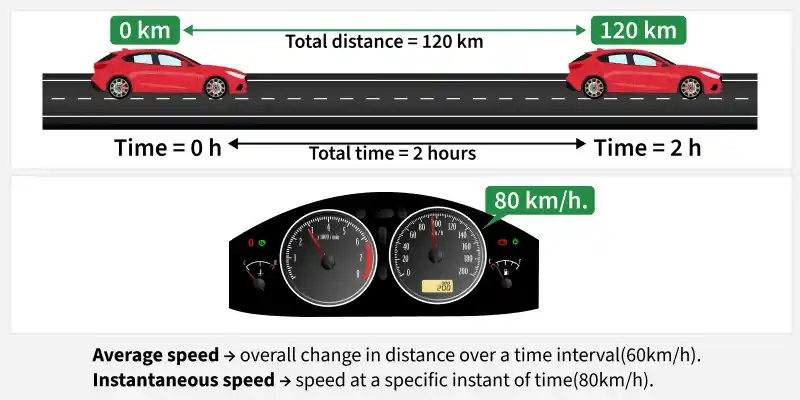
Example: If a car travels 120 km in 2 hours, its average rate of change (average speed) is: 60 km/h.
At a specific moment, the speed shown on the speedometer ( 80 km/h) is the instantaneous rate of change.
Average Rate of Change
The average rate of change measures how much a function changes over an interval. Secant lines are found by connecting two points on a curve. The slope of the secant line between two points represents the average rate of change in that interval.
Average Rate of Change = Slope(m) = △y/△x =
\frac{y_{2} - y_{1}}{x_{2} - x_{1}} =\frac{f(x_{1}) - f(x_{0})}{x_{1} - x_{0}}
Example: For f(x)=x2 from x=1 to x=3:
\frac{f(3) - f(1)}{3 - 1} = \frac{9 - 1}{2} = 4 So, the function increases at an average rate of 4 units per unit change in x over this interval.
How to find the average rate of change between two points using a secant line:
Step 1: Draw a secant line connecting the two points.
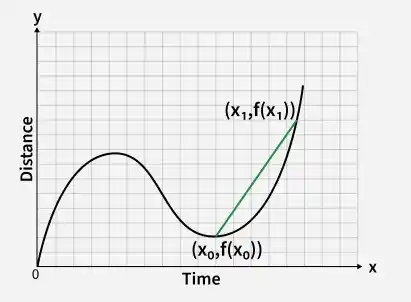
Step 2: Use the coordinates of the two points to calculate the slope.
Equation of slope:
Slope =\frac{y_{2} - y_{1}}{x_{2} - x_{1}}
The average change of the function over the given time interval[x0, x1]
Slope =\frac{f(x_{1}) - f(x_{0})}{x_{1} - x_{0}}
The slope of the secant line represents the average rate of change of the graph in that interval.
Once you've calculated the slope of the secant line, you use the slope can write an equation to represent it.
For Example:
Equation of slope:
y - y0 = m(x - x0)
m = slope of secant line = 4/7
x0 = 2
y0 = 9y - 9 = \frac{4}{7}(x -2)
Hence, the equation of the secant line between x = 2 and x = 9 is
y - 9 =\frac{4}{7}(x -2)
Instantaneous Rate of Change(Derivatives)
The instantaneous rate of change measures how fast a function is changing at a specific point.
The tangent line at a point is found by drawing a straight line that touches a curve at that point without crossing over the curve. The slope of the tangent line at a point represents the instantaneous rate of change, or derivative, at that point.
Instantaneous Rate of Change =
f'(x_0) =\lim_{\triangle x \to 0} \frac{f(x_{0}+\triangle x) - f(x_{0})}{\triangle x}
Example: For f(x) = x2, the derivative is:
f′(x) = 2x
At x = 2: f ′(2) = 4
So, the function is changing exactly at a rate of 4 at x = 2.
How to find the derivative at a point using a tangent line:
Step 1: Draw a tangent line at the point.
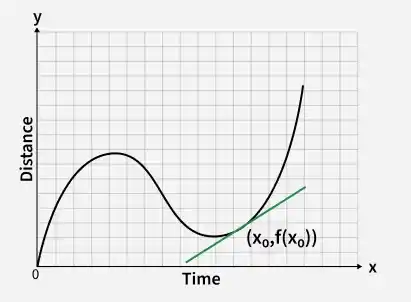
Step 2: Use the coordinates of any two points on that line to calculate the slope.
Equation of slope:
Slope =\frac{y_{2} - y_{1}}{x_{2} - x_{1}}
The average change of the function over the given time interval x0
Slope =f'(x_0) =\lim_{\triangle x \to 0} \frac{f(x_{0}+\triangle x) - f(x_{0})}{\triangle x}
The slope of the tangent line at a point represents
the instantaneous rate of change, or derivative, at that point.
Once you've calculated the slope of the tangent line, you can write an equation to represent it.
For Example: Equation of slope:
y - y0 = m(x - x0)
m = slope of tangent line =\frac{5}{6}
x0 = 16
y0 = 6y - 16 = \frac{5}{6}(x - 6)
Hence, the equation of the tangent line at x = 16 isy - 16 = \frac{5}{6}(x - 6)
Solved Examples
Question 1. Find the average rate of change over the interval x = 4, x = 6.
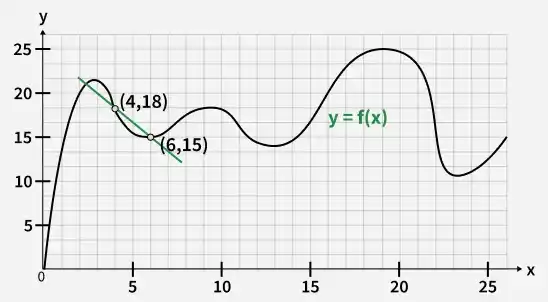
Point 1: (4, 18)
Point 2: (6, 15)
Slope =
\frac{y_{2} - y_{1}}{x_{2} - x_{1}} =
\frac{15 - 18}{6-4} =
-\frac{3}{2} Hence, the average rate of change =
- \frac{3}{2}
Question 2. Write the equation of the tangent line at x = 16.
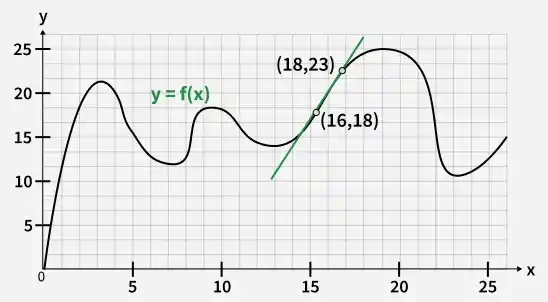
Point of intersection: (16, 18)
Slope =
\frac{23 - 18}{18 - 16} =
\frac{5}{2} Equation of tangent line:
y - 18 = \frac {5}{2}(x - 16)
Question 3. Find the average rate of change over the interval x = 4, x = 25. How does this compare to the derivative at x = 4?
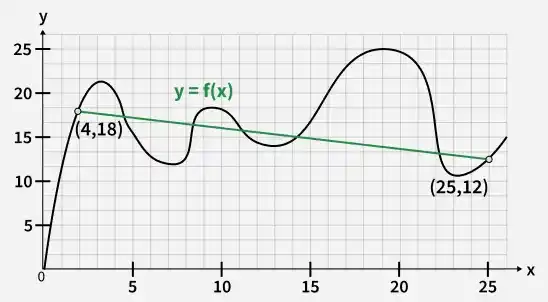
Slope of secant line =
\frac {12 - 18}{25-4} =
- \frac{6}{21} The average rate of change over x = 4, x = 25 is -6/21,
which is less than the derivative of y at x = 4, which we found to be 7/3.
Question 4. Find the instantaneous rate of change of the given function f(x) = 2x2 + 18 at x = 9 ?
Given: f(x) = 2x2 + 18
f'(x) = 4x + 0
f'(x) = 4x
Now we have to find the instantaneous rate of change at x = 9
f '(9) = 4x
f'(9) = 4(9)
f'(9) = 36
Question 5. Find the instantaneous rate of change of the given function f(x) = 4x2 + 12x + 8 at x = 4 ?
Given: f(x) = 4x2 + 12x + 8
f'(x) = 8x + 12
Now we have to find the instantaneous rate of change at x = 4
f'(4) = 8x + 12
f'(4) = 8(4) + 12
f'(4) = 44
Practice problems
1: Given the function f(x) = 3x2−2x+1, find the average rate of change from x = 1 to x = 4.
2: Find the instantaneous rate of change of the function f(x) = x2+3x at x = 2.
3: Compute the instantaneous rate of change of the function g(t) = et at t = 1.
4: Determine the instantaneous rate of change for the function h(x) = ln(x) at x = 1.
5: For the function g(t)=5t−7, calculate the average rate of change over the interval from t = 2 to t = 5.
6: Find the average rate of change for the function