
Angles are formed when two rays meet at a common endpoint, called the vertex. Angle measures the rotation or "turning" between the two rays. Angles are a key concept in mathematics, especially in geometry, and are typically measured in degrees (°) or radians (rad).
In this lesson, we'll learn about the different angles—like right angles, acute angles, and obtuse angles. We'll learn how to identify them and see where they appear.
Table of Content
What are Angles?
Angles are a measure of the rotation or the amount of turning between two intersecting lines, rays, or line segments around a common point, called the vertex. They are commonly measured in degrees (°) or radians.
Key Components of an Angle
- Vertex: The point where the two lines or rays meet is called the vertex of the angle.
- Sides: The two lines or rays that form the angle are known as the arms or sides of the angle.
- Angle Measurement: Angles are measured in degrees (°), with a full circle equaling 360°. For example, a right angle, which represents a quarter turn, is 90°.
Real-Life Examples of Angles
Angles are everywhere in daily life! For example:
- When you open a book, the pages form an angle with the spine.
- The corners of rooms create right angles (90 degrees).
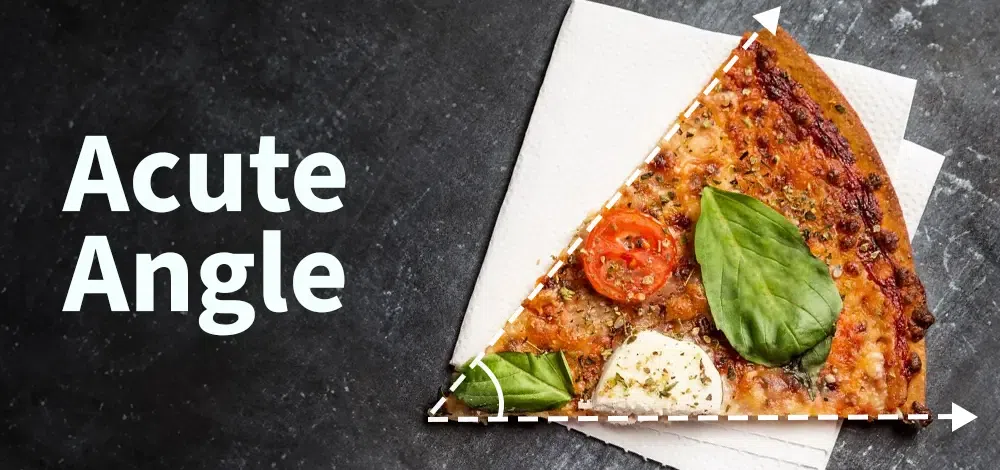
- When you slice a pizza, the slices form acute angles (less than 90 degrees).
- The hands of a clock make different angles as time passes—at 3 o'clock, the hands form a right angle.
- Even the incline of a ladder leaning against a wall is an example of an obtuse angle (greater than 90 degrees).
Types of Angles
There are various angles in maths:
Acute Angle
An acute angle is defined as an angle which is less than 90 degrees is called acute angle.
Obtuse Angle
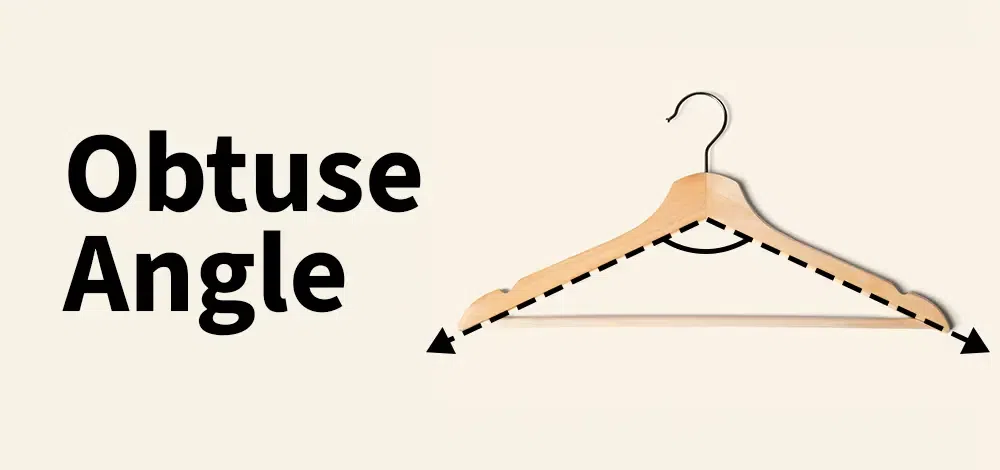
This angle is bigger and (wide). It’s more than 90 degrees but less than a straight line.
Right Angle
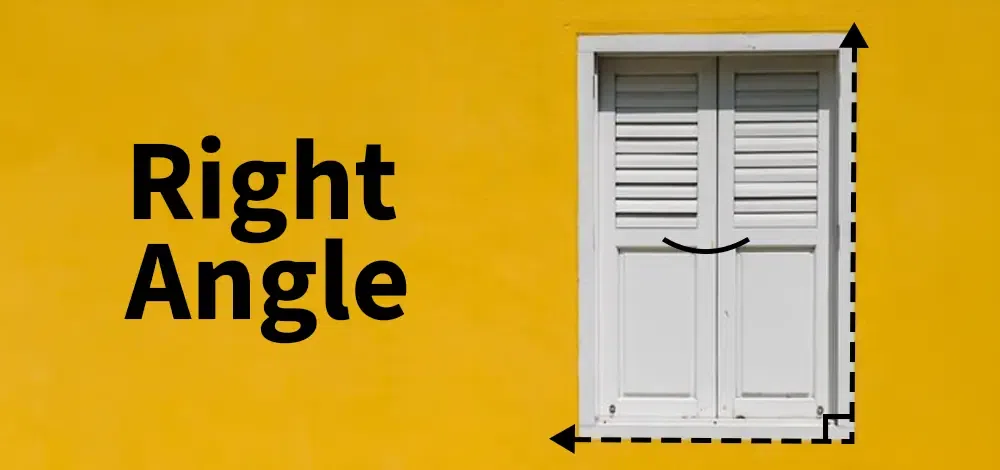
This angle looks like the corner of a square or a book. It's always exactly 90 degrees.
Straight Angles
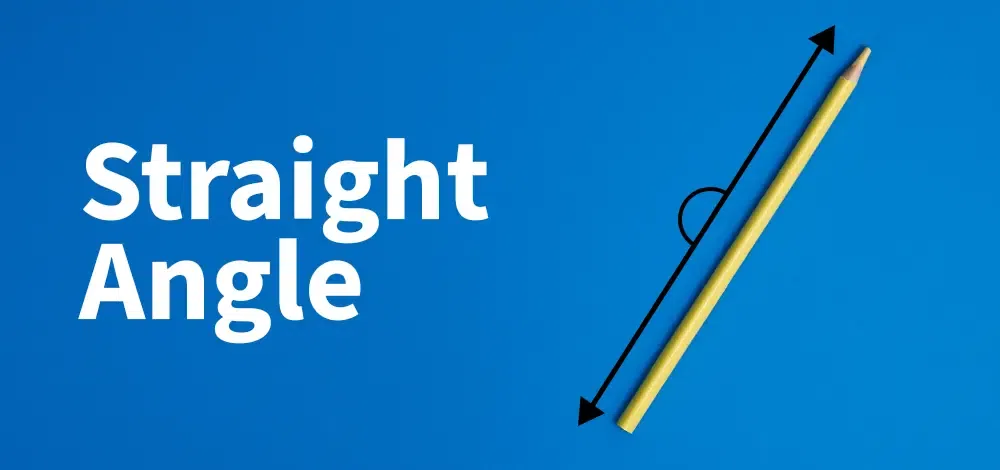
A straight angle is exactly 180°. It forms a straight line, like a flat horizon.
Reflex Angle
A reflex angle is an angle that measures more than 180° but less than 360°. It's the larger angle when you go around the outside of a shape or a figure.

Complete Angles
A complete angle is exactly 360°. It makes a full circle, like a clock hand that has gone all the way around.

How to Measure Angles Using a Protractor
To measure angles using a protractor, follow these simple steps:
Step 1: Identify the Angle's Vertex.
The point where the two lines of the angle meet is called the vertex. Place the protractor’s small hole or center mark on the vertex of the angle.
Step 2: Align One Ray of the Angle Rotate the protractor so that the zero line (the straight line at the bottom of the protractor) is aligned with one ray (side) of the angle. Make sure it's perfectly aligned to the baseline.
Step 3: Read the Measurement
- Find where the other ray intersects the numbered scale on the protractor. Most protractors have two sets of numbers (inner and outer). Use the set that starts from 0 on the side where your first ray was aligned.
- If the angle opens to the right, read the outer scale. If it opens to the left, read the inner scale.
Step 4: Check the Type of Angle
- Angles less than 90° are acute.
- Angles equal to 90° are right angles.
- Angles between 90° and 180° are obtuse.
- Angles equal to 180° are straight angles.
Angle Relationships
When teaching kids about angle relationships, it’s important to start with some basic definitions and build up from there. Here are key relationships and how to explain them in a kid-friendly way:
Complementary Angles
Two angles are complementary if their sum is 90°.
Example: If you have a 60° angle, the angle that complements it is 30°, because 60° + 30° = 90°.
Read More about Complementary Angles.
Supplementary Angles
Two angles are supplementary if their sum is 180°.
Example: If one angle is 120°, the angle that supplements it is 60°, because 120° + 60° = 180°.
Read More about Supplementary Angles.
Adjacent Angles
Two angles that share a common side and vertex but do not overlap, are called adjacent angles.
Example: If you draw a line and place two angles right next to each other, they are adjacent angles.
Read More about Adjacent Angles.
Vertical Opposite Angles
When two lines cross, the angles opposite each other are called vertical angles, and they are always equal.
Example: If two lines intersect and one of the angles is 50°, the angle directly across from it is also 50°.
Read More about Vertical Opposite Angles.
Fun Activities to Learn About Angles
Some fun activities to learn about angles are:
- Angle Hunt: Have kids search for objects around the classroom or home that form different angles (e.g., door corners for right angles, scissors for acute angles).
- Angle Art: Give kids protractors, rulers, and colored pencils to create artwork using different angles. They can label each angle type they use.
- Clock Angles:Use an analog clock to show how the hands form different angles (e.g., at 3:00 it’s a right angle, and at 2:00 it’s angle).
- Angle Dance:Play music and ask kids to freeze in different angle shapes when the music stops. Use flashcards to show which angle to make.
- Paper Plate Angles:Cut out a paper plate into different sections (e.g., halves, quarters) and use them to explain and visualize angles like 90°, 180°, and 360°.
- Protractor Games:Teach kids how to measure angles with a protractor, and turn it into a game where they guess the angle before measuring it.
Solved Examples
Example 1: If you know two angles in a triangle are 40° and 60°, what is the type of the third angle?
Solution:
First, find the missing angle: ( 180° - (40° + 60°) = 80° ).
80° is less than 90°,
So it is an acute angle.
Example 2 : What is the supplement of a 70° angle?
Solution:
Supplementary angles add up to 180°.
( 180° - 70° = 110° ).
The supplement of a 70° angle is a 110° obtuse angle.
Example 4: An angle measures 360 degrees. What type of angle is it?
Solution:
An angle that measures exactly 360 degrees is a complete angle.Answer: The angle is a complete angle.
Example 5 : If angle (
Solution:
A 360° angle is a full rotation or complete angle.