
Derivatives are a core concept in calculus used to measure the rate of change of a function. They are defined using limits and represent the instantaneous change in a quantity.
Derivatives
For a function f(x), the derivative at x = a gives the instantaneous rate of change at that point.
It is denoted by
At x = a,
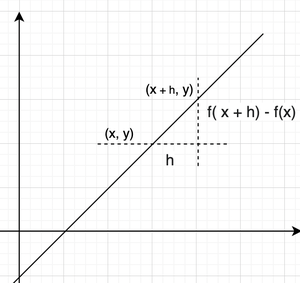
Notice in the figure as the interval "h" approaches zero. The line approaches to being a tangent from a chord. This means that now the derivative when h approaches zero gives us the slope of the tangent at that particular point.
Derivatives of some Basic Functions
The table below shows the derivatives of some standard basic functions.
| Function | Derivative |
|---|---|
| c | f'(x) = 0 |
| Ax + b | f'(x) = A |
| x2 | f'(x) = 2x |
| √x | f'(x) = |
| ex | ex |
| ax | ln(a).ax |
| logex | |
| logax | |
| sin(x) | cos(x) |
| cos(x) | -sin(x) |
| tan(x) | sec2(x) |
Rules of Differentiation
The table above lists derivatives of standard functions. In practice, functions are often combinations of two or more functions connected by addition, subtraction, multiplication, or division. We use following derivative rules for finding their derivatives:
- Summation or Difference Rule
- Product and Division Rule
Consider two functions f(x) and g(x). Let's say there is a third function h(x) which combines these two functions.
Summation and Difference Rule
Case 1: h(x) = f(x) + g(x)
This function is summation of both f(x) and g(x), the derivative of such functions is given by,
\frac{dh}{dx} = \frac{d}{dx}(f(x) + g(x)) ⇒
\frac{dh}{dx} = \frac{d}{dx}(f(x)) + \frac{d}{dx}(g(x)) or
h'(x) = f'(x) + g'(x)
Case 2: h(x) = f(x) - g(x)
This function is the difference of both f(x) and g(x), the derivative of such functions is given by,
\frac{dh}{dx} = \frac{d}{dx}(f(x) - g(x)) ⇒
\frac{dh}{dx} = \frac{d}{dx}(f(x)) - \frac{d}{dx}(g(x)) or
h'(x) = f'(x) - g'(x)
Product and Division Rules
Case (i): h(x) = f(x) x g(x)
This function is product of both f(x) and g(x), the derivative of such functions is given by,
\frac{dh}{dx} = \frac{d}{dx}(f(x) \times g(x)) ⇒
\frac{dh}{dx} = \frac{d}{dx}(f(x))g(x) + \frac{d}{dx}(g(x))f(x) or
h'(x) = f'(x)g(x) + g'(x) f(x)
Case (ii): h(x) =
This function is division of both f(x) and g(x), the derivative of such functions is given by,
\frac{dh}{dx} = \frac{d}{dx}(\frac{f(x)}{g(x)}) ⇒
\frac{dh}{dx} = \frac{\frac{d}{dx}(f(x))g(x) - \frac{d}{dx}(g(x))f(x)}{(g(x))^2} or
h'(x) =
\frac{f'(x)g(x) - g'(x) f(x)}{(g(x))^2}
The division and product rules are also called the Leibniz rules.
Solved Examples
Problem 1: Find the derivative for f(x) = x2 + 3x.
Solution:
This function is the sum of two different function. Sum rule will be used here.
f(x) = x2 + 3x
Here, h(x) = x2 and g(x) = 3x.
f(x) = h(x) + g(x)
⇒f'(x) = h'(x) + g'(x)
⇒ f'(x) =
\frac{d}{dx}h(x) + \frac{d}{dx}g(x) ⇒f'(x) =
\frac{d}{dx}x^2 + \frac{d}{dx}3x ⇒f'(x) = 2x + 3
Problem 2: Find the derivative for the function f(x) = ex + sin(x).
Solution:
This function is the sum of two different function. Sum rule will be used here.
f(x) = ex + sin(x)
Here, h(x) =ex and g(x) = sin(x)
f(x) = h(x) + g(x)
⇒f'(x) = h'(x) + g'(x)
⇒ f'(x) =
\frac{d}{dx}h(x) + \frac{d}{dx}g(x) ⇒f'(x) =
\frac{d}{dx}e^x + \frac{d}{dx}sin(x) ⇒f'(x) = ex + cos(x)
Problem 3: Find the derivative for f(x) = 5x4 - 3x2.
Solution:
This function is the difference of two different function. Difference rule will be used here.
f(x) = 5x4 - 3x2
Here, h(x) =5x4 and g(x) = 3x2
f(x) = h(x) - g(x)
⇒f'(x) = h'(x) - g'(x)
⇒ f'(x) =
\frac{d}{dx}h(x) - \frac{d}{dx}g(x) ⇒f'(x) =
\frac{d}{dx}5x^4 - \frac{d}{dx}3x^2 ⇒f'(x) = 20x3 - 6x
Problem 4: Find the derivative for the function f(x) = 5log(x) - 3x.
Solution:
This function is the difference of two different function. Difference rule will be used here.
f(x) = 5log(x) - 3x
Here, h(x) =5log(x) and g(x) = 3x
f(x) = h(x) - g(x)
⇒f'(x) = h'(x) - g'(x)
⇒ f'(x) =
\frac{d}{dx}h(x) - \frac{d}{dx}g(x) ⇒f'(x) =
\frac{d}{dx}5log(x) - \frac{d}{dx}3x ⇒f'(x) =
\frac{5}{x} - 3
Problem 5: Find the derivative for f(x) = 5x4.sin(x)
Solution:
This function is the product of two different function. Product rule will be used here.
f(x) = 5x4.sin(x)
Here, h(x) =5x4 and g(x) = sin(x)
f(x) = h(x).g(x)
⇒f'(x) = h'(x) g(x) + h(x)g'(x)
⇒ f'(x) =
\frac{d}{dx}(f(x))g(x) + \frac{d}{dx}(g(x))f(x) ⇒f'(x) =
\frac{d}{dx}(5x^4)sin(x) + \frac{d}{dx}(sin(x))5x^4 ⇒f'(x) = 20x3sin(x) + 5x4cos(x)
Problem 6: Find the derivative of f(x) = 5ex.log(x)
Solution:
This function is the product of two different function. Product rule will be used here.
f(x) = 5ex.log(x)
Here, h(x) =5ex and g(x) = log(x)
f(x) = h(x).g(x)
⇒f'(x) = h'(x) g(x) + h(x)g'(x)
⇒ f'(x) =
\frac{d}{dx}(f(x))g(x) + \frac{d}{dx}(g(x))f(x) ⇒f'(x) =
\frac{d}{dx}(5e^x)log(x) + \frac{d}{dx}(log(x))5e^x ⇒f'(x) =
5(e^xlog(x) + \frac{1}{x}e^x)
Problem 7: Find the derivative of f(x) =
Solution:
This function is the division of two different function. Division rule will be used here.
f(x)=\frac{x + 1}{2x} Here, h(x) =x + 1 and g(x) = 2x
so,
⇒
f'(x)=\frac{g(x)h'(x) - h(x)g'(x)}{(g(x))^2} ⇒ f
h'(x)=\frac{d}{dx}(x+1)=1\\g'(x) = \frac{d}{dx}(2x)=2 ⇒ f
f'(x)=\frac {(2x)(1)-(x+1)(2)}{(2x)^2} Numerator:
⇒ f'(x) =
2x-2(x+1)=2x-2x-2=-2 Denominator:
⇒
(2x)^2 = 4x^2 ⇒ f'(x) =
f'(x)=\frac{-2}{4x^2} = -\frac{1}{2x^2} ⇒
f'(x)=-\frac{1}{2x^2}
Problem 8: Find the derivative for the function f(x) =
Solution:
This function is the division of two different function. Division rule will be used here.
f(x) =
\frac{log(x)}{2x} Here, h(x) =log(x) and g(x) = 2x
f(x) =
\frac{h(x)}{g(x)} ⇒f'(x) =
\frac{g(x)h'(x) - h(x)g'(x)}{(g(x))^2} ⇒ f'(x) =
\frac{\frac{d}{dx}(h(x))g(x) - \frac{d}{dx}(g(x))h(x)}{(g(x))^2} ⇒f'(x) =
\frac{\frac{d}{dx}(log(x))2x - \frac{d}{dx}(2x)(log(x))}{4x^2} ⇒f'(x) =
\frac{1- 2log(x)}{4x^2}
Practice Questions
1. If f(x) = 3x² - 2x + 5 and g(x) = x³ + 4x, find the derivative of h(x) = f(x) + g(x).
2. Given f(x) = x² and g(x) = sin(x), find the derivative of their product: (f·g)(x).
3. If f(x) = e^x and g(x) = ln(x), determine the derivative of their composition: f(g(x)).
4. Find the derivative of h(x) = (x² + 1) / (x - 2) using the quotient rule.
5. If f(x) = x³ and g(x) = cos(x), find the derivative of their difference: f(x) - g(x).