
The absolute value of a number is its distance from zero on the number line, regardless of direction, meaning it is always a non-negative value.
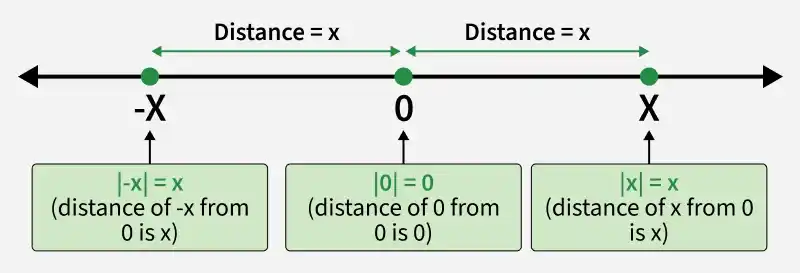
The general form of an absolute value function is:
f(x)=|x|=\begin{cases} x,& x \ge 0 \\ -x, & x<0 \end{cases}
- f(x) is the output of the function,
- x is the input,∣x∣ denotes the absolute value of x, which is defined as: If x ≥ 0, then ∣x∣ =x, If x < 0, then ∣x∣ = −x.
Examples: |3| = 3, |-1| = 1, |0| = 0
Properties of Absolute Value Function
Some of the common properties related to the Absolute Value Function are:
- Idempotent: A function f(x) is idempotent if and only if f(f(x)) = f(x). The modulus function f(x) = |x| is idempotent because applying the modulus function twice does not change the result:
| | x | |= | x | ; x ∈ ℝ
- Non-negativity: The absolute value of any real number is always non-negative.
| x | ≥ 0; for all x ∈ ℝ
- Multiplicity: The absolute value of the product of two numbers is equal to the product of the individual moduli of both numbers.
| ab | = | a | | b | for all a, b ∈ ℝ
- Positive Definiteness: The absolute value of x is zero if and only if x is zero.
| x | = 0 ⇔ x = 0
- Symmetry: The absolute value function |x| is symmetric with respect to origin. Mathematically, this is repesented by:
| -x | = | x |
- Triangular Inequality: The modulus of the sum of two numbers is less than or equal to the sum of the moduli of the individual numbers. If a, b
\in\R , then:
∣ a + b ∣ ≤ ∣ a ∣ + ∣ b |
The triangle inequality has several variations. Here are three common forms:
- If a,b
\in\R , then|\,|a|-|b|\,|\le|a-b| . - If a,b
\in\R , then|a-b|\le|a+b| . - If
a_1,a_2,a_3,... ,a_n are any real numbers, then|a_1+a_2+a_3+...+a_n|\le|a_1|+|a_2|+|a_3|+...+|a_n| .
Absolute Value Equations
An absolute value equation is an equation in which a variable appears inside an absolute value expression. Since absolute value represents distance, solving such equations involves considering both the positive and negative possibilities.
An absolute value equation can be written as: |A| = B
- If B < 0, the equation has no solution, because absolute value is always non-negative.
- If B ≥ 0 , then: ∣A∣=B equals, A = B or A = −B
Example: Solve the equation: ∣x−4∣=6
x−4 = 6 or x−4 = −6
x = 10 or x = −2
Graph of Absolute Value Function
The graph of the absolute value function is V-shaped. For example, the graph of ∣x∣ has its vertex at the origin.
To plot the graph, we simplify the modulus expression based on the sign of the expression inside it. This involves finding intervals where the expression inside the modulus is positive or negative.
For example, consider y=∣x∣:
y=|x|=\begin{cases} x,& x \ge 0 \\ -x, & x<0 \end{cases}
1. For
2. For x < 0, the resultant equation is y = -x, which is a straight line passing through origin with slope -1.
Plotting both equations together gives the graph of y=∣x∣.
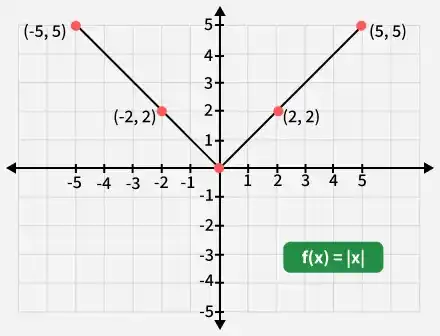
The graph is symmetric about the y-axis, meaning |x| is an even function. The vertex (0,0) is the point where the graph changes direction.
Solved Examples
Example 1: Find the value of x for |x-2| = 3.
First, Identify the value of x for which the expression inside the modulus function becomes zero.
In this example, the function inside the modulus, f(x) = x-2, becomes zero at x=2.
By definition of absolute value function, when x>2 the modulus will open with positive sign and when x<2 it will open with negative sign.
For x > 2
|x - 2| = 3
x - 2 = 3
x = 5And for x < 2:
|x - 2| = 3
-(x - 2) = 3
x - 2 = -3
x = -3+2
x = -1Therefore, the value of x are 5 or -1.
Example 2: Find the value of x for |x-5| = 0.
In this question when x is greater than 5 it will open will positive sign and it will open with negative sign when x is less than 5.
For
x\ge0 andx<0 ,|x-5| = 0
±(x-5) = 0
x-5 = 0
x = 5
Example 3: Solve the inequality for x: |x-4| > 3.
Inequality |x-4| > 3 means that the distance between x and 4 is greater than 3.
This can be split into two separate inequalities:
- When x>4, the inequality becomes x-4>3.
- When x<4, the inequality becomes -(x-4)>3, which is equivalently x-4 < -3.
Now, let's solve these inequalities separately.
Solving the inequality when x>4:
\Rightarrow x-4>3Adding 4 to both sides, we get:
\Rightarrow x>7Solving the inequality when x<4:
\Rightarrow x-4<-3Adding 4 to both sides, we get:
\Rightarrow x<1The solution to |x-4|>3 is the union of the solutions to the two cases:
\Rightarrow x>7 \,\cup\,x<1\\\Rightarrow x\in(-\infty,1)\cup(7,\infty)
Example 4: Solve the inequality for x:
\Rightarrow\frac{|x-4|}{|x+4|}>0 The above inequality can be rearranged to:
\Rightarrow\frac{|x-4|}{|x+4|}\cdot|x+4|>0\cdot |x+4| Since |x+4| is a positive quantity, it does not affect the inequality. Therefore, for
x\in\R-\{-4\} :\Rightarrow |x-4|>0Using the property,
|a|\ge b\iff a\in (-\infty,-b]\cup[b,\infty) we get:
x-4 > 0 or x-4 < 0Adding 4 on both sides:
x > 4 or x < 4
Therefore, the final solution will be:
\Rightarrow x\in(-\infty,4)\cup(4,\infty)-\{-4\} orx\in\R\,-\,\{-4,4\} .
Example 5: Solve the inequality for x: |x-4|(x-5) > 0.
Critical points are x = 4, and x = 5, where the product is zero. The expression |x-4| is always non-negative, and the factor x-5 is greater than zero when x>5.
Therefore, the expression |x-4|(x-5) is greater than zero if and only if x > 5.
Solution will be: x > 5
Practice Questions
Question 1: Find the value of x in the following equations.
- |x-1| = 1
- |3x+5| = 0
- |x|(x+2) = 5
\frac{x}{|x-1|} = 3- |2x-4| = |x+2|
Question 2: Solve the following inequalities.
- |x-3| < 1
- |3x+1|
\le 4 - |2x-3|
\ge 3 \frac{|x|}{|x+1|} < 2|1+\frac{4}{x}| > 5
Answer Key
Answer key for Q1
- x = 2 or 0
- x =
\frac{-5}{3} - x =
-1-\sqrt{6} or-1+\sqrt{6} - x =
\frac{2}{3} or\frac{3}{4} - x = 6 or
\frac{2}{3} Answer key for Q2
- 2 < x < 4
-\frac{5}{3} \le x \le 1 x\in(-\infty,0] \cup[3,\infty) -2<x<-1 or-\frac{2}{3}<x<2 x<-\frac{2}{3} or0<x<1