
Every cell in our bodies is trained to perform a specific function. A tissue is composed of cells of similar types, classified based on their structure and function. The human body is composed of four distinct types of tissue: epithelial, connective, nervous, and muscular. Large sheets of cell-based tissue known as epithelial tissue typically cover all exposed body surfaces and line internal body cavities.
All three major embryonic layers that produce epithelial tissue are ectoderm, endoderm, and mesoderm.
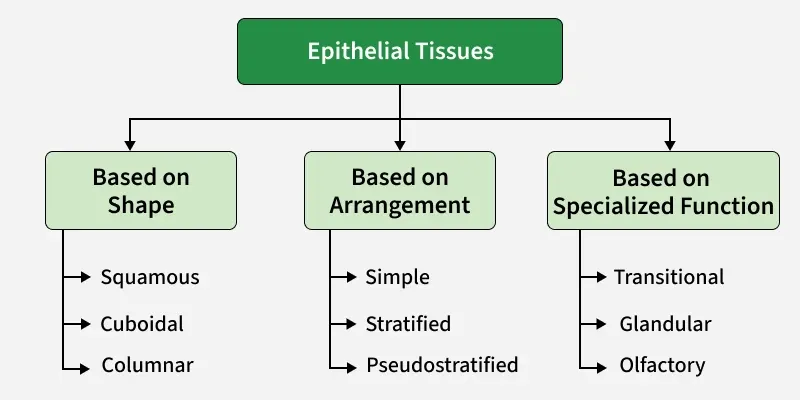
Classification Based on Shape
Based on shape, the epithelial tissues are classified into three types, which are given below:
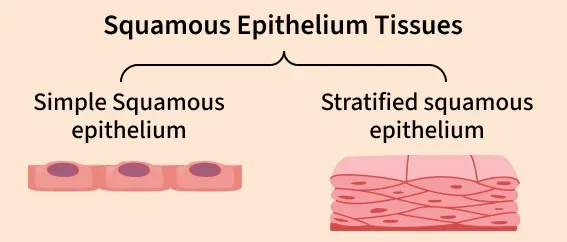
1. Squamous Epithelium
Squamous epithelium is made up of thin, flat, scale-like cells arranged closely together. It is well adapted for diffusion, filtration, and protection. They are mostly found in the mouth, oesophagus, alveoli of the lungs, and blood vessels.
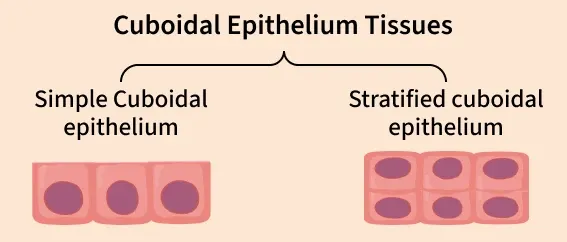
2. Cuboidal Epithelium
Cuboidal epithelium is composed of cube-shaped cells with a centrally placed, round nucleus. It is mainly involved in secretion, absorption, and protection. This type of tissue has a similar width and height, resulting in a primarily cube-shaped appearance.
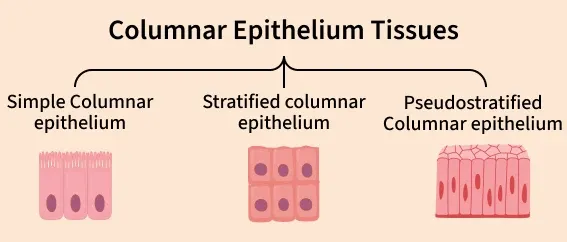
3. Columnar Epithelium
Columnar epithelium is made up of tall, pillar-like cells with elongated nuclei usually located near the base. It is mainly concerned with absorption, secretion, and protection. This type of tissue has a column-like shape and is taller than it is wide. There are two types of columnar epithelium: ciliated columnar epithelium and glandular columnar epithelium.
Classification Based on Arrangement
Epithelial tissue is classified as simple or stratified, or compound epithelium, based on the number of layers present.
1. Simple Epithelium
Simple epithelium is composed of a single layer of identical cells, typically found on secretory and absorptive surfaces, where the single layer enhances these processes. Simple epithelium is divided into three major types, which are named after the shape of the cells, which differ in function.
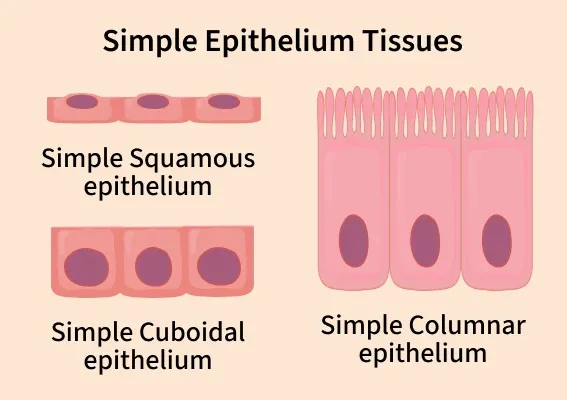
The simple epithelium is classified into three types: simple squamous, simple cuboidal, and simple columnar.
Types of Simple Epithelial | Description | Examples |
|---|---|---|
Simple Squamous Epithelium | Their cells resemble scales and have a flattened or round shape. | Capillary walls, pericardial, pleural, and lung alveolar linings |
Simple Cuboidal Epithelium | These cells can perform secretory, absorptive, or excretory functions. | The collecting ducts of the kidney, pancreas and salivary gland |
Simple Columnar Epithelium | These cells can be secretory, absorbent, or excretory in nature. Some of these tissues contain goblet cells. | The stomach, colon, and rectum secrete mucus. |
2. Stratified Epithelium
A stratified epithelium is made up of several layers of different-shaped cells. Daughter cells resulting from cell divisions push older cells upward toward the apical layer as basal cells divide. Tough proteins predominate as cytoplasm decreases, and cells transform into tough, hard structures that eventually die.
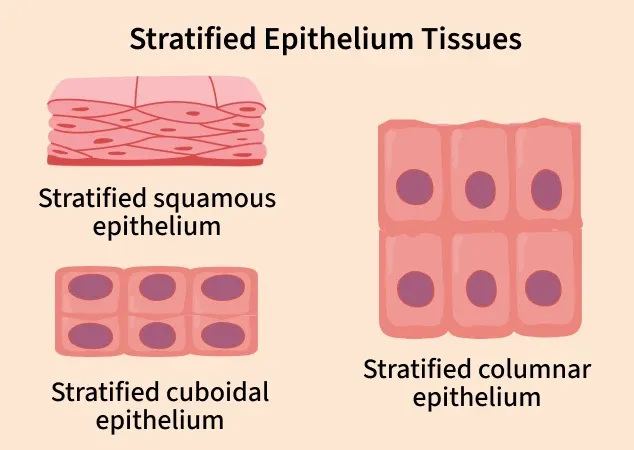
The stratified epithelium is classified into three types: stratified squamous, stratified cuboidal, and stratified columnar.
Types of Stratified Epithelial | Description | Examples |
|---|---|---|
Stratified Squamous Epithelium | They primarily protect against abrasion and water loss. | Oral cavity, oesophagus, larynx, and other areas. |
Stratified Columnar Epithelium | Their primary functions are secretion and defence. | Conjunctival covering of the eye. |
Stratified Cuboidal Epithelium | In nature, its primary function is to protect. | They primarily line sweat gland excretory ducts and large excretory gland ducts. |
3. Pseudostratified
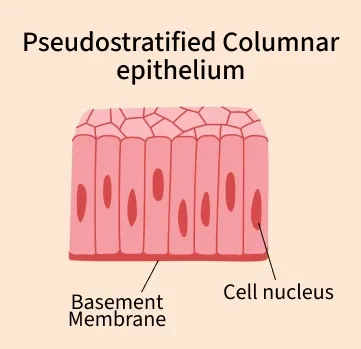
Pseudostratified epithelium is a type of epithelial tissue that appears to be multilayered (stratified) but is actually composed of a single layer of cells. The cells differ in height, and their nuclei are located at different levels, giving a false appearance of stratification. Cilia are found on the apical surface of these cells. Cilia are motile, meaning they beat in unison to move fluid in a straight line. Cilia in the trachea propel mucus and particles into the pharynx and out of the airways. Cilia are significantly longer than microvilli.
Classification Based on Specialised Functions
Epithelial cells can also be classified based on their special functions, which include:
1. Transitional Epithelium (also known as urothelium)
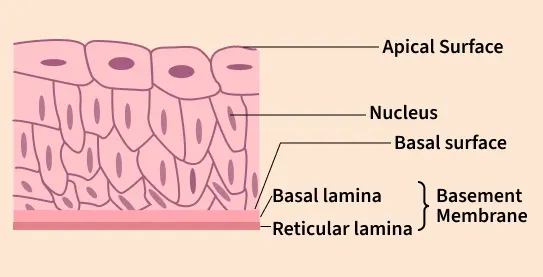
It is made up of several layers of cells that flatten out when stretched. It lines the majority of the urinary tract and allows the bladder to expand. Transitional epithelium is a multilayered epithelium whose cells change shape when the tissue is stretched and return to their original shape when relaxed.
2. Glandular Epithelium
It is specialized in the production and secretion (release) of substances. It is found in your glands, which are specialized organs capable of producing, storing, and/or releasing substances such as hormones, proteins, and water. Glandular epithelium consists of epithelial cells modified to produce and secrete chemical substances required for various body functions.
3. Olfactory Epithelium
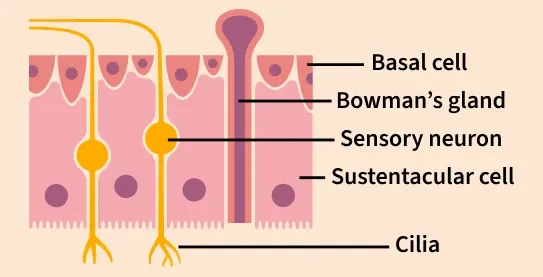
It is a specialized type of epithelial tissue responsible for the sense of smell. It is located in the upper part of the nasal cavity and contains sensory cells that detect odour molecules present in the air. Olfactory epithelium is a specialized sensory epithelium responsible for the sense of smell (olfaction). It detects odour molecules from the air and converts them into nerve impulses.
Characteristics of Epithelial Tissue
Characteristics of epithelial tissues are given below:
- The tissue is avascular, which means it lacks blood vessels. Diffusion transports nutrients and waste between neighbouring connective tissues.
- The epithelium's upper surface is free or exposed to the outside of the body or an internal body cavity. The basal surface is supported by connective tissue. Between the epithelial and connective tissue layers, a thin extracellular layer known as the basement membrane forms.
- The endothelium is the epithelial tissue that lines vessels in the lymphatic and cardiovascular systems, whereas the mesothelium is the epithelial tissue that forms the serous membranes lining true cavities.
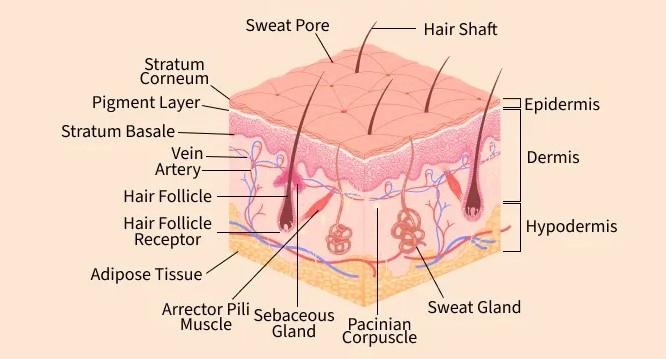
- The ectoderm gives rise to the epithelial tissue that makes up the cutaneous membranes.
- The endoderm is where the majority of the mucous membrane epithelial tissue originates.
- Mesoderm is the source of epithelial tissue, which lines vessels and open spaces in the body.
- There are three types of junctions present: tight junctions (prevent tissue leakage), adhering junctions (keep adjacent tissues well cemented together), and gap junctions (allow ions and molecules to move across tissue more easily).
Functions of Epithelial Tissue
- Substance exchange: Epithelial tissue regulates the exchange of substances between the body and the external environment, as well as the exchange of substances within the body.
- Protection: It is the first line of defense against mechanical injury, chemical exposure, excessive fluid loss, and infections because it covers the entire body surface.
- The Secretion Procedure: The majority of epithelial cells can produce secretive macromolecules. The glandular epithelium is one of the best examples. Because the endocrine gland is secretive in nature, it secretes hormones directly into the bloodstream, some of which are insulin, thyroxin, and others. Exocrine glands, which are also secretory in nature, release their secretions(enzymes, sweat, sebum, saliva, etc.) into ducts, such as skin sebum and digestive enzymes in the small intestine.
- Process of Absorption: Surface epithelial cells primarily perform absorption with the assistance of microvilli, which increase surface area for absorption. The columnar epithelium of the small intestine is another example. Their primary function in the digestive tract is nutrient absorption.
- Sensation: Sensory receptors are found in the epithelial tissue of the nose, eyes, and ears, as well as taste buds, and aid in the transmission of signals from external stimuli to the brain.