
Proteins are complex organic biomolecules made up of long chains of amino acids linked together by peptide bonds. They are among the most important macromolecules present in living organisms, performing a wide variety of structural and functional roles in the body. Proteins are essential for growth, repair, metabolism, transport, defence, movement, and the regulation of body processes.
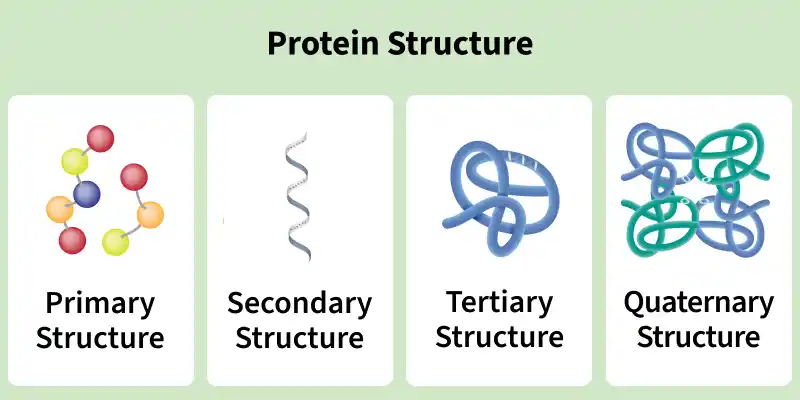
Structure of Proteins
The structure of proteins is mainly classified into four levels:
1. Primary Structure
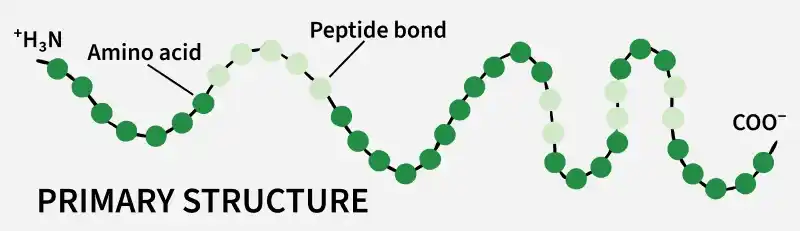
- The primary structure of a protein refers to the specific sequence and arrangement of amino acids in a polypeptide chain. This sequence is extremely important because it determines the final shape and biological function of the protein.
- Proteins are composed of one or more polypeptide chains, and each chain contains amino acids arranged in a unique order. Even a slight change in the sequence of amino acids may alter the structure and function of the protein.
- The amino acids are linked together by strong covalent peptide bonds, which maintain the primary structure of proteins. The sequence of amino acids is controlled by the genetic information stored in DNA. Mutations in DNA may alter the amino acid sequence, leading to changes in protein structure and function and causing genetic disorders such as sickle cell anaemia, cystic fibrosis, and albinism.
- Most amino acids contain a central chiral carbon atom attached to four different groups: an amino group (–NH₂), a carboxyl group (–COOH), a hydrogen atom, and a variable side chain called the R group
- The R group differs among amino acids and gives each amino acid its unique chemical properties.
2. Secondary Structure
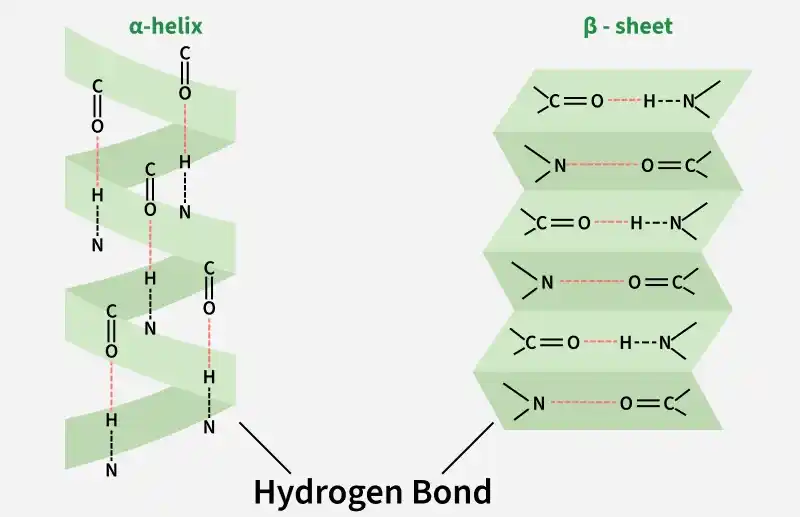
The secondary structure of proteins refers to the local folding or coiling of the polypeptide chain due to hydrogen bonding between the carbonyl (–CO) group and the amino (–NH) group present in the peptide backbone. Proteins do not remain as straight chains in their natural state. Instead, the polypeptide chain folds into regular patterns that are stabilised by hydrogen bonds. The two major types of secondary structures are:
Alpha-Helix (α-Helix)
- The alpha-helix is one of the most common secondary structures found in proteins. In this arrangement, the polypeptide chain coils into a right-handed helical structure.
- Hydrogen bonds are formed between the amino group of one amino acid and the carbonyl group of another amino acid located nearby in the chain. These hydrogen bonds stabilise the helical arrangement.
Examples: hair, nails, and wool.
Beta-Pleated Sheet (β-Pleated Sheet)
- In the beta-pleated sheet structure, the polypeptide chains are stretched out and arranged side by side. These chains are held together by hydrogen bonds formed between adjacent polypeptide chains.
- The structure appears folded like a pleated sheet, which gives it the name beta-pleated sheet.
Example: Silk fibroin
3. Tertiary Structure
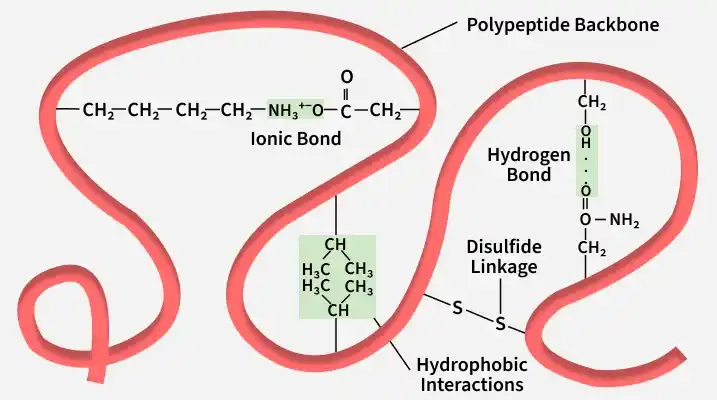
- The tertiary structure of a protein refers to the overall three-dimensional folding of a single polypeptide chain. It is formed when the secondary structure undergoes further folding and twisting.
- This structure develops because of interactions between the side chains (R groups) of amino acids. These interactions fold the polypeptide chain into a compact, stable, and functional structure.
- The tertiary structure is stabilised by several types of interactions, including Hydrogen bonds, Disulphide bonds, Ionic bonds, Van der Waals forces, and Hydrophobic interactions
- The tertiary structure determines the biological activity of most proteins. Enzymes, antibodies, and many globular proteins possess a well-developed tertiary structure.
4. Quaternary Structure
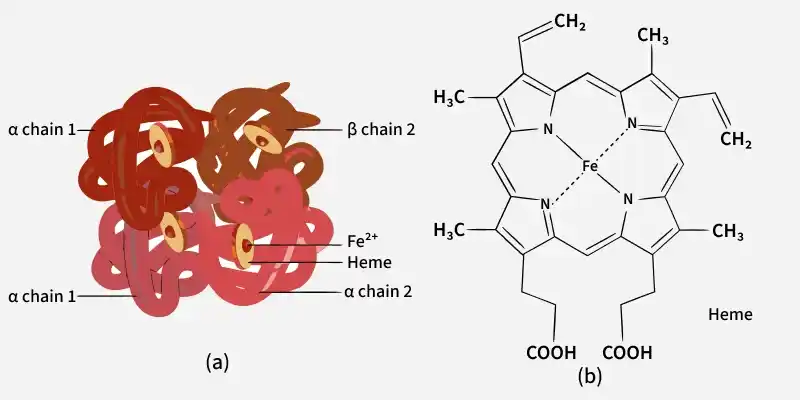
- The quaternary structure of proteins refers to the arrangement and interaction of two or more polypeptide chains called subunits that combine to form a functional protein.
- Each subunit first folds into its own tertiary structure, after which the subunits associate together to form the complete protein.
- The subunits are held together by hydrogen bonds, ionic interactions, hydrophobic interactions, and sometimes disulfide bonds.
- Haemoglobin is a common example of a protein with quaternary structure because it consists of four polypeptide subunits working together.
- Some proteins also contain structural and functional units known as domains. Each domain has a specific three-dimensional structure and performs a particular biological function.
Types of Proteins
Based on their molecular shape, proteins are mainly classified into two types:
Fibrous Proteins
Fibrous proteins are formed when long polypeptide chains run parallel to each other and are held together by hydrogen bonds and disulphide bonds. These proteins have a long, fibre-like structure and are generally insoluble in water. They mainly perform structural and protective functions in the body. Examples include keratin, found in hair, nails, and skin; collagen, found in connective tissues; and myosin, found in muscles.
- Long and thread-like structure
- Insoluble in water
- Strong and durable
- Mainly structural in function
Globular Proteins
Globular proteins are formed when polypeptide chains fold into compact, spherical shapes. These proteins are usually soluble in water and perform dynamic functions such as catalysis, transport, regulation, and defence. Examples are insulin, albumin, haemoglobin, and enzymes
- Compact and spherical structure
- Soluble in water
- Functionally active
- Involved in metabolic activities
Functions of Proteins
Proteins perform numerous important functions in living organisms.
- Many proteins act as enzymes and function as biological catalysts that accelerate metabolic reactions such as digestion, respiration, and synthesis of biomolecules.
- Certain hormones are proteinaceous in nature and help regulate physiological activities in the body. Examples include insulin and growth hormone.
- Structural proteins provide support, strength, and protection to cells and tissues. They are important components of muscles, bones, skin, hair, cartilage, and connective tissues.
- Proteins such as antibodies help protect the body against harmful microorganisms, including bacteria and viruses.
- Storage proteins store important nutrients and minerals required for growth and development. Examples include casein in milk and albumen in egg white.
- Transport proteins carry substances from one part of the body to another. For example, haemoglobin transports oxygen in the blood.
- Receptor proteins help cells detect and respond to chemical signals, hormones, and external stimuli.
- Contractile proteins such as actin and myosin are responsible for muscle contraction, movement, and the regulation of heartbeat.