
Animal tissue is a group of cells along with intercellular substances that perform one or more functions in the body. The structure of animal tissues depends on their function and location in the body.
- Tissues work together in a coordinated manner to maintain the structural integrity and physiological functions of the body.
- They help in movement, provide structural support and protection, and facilitate communication and coordination within the body.

Animal tissues are divided into 4 types known as epithelial, connective, nervous and muscle tissue.
1. Epithelium Tissues
They originate from the ectoderm, mesoderm and endoderm of the embryo. They are found on the external body surface and internal organs of the body. Different types of Epithelial cells are shown in the figure below:
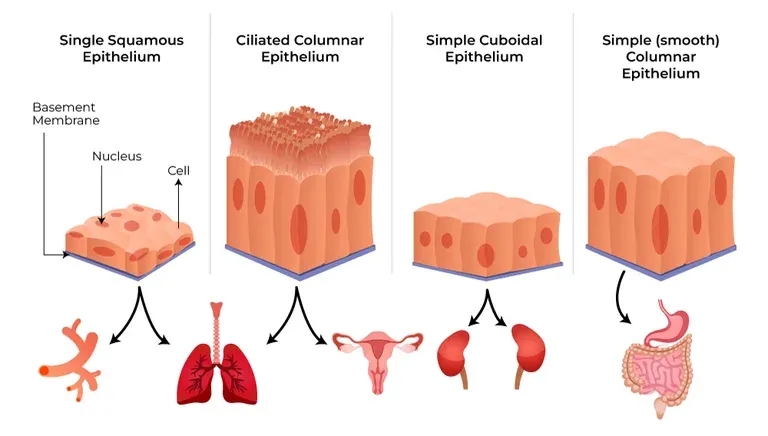
- Structure: Epithelial tissue is composed of closely packed cells that form continuous sheets and covers the body's external and internal surfaces. These cells are tightly joined together by specialised structures like tight junctions and desmosomes.
- Types: Various types of epithelial tissue are divided based on the shape of the cell. They are as follows:
Types of Epithelial Tissues | Description |
|---|---|
Simple Squamous epithelial tissue | A single layer of flat, scale-like cells is found in the lining of blood vessels and air sacs of the lungs. |
Stratified Squamous epithelial tissue | Multiple layers of flat cells form the outer layer of the skin and the lining of the oral cavity. |
Simple Cuboidal epithelial tissue | Single layer of cube-shaped cells, lining small ducts in glands and kidney tubules. |
Simple Columnar epithelial tissue | Single layer of tall, column-shaped cells, lining the digestive tract. |
Pseudostratified Columnar epithelial tissue | Appears stratified but is a single layer of cells with cilia, lining parts of the respiratory tract. |
Transitional epithelial tissue | Found in the urinary bladder, able to stretch |
2. Connective Tissues
Connective tissues originate from the mesodermal cells of the embryo. It provides attachment and support to the different tissues of the body. A diagram of Connective tissue showing mast cells, macrophages, fibroblasts and collagen fibres is shown below:
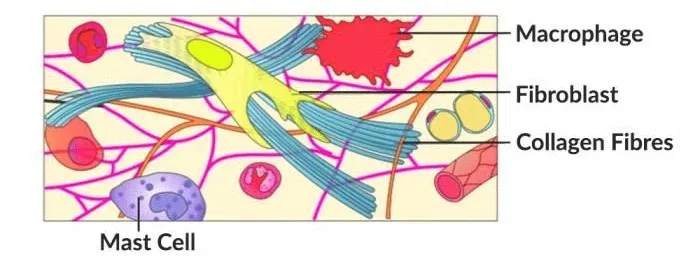
Structure: The connective tissue consists of the cells, fibres and ground substance.
Cells: The connective tissue contains various types of cells, including:
- Fibroblasts: They produce the extracellular matrix.
- Adipocytes: These are fat cells that provide insulation.
- Macrophages: These are immune cells that are involved in defence and tissue repair.
- Mast cells: They provide an inflammatory response.
Extracellular Matrix: The extracellular matrix of connective tissue consists of:
- Fibres: These include elastin (provides elasticity), collagen (provides strength and flexibility), and reticular fibres (form supporting networks).
- Ground Substance: It forms a gel-like material that surrounds cells and fibres and contributes to the tissue's consistency.
Types: Several types of connective tissue are as follows:
Types of Connective Tissues | Description |
|---|---|
Areolar | It is loose connective tissue that provides a space for blood vessels and supports organs. |
Adipose | It stores fat and provides insulation, cushion, and energy storage. |
Cartilages | It is a firm and flexible tissue found in the ears, nose, and joints. |
Bone | It supports the body and gives it proper shape and form. |
Blood | It is a fluid connective tissue, also known as vascular tissue, that consists of red and white blood cells and platelets. It is responsible for transporting substances throughout the body. |
3. Muscle Tissues
The muscular tissue originates from the mesoderm of the embryo. It helps in movement or locomotion and supports the bones and other structures of the body. Different types of muscle cells are shown below:
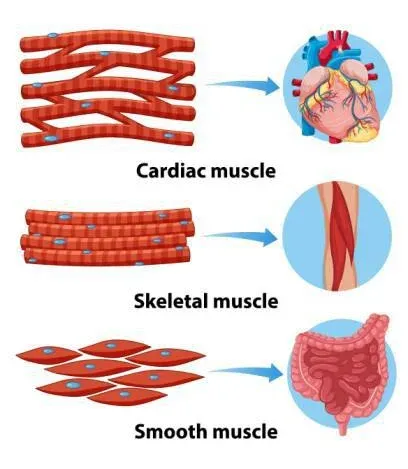
Structure: Muscle tissues are composed of long, cylindrical cells (muscle fibres) with a striated appearance.
Types: There are three main types of muscle tissue:
- Skeletal Muscle: It is attached to bones and is responsible for voluntary movements.
- Smooth Muscle: It is found in the walls of internal organs and carries out involuntary processes like digestion.
- Cardiac Muscle: It is found only in the heart and is responsible for pumping blood rhythmically.
4. Nervous Tissue
Nervous tissue originates from the ectoderm of the embryo. It mainly consists of nerve cells or neurons and glial cells, which provide support and insulation. The diagram of nerve cells is shown below:

Structure: Nervous tissue consists of neurons (nerve cells) and glial cells, which are connected by synapses.
- Neurons: Neurons are the functional unit of nervous tissue. They consist of a cell body, dendrites (branch-like extensions that receive signals), and an axon (a long projection that transmits signals to other neurons).
- Glial Cells: Glial cells, or neuroglia, are non-neuronal cells that support and protect neurons. They provide insulation and help maintain the extracellular environment.
Types: Different types of neurons help in information processing and transmission. They include sensory, motor, and interneurons.
- Sensory Neurons: They transmit sensory information to the central nervous system (CNS) from receptors.
- Motor Neurons: They carry signals to muscles and glands from the CNS that help in movement and responses.
- Interneurons: These are found within the CNS, and they integrate and process information that helps in communication between sensory and motor neurons.
Functions of Animal Tissues
Animal tissue performs various physiological and bodily functions. Some of the functions of the animal tissues are as follows:
Epithelial Tissue
- Forms protective barriers on body surfaces.
- Facilitates absorption in the digestive and respiratory tracts.
- Secretes hormones and enzymes.
- Participates in sensory perception, such as taste and smell.
Connective Tissue
- Provides structural support to organs and tissues.
- Connects and anchors bones, tendons, and ligaments.
- Stores energy in the form of fat.
- Acts as a transportation medium for blood.
Muscle Tissue
- Enables voluntary and involuntary movement.
- Generates force for activities like walking and lifting.
- Supports posture and maintains body temperature.
Nervous Tissue
- Facilitates the transmission of electrical signals.
- Coordinates sensory perception and motor responses.
- Regulates and controls body functions, including heartbeat and breathing.
- Stores and processes information in the brain.