
The human excretory system, also known as the urinary system, comprises the kidneys, ureters, bladder, and urethra. The human excretory system filters waste products and excess substances from the bloodstream, resulting in the formation of urine. It performs blood filtration through numerous microscopic units known as nephrons. In addition to waste elimination, the excretory system plays a vital role in regulating electrolyte levels, blood pressure, and the body's acid-base balance.
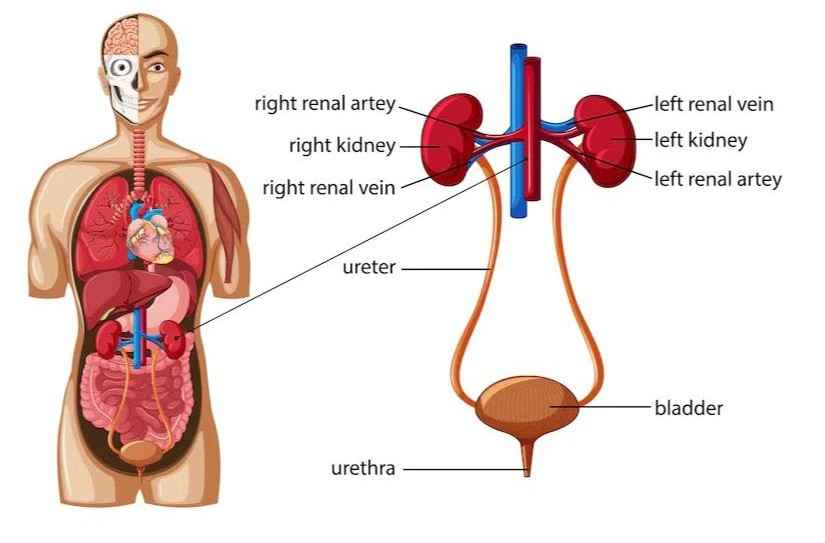
Excretory System Organs
The human excretory system is responsible for eliminating waste products and maintaining the body's electrolyte and fluid balance. The excretory organs responsible for carrying out the excretion of the waste products are as follows:
- Pair of Kidneys
- Pair of Ureters
- Urinary Bladder
- Urethra
1. Kidneys
Kidneys are bean-shaped organs that filter blood to remove waste products and excess substances, such as urea, creatinine, and excess salts. They also regulate blood pressure and the concentration of ions in the blood. The normal size of a kidney is 10-12 cm, the width of 5-7 cm, and the weight is approximately. 120-170g.
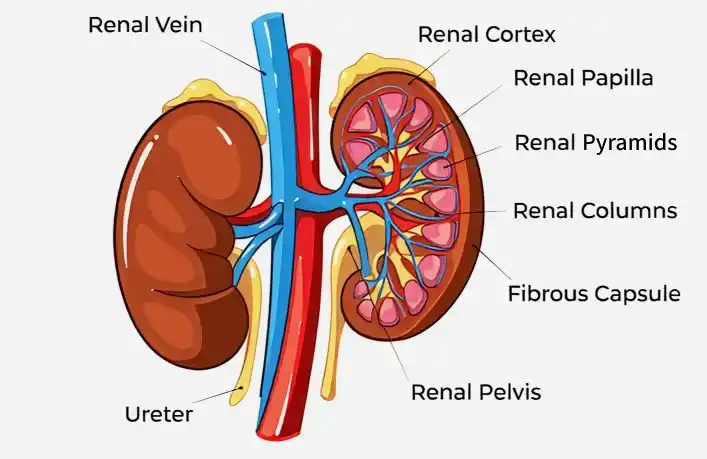
Structure of the Kidney
The overview of the basic structure of the kidney is explained below:
Capsule
The outermost layer of the kidney is known as the Capsule. It is hard in nature, made up of stromal cells surrounded by connective tissue. It plays an important role in the development of the kidneys. Given below is a diagram of the anatomy of the kidney, which shows the cortex and medulla parts of the capsule.
- Cortex: The renal cortex is the outermost layer of the kidney. It contains the glomeruli, which are clusters of tiny blood vessels responsible for initial blood filtration. Blood is filtered here to remove waste products, electrolytes, and excess water, forming an ultrafiltrate that enters the nephrons. The renal cortex contains the proximal and distal convoluted tubules, which are parts of the nephrons involved in the reabsorption and secretion of substances.
- Medulla: The renal medulla is the inner part of the kidney. It contains renal pyramids, which are cone-shaped and have tubules that carry urine from the cortex to the renal pelvis. Each pyramid has a papilla at its tip, where urine is collected and delivered to the minor calyces. The medulla plays a vital role in concentrating urine.
Nephron
The nephron is the functional unit of the Kidney. The Nephron is the small functional structure that produces urine in humans. The urine, which is being produced by the nephrons, is excreted outside of the body.
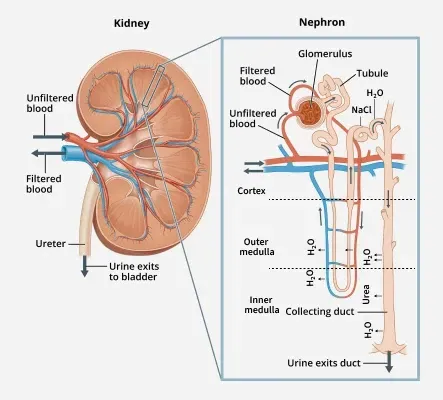
The structure of the Nephrons can be divided into two parts as follows:
Renal Corpuscles - They consist of blood vessels and different layers. It forms part of the cortex region of the kidney, where urine formation takes place. It consists of:
- Glomerulus - A tuft of capillaries surrounded by Bowman's capsule, which filters water and solutes from blood to form filtrate.
- Bowman's Capsule - Cup-shaped structure surrounding the glomerulus. It collects filtrate for transfer to renal tubules.
Renal Tubules - Long, convoluted tubes connected to the Bowman's capsule, where reabsorption and secretion of filtrate take place.
Henle's Loop
Henle's loop is a part of the kidney's filtration system, consisting of both an ascending and descending limb. It plays a crucial role in reabsorbing water and salts from the urine, helping in the concentration of urine and regulation of the body's water balance.

Features of the Loop of Henle
- The loop extends from the renal cortex into the medulla, creating a concentration gradient that allows for efficient water reabsorption.
- Depending on the type of nephron - cortical or juxtamedullary - the length of Henle's loop varies.
- The juxtamedullary nephrons have longer loops that extend deeper into the medulla, and cortical nephrons have shorter loops. This adaptation allows for more efficient concentration of urine in situations where water conservation is essential.
2. Ureters
Ureters connect the kidneys to the bladder, allowing the flow of urine from the kidneys to be stored in the bladder. Given below are the features of the ureters:
- They play a vital role in urinary excretion by transporting urine, which contains waste products and excess substances, away from the kidneys.
- Each human has two ureters, one for each kidney, and they vary in length but are typically about 25-30 cm long.
3. Urinary Bladder
This is the sac-like organ present in the human body. This helps to store the urine inside it for a while. Given below are some features of the urinary bladder:
- The capacity of the bladder is 400–600 mL of urine.
- The urinary bladder can be divided into two parts: the upper part and the lower part. In the lower part, there is the neck. From the neck, the urethra is attached to this area.
- The bladder is situated in the pelvic cavity of the human body.
4. Urethra
The primary function of the urethra is to carry urine from the bladder to the outside of the body during urination. Given below are a few features of the urethra:
- In males, the urethra also serves as the passage for semen during ejaculation, as it extends through the penis.
- In females, its sole function is urine elimination.
- The urethra is equipped with muscular sphincters that allow voluntary control over the release of urine, facilitating the regulation of bladder emptying.
Urine Formation
Urine is produced in the nephrons through a series of steps:
Steps of Urine Formation | Description |
|---|---|
1. Glomerular Filtration |
|
2. Tubular Reabsorption |
|
3. Secretion of Ions |
|
Functions of Tubules
The functions of tubules are given below:
- Glomerulus: Filters blood.
- PCT (Proximal Convoluted Tubules): Reabsorbs ions, water, and nutrients; eliminates toxins; maintains ionic balance and pH.
- Descending Loop of Henle: Adds concentration to the filtrate by being permeable to water.
- Ascending Loop of Henle: Dilutes the filtrate by being impermeable to water but permeable to electrolytes.
- DCT (Distal Convoluted Tubule): Reabsorbs sodium ions and water; maintains ionic equilibrium and pH.
- Collecting Duct: Absorbs water from the filtrate.
Micturition
The urinary bladder stores urine produced by the nephrons. Micturition, commonly known as urination, is the process of emptying the bladder of urine.
- When the bladder fills with urine, sensory receptors in its walls send signals to the central nervous system, indicating the need to urinate.
- In response, the brain sends messages to relax the muscles around the bladder while contracting the muscles of the bladder itself.
- This coordinated action allows urine to flow from the bladder through the urethra and out of the body.
- Micturition helps maintain proper fluid balance and remove waste products from the body.
Functions of the Human Excretory System
The main function of the excretory system is to produce urine or waste material. The process of the production of the water material is mainly inside the kidney. The functions of the Human Excretory System are as follows:
- Removes metabolic waste products like urea and creatinine from the body.
- Regulates water levels by adjusting urine concentration.
- Maintains proper levels of ions like sodium, potassium, and calcium.
- Controls blood pressure through the renin-angiotensin-aldosterone system.
- Helps maintain the body's pH levels within a narrow range.
- Produces erythropoietin to stimulate red blood cell production.
- Clears drugs and toxins from the bloodstream.
- Adjusts urine concentration to match hydration levels.
- Filters the blood to remove waste products and excess substances.
- Temporarily stores urine in the bladder and expels it through the urethra during urination.
Disorder of the Human Excretory System
When any part of the excretory system malfunctions, it causes disorders of the excretory system. Given below are some of the disorders of the human excretory system.
The following are the disorders that are related to the human excretory system:
- Kidney Stones: Hard deposits of minerals that can block the urinary tract, causing intense pain.
- Urinary Tract Infections (UTIs): Bacterial infections affecting the bladder (cystitis) or kidneys (pyelonephritis).
- Chronic Kidney Disease (CKD): Gradual loss of kidney function, often linked to conditions like diabetes and hypertension.
- Renal Failure: Complete loss of kidney function, requiring dialysis or transplantation for survival.
- Glomerulonephritis: Inflammation of the kidney's filtration units, leading to protein and blood in the urine.
Dialysis Process
Dialysis is a medical treatment for individuals with kidney failure, and it is an artificial procedure to remove excess wastes and fluids from the blood when a patient's kidneys are not functioning properly and naturally. The process of dialysis is shown below:

The dialysis process is explained as follows:
- Two primary types of dialysis are haemodialysis and peritoneal dialysis.
- Haemodialysis uses a machine to filter blood outside the body. Blood is drawn from a vascular access and returned cleansed.
- Peritoneal dialysis uses the abdomen's lining as a natural filter. A sterile solution is introduced into the abdominal cavity. Waste and excess fluids diffuse into the solution. The used solution is drained and replaced regularly.
- Dialysis is done multiple times weekly (haemodialysis) or daily (peritoneal). It helps manage kidney failure but is not a cure, often necessitating a lifelong commitment.
Importance of the Human Excretory System
- It eliminates metabolic waste products, such as urea and creatinine, from the body, preventing their harmful buildup.
- The excretory system helps control blood pressure by regulating the volume of blood and sodium levels through the release of renin and aldosterone.
- It maintains the balance of electrolytes like sodium, potassium, and calcium, which are essential for nerve and muscle function.
- The system regulates the body's pH levels by excreting excess hydrogen ions and reabsorbing bicarbonate ions.
- The kidneys filter and purify around 180 litres of blood daily, removing toxins and excess substances.
- It controls the amount of water in the body by adjusting urine concentration, preventing dehydration or overhydration.
- The kidneys release erythropoietin, a hormone that stimulates red blood cell production in response to low oxygen levels.
- It aids in detoxifying the body by filtering out drugs, chemicals, and toxins.
- The kidneys convert vitamin D into its active form, necessary for calcium absorption and bone health.