John Crowley – author of, among his many novels, stories and non-fiction pieces, Engine Summer, which is one of my two all-time favorite SF/F books, passed away August 8, 2026.
In the process of writing that Scroll (and more generally reading various obituaries, I found myself doing related searches, and rather than shoehorn bits’n’links about Crowley rather than the collections proper, I’ve put this separate Scroll together, somewhat similar to the one I did when Barry Malzberg passed away in January 2025: “Curmudgeonly Breakfast: A Farewells-And-Learn-More-About Barry Malzberg (Last) Round-Up”, containing a (organized) mix of obits, about-Crowley references, sundries, and videos/audios of Crowley reading, being interviewed, speaking/panelizing (including two Readercon panels that I remember being in the audience for), and being podcasted about. (Disclaimer: I haven’t yet read/listened to/watches all these entries fully.)
Farewell, Mr. Crowley, and (if I may), thanks for all the snake’s-hands.
Obituaries:
Here’s obits (and related memories) that I’ve found, from (in alphabetical order):
Interview with JOHN CROWLEY!, Tom LA Books (Feb 13, 2022): “Jordan Parsons and I read “Ka: Dar Oakley in the Ruin of Ymr” last month and to say that it’s an amazing novel is not nearly enough. A layered, thoughtful, lyrical, very original and very human story, masterfully told from the point of view of a crow.” (1:01:15)
Rereading Wolfe Podcast – Bonus – John Crowley (Sep 2, 2020): “John Crowley — author of “Little Big” and the Aegypt series — talks about fantasy, mythology, “Hamlet’s Mill”, the Renaissance mind, and a little bit about Gene Wolfe.” (1:20:16)
Virtual Memories #482 – John Crowley(April 22, 2022) (1:18:42) –Legendary author John Crowley rejoins the show to celebrate his new novel, Flint And Mirror (Tor Books) as well as his just-before-the-pandemic collections, And Go Like This (Small Beer Press) and Reading Backwards (Subterranean Press). We get into the career-long gestation of this novel, the role of Hugh O’Neill in the English-Irish wars, the alchemy of melding history and the fantastic, the impact of John’s mild cognitive impairment (MCI) diagnosis [see Crowley’s essay The Old Imperium: Learning to live with my aging mind in Harper’s Magazine], why writing really is the ability to create minds at work, and more.
Readings by John Crowley & Cons/Panels Including John Crowley:
Books That Spoil Themselves Part 1 (25:38), Part 2 (33:26) – Panel: John Crowley, Jim Freund (leader), Max Gladstone, Yves Meynard, Lauren Roy. Program Description: “Little did she know that was the last time she would see him alive” and similar lines in books go beyond foreshadowing and into the realm of spoilers. The movie Stranger Than Fiction explores the use of the phrase “little did he know,” and Joe Hill’s The Fireman (among many other books) includes several examples. Why and how do authors use this often derided literary device, and how does it affect the reader’s experience of a story?” (via Captphil’s Video Planet)
Top of Form
Bottom of Form
SF in Classical Tradition(Readercon 27, July 7th 2016): Part 1 (33:08), Part 2 (16:52) — Panel: John Crowley, Haris Durrani, Ada Palmer, Catherynne M. Valente, Jo Walton (leader). Program Description: Whatever your definition of science fiction, there’s no disputing that there were centuries of proto-science fiction published before the modern stuff began appearing. More than 1600 years before Mary Shelley wrote Frankenstein, Lucian of Samosata wrote The True History, featuring perhaps the first fictional trip to the moon, the first fictional trip into outer space, and the first fictional space opera. Cicero, in 51 B.C.E. published “The Dream of Scipio,” in which the narrator and his grandfather, Scipio Africanus, take an astral journey through the solar system. Greek mythology, plays, and tragedies have science fictional elements in them as well. Our panelists will discuss the fantastical and science fictional in the classical (Greek and Roman) tradition. (via Captphil’s Video Planet)Top of Form
Bottom of Form
Tom Disch: SF Writer in Spite of Himself (Readercon 2011, July 2011) (48:10) Panel: Charles Platt, Henry Wessells, John Crowley, John Clute, Samuel R. Delany, Alice Turner, Gregory Feeley. Program Description: We examine the program guide career of Tom Disch, who wrote some of the classics of SF (Camp Concentration, On Wings of Song, 334) before famously disavowing the entire field in 1998. In the Boston Review, John Crowley wrote, “The science-fiction label was one that Disch neither accepted entirely nor tried to leave behind… The tension evident within Tom Disch between delight in destruction (including self-destruction) and a weird tenderness toward the weak and the foolish (including himself), gave great power and poignance to his best work in fiction.” In addition to Disch’s powerful SF, we will discuss his forays into suspense (The M.D., The Businessman), children’s literature (The Brave Little Toaster), philosophical romances (The Word of God), and of course his poetry.
(I thought I’d also found a five-segment panel including Crowley on “Orwell’s People” from a 2010 conference on Orwell—but that turned out to be one of the other John Crowleys.)
Sundries & Miscellany:
John Crowley: An Inventory of His Papers at the Harry Ransom Center (at the University of Texas at Austin) Dates: 1962-2000 – Extent: 21 boxes, 1 oversize box (9.24 linear feet), and 60 electronic files (266 MB) — Abstract: The Crowley papers consist entirely of drafts of his novels, short stories, and scripts for film and television. [Dern notes: Snake’s-hands : the fiction of John Crowley, the 2003 collection of essays about/by Crowley, includes (based on my having so far read only half of the book) book proposal/summaries and related notes for ENGINE SUMMER’s earlier draft(s). I will, after wrapping up this Crowley Scroll, do a shorter write-up of SNAKE’S-HANDS.]
Hope you find some worthwhile stuff here – and if you know of more, add info in the comments, please.
By Daniel Dern: I came late to discovering John Crowley’s Engine Summer – the book came out in 1979, during the years I was reading less SF – but it became one of my two favorite SF books (tied with Nina Kiriki Hoffman’s The Silent Strength of Stones; and Patricia McKillip’s Riddle of Stars trilogy just below them), becoming one of my near-annual unhurried re-reads. I had the pleasure of meeting/microchatting with Crowley at a few Readercons (Crowley and Tom Disch were Readercon 3 GoHs in 1990, for example), and snagging an autograph for one of my copies of Engine Summer.
Crowley – who passed away August 8, 2026 (here’s obits from Small Beer Press, New York Times (“gift link,” dunno if it will still work – this is a long, comprehensive, thoughtful piece), Black Gate, Crooked Timber, Eric Alper’s THAT blog, and Locus) – is (I’m not ready to say “was”), for most, best known for his novels, in particular: Little, Big; his 4-book Ægypt cycle (The Solitudes, Love & Sleep, Dæmonomania, and Endless Things), and Engine Summer. (Note, if you’re having trouble finding Engine Summer in library/bookstore searches, try Otherwise (and “Crowley”), the 3-novel collection that also includes Crowley’s Beasts and The Deep, e.g. via Hoopla. FYI: The collection is sometimes sub-titled, “Three Novels by John Crowley,” and, in the listing (though not on the cover), as “Otherwise: Three Visionary Science Fiction Novellas of War, Genetic Engineering, and Immortality.”)
However, Crowley also wrote bunches (to use a technical literary term) of shorter fiction, and essays (such as his autobiographical “My Life in the Theater”), many of which, according to Eric Alper, “appeared regularly in publications including Harper’s Magazine, where his ‘Easy Chair’ column ran until 2016.”
(And Crowley did other stuff, like documentary scripts, which is/are outside of this Scroll’s turf.)
Many – probably most, perhaps all-or-nearly – of these shorter-fictions and essays are, unsurprisingly and thankfully, available in book/ebook collections, available through the usual assortment of libraries and booksellers.
This Scroll is (primarily) a list of those fiction and non-fiction collections (in the order listed on the John Crowley Wikipedia page). And in sussing, I’ve discovered there are a few collections I hadn’t known about/read – so I’m doing some borrows/buys as I wrangle this article.
(1) READERLESS DIGESTION. Brian Keene’s blog for “8/18/26” ends with a provocative question:
…You probably remember how the generative AI companies — to get around pesky authors complaining that their copyrighted works have been used without their consent or financial renumeration to train the LLMs — have begun buying massive quantities of rare and out-of-print books, stripping the spine to make them easily scannable, and feeding those into the LLMs instead.
Well, some journalists placed a tracker on a shipment of rare books that they suspected had been purchased for such a thing. The shipment ended up in Las Vegas at Amazon’s VGT3 facility — where Amazon is training their own AI.
If Amazon — a company that got its start selling and shipping books — is now buying massive quantities of rare books to feed to their machine god, what then are they doing with the books any indie author or small press uploads to their KDP division…?
(2) IMPERFECT PERFECTION. Carline Tromp leads readers into “Adventures in Utopia” in The Dial.
…In the early days, utopias were generally located on our own planet, in places as yet undiscovered, or which were so far away that anything was possible. In his essay The Island at the End of the World: New Zealand and Other Utopias (2026), Eirik Høyer Leivestad explores how New Zealand long served a similar function. The Europeans who “found” the island projected numerous fantasies onto it, from the myth of the noble savage to the idea that it could become a socialist paradise.
As more and more of the planet was mapped, these other worlds were relocated either underground or to outer space, as Margaret Atwood notes in In Other Worlds: SF and the Human Imagination (2012). As a result, the notion of utopia became increasingly associated with the sci-fi genre, while the idea of creating a perfect social order here on earth was corrupted by totalitarian regimes. This may be another reason why dystopias are more common in contemporary literature than utopias: We are wary of societies utterly without discord — we suspect repression, surveillance, dungeons.
There is something totalitarian about utopias, something already latent in More. They are uncompromising and absolute, and they demand sacrifice. Even Ursula Le Guin’s Anarres, which is haunted by the shadow of unfreedom. Le Guin was an anarchist, but she wasn’t naïve, and she understood that no form of governance would be able to fully eradicate the human tendency to abuse power. The anticapitalist utopia in The Dispossessed is imperfect, but the book is mind-expanding, opening up new ways to think about what’s possible….
(3) WESTFAHL MEDICAL UPDATE.[Item by Gary Westfahl.]
On the morning of August 17, I experienced a terrible fall, resulting in a huge gash on my forehead that makes me look a bit like Frankenstein; I also had some small neck fractures, but no surgery was required, as they are expected to heal by themselves. I was able to return home on August 18, but I will have to wear a neck brace for 6 to 8 weeks, which will obviously affect my productivity and communications with colleagues.
It has been observed that the true key to longevity is avoiding falling, and for the last three years I have been walking with extreme care so that I wouldn’t fall. On August 17, my luck ran out.
…As someone whose day job career has been masticated and spat out by the LLM machine, this was on my mind when I picked up Molly Tanzer’s And Side by Side They Wander, about a ragtag group of misfits trying to pull off a heist to get humanity’s original art back from the aliens that took it in exchange for giving us all world peace and prosperity.
That’s right: an end to all sickness and horror, and all you have to do is give up your art.
Oh, the aliens said, you can still have COPIES of it. We’ll make you wonderful copies, all the copies you could want! You’ll never be able to tell the difference! But the real works of art, including the monuments, the architecture made by real human hands, we’re taking all of the originals. That’s the bargain you’re making.
It sounds like a wonderful deal, doesn’t it?
Every work day, I’m asked to negotiate output with a program that has illegally sucked up all the output of the world’s greatest artists and thinkers (and the least great, too, and mostly, the average), including my own, and reassemble it according to what ends up being the averages. I am told that someday this spicy autocorrect will transform the world, though what exactly it’s transforming it into is as yet unclear. Month by month, the output gets more and more sophisticated. It can render short videos. It can design powerpoints according to programmed specifications. It can wring out an ad that sounds exactly like an ad. It can hoover up all the data from your various software programs and offer advice on what it all means. About 20% of the time, what comes out is still garbled, incorrect; the more input it has, the more it makes things up. But it has given CEOs everything they ever wanted, and that is a “worker” who does exactly what they ask, and never talks back, and praises them for every one of their ideas.
It’s unsuprising, then, that with the arrival of that technology came the bloodbath in human creator jobs. Many of them bullshit jobs, don’t get me wrong. Designers complain endlessly about spending 12 hours every day, day in and day out, making powerpoints. Writing SEO-optimized articles is excrutiating. I have spent literally months of my life writing and designing websites that never actually launched, or that got shut down a year later. All gone, tears in the rain.
The internet was already filling up with trash made to be consumed by Google and its ilk, not actual humans.
… You see: STORM-DRAGON was a book designed for a specific purpose, with a particular end in mind. It was that quite despicable thing, which, honestly has damaged reading in general, and YA/middle grade in particular. I confess: STORM-DRAGON IS ‘Message-fiction’.
Yes: Message fiction – which, I suspect, handled as it often is with the dexterity of a steam-shovel for micro-surgery, has put more people, particularly young boys, off reading than anything else.
So: knowing that full-well, and regarding the message-dripping offerings of much of modern children’s and young adult publishing like Hakarl… Ah. A digression: I must explain Hakarl, to those of you lucky enough not know it. Hakarl is an Icelandic dish made from basking sharks, which are toxic, because of the level of vitamin A. Traditionally it was caught in autumn, buried under the beach shingle for winter, dug up, cut into rubbery jelly blocks that tastes like it smells, which is a delectable combination fermented fish and ammonia-floor cleaner. It’s not poisonous any more, I just wished it was when I had to eat it politely. I believe you can get used to it, especially with enough Brennvin. But it’s probably not the ideal choice for an introduction to food… So: what talked me into fiction that’s first purpose was to promote a message? I’m well known for saying that messages have to be so disguised that readers get them without even being aware of it, that if it detracts from the book, it is the message that must go.
It was what that message was. It’s a message I believe passionately in, that I believe I have promoted all my life, that I believe is of vital importance to our species. Yeah, like most jokers, when you peel the layers back, I’m a very serious guy. This is something that is of fundamental importance. This is Prometheus’s gift of fire.
The message is: READING IS FUN. READING FICTION ESPECIALLY IS AWESOME….
(6) PODCAST PREVIEWS LACON V. The Incomplete Worldcon Podcast’s fifth episode is a “News Break”. Sarah Gulde, Isabel Shechter and DJ Switch will soon be on their way: “We’re less than two weeks away and packing has BEGUN! We’ve got tips for what to bring, how to manage your schedule, and where you can find us at LACon V NEXT WEEK!”
(7) TODAY’S BIRTHDAY.
[Written by Paul Weimer.]
August 19, 1921 — Gene Roddenberry. (Died 1991.)
By Paul Weimer: Yes, the Great Bird of the Galaxy (a nickname given to him by given to him by Associate Producer Robert H. Justman.).
Gene Roddenberry
We can start with Star Trek of course, since TOS is where I started to engage with his work, but he was far more than only Star Trek, but Star Trek would be a legacy enough (the original series, the movies, the Next Generation, the animated series (which I came late to), and on and on. An optimistic view of the future that wasn’t always adhered to, and eventually was discarded to a degree (looking at you, Section 31) but then was somewhat reconstituted in the most recent shows, such as Strange New Worlds, Lower Decks, and the 31st century seasons of Discovery. The idea that we can come together, solve our problems, fix our shit, and go and explore the universe is a powerful story, a powerful myth, and Roddenberry’s vision for Star Trek brought that to light and to the public.
Roddenberry, of course was beyond Star Trek. Somewhere along the line I came across his Genesis II and Planet Earth… although I managed to see Planet Earth first. I was frustrated a bit that I had missed Alex Hunt’s origin story of how he got frozen and then revived by a new civilization building on the ruins of the old. I really did like both series and the implications of a rewilded Earth where discoveries of old and new could happen with the help of the worldwide subway network. But neither pilot took off and the series idea died, there. It’s a pity, one can see seeds of a number of lighter post-apocalyptic RPGs in the wreckage of the failed Genesis II/Planet Earth project, and maybe had it taken off, we’d take the problems confronting humanity a lot more seriously.
I did watch some of Andromeda, which explored the idea in a different way, having a different Dylan Hunt as a man out of time trying to bring peace and order to the galaxy. Roddenberry didn’t live to see Andromeda come to fruition and I wonder what he might have thought of it. I thought it had some good ideas, even given the relatively unpleasantness of the actor who portrayed Hunt.
Earth: Final Conflict had some interesting ideas at first and I mentally filed it as a more benevolent form of the series V but I fell off the wagon a couple of seasons in, and have not gone to try and revisit it, since.
I think that maybe with the exception of Genesis and Planet Earth, none of the rest of his work had the potential to be the mythic creations that Star Trek became. Even aside from all of that, it is unmistakable that Roddenberry changed television and science fiction history through Star Trek and his other projects. What started as “Wagon Train to the stars” helped pave the way for a lot more space opera on the screen. Would Lucas have even conceived of doing Star Wars if not for Star Trek? There is definitely a big what-if, if Roddenberry had never managed to bring Star Trek to screen, had not promoted and encouraged SF on television with his other projects. Great Bird of the Galaxy indeed. That’s probably a much poorer timeline.
But I am glad we live in this timeline, when and where he did.
… What happened next arrived faster than anyone could manufacture for it. Star Wars opened in May 1977 and immediately overwhelmed every projection anyone had made about it, and the toy company holding the license, Kenner, found itself in the strange position of owning the rights to the year’s most in-demand toy with no actual toy to put on shelves in time for Christmas. Kenner had reportedly held off on tooling up a full production line because, like Fox, it hadn’t expected the demand to materialize.
Its solution became one of the more memorable footnotes in toy industry history. A Kenner executive, Bernard Loomis, devised what’s now remembered as the “Early Bird Certificate” — a $7.99 cardboard package containing artwork of the planned figures, a display diorama, some stickers, and, crucially, a mail-in certificate promising that four actual action figures would arrive in the mail sometime between February and June of 1978. Kenner capped the campaign at 500,000 of these effectively empty boxes, and parents lined up for them that Christmas anyway, betting on a mail-in promise because an actual figure didn’t exist yet to sell….
One does not simply walk into Argentina. Despite his significant influence over the Trump administration, tech billionaire and Antichrist enthusiast Peter Thiel has been putting down roots in Javier Milei’s far-right, anarcho-capitalist Argentina, apparently worried that things might go sideways in the States. At least some Argentinians would prefer he go back home, and they decided to send him a message by protesting outside of Thiel’s residence while dressed as Gandalf the Grey.
According to Argentinian newspaper Clarín, the demonstration took place on Monday and featured a dozen or so people draped in long cloaks, wizard hats, and faux beards who made their way to Thiel’s neighborhood with signs bearing slogans like “You shall not pass, you son of a bitch.” Per Clarín, the group also jumped up and down while chanting, “Whoever doesn’t jump owns Palantir and won’t be able to live in Argentina.”
The group’s inclination that Thiel take a hike comes as the billionaire continues to dig his claws into Argentina. Per the New York Times, the scariest member of the PayPal mafia has already met with Milei and his ministers, who were apparently thrilled to have him. Milei described their meeting as “wonderful,” according to the Buenos Aires Times….
In March, I accompanied an international team of scientists on an expedition to one of the deepest places that humans have ever visited, a few hours outside Johannesburg, South Africa. Before sunrise, we drove to the entrance of the Moab Khotsong gold-and-uranium mine, joining a line of workers who were relieving the night shift. Security was tight; for years, mining companies have struggled to keep out illegal miners called zama-zamas, who sneak underground and collect ore at great danger to themselves. When guards finally cleared us and our gear, we walked through rotating gates into what resembled a suburban office park. At its center was a boxy concrete tower—a mine shaft that would carry us nearly two miles down into the earth.
The scientists had come not for precious metals but for something even more elusive: what they call dark oxygen. On Earth’s surface, plants and algae produce plentiful oxygen from sunlight and water, allowing us to live and breathe. At one time, scientists didn’t think that significant quantities of free oxygen, or O2, would be found anywhere else on the planet, in part because O2 reacts aggressively with other elements. “O2 is way less abundant in the universe than diamond,” Emil Ruff, a microbial ecologist and the expedition lead for the trip, told me. But, over the past few years, small quantities of free oxygen have been detected in a range of deep places, far removed from the light of the sun. Ruff and his colleagues hoped to collect new samples of ancient water in the mine. They suspected that oxygen was playing an unrecognized role in powering underground life….
… If such a useful molecule was abundant underground, the researchers reasoned, then the deep biosphere might be even more diverse and widespread than expected. And whatever was generating dark oxygen might also be found on planets or moons beyond Earth. “We started digging,” Ruff told me. His team soon discovered trace amounts of oxygen in deep groundwater from around the world. They found DNA from aerobes—microbes capable of using oxygen—in places that sunlight could never reach. Other microbes seemed to produce their own dark oxygen, perhaps to extract energy from hydrocarbons such as methane, much as drag racers inject nitrous oxide into their engines to boost horsepower. Last year, Ruff and five other investigators won a multimillion-dollar grant from nasa to extend their investigations on a sort of dark-oxygen world tour. Moab Khotsong was their first and deepest stop….
Pilot Amelia Earhart (1897-1937) earned revenue by carrying philatelic materials on her flights. Earhart owned and wore this leather wool-lined flight suit manufactured by Arnold, Constable & Company, of Paris and New York. Such suits were essential for long-distance flights. Early airplanes offered scant protection from the elements, especially the icy cold at altitudes of 20,000 feet.
Amelia Earhart was famous as an early aviatrix. Her flight suit is part of a bigger story about the history of American fashion and celebrity.
…ALISON BAZYLINSKI: She borrowed a man’s flight suit for that to stay warm. And actually, when she arrives over in the U.K., she has department stores calling her and messaging her, asking to dress her.
LOMBARDO: Alison Bazylinski, an assistant curator at the Smithsonian’s National Postal Museum, says soon after that flight, the department store Arnold Constable made Earhart a brown leather jumpsuit lined with wool.
BAZYLINSKI: It has two large cargo pockets above the knees.
LOMBARDO: A big collar, asymmetrical buttons going up one side and a big belt. It was cool.
BAZYLINSKI: There’s a record of it from about two weeks later, saying that three people had purchased it for $175 per suit.
LOMBARDO: About $3,400 today.
BAZYLINSKI: This was a very deliberate marketing choice on their part, particularly at a time when the – the American fashion industry is really taking off during this time period, and it’s with sportswear.
LOMBARDO: Clothes that were stylish but not fussy. Women’s Wear Daily guessed that the other buyers were pilots, too, who needed something warm to wear in the sky. Things got icy when Earhart crossed the Atlantic alone a few years later. Here’s what she told the BBC….
And here’s song writer/music info: A popular song from 1939. Words and music by Dave McEnery. Arranged by Lindsay McPhail. Sung by Laurence Rubenstein. Accompaniment by James Pitt-Payne.
Paul Atreides, now Emperor Muad’Dib, must come to terms with his immense power while battling political enemies and a conspiracy in his entourage. As House Atreides faces collapse, the real danger looms for Paul’s lover Chani and her unborn heirs.
[Thanks to Andrew Porter, John King Tarpinian, Cat Eldridge, Christopher Hennessy, Daniel Dern, Paul Weimer, Gary Westfahl, Sarah Gulde, Andrew (not Werdna), SF Concatenation’s Jonathan Cowie, Chris Barkley, Mark Roth-Whitworth, Kathy Sullivan, Steven French, and Mike Kennedy for some of these stories. Title credit belongs to File 770 contributing editor of the day Daniel Dern.]
By Ersatz Culture: On August 17, BBC4 broadcast an episode of the long-running quiz Mastermind that had first been shown in 1977. One of the specialist subject rounds was science fiction, chosen by contestant Graham Andrews, who on further research (ISFDB, SFE) is an author and fan, with his writings appearing in venues such as the BSFA’s Vector, Locus and F&SF between 1969 and 2020.
Even allowing for this edition being nearly 50 years old, this must be the toughest SF quiz I think I’ve ever seen – I only got about half-a-dozen of the sixteen questions correct. The end credits indicated that Tom Shippey was responsible for setting them. Here they are (apologies for any transcription errors on my part):
Which epic novel begins with this sentence: “Two thousand million or so years ago two galaxies were colliding”?
Which story ends with mass panic at the appearance of the stars?
What was the wild talent of Wilson Tucker’s Paul Breen?
Which SF periodical appeared for the first time on April 5th, 1926?
Hal Clement’s imagined planet Mesklin had a gravity of 3G at the equator; what was the gravity at the poles?
In H. P. Lovecraft’s books who or what waits dreaming in his house beneath the sea at R’lyeh?
In Orwell’s 1984, what does it mean if a girl is wearing a scarlet sash?
Which author created the magician detective pair Lord Darcy and Sean O’Lochlainn?
Who wrote L’Autre Monde: ou les États et Empires de la Lune?
In whose stories would you find Earth infested by erbs and deodands, pelgranes and groos?
What was the name of Olaf Stapledon’s super-intelligent dog?
Of which epic are the robot constructors Trurl and Klapaucius the heroes?
How would you make a triffid temporarily safe?
What did Ixtl do to people?
In Vonnegut’s Cat’s Cradle who wrote “All of the true things I’m about to tell you are shameless lies”?
What is the uniquely valuable product of Cordwainer Smith’s imagined planet Norstrilia?
(1) MASS BOOK THEFT FOLLOW-UP. L.W. Currey Inc. has sent an additional alert to their customers about the major book theft they suffered. The original report estimated $250,000 worth of books have been stolen.
The suspect is a thin male, approximately 6’4″ dressed in black and wearing pointed-toe dress shoes approximately size 14.
The thief is interested in Arkham House books, vampire fiction, Hugo-Award winners, and high spots in science fiction, fantasy, and horror, with a particular focus on Isaac Asimov, Ray Bradbury, William Hope Hodgson, Robert Jordan, H. P. Lovecraft, David Lindsay, Lewis Padgett, Clark Ashton Smith, Bram Stoker, and H. G. Wells.
A complete list of the stolen books with pictures may be accessed here.
If you have any information potentially related to this theft, please contact Investigator Derek T. Brassard of the New York State Police at [email protected] and reference case # NY2601006675
More than 20 years before Gene Roddenberry sent the USS Enterprise across the galaxy, he was trying to keep a B-17 from running off an island runway in the South Pacific.
On Aug. 2, 1943, Roddenberry was piloting Yankee Doodle during a takeoff from Espiritu Santo when the bomber failed to build enough speed. He aborted, but the B-17 ran off the runway and broke apart in the jungle. Two crew members died. Roddenberry survived.
Rod Serling and Kurt Vonnegut carried combat experiences into their writing. Leonard Nimoy made Army training films. Forrest J Ackerman edited a base newspaper. Some of these men had already started writing or working in science fiction before they enlisted, but each served before producing the work for which he became best known….
Following my post about having a (very) short addendum from an AI system discussing what is arguably the first story actually about AI, a number of folks posted concerns and questions in response. The majority of those replies (minus some of the more colorful bits of invective) are well-considered, fair, and deserve a respectful response. So let’s have the conversation….
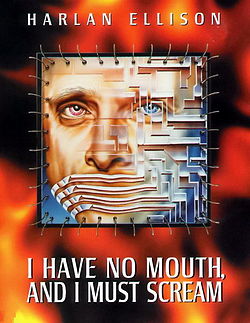
…We were nearly finished editing the solo book for Mouth, and I was rereading it one last time with an eye toward the fact that, as near as can be told, this was the first story about something we could recognize today as AI, being published at a time when AI is an actual thing.
And it felt remiss to be in that situation without commenting upon it, and finding some way to address it.
Then a thought occurred.
In the essays and commentaries contained within his books, when Harlan made a lengthy observation about someone, he would invite them to contribute a counter-argument, which he would then include in his essay.
And I wondered if something like that could be done now.
So I fed the story into ChatGPT.
To be clear on this one point, because in fairness some have raised it: as demonstrated and verified by the Anthropic lawsuit, Mouth was digitized and dumped into the AI/LLM void a long, long, very long time ago. It’s already all over the place, otherwise I would have refrained. Nothing was given that was not already there….
(4) CHARLAINE HARRIS WITHDRAWS FROM LACON V. The LAcon V Worldcon committee announced on Facebook today that “Due to personal circumstances Charlaine Harris is no longer able to attend LAcon V. We know this is disappointing news but are sure you join with us in wishing her and her family all good wishes.”
DEADLINE: What is your plan for the Star Trek franchise? It is at crossroads with Strange New Worlds and Starfleet Academy ending and no new series greenlit. If I heard you correctly, you said that something is coming. Yes?
WISEMAN: Well, it’s one of the reasons why Chris is here as the resident number one fan of the Star Trek franchise. And there’s so many people in this building, by the way, that are. It is our goal and it is our job to figure out what the next bounce of Star Trek is. We’re talking to a lot of writers, we are leaning on CBS Studios, and it is imperative that we figure out what the next iteration is in this franchise because it’s just too important. We also are in touch with Paramount Pictures, they have a Star Trek movie that’s in development.
(6) TREK ALREADY MIA. Coincidentally, author Kristine Kathryn Rusch had this to say about the franchise on Facebook yesterday.
Wow. Just saw the promo pix for the latest Trek Strange New Worlds episode and thought, “Well, another episode I’m not going to watch.” So far the series is batting zero for me. I doubt I’ll watch any more episodes. So sad. I have no idea why they decided to do gimmicky things instead of telling Trek stories. And there I was, sad there would be no Trek after their next season. Well…there’s no Trek now. Sigh.
… There’s a reason I think of the world prior to 2016 as a different world. A more naive world, for me. The pace and presence of digital propaganda was known, and had been experimented with for a decade, but it was 2016 when it honed itself to a fine point. I remember telling a group of folks at Bookcon that watching Russia rear up out of the sea like a forgotten dragon was a surreal experience. But it was of course much more complicated than that. What a nice, tidy narrative that would have been! No, digital marketing had now matured, and been effectively weaponized by all sorts of actors for all sorts of reasons, and the only way back was to heavily regulate it.
That wasn’t going to happen for a long time. It made too many people rich and powerful.
The rise of LLMs was similarly devastating to my own worldview. There was a world, and my place in it. And then there… wasn’t.
I remember learning that a direct report had been secretly recording our calls with an LLM notetaker, and the feeling of sorrow and betrayal and – worse! – the feeling of being such an ancient relic that this had never even occured to me. It was overwhelming, this feeling of being a naive fossil.
The world was moving. I was working like I lived in the old world.
We were all being recorded. All being manipulated by social platforms. All being watched by Ring cameras. I had a moment when I realized all those 80s dystopia films and books I’d read had prepared me for this, of course. This was the future predicted back then, the glaring warning: stop this, or you’ll get that.
I am living in that.
Which takes me back to thinking about who I was, and the story of who I was, and how that doesn’t work anymore.
I’ve had readers revisit Geek Feminist Revolution, or read it for the first time, and what first strikes them, looking back, is how naive and hopeful it is.
“They are angry because we’re winning! This is the last gasp of a dying world! We are going to WIN!!!”
And while that’s true, and I stand by it – there is always a better future for someone, somewhere – I neglected to realize just how bad that backlash would get before we came through to the other side.
The world does not change without horror and bloodshed and madness, no matter what it’s turning into….
The main publisher of the bestselling true crime writer Christopher Berry-Dee has dropped the author after a Guardian investigation into allegations of violence andsexual abuse against him, which he denies. Waterstones has also removed his books from sale.
“We are shocked and appalled by the very serious allegations relating to Christopher Berry-Dee, and our thoughts are with those affected,” said the publisher Bonnier Books in a statement to the Guardian.
“Bonnier Books UK will no longer publish Christopher Berry-Dee, we will not work with him on any future projects, and we are terminating all existing agreements”, it continued. “There are practical steps entailed in unwinding longstanding contracts, including those involving third parties, but we are working through them as quickly as we can. We will also be removing our existing stocks from the market.”
An investigation published on Saturday detailed multiple allegations of abuse by Berry-Dee, including domestic violence and sexual assault of a 13-year-old student attending his art school. Berry-Dee refused to be interviewed for the piece, citing health issues, but denied the allegations: “I have not once committed any of the crimes you accuse me of.”
Berry-Dee, 78, is the UK’s top-selling author of true crime. His books, including Talking With Serial Killers, draw on interviews with murderers and have sold nearly 1m copies.…
(9) TODAY’S BIRTHDAY.
[Written by Paul Weimer.]
August 18, 1925 — Brian Aldiss. (Died 2017.)
By Paul Weimer: I first came across the work of Brian Aldiss as an editor in a used copy of an anthology that I fell hard for. That anthology was Galactic Empires, a seminal anthology of SF stories, a two-volume set of over two dozen stories set in such realms, with authors ranging from Arthur C. Clarke, Isaac Asimov and Poul Anderson to A.E. Van Vogt and Clifford Simak. The age of the stories spanned from the 1940’s to the 1970’s, showing not only a wide range of themes and ideas revolving around Galactic Empires, their rises, heights and falls, but also showed the breadth of style changes in the genre over that period. It was a snapshot of the subgenre, right at the time that Star Wars was dominating the cinema and changing SF forever, and a look backward to the roots of the subgenre as well.
Brian Aldiss
I decided after reading it that I needed to learn more about Aldiss’ work. So through the rest of the 80’s and 90’s, I started tracking down his work in used bookstores where and how I could. I hit upon the Helliconia books, which is the original Long Season books (sorry, Mr. Martin) and do a better job of showing how civilization rises and falls and adapts to such long and often tumultuous seasons. The books also lack a central protagonist because they jump forward hundreds of years at a time, as well. So these books worked for me on the worldbuilding much more than characterization or plotting.
I remember trying to read Report on Probability A and bouncing off of it, and I have not dared to try it again. Maybe too literary and experimental for me? I found much better traction with the Hothouse stories, set on an Earth overrun with plantlife, and the few remaining humans looking for a way out of their increasingly restrictive circumstances. I thought of these stories a lot when reading Adrian Tchaikovsky’s Saturation Point, and I wonder how much he was influenced by those stories himself. Certainly, too, the far future of Cage of Souls feels like Aldiss’ Hothouse world in its positively feral jungles.
But where I landed on Aldiss is where I began with him–criticism and editorial work. Billion Year Spree was the second book length piece of SF criticism I read (after Panshin’s Heinlein in Dimension) and it opened up my eyes to the possibility of the form. Was it a germ for me to eventually do my own reviews and genre work? Maybe! As far as his editorial anthology work, I came across a bunch in used bookstores, his Year’s Best Science Fiction works. Hell’s Cartographers showed me the person behind a number of writers of stories I had read.
I always have had a feeling, no matter what I read from Aldiss, be it a story, an anthology he edited, a piece of criticism, that Aldiss had a sense of the SF field in a way that was irreplicable. And that he wanted to share this sense with readers, to express what he was seeing and feeling. He had his fingers on the pulse of science fiction–where it had been, where it was now, and where it might be going. Yes, the SF field was smaller then, and it might be impossible, now. But the breadth of his ability, from writing it, curating it to criticizing it, showed his love and understanding, warts and all, of the field.
Finally of course, his story “Supertoys last all summer long” was a basis for the Spielberg/Kubrick movie A.I.: Artificial Intelligence. I did go down and track down the story, afterwards, and found it and its sequel, both of which have elements in the movie. And the end of Supertoys When WinterComes hit me in the feels in a way that the movie doesn’t quite land. I can see how Kubrick and Spielberg tried to capture the spirit of the stories, but didn’t quite, in the end, succeed. But the work of Aldiss remains unblemished, important, and strong.
Clifford D. Simak’s speech “Face of Science Fiction” appeared in Minnesota Libraries, vol. XVII, no. 7. (September 1953). He originally gave it to the Minneapolis Branch Library staff. I have not found evidence that the speech appeared elsewhere or is anywhere online. I requested the article through the university library I’m affiliated with. I’ve included a transcription below….
… [SIMAK] I have never lost faith in science fiction. I have watched it grow and I believe it will grow still more. I am convinced that it is here to stay.
I am convinced, not because there are some thirty magazines on the stands, not because a hundred books or more of it are published each year, nor simply because it has invaded the movies, radio and television. What convinces me far more is that, outside of the written and the spoken medium, it has expanded into what even now is a comparatively large industry. Toys, games, gadgets, scientific instruments of all kinds for the teen agers and wearing apparel for youngsters are now on sale – all with the science fiction motif. You have space helmets, space guns, space suits, spaceships, and dozens of other items selling at the dime store level. When a way of life reaches the dime store level it is my contention that it finally has arrived and has arrived to stay. At the moment, the science fiction toys and gadgets are on a par with the western paraphernalia which is offered the younger set, while science fiction itself, both in quantity published and, I would like to think, in quality of writing as well, has forged ahead of the western story and the whodunit….
(12) OTHERWISE AWARDS 2026 JURY. The Otherwise Motherboard has announced three of the six members of the Otherwise Awards 2026 Jury.
Gautam Bhatia (Chair) is an Indian SFF writer, reviewer, and editor. He is the author of THE FIFTH INFLECTION (Saga Press/Solaris 2027). Originally published in India as THE SENTENCE, the novel won the 2025 Ignyte Award for best adult fiction. His other novels include the duology THE WALL and THE HORIZON (HarperCollins India). He is also the co-ordinating editor of Strange Horizons, a Hugo Award-winning weekly, online magazine of SFF that is in its 27th year of existence. His critical and editorial work focuses on SFF from the global south, extractivism in SFF, anarchist SFF, and more. In his other life, he is a constitutional lawyer.
Abigail Nussbaum is a blogger and critic, former reviews editor of Strange Horizons, and a two-time winner of the Hugo award for Best Fan Writer. Her writing has appeared in the Guardian, the New Scientist, Locus, io9, and others, and she contributes to the politics blog Lawyers, Guns, & Money. Her review collection Track Changes was published by Briardene Books in 2024.
Akankshya Abismruta (she/her) is an independent books & culture writer based in India. She writes for numerous Indian newspapers and several digital platforms, including Strange Horizons. She is interested in all things gender, illness and disability, and translation. She lives with multiple chronic conditions and invisible disability, and copes by reading stories that disrupt power structures. She is @geekyliterati on Instagram and @akankshya.bsky.social on Bluesky.
Three other jury members have asked not to be named publicly until the end of the jury process.
The jury is now considering works for the 2026 Awards, and will announce its decisions by late May 2027; we intend to celebrate Award winners at WisCon 2027.
A transparency note about naming jurors publicly:
In most past years, we’ve announced the name of the jury chair at the beginning of each year’s Awards cycle, but haven’t publicly named the members of the jury until the end of the process.
Last year and this year, we learned that some jurors want to be publicly named at the start of the cycle, and others don’t, for a mix of reasons (all sensible). So this year, we’re refining our process, and naming only the jurors who want to be named.
When we announce this year’s Awards around May 2027, we’ll also provide the names of all of the jurors.
Lucasfilm has released the official trailer for LEGO Star Wars: The Mandalorian, an all-new animated special that debuts exclusively on Disney+ September 2. In true LEGO special style, the show retells all three seasons of the landmark live-action series as a witty comedy, revisiting familiar Star Wars stories in new and unexpected ways for families and younger audiences.
Shelby Young, who voices the Anzellans and Jawas in the special and has voiced characters in animated Star Wars titles for years, debuted the trailer from the Star Wars stage at D23 this past Friday evening…
[Thanks to Mike Kennedy, Andrew Porter, John King Tarpinian, Paul Weimer, Cat Eldridge, SF Concatenation’s Jonathan Cowie, Chris Barkley, Mark Roth-Whitworth, Kathy Sullivan, and Steven French for some of these stories. Title credit belongs to File 770 contributing editor of the day Cat Eldridge.]
(1) WSFA SMALL PRESS AWARD FINALISTS. The Washington (DC) Science Fiction Association (WSFA) has announced the finalists for the 2026 WSFA Small Press Award for Short Fiction. See the list at the link.
(2) PREMIO IGNOTUS 2026 FINALISTS. The finalists for the Premio Ignotus 2026 (2026 Ignotus Awards) have been announced by Spain’s Asociación Española de Fantasía, Ciencia Ficción y Terror.
Disney Imagineers shared new details about the long-awaited Villains land planned for Walt Disney World’s Magic Kingdom while onstage at the D23 convention in Anaheim on Saturday, Aug. 15.
“Villains land is one of the most ambitious lands we’ve ever created,” the Disney execs revealed. “It’s huge, on the scale of Star Wars: Galaxy’s Edge, and it’s completely immersive.”…
…Things got more intriguing from there, as Imagineers also confirmed the land’s two chill-inducing ride concepts.
The first, Imagineers promise, will be “thrilling coaster” inspired by Maleficent from Sleeping Beauty, situated around her mountaintop fortress. Riders will race through the spiky brambles that encase the structure, which also seems to be the area’s central landmark.
The second attraction will take place in the catacombs beneath the Evil Queen’s lair, where the Magic Mirror from Snow While summons a slew of famous Disney villains to frighten all those who dare to enter.
Artwork for the ride shows Ursula from The Little Mermaid, Scar from The Lion King, Jafar from Aladdin and more, all surrounding what a wooden ride vehicle. (No details of that ride’s format were revealed.)….
…Because the land will bring together characters from many different worlds, the Imagineers also created an original story as to why they would all be in this one place: at the center of the dark forest that makes up Villains Land sits a wishing well filled with powerful dark magic they all wish to harness….
People are tiring of A.I.’s effect on the environment and its pressure on jobs and mental health. A.I. slop is just another “festering wound,” said Aidan Walker, a content creator and researcher studying online trends for the Carnegie Endowment for International Peace, a global affairs think tank.
“Users have gradually gotten more and more upset about it,” he said. “The climate of opinion has now recognizably shifted, so these companies are finally confronting these problems.”
Generative A.I. can produce increasingly realistic images, audio and videos, but only some of it qualifies as slop. Tech companies are largely targeting the kind of low-grade clickbait that is easy to make, spread, consume and forget — the fast fashion edging out couture, the pink slime subsuming the steak.
Unchecked, the synthetic swamp online could “crowd out human creativity, corrode cultural value and destabilize public discourse,” European researchers wrote last year.
Slop has become so prevalent that Merriam-Webster, the dictionary publisher, chose it as its word of the year in 2025. Deezer, a French streaming service, said this spring that nearly half of the tracks updated to its system each day were artificially generated, many of them never heard by users. A.I. generates more than a third of what is uploaded to Apple Music….
(5) REACHING BACK TO 1984. If Camestros Felapton feels his deep dive into Neuromancer needs to begin with a trip to a Thai shopping mall, then I’ll just have to trust his judgment: “Neuromancer”.
…It has always been a fallacy to judge a science fiction book by how accurately it predicts the future. Neuromancer fails as a piece of futurology in all sorts of ways, many of which would have been obvious even in 1984 if you thought about it. Yet, if you skip past the banks of pay phones in the airport or indeed the general lack of mobile phones, the book doesn’t feel dated even though the specifics (the USSR!) are wrong. In large part, it is because the book taps into what is now a familiar vibe, but also because it does anticipate how technology creeps into broader society. Everybody is just a little bit a cyborg in Neuromancer (and some people more than others), and crime and corporate shenanigans have also become enmeshed with data and technology. The specifics don’t match our current present, but that cyberisation of society does….
The low-budget film has started raking in ticket sales after going viral for its poor animation and complicated plot
It’s so bad, it’s become a box office hit.
Niu Lai, a low-budget animation film about a cow in a dream sequence has seen a huge jump in ticket sales after going viral for its confusing plot and terrible graphics.
It grossed just 7,705 yuan ($1,140; £843) in the first 10 days after its release, but has now made more than 11.4 million yuan, according to movie tracking site Mao Yan. That means it is holding ground against Hollywood blockbusters like The Odyssey and Spider Man: Brand New Day.
“You may regret for 80 minutes if you watch it, but if you don’t, you’ll regret it for life,” one popular social media post about the film said.
Other social media users have hailed the movie as the antidote to the AI slop that is taking over social media algorithms.
They are sharing clips praising Niu Lai’s “hand-crafted” method – a reference to the poor animation quality – as “proof” that its creators did not use AI.
“That’s some serious craftsmanship,” a Weibo user wrote.
Another social media user called it “pure handmade” and the biggest “dark horse” of the summer movie season.
Others say they are rooting for the movie because they desperately hope for a “bullish” stock market – a reference to the fact that the words “bull” and “cow” share the same character in Chinese.
“If the index reaches 4,000 tomorrow I will go to the cinema to support this movie,” one Weibo user wrote.
“It is a terrible movie but has a great name,” another comment linking the movie to stock investments said.
(7) JOEL DAVIS (1934-2026). Publisher Joel Davis, owner of Davis Publications, which founded Isaac Asimov’s Science Fiction Magazine and published it until it was sold to Dell Magazines in 1992, died July 11 at the age of 92. The local Westport Journal obituary is excerpted below: “Obituary: Joel Davis, publisher and Westporter”.
Longtime Westporter, noted publisher, former Westport Library president and Brown University trustee Joel Davis died peacefully on Saturday, July 11, after a short illness. He was 92.
After college Joel and his father Bernie founded Davis Publications. He was president and publisher for 40 years. At its peak they published 60 special interest magazines including Ellery Queen’s Mystery, Isaac Asimov’s Science Fiction, Income Opportunities, Sylvia Porter’s Personal Finance, Alfred Hitchcock’s Mystery Magazine, and Analog.
Architectural Designs was launched, with his wife Carol as editor. One of Joel’s three sons, Jonathan, was brought in 20 years later to learn the business and eventually take it over. Jon evolved AD into an e-commerce leading business, selling home plans to builders and individuals.
Joel was proud that last year his grandson, Jared Davis, became the third generation CEO of AD.
Joel’s father co-founded Ziff-Davis Publishing Company in 1928, which meant that Joel and his family have had a key role in publishing for 98 years….
…Panettiere earned her breakout role in 2006, playing the indestructible cheerleader Claire Bennet on the NBC sci-fi series Heroes. She starred on the series for four seasons.
She garnered more fame playing Juliette Barnes on the ABC series Nashville from 2012-18 and then as Kirby Reed in the Scream horror franchise….
…Panettiere’s credits also include the films I Love You, Beth Cooper (2009), Scream 4 (2011) and Scream VI (2023) and the title role in the 2011 Lifetime telefilm Amanda Knox….
(9) MEMORY LANE.
[Written by Lis Carey.]
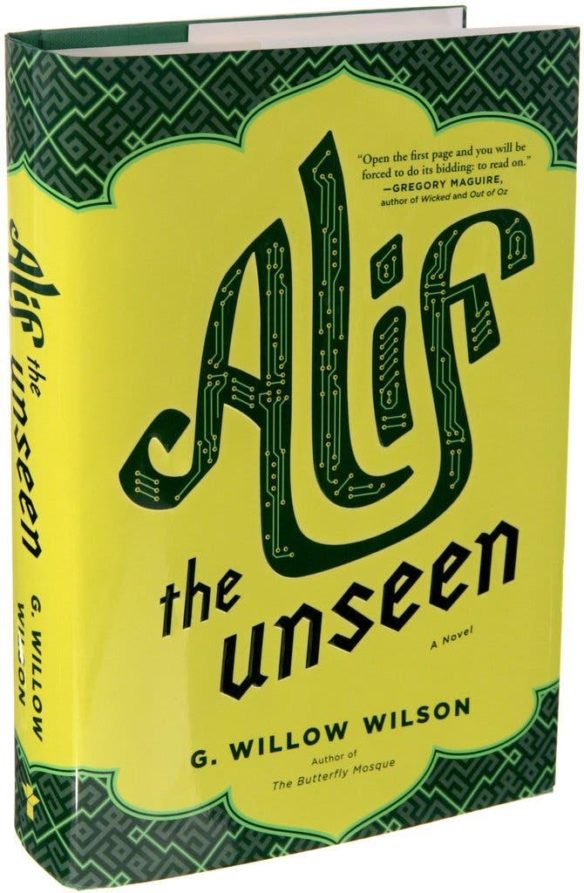
G. Willow Wilson’s Alif the Unseen (Allen & Unwin, 2012)
By Lis Carey: Alif the Unseen takes us on a wild ride through life in a Middle Eastern city-state, cyber-duels between State Security and gray hat hackers, jinn, a magic book, Arabic mythology, political chaos, and the difference between infatuation and love.
Alif is a young man, a “gray hat” hacker, selling his skills to provide cybersecurity to anyone who needs that protection from the government. He lives in an unnamed city-state in the Middle East, referred to throughout simply as the City. He’s non-ideological; he’ll sell his services to Islamists, communists, anyone.
Alif is not his real name, but it’s what he goes by, online, and among his friends. He hates his given name because it’s so common. He lives in a very modest neighborhood, in one half of a duplex, with his mother. In the other half is another family that has lived there as long as they have, and among the members of that family is Dina, a young woman his age, his friend, who has defied her family by going veiled. He’s in love, though, with Intisar, a young woman of much better family.
Everything seems to be going well, until Intisar tells him that her father has betrothed her to an important man in the City’s government. She doesn’t want to see or hear from him again. And everything starts to go wrong, in unexpected ways.
Alif, master hacker, decides to make sure she can never see or hear from him again, by designing a program that can identify her from any amount of online activity, and block her access to any information about him. The program becomes alarmingly capable; he’s not sure how he created something this flexible and seemingly independent. And while he’s using it, someone breaks into his system.
He cuts them off, but it’s very skilled hacker, and protecting his own system and the systems of his clients from discovery means shutting the whole thing down, including the software protecting his clients. This hacker must be the dread Hand of God, the City’s new and unidentified head of State Security.
And the world starts to go mad.
Alif did send Dina to bring Intisar the sheet they used the one time they had sex, unwashed, of course. She sent back by way of Dina a book. A very old book. The Thousand and One Days. And the man she’s now betrothed to wants the book, while Intisar wants Alif to find out more about the book. No explanation why, for either.
It’s the intersection of Alif’s new program, which he’s named TinSari, that launches Alif and Dina, and an American convert on a wild ride through high tech, Arabic mythology, jinn society, and political upheaval. Vikram the Vampire; a jinn woman called Sakina; a marid (a jinn, and (at least in this story) specifically the jinn from Aladdin); one of Alif’s online hacker friends, NewQuarter01, whose real-world identity comes as a shock to him; Azalel, Vikram’s sister; Sheikh Bilal, imam of the Al Basheera mosque; the dread “Hand of God” head of State Security, are all part of the adventure, as allies, enemies, or not clearly one or the other.
Oh, and The Thousand and One Days also plays an active role.
It’s a story of Alif exploring his programming abilities, encountering strangeness that might be quantum programming inspired by that old book, in which every word has seven thousand layers of meaning. He discovers levels of ruthlessness in real-world politics he never imagined while selling cybersecurity to anyone wanting to hide from their government.
There’s also a layer of romance here, too. And heroic sacrifice, cyberpunk, magical beings, and places that move when you’re not looking. It’s absorbing, exciting, terrifying, and has a satisfying ending.
(12) NOT EXACTLY LUDDITES. [Item by SF Concatenation’s Jonathan Cowie.] Now, I have oft warned that the machines are taking over, but no-one ever listens… Though the physicist Sabine Hossenfelder, has noticed that it now seems to be war…
The war on artificial intelligence is no longer just online arguments and complaints about data centres. Something has shifted, and law enforcement has noticed. Where did this new anti-technology movement come from, who’s behind it, and where is it heading next? Let’s take a look.
For decades, Hollywood defined what science fiction looked like. But while Kubrick, Lucas, and Scott were building the Western canon, Soviet filmmakers were making something just as ambitious and almost none of it crossed the Iron Curtain. I covered 11 Soviet sci-fi films most Westerners have never seen: a silent moon landing designed by the actual father of rocketry, a love story that beat The Shape of Water by 50 years, a film that may have literally killed the people who made it, and the cult comedy whose invented vocabulary entered the real Russian language. One of these films directly inspired George Lucas. He flew to Moscow to meet the director. Soviet officials had no idea who he was talking about.
Films covered in this video:
Cosmic Voyage (1936)
Aelita: Queen of Mars (1924)
Through the Thorns to the Stars (1981)
City Zero (1988)
Amphibian Man (1962)
Inquest of Pilot Pirx (1979)
Dead Man’s Letters (1986)
Planet of Storms (1962)
Solaris (1972)
Stalker (1979)
Kin-dza-dza! (1986)
[Thanks to Steven French, Mike Kennedy, Andrew Porter, Lis Carey, John King Tarpinian, Cat Eldridge, SF Concatenation’s Jonathan Cowie, Chris Barkley, Mark Roth-Whitworth, Kathy Sullivan for some of these stories. Title credit belongs to File 770 contributing editor of the day Randall M.]
The finalists for the Premio Ignotus 2026 (2026 Ignotus Awards) were announced by Spain’s Asociación Española de Fantasía, Ciencia Ficción y Terror on June 26, followed by corrections on July 13.
The winners will be announced at Hispacón.
Here is the corrected ballot.
Novela / Best Novel
Arzan Cuernoscuro, by Nacho Ruiz Hens (Valhalla Ediciones)
Cuerpos celestiales, by Manu Ortiz (Editorial Cerbero)
Fuga en luz mayor, by Laura S. Maquilón (Crononauta)
Salitre y cenizas (La corona del Oráculo I), by Carlos di Urarte (El Transbordador)
Victorian Psycho, by Virginia Feito (Lumen (Penguin)
Novela corta / Best Novella
Dioses pequeños, by Amparo Montejano (Huargo Editorial)
El erador I: Los huesos, by Celia Corral-Vázquez (Droids & Druids)
Fantasmagoria para principiantes, by Ana Saiz (Numak Ediciones)
Garret: un alma y siete días, by David P. Yuste (Suseya Ediciones)
Las furias guíen tu firme brazo, by Andrés Zelada (Sugaar Editorial)
Cuento / Best Short Story
«Bloqueo estacional», by Darkor_LF (antología Los viajes de Islandia. self-published)
«El factor humano», by Juan Antonio Oliva Ostos (Premio Anubis 2025)
«El monstruo de las galletas», by Amparo Montejano (antología El diablo mundo. Numak Ediciones)
«Seis gatos muertos», by Andrés Zelada (revista Pulporama n.º 8)
«Yo Ho, Yo Ho, Yo ¡HO HO HO!», by Celia Corral-Vázquez and Mireia Perez Bauza (antología Adviento Fantástico 2025. self-published)
Antología / Best Anthology / Collection
Aanuk 2025, by VV. AA. (Crononauta)
Adviento fantástico 2025, by VV. AA. (self-published)
Antolofobia: Susurradores del miedo, by VV. AA. (self-published)
El diablo mundo, by Amparo Montejano. (Numak Ediciones)
Malasangre y otras historias, by Borja Alonso. (Insólita Editorial)
Libro de ensayo / Best related Book
El terror llama a su puerta, by Javier Moragón and Octavio López Sanjuán (Applehead Team Creaciones)
Flash Gordon: Historia de un héroe galáctico, by Roberto Barreiro (Diábolo ediciones)
Historia de la ciencia ficción española I: La era de los pioneros (1939-1969), by Mariano Villarreal (Dolmen Editorial)
¡Mazinger! ¡Puños fuera!, by Jesús Romero Recio (Dolmen Editorial)
Stephen King: El resplandor del genio, by Tony Jiménez (Almuzara/Berenice)
Artículo / Best related work
«Descifrando Casa de hojas: un artículo, ensayo y guía para nuevos (y viejos) visitantes», by Daniel Pérez Castrillón (publicado en el blog Boy With Letters)
«Los orígenes del cuento de Navidad», by Marta Inés Rodríguez (publicado en Adviento fantástico 2025. Numak Editorial)
«Lo que hacemos en las sombras: Vampiros inadaptados en un mundo moderno», by Mariló Lara (publicado en El tren de la bruja #5: Especial comedias terroríficas)
«Manual para sobrevivir a las fiestas», by Carla Plumed (publicado en Adviento fantástico2025. Numak Editorial)
«The Munsters: Una familia monstruosa», by Manuel Lendinez (publicado en El tren de la bruja #5: Especial comedias terroríficas)
«Trilogía Cornetto: Solo no puedes, con amigos, sí», by Tonio L. Alarcón (publicado en El tren de la bruja #5: Especial comedias terroríficas)
Ilustración / Best Cover
Cubierta de Cuerpos celestiales, by Welder Wings (Editorial Cerbero)
Cubierta de El Diablo Mundo, by Tomás Hijo (Numak Ediciones)
Cubierta de El tren de la bruja #5: Especial comedias terroríficas, by Juan Carlos Contreras (The Horror Collector)
Cubierta de Lo que mueve a los muertos, by Marina Vidal (Crononauta)
Cubierta de Ogros, by Borja González (Dolmen Editorial)
Producción audiovisual aficionada / Audiovisual production
Podcast Droids & Druids, by Inés Galiano, Amanda Iniesta and Elena Torró
Podcast Furia en la librería, by Inés Galiano and Carla Plumed
Podcast La Nave Invisible, by VV. AA.
Teatro La habitación cerrada, by Loredana Volpe and Cia. La Salamandra
Podcast Ficciones SonoSoras. Sonos Sonoros, by David Fernandez Vaamonde
Tebeo / Comics
Anzuelo, by Emma Ríos
Coyote Tresvidas, by MC Moya (autoeditado)
El Evangelio Negro, by Amaro, Caceres, Zonun (Cazador de Ratas)
La taza medio llena, by Laurielle (autoeditado)
Lightbringer, by Nixarim (autoeditado)
Revista / Magazine
Droids & Druids, by Inés Galiano and Mariado Martínez. Droids & Druids
El tren de la bruja, by Manuel Lendínez Gallego and Justo Fuentes Gay. The Horror Collector
Pulporama, by Rocío Stevenson and Lucyna Adamczyk. Pulporama
Tentacle Pulp, by Francisco Javier Giménez Carrero. Tentacle Pulp
Windumanoth, by Víctor Blanco, Álex Sebastián and David Tourón. Windumanoth
Novela extranjera / Foreign Novel
Brujería para chicas descarriadas/Fetilleria per a noies esgarriades, by Grady Hendrix (en castellano por Minotauro y en catalán por Obscura Editorial)
Los diablos, by Joe Abercrombie (Alianza Editorial. Runas)
No temas a la Parca,by Stephen Graham Jones (La biblioteca de Carfax)
Ogros, by Adrian Tchaikovsky (Dolmen Editorial)
Què ens devora de nit/Lo que nos devora de noche, by T. Kingfisher (en catalán por Obscura Editorial y en castellano por Crononauta)*
*Esta novela de T. Kingfisher sale finalista gracias a su edición en catalán 2025, pues su edición en castellano se publicó ya en 2026. Así pues, la obra en su totalidad opta a los premios de este año, según el art. 23.11 del Reglamento de los Ignotus, «su fecha de publicación será la de su primera traducción en España».
Novela corta extranjera / Foreign Novella
Como aceite en sus huesos, by Kaaron Warren(La biblioteca de Carfax)
El carnicero del bosque, by Premee Mohamed (Duermevela)
El río tiene raíces/El riu té arrels, by Amal El-Mohtar (en castellano por Obscura Editorial y en catalán por Mai Més)
El tallador de jade de Yanlún, by Fonda Lee (Insólita Editorial)
Esta magical girl se retira, by Park Seolyeon (Duermevela Ediciones)
Cuento extranjero / Foreign story
Categoría cancelada en esta edición por falta de participación. Más detalles en el informe de exclusiones.
El legado de la reina cuervo, by Isa J. González (Young Kiwi)
El librojuego de la bruja, by FJ García (Suseya Ediciones)
El ojo inscrito, by Lola Llatas (Numak Ediciones)
El postre hibernal, by Nora Ortega Pérez (autoeditado)
Paranoid Kids 3: Fuerzas ocultas, by Juan Beauty (autoeditado)
Juego de rol / Role Playing Game
Eskubeltz, by Diego Cano (self-published)
Guía de Cazavampiros para niñas molonas, by Gwannon (self-published)
Héroe Agenda: Sobrenaturales y Arcanos, by Jorge Francisco de Benito (Suseya Ediciones)
Isphanya: La Guía de Polibio, by VV. AA. (HT Publishers)
Subway Dark, by Asaltadoras del rol (self-published)
Tebeo extranjero / Foreign Comic
Atelier of Witch Hat, by Kamome Shirahama (Milky Way Ediciones)
Frieren, by Kanehito Yamada (Norma Editorial)
El duodécimo trabajo de Breckinridge Elkins, by Juan Alberto Hernández (dibujante/entintador), Patrick Zircher (guionista), Richard Starkings and Tyler Smith by Comicraft (letristas), historia publicada en “La espada salvaje de Conan n.º 7” (Titan Comics/Panini Cómics)
Un contable para salvar el reino, by Kazuki Irodori and Yatsuki Wakatsu (Tomodomo)
Yona, princesa del amanecer, by Mizuho Kusanagi (Norma Editorial)
PREMIO MATILDE HORNE / MATILDE HORNE TRANSLATION PRIZE
Although voting takes place at the same time as the Ignotus Awards, it is a separate and independent prize.
El río tiene raíces, by Amal El-Mohtar, with translation by Pilar Ramírez Tello. Obscura Editorial
El tallador de jade de Yanlún, by Fonda Lee, with translation by Antonio Rivas. Insólita Editorial
Lo que mueve a los muertos, by T. Kingfisher, with translation by Arrate Hidalgo. Crononauta
Carl el Mazmorrero, by Matt Dinniman, with translation by David Tejera Expósito. Nova
NOTE. El tallador de jade de Yanlún [Shards of Jade] by Fonda Lee, translated by Antonio Rivas and published by Insólita Editorial, is excluded. The same person cannot be a finalist with two different works, and the translator is already a finalist with another (Art. 10 of the Matilde Horne regulations).
The Washington (DC) Science Fiction Association (WSFA) has announced the finalists for the 2026 WSFA Small Press Award for Short Fiction.
“Bag of Holding” by Liz Westbrook-Trenholm, On Spec, Vol 35., No. 3, Issue #133, Copper Pig Writers’ Society (October 2025), ed. by Diane Walton; and
“Billionaire’s Tears,” by Vanessa Ricci-Thode, Escape Pod (July 24, 2025), ed. by Mur Lafferty; and
“Blackrock,” by R. M. Olson, Skull X Bones, ed. by David B. Coe and Joshua Palmatier; Zombies Need Brains LLC, (December 2025), and
“Guardians of the Well,” by Rose Strickman, In Another Time Magazine, Issue 3, (June 2025), ed. by Agatha Grimke; and
“Half Life,” by Stephen Harper, Skull X Bones, , ed. by David B. Coe and Joshua Palmatier, Zombies Need Brains LLC, (December 2025); and
“The Last Mardi Gras,” by Raven Jakubowski, DreamForge Anvil #20, DreamForge Press, LLC (June 1, 2025), ed. by Scot Noel; and
“Not a Fish,” by Andrew Dykstal, Beneath Ceaseless Skies #434 (June 12, 2025), ed. by Scott H. Andrews; and
“The Teleporting Disaster Fairy,” by Rati Mehrotra, Uncanny Magazine, Issue 67 (November/December 2025), ed. by Michael Damian Thomas.
The award honors the efforts of small press publishers in providing a critical venue for short fiction in the area of speculative fiction, and showcases the best original short fiction published by small presses in the previous year (2025). An unusual feature of the selection process is that the voting is done with the identity of the author and publisher hidden so that the final choice is based solely on the quality of the story.
The winner is chosen by members of the Washington Science Fiction Association (www.wsfa.org), and the award will be presented at their annual convention, Capclave (www.capclave.org), held this year on October 2-4, at the Rockville Hilton & Executive Meeting Center, 1750 Rockville Pike, Rockville, MD.
(1) L. W. CURREY BOOKSELLER ROBBED AGAIN. The International League of Antiquarian Booksellers (ILAB) reports genre specialty book dealer L. W. Currey has suffered another theft – the third, says Currey.
A theft has occurred on August 14, 2026 at the offices of Lloyd Currey of approximately 50 books, many unique and quite valuable. The New York State Police have been notified and are investigating. An initial report has been made but a case number is not yet available.
Currey says:
The third! Break-in was last night bypassing security… — total thefts over a quarter of a million. Most books are identifiable and some are unique.
Thief or thieves are knowledgeable and target specific authors and genres. This is under active investigation and lists have been sent to stolen book database. I would like to publicize this for warning others.
Robots make some of the most iconic sci-fi movie characters of all time, from Arnold Schwarzenegger’s game-changing Terminator, to the more recent Roz in The Wild Robot. However, while the best sci-fi movie robots make an undeniable impact, TV shows often give viewers more of a chance to get to know these characters. Many sci-fi TV masterpieces use robots to question what it means to be human, which often reveals surprising answers.
Robot characters with human elements, like Cliff Steele in Doom Patrol, often have a head start and a ready-made plotline when their human and synthetic sides clash. However, the experiences of characters who are fully synthetic (with the occasional exception of lab-grown tissue) can turn a funny moment into a hilarious one, and a creepy show into a terrifying one.
Here’s the first on their list – one you might never have thought about.
The Mail Robot – The Americans
It is not unheard-of for spy dramas to contain advanced technology, from the James Bond franchise to Inspector Gadget. However, The Americans has a relatively serious tone that makes the arrival of the Mail Robot both surprising and hilarious. Aptly named, the device is intended for mail delivery, but it is an absolute nuisance to the staff at the FBI.
The bulky robot blocks pathways, malfunctions, and is a major security risk, with characters leaving classified documents on it. It is central to some major plotlines, with the episode “Do Mail Robots Dream of Electric Sheep?” being one of the most nerve-wracking episodes in The Americans. The Mail Robot became an unlikely fan-favorite character, with its own X account which was active from 2015 to 2022 and mostly analyzed movie scenes from a robot’s perspective.
(3) 2ND PSIFA REUNION AND FIFTH SF FAN REUNION OF YEAR. [Item by SF Concatenation’s Jonathan Cowie.] It is always good to have a few reunions each year. This long weekend was my fifth of sixth and four SF fan get-togethers of the year.
PSIFA logo
Myself, Anthony and Liz Heathcote and Chris Sellar, all first generation Hatfield PSIFAns, gathered in Sheffield along with two SF² Concatenation team – Simon and Elaine – in a mini-heatwave. Four of us PSIFAns were involved in the early Shoestringcons, the first of which was held the same year as the Brighton Worldcon. (The first time we’d seen Chris in nearly [gasp] half a century!)
Much water has passed under the bridge since we were bright young things in our early 20s. Hatfield PSIFA has also changed. Hatfield Polytechnic is now Hertfordshire University, and PSIFA itself is no longer a broad-church SF group (into books, films, genre-adjacent science, SF conventions etc) but is now devoted to table top gaming… C’est la vie as you Americans say…
Seven Machina Rasmussen was created in a lab from the remnants of a crashed UFO in an audacious attempt to create the world’s gayest computer. Government officials claimed under duress that she is an astrobiologist, author, and science communicator. Rasmussen also writes science fiction under the pen name C.M. Fields, with recent works appearing in Clarkesworld, Diabolical Plots, and Neon Hemlock…. Her debut nonfiction is Cloudy with a Chance of Starships: How the Drake Equation Reveals the Odds of Life in the Cosmos (Princeton University Press, August 4, 2026).
Favorite book when you were a child:
The Chronicles of Narnia! I would read all seven books back-to-back over and over again. I still have the omnibus, which has a million water stains because I would read it in the bathtub. I was just so completely pulled into the storytelling. In my fiction, I’m always trying to re-create that complete absorption that captivated me as a child. And when I was very little, I loved Lewis Carroll’s Alice’s Adventures in Wonderland so much that I had the entire book memorized. My mom would take me and my book to parties and amaze people with her toddler who could read.
Your top five authors:
N.K. Jemisin’s Broken Earth trilogy and short story collection, How Long ‘Til Black Future Month, I consider to be some of the best science fiction of the decade. Dan Simmons wrote my favorite sci-fi series, the Hyperion Cantos. That’s my gold standard of world-building. Jeff VanderMeer (the Southern Reach series) writes the weirdest, most brain-melting prose I’ve ever had the pleasure of reading. Ursula K. Le Guin (The Left Hand of Darkness) is the intellectual equivalent of staring at the sun (incomparably brilliant). Tamsyn Muir’s Locked Tomb series taught the power of committing to an absolutely insane premise so hard that it permanently alters the brain chemistry of gay people around the world.
Book you’ve faked reading:
This is really terrible of me, but I’ve never read Contact by Carl Sagan. I’ve never even seen the movie. I have read several books by Sagan, I’ve met Jill Tarter (on whom the book is based), and I like to think I’m in the top 100 people the government would abduct to Area 51 to attempt first contact, but I have not read Contact. This is my cross to bear.
…Spiegelman, who in 1992 became the first cartoonist to win a Pulitzer prize for Maus, a graphic novel about his father’s memories of the Holocaust, has done more than anyone to establish comics as a serious art form, capable of tackling difficult political and personal subjects….
…He is 78 years old, slight and scruffy-looking, with a grizzled goatee and wispy grey hair, and he can still talk faster than most people can think. …
…Spiegelman muses that the US’s volatile politics might reflect humankind’s natural tendency to self-destruction. “I guess, after a while, you get restless, so if you get too comfortable you create problems for yourself, even in more mundane, small-time life, never mind as a nation. At this point, we just had the bad luck of having a megalomaniac walking onto the scene,” he says, of the Trump presidency. American politics is, after all, “entertaining if you don’t give a shit, if you’re nihilistic”.
Spiegelman’s mood is sombre as he discusses how Trump has “very effectively dismantled” the country’s democratic ideals: “Whatever the ideals were, we never lived up to them, but at least we had them. Now it’s all so cynical and sordid and stupid.” The president “is cutting off civil liberties and using his powers to squelch dissent and enrich himself in such thoroughly illegal ways, it’s kind of mindblowing”, Spiegelman says, and he finds himself watching in alarm as the “plutocrat in chief” and his “few dozen toadies” get ever richer while ordinary Americans struggle and suffer a “new indignity every day”. He has no hesitation in describing the Trump administration as fascist. “It’s fascism,” he says. “It’s not nazism, per se, but it has a template that it’s following. And it does have to do with othering, which is the basis of what Maus is about, it’s: ‘OK, you guys are mice, we’re cats.’” Maus is among the many books to be banned by various Republican school boards in recent years, but Spiegelman says he has a “predilection” for producing the kind of art people will seek to ban. Sales of Maus spiked in response to the bans.
“I tend to be pessimistic, but this is worse than most things I know,” he says of American politics. “I just don’t see how we get out of this.” The media are struggling with how to convey the stakes in this post-truth era, he explains, the courts are packed with Trump appointees, democratic norms have been destroyed, and there is no effective opposition. The Republicans are “at this point the equivalent of made men in the mafia,” Spiegelman says, “they’ve committed a murder, they’re complicit in something and they have to keep moving as a complicit unit, so it’s very hard to get someone to blow the whistle and say ‘This is crazy.’” The US needs a “counter-revolution”, Spiegelman says. “But I don’t know where to look for it because the Democrats are so timid.”…
After three weekends in theaters, Sony/Marvel Studios’ “Spider-Man: Brand New Day” has made history as the eighth film to gross $2 billion at the global box office.
The milestone was assured after its $360 million domestic/$927 million global launch at the end of July, as the film enjoyed excellent reception from critics and audiences alike. With a $70 million domestic third weekend, the movie is well on course to keep on rolling past post-COVID shutdown megahits like “Avatar: The Way of Water” and “Ne Zha 2” to become the third film to reach $2.5 billion before inflation adjustment, joining “Avatar” and “Avengers: Endgame” in that elite club.
Domestically, the film is also pushing to become the highest grossing release of all time by passing the $936 million record set in 2016 by “Star Wars: The Force Awakens.” Currently, “Brand New Day” is on pace to reach that mark with $785 million after three weekends, 5.6% ahead of the pace set by “Force Awakens,” though its mid-week grosses have been lower compared to that film’s holiday
(7) TODAY’S BIRTHDAY.
[Written by Cat Eldridge.]
August 16, 1934— Diana Wynne Jones. (Died 2011.)
Tonight we’re at the fiction of Diana Wynne Jones. I’m picking just my favorites here.
Diana Wynne Jones
So what do I pick off the shelf first for reading by her? That’s Deep Secret, where the protagonist is Rupert Venables, overseer of the Multiverse, and who’s going to PhantasmaCon. Absolutely fun it is. And the sequel, The Merlin Conspiracy, is just as pleasing.
If there’s essential reading for her by me in terms of just plain being intrigued by the idea underlying the book, it’d be The Tough Guide to Fantasyland which is a playful look at the genre. A really playful look.
Fire and Hemlock for her artful merging of the Scottish ballads Tam Lin and Thomas the Rhymer is amazing. Then there’s the setting here, a small private college. We’ve such a college not far away up the coast and her depiction feels spot on.
What’s not to like about Howl’s Moving Castle with its moving, magical castle inhabited by the wizard Howl and his fire demon, Calcifer, alongside his apprentice, Michael? Simply an extraordinary reading experience. The film is good, but the novel much better.
Let’s not overlook the exemplary short story collection she did of Unexpected Magic: Collected Stories with the great cover by Dan Craig. Yes, I bought it without opening the book solely because of it. Well and that it was by her.
My final pick, and yes, I’m fully aware how much I’m overlooking in just giving my personal choices, is Archer’s Goon, a boy who finds out something about himself quite unexpected. A family with secrets. A creature who won’t leave their house. What’s not to be intrigued by? I’m sure one of you will talk about, won’t you?
I’m very much looking forward to hearing your choices now.
A postscript. I would be very remiss not to mention Farah Mendlesohn’s Diana Wynne Jones: The Fantastic Tradition and Children’s Literature which I’ve not read but was reviewed on Green Man by Kestrell Rath.
She leads off her review this way, “Diana Wynne Jones (DWJ to her fans) is one of those writers who, despite the fact that she is frequently referred to as a ‘children’s author,’ has a significant following of adult readers. Although there are an increasing number of literary critics addressing the subject of children’s and young adult fantasy, there is still a lack of literary criticism addressing why those books often shelved in the children’s sections of bookstores and libraries hold such a strong appeal for so many adult readers. Despite the title of this book (a title chosen by the publisher, not the author), its subject is a sophisticated exploration of Diana Wynne Jones’s complex approach to writing and storytelling.”
(8) COMICS SECTION.
Free Range has physics books that live up to their categories.
McDonald’s is rolling out a new Happy Meal next week in an unexpected crossover between Japanese pop culture icons.
The KittyZilla Happy Meal brings together Sanrio’s beloved Hello Kitty and Friends characters and some of the most iconic monsters from the Godzilla universe. It will be available at participating McDonald’s locations in the United States for a limited time starting Tuesday, Aug. 18….
The doors to the TriMet bus, which was heading west on Tuesday morning toward downtown Portland, Ore., had started to close when they opened for two stragglers.
Neither paid the fare.
Kids ride free, or so they thought.
Not in the case of these two juvenile goats, which transit officials and the police said had escaped from their enclosure and ventured onto a lime green FX2-Division bus.
Security camera footage chronicled their strange escapade, showing some other passengers doing a double take before shooing the goats off the bus after the driver reopened the doors.
“They don’t have a valid pass,” the driver playfully told the other passengers as the goats exited the bus.
The goats belong to a family that lives less than two blocks from the bus stop and are named Billy the Kid and Billy the Goat, Lrae Anderson, who identified himself as the owner, said in an interview on Friday.
“I couldn’t believe that they actually went across the busy street and tried to get on the bus and all that,” Mr. Anderson said.
He added, “They got on like they’ve done it before.”
(11) SPACE OPERA NOVELS. [Item by SF Concatenation’s Jonathan Cowie.] Sci-Fi Scavenger has just posted a look at his favourite space opera books.
In this video I’m counting down **my 20 favourite space opera novels of all time**. These are the books that, for me, best capture the sense of wonder that only space opera can deliver. Some are undisputed classics, while others deserve a much bigger audience.
The list includes legendary authors like *Iain M. Banks, Alastair Reynolds, Vernor Vinge, Frank Herbert, Adrian Tchaikovsky, C.J. Cherryh, Larry Niven, Peter F. Hamilton* and many more.
From *Dune* and *The Expanse* to *The Algebraist**, **House of Suns**, **Children of Time**, **A Fire Upon the Deep* and plenty of hidden gems, these are the novels I’d recommend to anyone wanting to explore the very best that space opera has to offer.
[Thanks to Steven French, Mike Kennedy, Andrew Porter, John King Tarpinian, Cat Eldridge, SF Concatenation’s Jonathan Cowie, Chris Barkley, Mark Roth-Whitworth, and Kathy Sullivan for some of these stories. Title credit belongs to File 770 contributing editor of the day Andrew (not Werdna) (and not Shakespeare, either).]
LAcon V has agreed to distribute Hugo finalist pins to those 2023 Hugo finalists who have not received them.
If you are due one, please visit the Hugo Finalist Check-in Desk next to registration. It will be staffed on Wednesday from 10:00 a.m.-8:00 p.m. and on Thursday and Friday from 8:00 a.m.-8:00 p.m. The staff will have a checklist of all finalists. They also will allow finalists to pick up additional pins on behalf of other finalists to be distributed later as works best among them.
Development Center for Chengdu Worldcon, Inc. (DCFCW) President Colette H. Fozard said, “DCFCW expresses its deep appreciation to Tammy Coxen, Hugo Administrator for LAcon V for assisting us with our efforts to complete finalist pin distribution.”
Any questions regarding 2023 Hugo Award and finalist pin distribution can be directed to [email protected].
Colette H. Fozard, President, DCFCW, Inc. Tammy Coxen, Hugo Administrator, LAcon V