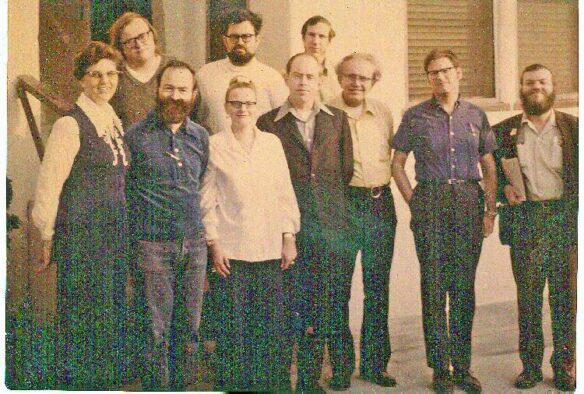
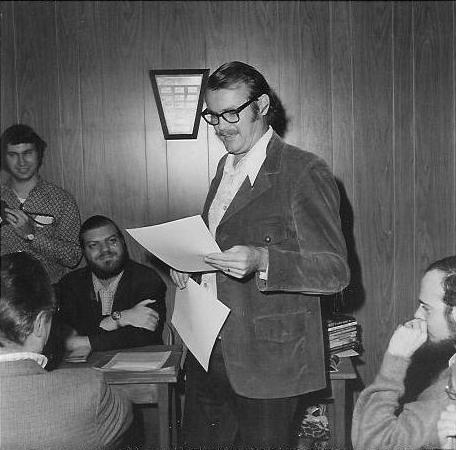
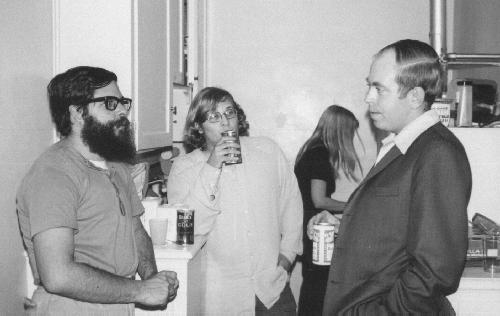
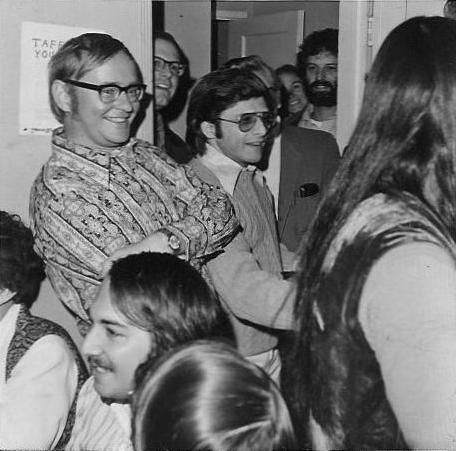
By SF Concatenation’s Jonathan Cowie: I suspect that I am not alone among Filers of a certain age who have a number of fan reunions each year. Last week I had my third of the year so far when a small number of first generation PSIFAns gathered in a town several rail stations north of St Albans (more of which shortly). PSIFA (the Polytechnic ScIence Fiction Association) was Hatfield Polytechnic’s (now Hertfordshire University’s) SF group founded back in 1978 (which is uncomfortably close to being half a century) ago.
PSIFA logo, sweat-shirt iteration
The Elephant House Student’s Union building – an exact miniature of London Regent’s Park Zoo’s elephant house – that provided the venue for the Shoestringcons.
PSIFA was known for its meetings of talks, films (that rivalled the college’s Film Appreciation Society), a Campus Radio (the first student radio station in the UK) SF show called Radio Free Entropy (the first fan radio show?), field trips to Novacon and Eastercon as well as London’s specialist SF bookshops, and a series of Shoestringcon SF conventions.
As it happened, at this week’s reunion gathering was the Chairman of Shoestringcon 1: Polycon. Go back to 1979 and the end-of-term euphoria and a bunch of PSIFAns were hanging out with the StAlbans SF group Staffen (StAlbans fen) in a pub not far from StAlbans rail station. Back then, much of the chat was about the then forthcoming Worldcon to be held in Brighton and some foolish wag suggested that PSIFA should run a mini-convention. It was decided to call it Shoestringcon as we knew that there would be comparisons with that year’s Worldcon and we wanted to signal that it was being run on a tight budget. The Staffen fans were enthusiastic in having some mugs run a convention in the next town. So, who to be the con’s Chair? Well, as it happened one PSIFAn was temporarily, absent in the toilets making a watery offering to Bacchus and so he was duly volunteered.
That individual was also present at the recent 2026 reunion and at some stage, once again, he went to make an offering to Bacchus. This time he wasn’t volunteered to be a con Chair but did return somewhat excited as the pub’s gents’ toilet had a picture of a flying Victorian and a stargate…
And lo, nearly half a century ago, the convention came to pass with GoHs Ken Bulmer and Mat Irvine. PSIFA is still going today but has (we hope temporarily) lapsed – seduced by the dark side – from being broad church SF group to a table top gaming society.
Having said all that, at these fan reunions, the years and decades simply melt away, it is as if we all last meet a week ago.
If London the first Thursday of the month belongs to the ‘London SF Circle’ a.k.a ‘The Globe’ a.k.a ’The One Tun’ and now ‘Bishop’s Finger’ SF fan meet (there’s a history), then the 2nd Thursday arguably belongs to South-East London’s Northumberland Heath Science Fiction Society which will be 10 years old in 2027. This group loosely sprang out of the former N W Kent SF (Phoenicians) meetings of the 1990s in Dartford that also met on 2nd Thursdays of the month.
Royal Oak
The group consists of a score or so of fans of whom several to a dozen regularly turn up to the 2nd Thursday meetings.
It is a broad church group with members being diverse and into different aspects of SF be it books, films, TV, comics and conventions or combinations thereof.
Some members go to conventions such as the well-established student con, PicoCon, at Imperial College in Kensington, or the longstanding Sci-Fi London film fest. In addition, there is a retired, as will as shift-worker, contingent who regularly (almost monthly) go to the cinema week-day afternoons.
The 2nd Thursday monthly meetings themselves are informal affairs of wide-ranging chat on many SFnal topics.
Meetings take place from 8:00 pm at the Royal Oak, (Google map search London DA8 3HB). This is either a 20-minute 229 bus east-bound, ride from Abbey Wood (rail and Elizabeth line) station (getting off at the Northumberland Park stop) or 5-minutes 229 bus north-bound from Barnehurst rail station getting off at the Mill Road stop (which is bang outside the pub).
All Filers welcome (and all encouraged to spread the word to any fan friends based in SE London).
This data is for any File 770 reader who has time flexibility during any period, and who is passing though Big Smoke London, UK. Especially re: the recently publicised and major items on in London now (i.e. Fairy Tales / British Library NW1 2DB and… Escher / Somerset House WC2R 1LA) — I’ve mentioned both of those in a previous File 770 posting.. One could combine all three, if timing is suitable. ]
By Dave Lally: London fandom’s regular monthly meet, known as the London “One Tun” or just “Tun” (don’t ask!) is one of the longest SF+F meets in the UK. It happens on the FIRST Thursday of every month (almost without fail, but see * below, if visiting in December and/or January).
From 1800->closing time in a London pub (real craft ale/hot food). No formality involved — just news, views etc. Local-to-London or (as may be the case for many File 770 readers) out-of-town, and just passing though: all are welcome.
Top floor (private) Bar: THE BISHOPS FINGER, West Smithfield. UK Postcode (zipcode) for internet maps: EC1A 9JR. Order your drinks and hot food on the ground floor. Your food will be brought up to you. Also note that this venue may prove difficult if one has a physical disability (steep stairs to the 1st floor: no lift).
Nearest public transport: —>Tube (London Underground) Barbican; —>Elizabeth Line : Farringdon (Nota Bene: use the Barbican exit and this rail line connects with London Heathrow Airport (IATA: LHR) on the west side of London); —>Main Line National Rail: Farringdon (that is on the “Thameslink” north-south rail line which –inter alia– connects with London’s Gatwick Airport (IATA: LGW) on the south side of London).
Amongst the past attendees at The Tun (tho then in a different location) was the now late Isaac Asimov in 1974 (on his then only visit to the UK).
* IMPORTANT : in recent years, the very 1st Thu of the month in January each year has seen said Pub closed (for staff vacation) so in January and only in that month, it is the SECOND Thu of the month. Also and only in December each year, as well as the usual 1st Thu meet, there is also a get-to-gether on the 3rd Thu of said month (known as “The Christmas Tun”).
And re this data –on appearing in File 770 — if possibly passing through the UK in a future visit, copy this data out now, as an email message to yourself (for future use) . It would be recommended to file it under (e.g.) “regular London SF meeting”: so if in the future, one has the info available, should one later decide to pass through the UK and on such passing through, one is there round the early part of each month.
The Los Angeles Science Fantasy Society officially opens their new clubhouse in Northridge, California on March 19, during the weekly Thursday evening meeting, followed by a Housewarming event on Sunday afternoon, March 22.
A storied history of genre fiction in Los Angeles. Early members included literary and entertainment legends Ray Bradbury, Ray Harryhausen and Forrest J Ackerman. The legendary members continue through today, as we celebrate current writers, Larry Niven, Steven Barnes and David Gerrold amongst our wide membership.
Doors open at 7pm weekly on Thursday evenings for our 8pm meeting. Guests can peruse the shelves before and after the procedural agenda.
The March 22 Housewarming event opens at 1pm and will feature panels with professional writers, Larry Niven, Craig Miller, and Gene Turnbow on how LASFS influenced their careers and a second panel of LASFS Officers, past and present, on the history of LASFS and the clubhouses. There will be a fundraising auction of genre memorabilia to benefit the organization.
The Los Angeles Science Fantasy Society, LASFS, was founded Oct. 27, 1934. It is the world’s oldest continuously active science-fiction and fantasy club. LASFS is composed of professional writers, aspiring writers, fans of genre literature, media, gaming and more. Notable members include Larry Niven, Ray Bradbury, Forrest J Ackerman, David Gerrold, and far too many to list here. Our unofficial motto is “Death Will Not Release You”.
The club maintains the largest privately owned lending library of Science Fiction and Fantasy in the world, with over 28,000 volumes.
For updates, follow LASFS on Facebook and Instagram, and search for #LASFS.
Los Angeles Science Fantasy Society 8819 Reseda Blvd. Northridge, CA 91324.
The Baltimore Science Fiction Society announced today that the BSFS Annual Poetry Contest has been renamed in honor of SF author Steve Miller. The official contest name is now the Steve Miller BSFS Annual Poetry Contest.
With the approval of Steve’s wife and collaborator, Sharon Lee, the BSFS membership voted to rename the contest. Steve passed away in February 2024.
The poetry contest was founded in 2008, and has continued annually since then, regularly garnering hundreds of entries from around the world. Winning poets receive a cash prize and have their poems published on the BSFS website and in the BSFAN, the souvenir book for Balticon, the annual convention sponsored by BSFS on Memorial Day weekend. They are also granted a full weekend membership and are invited to read their winning entries.
Complete rules and winning entries for previous years can be found here.
By Žarko Milićević: On Monday March 11, 2024, at Belgrade Youth Center, Serbia, the “Lazar Komarčić” Science Fiction and Fantasy Society held a lecture on the beginnings of genre publishing in Serbia/Yugoslavia. The lecturers were Miodrag Milovanović, author of Srpska naučna fantastika (Serbian science fiction, 2016) and Žarko Milićević (LK society’s president, on blueskyfacebook or nerazuman(at)gmail.com).
Since this is the first time we’re reporting: “Lazar Komarčić” Science Fiction and Fantasy Society is from Belgrade, Serbia, established 1981. Meetings are held every Monday at 19:00. Our host is the Belgrade Youth Center. Each monthly meeting is a panel / discussion / presentation (new books/comics) / book club. Our fanzine Emitor, which won best fanzine at 2014 Eurocon, published its 500th issue in September 2023. You can find some scans here. In #500 there is an almost complete list of all panels 1981-2023, and we’re trying to list the conventions and con programmes next.
Website www.emitor.rs fell into disuse but has plenty of non-current material. Online we hang out on Facebook mostly, also Instagram. Write at lazarkomarcic (at) gmail.com
These are the key parts of the lecture:
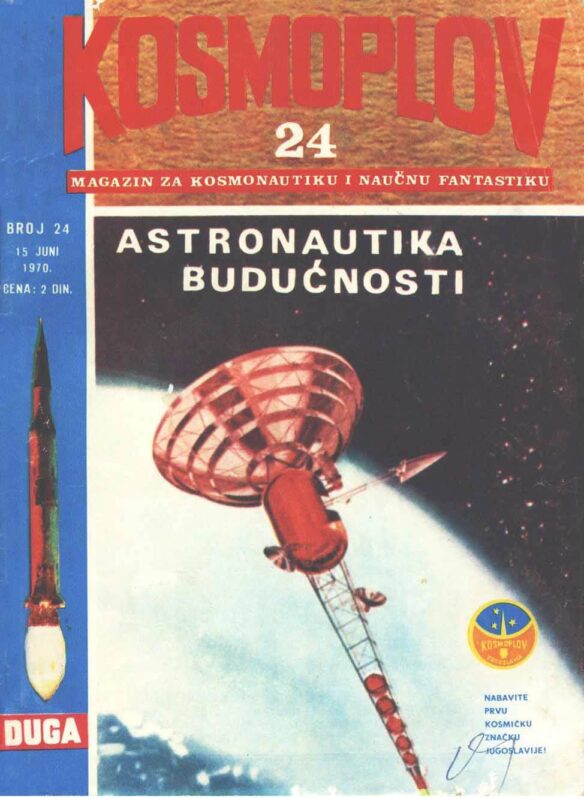
55 YEARS OF KOSMOPLOV – Beginnings of genre publishing
The 60s were a time of print magazines: there were school magazines, youth magazines, technology, home economics, astronautics, DIY, etc… magazines, and in almost every one (and also in daily and weekly newspapers) stories or novels in sequels were published, often of the science fiction genre which was on the rise during the Space Race. However none was dedicated specifically to science fiction. Same thing applies to books and book series.
Newspaper publishing company “Duga”, Belgrade, started a popular pulp magazine 300 ČUDA (300 wonders) in 1954. with sub-pages ZELENI DODATAK and PLAVI DODATAK that occasionally contained science fiction novels and SF stories. (300 ČUDA ended in 1974.)
“Dnevnik” from Novi Sad, Serbia, launched the pulp novel series X100 in 1962. with crime / western / sf novels, with over 1000 issues. Much later, in the 80s they launched the SF-only series X-100 SF.
In 1967, the publishing house “Yugoslavia”, Belgrade, launched the KENTAUR science fiction series under the editorship of Ivan V. Lalić and Vitomir Korać. Impressive edition, 8 books, hardcover, black and white covers, sadly put to end immediately.
KOSMOPLOV (interslavic for Spaceship) was launched in 1968 by “Duga”, as a specialized magazine for Cosmonautics and Science Fiction, edited by Gavrilo Gaja Vučković. It was the first specialized publication that had SF as an key and integral part of its editorial intention, as well as its name. KOSMOPLOV had color covers, 72 pages, 24 issues, starting as a monthly and then sped up to biweekly. Content was mainly western SF, in contrast to mostly Soviet stories that were available in the 40s and 50s. Vučković also started asking for Yugoslav authors, and published them under real names (most authors were published under foreign sounding pen names because rates were larger for “translation”, which gives researchers huge problems when establishing authorship).
KOSMOPLOV was shut down in June 1970, when the publisher fell into financial problems. It sold well enough on its own, so Vučković practically immediately after the demise of KOSMOPLOV successfully pitched a new magazine named GALAKSIJA (Galaxy) with similar concept, broadening the subject first to aeronautics and then to popular science and computer programming.
The first issue of GALAKSIJA was published in March 1972. Vučković continued publishing SF stories. The company “Duga” that owned GALAKSIJA was dissolved in 1974 for dissident and anti-communist content in their flagship magazine DUGA, and annexed to another publisher “BIGZ” (Beogradski izdavački grafički zavod). Some of the magazines were dropped, but GALAKSIJA continued to grow, while gradually reducing the space dedicated to SF. Vučković published ANDROMEDA in 1976, a first SF collection as kind of a best-of stories from GALAKSIJA, and also enlisted Zoran Živković as translator and editor. It was a huge success and sold out its 10,000 copies, and had three yearly issues.
Croatian publishing company “Vjesnik” launched SIRIUS, also in 1976, which became the best known SF magazine in Yugoslavia, attaining the largest circulation in Europe for a genre magazine, and winning two ESFS prizes.
The success of ANDROMEDA urged the revival of “Yugoslavia’s” SF series KENTAUR, a series that set a tremendously high bar, and won its editor Ivan V. Lalić an ESFS award also, at Eurocon in Poznan, Poland, 1976.
This lecture stops at the end of the 70s. The golden age of Yugoslav SF are the 70s and the 80s (marked by Živković’ publishing company “Polaris”). With the country’s demise in the 90s, the economic crash and the civil war, all these publications were slowly put to an end.
The 90s are a separate story now with separate countries, and separate attempts to revive the genre magazines, and that’s a topic for another lecture, as well as the history of fan organizations that started forming during the late 70s. Next time 🙂
[INTRODUCTION. I got a little misty reading Heath Row’s article inThe Stf Amateur about LASFS divesting some of its fanzine files. Since the clubhouse was sold in 2016 these decades-old legacies have been in a storage unit, and the club is no longer willing to bear the cost. The good news is part of them will end up filling gaps in the Eaton Collection at UC Riverside, with the remainder hopefully accepted by the University of Iowa’s collection, so the materials will live on. While people were pulling stuff out of the unit they also found some club heirlooms. Heath Row gaveFile 770 permission to run his account of the work party.]
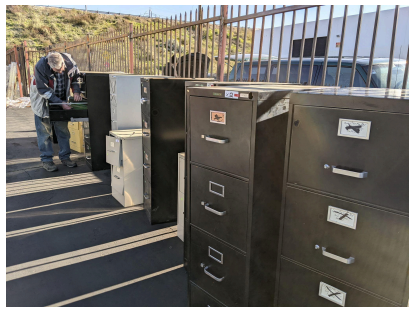
By Heath Row: Fun with Fanzines. Last weekend, I went to Sylmar to join a handful of LASFSans in cleaning out one of the club’s storage units. At the December board meeting, Elayne Pelz informed the board that the unit’s monthly cost had increased substantially, and the board voted to divest the club of the filing cabinets holding the club’s archives and various clubzine back issues, including De Profundis, APA-L, and LASFAPA.
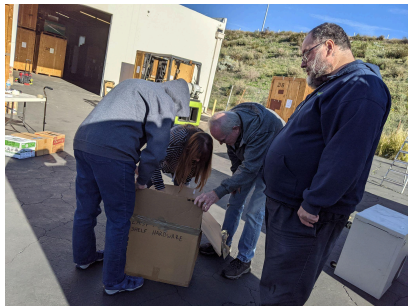
I went to see how much of those I could salvage, box, and fit in our car, for donation to the Eaton Collection of Science Fiction & Fantasy at the University of California, Riverside, and the Iowa Archives of the Avant-Garde at the University of Iowa, which has a sizable holding of apae material, including my previous donations. Pelz had previously reached out to potential homes, finding no takers, but I was able to identify and secure interest. The storage unit in question is not one we have ready access to. Materials are stored in large, wooden walk-in crates—pods—that are then warehoused. With a work group involving Pelz, Christian B. McGuire, Cathy and Dean Johnson, Gavin Claypool, and myself, we were able to empty three of five such crates, cutting the club’s storage costs substantially.
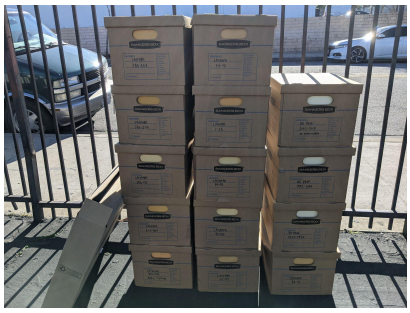
The resulting Banker’s boxes, now in my storage.
Over the course of several hours, I was able to prepare almost 20 Banker’s boxes of De Profundis dating back to 1957 (three boxes), APA-L #1-360 (five boxes), and LASFAPA #1-487 (11 boxes). While no archive wants the hard copy APA-Ls—they’re scanned and available online—the other materials will eventually go to Eaton. Duplicates from their holdings will hopefully go to Iowa.
Gavin Claypool and some of the filing cabinets for disposal.
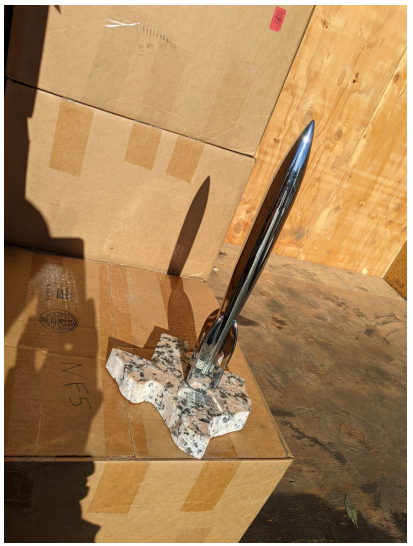
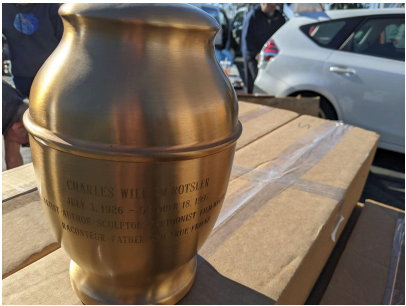
Pelz plans to donate early materials from the 1940s and 1950s to Fanac. Cathy Johnson assessed the club archives, and as far as I know, only clubzine and apae materials were set aside for disposal. (I didn’t see any back issues of Shangri L’Affaires, but there weren’t any in the cabinets we got rid of, so they’re still in storage.) After I’d boxed the materials I wanted to salvage, I got a chance to see some other prime holdings of the club. That included William Rotsler’s 1997 Hugo for Best Fan Artist and the urn that held his ashes after cremation. His ashes were subsequently spread by his family; the urn is empty.
Rotsler’s 1997 Hugo for Best Fan Artist.Rotsler’s urn
I also learned about a new—to me—LASFS-oriented apa, SSAPA, or the Second Sunday APA. It debuted April 14, 2002, and didn’t seem to last long. Does anyone remember anything about the SSAPA? (Joe Zeff, perhaps? You were in #1!) One additional vignette: When we identified the filing cabinets containing LASFAPA, they were locked. There was an assortment of keys and padlocks on hand, but none of the keys worked for those cabinets. I was worried we wouldn’t even be able to open them. I tried to jimmy it open with a flat key ring attachment, and Dean Johnson used what few tools he’d brought. Then we had the storage unit staff drill the lock bolts out! That did the trick.
The Greater Columbia Fantasy Costumers Guild, owing a staggering attrition penalty after failing to meet the hotel room block commitment for Costume-Con 40 in 2022, has announced they will dissolve.
Jamie Peddicord, the group’s representative on the International Costumers’ Guild Board of Directors, made the announcement on Facebook.
GCFCG logo
I unfortunately have some difficult news to share. You might be aware that Greater Columbia Fantasy Costumers Guild (GCFCG) did not have the attendance we needed at Costume-Con 40 to meet the room block for the hotel, which is in large part because of complications due to the COVID-19 pandemic.
One thing that worked against us is that the hotel penalized the convention heavily for not reaching a room block practically doubling the bill to $200,000. Since the con the guild has worked hard to come up with some means of paying the hotel to be able to continue the chapter and unfortunately we have exhausted our options.
The chapter board of directors, after looking at every option possible, had to come to the extremely difficult decision, due to the unmanageable debt, to dissolve the GCFCG. This is definitely not something we are doing lightly and to quote Sarah [Richardson] “It is painful and it hurts, but it has to be done.”
The GoFundMe appeal Richardson set up for the group last year only raised $1130. As she explained at the time:
…Many of our attendees, especially our international members, were unable to attend due to Covid travel restrictions were levied right before the convention. Because of this, over a fourth of our registered members (100+ people) were not able to attend. This led to our not meeting the room night obligations in our contract, and so we must pay a hefty “attrition” penalty….
Formed in 1982, the GCFCG was the founding chapter of the International Costumers’ Guild. Plans are being made for a new ICG chapter in Maryland.
By Mike Glyer: Fifty years ago on October 25, 1973 the Los Angeles Science Fantasy Society met for the first time in its very own clubhouse. Founded in 1934 in a member’s garage, over the decades the club led a nomadic existence, at better times meeting in Clifton’s Cafeteria, or the former beauty shop it rented on Bixel Street, or a room at the Palms Park Playground, and even a Unitarian Church parish hall. But sooner or later the LASFS always had to move on.
In the Sixties treasurer Paul Turner helped members catch the vision of buying their own clubhouse. They incorporated LASFS as a non-profit educational organization and started a Building Fund. When Bruce Pelz took over as treasurer a few years later fundraising really intensified. Every bit helped – I remember at the 1970 Directors Dinner where Harlan Ellison was guest speaker, Len Moffatt and others auctioned off their desserts for the fund. By 1973 there was over $26,000 in the fund.
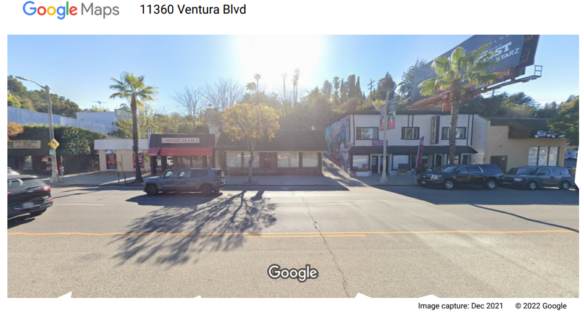
Although the club had always met in central Los Angeles, due to property prices the directors started looking in the San Fernando Valley. They found a building that was about the right size and price in the Studio City area, a former single-family residence which had been remodeled for use as a small shop on one of the Valley’s busiest streets. In August the club voted to buy the property at 11360 Ventura Boulevard in the Studio City neighborhood for $32,000.
LASFS Board of Directors outside the first clubhouse. Back row: Bill Warren, Bruce Pelz, Drew Sanders. Front row: June Moffatt, Phil Castora, Fuzzy Pink Niven, Milt Stevens, Dave Fox, Fred Patten, and Dan Alderson.
Chairman of the Board of Directors of the LASFS Milt Stevens did the time-consuming work of getting all inspections and preparatory financial arrangements made. Fans spread the word that the first meeting would be held on October 25. Members chipped in to buy large numbers of folding chairs – with the inducement that each chair would have a little stick-on plaque with the donor’s name.
And on that night a famous society reporter captured all the important details of the celebration:
BY TALLULAH FUGGHEAD. Christmas season came early to Tinsel Town as the members of the nation’s oldest science fiction club gathered to unwrap their new toy, the Clubhouse. Announcements had been sent to the roster of former attendees and to several pros in the area inviting them to attend. 108 people showed up to vibrate and soak up the gemutlichheit. Pros included Larry Niven, Jerry Pournelle, Ray Bradbury, Harlan Ellison, George Clayton Johnson, Ted Sturgeon, Mitchell Harding, Ron Cobb and who else but Forry Ackerman.
Despite the crunch, the meeting went extremely smoothly and even started on time. Pournelle, as President of the SFWA, read a congratulatory speech and relayed a very warm and egoboosting phonecall from Robert Heinlein.
SFWA President Jerry Pournelle reads a congratulatory letter from Robert A. Heinlein.
From the Science Fiction Writers of America. Science fiction clubs and SF fandom are a nearly unique phenomenon. Few other literary genre enjoy this kind of enthusiastic support from their readers. Not long ago, the Los Angeles Shakespeare Society lost its clubhouse — and here is LASFS, moving into its own. We’re the wave of the future, all right. We presume that within a few years you will install a Dean Drive or Daleth Effect engines or some other means of locomotion for a tour of the solar system. We trust that we’ll be invited for the second cruise. On behalf of all the members of the SFWA, congratulations to LASFS, Inc. on the realization of a dream. /signed/ Jerry Pournelle
From Robert A. Heinlein. To the Officers and Members of LASFS: At last a home of our own!! I joined the LASFS in December of 1938, or possibly January 1939. It was at a meeting of the Hollywood chapter at which Forrest J. announced that a new magazine — UNKNOWN WORLDS — would be on the stands in February 1939: so that makes me a junior member, as the club was established five years earlier. I met Russ Hodgkins that night, and other old timers. Morojo, Forrest J., Doc Daugherty, and others — then started attending meetings at Clifton’s Cafeteria and met Hank Kuttner, Jack Williamson, Julie Schwartz, Bob Olson, Frank Brady, Ray Bradbury, Bruce Yerke, Pogo and many others. I remained active until after Pearl Harbor, then settled in Colorado after the war — and have never joined any other SF club, and thought of myself as still a member. In fact I was told so several years running. What is your lifetime non-resident fee for an old crock whose life expectancy is now 13 years, if they don’t lynch him first? I’ll pay it. Again, congratulations to us all on achieving a dream that started almost 40 years ago — and seemed as fantastic then as atomic bombs, nuclear power, men on the moon, and other such nonsense — nonsense to all practical, clearthinking, sober citizens who wouldn’t be caught dead reading one of those silly magazines with space ships on the cover. Warmest greetings to my fellow dreamers, /signed/ Robert A. Heinlein.
There were also good wishes from another cherished sff author.
From Theodore Sturgeon. Dear and valued LASFS. Without readers a writer would be somewhat less than nothing. Without the SF reader, the most passionate and talented SF writer would have nowhere to go. Without the SF fan, who is the most ardent and the most articulate of all readers, I would have been without the notice and encouragement which has been so valuable to me all my writing life. LASFS is the archetype of fandom, and as I celebrate this occasion with you, I welcome the chance to express my gratitude. Thank you. /signed/ Theodore Sturgeon
Ackerman talked about the club’s origins, and read a list of the loved departed, like Ron Ellik. The program was a slide show of the history of LASFS meeting places, including a Polaroid slide of Forry taken minutes before at THE Clubhouse, which LASFS may even decide to formally name “Evans-Freehafer Hall,” to honor a lapsed Tradition.
Traditionally, this type of program would evacuate the meeting more than the usual program, but interest held up. LASFS, of course, is an excuse to talk; some quiet types listen, instead, but they aren’t really faaaans, now are they? So the “meeting” exists on three levels: The Formal Meeting cum Program, the groupings that talk to each other outside the meeting. And the APA L collation and attendant talking. Praise Herbie and pass the insulation.
The attendees were too impressed by the actual B*U*I*L*D*I*N*G and the Population Density (as dense as usual) to infight, though Bjo suffered from Crowdstrophobia. The one anticipated issue, smoking, turned out to be no problem due to the evening breeze and the ceiling fans. Physically, the modest bungalow (fire marshal rated at 80 people max) has a meeting room the size of two living room cubicles (and thus half is paneled, half is painted an orcish yellow, with no trace of the knocked-down wall that separated them). The den is also paneled, but will soon be LASFS Library book-lined. Kitchen is painted green, service room blue, and the corridor reddish-purple, color-coordinated by Shirley Scrounge.
Dan Goodman, Craig Miller and Milt Stevens in the kitchen.
The back of the main meeting room, looking into the service room. Standing: Jack Harness, Fred Patten (in doorway), Harlan Ellison. Foreground: Elst Weinstein.
$25 grand paid down, with the remaining $7,000 handled by personal bank loans, which will have to be repaid. The chairs were personally paid for so swiftly, with plaques (“endowed” as the term goes) that a couple of paid-for hoaxes have to be combined with others, or something. LASFS may have some deadbeat members, but two hoaxes have dues paid scrupulously by their perpetrators.
Fan Historians are alerted that the first person to utilize the LASFS Toilet during a meeting was Ray Bradbury.
A hundred copies of a 65-page APA L were collated and distributed in amongst the program and talking, and eventually the meeting dispersed to check out nearby restaurants for the after-meeting discussions. About ten years to the day before this meeting, the Building Fund was started, and behold, we have the first Pandemonium. Well, Talu has to cover the Fatty Arbuckle scandal now, so goodbye until tomorrow.
(Rumors abound that Tallulah was a fan whose writing style would be instantly recognizable to those who had been active some years in the past. I’m pretty sure it was Jack Harness.)
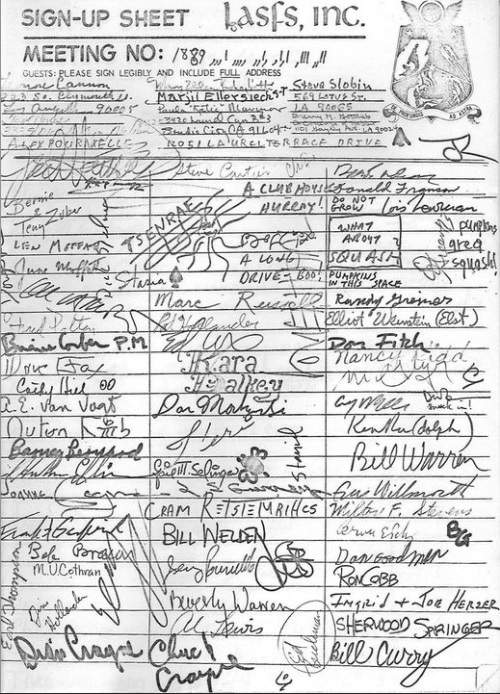
Here is the top page of the sign-in sheet from the first meeting. My name is scrawled in the third column twelve lines down, right after Nancy Kidd and before Craig Miller.
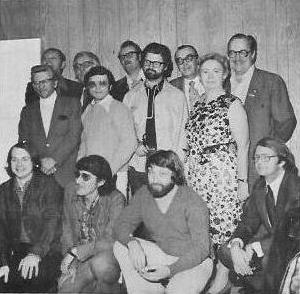
And most of the pros on hand were assembled for a photo in the paneled back room where eventually the club’s library would be squeezed.
First meeting at the original LASFS clubhouse in 1973. Photo by Stan Burns. Back row, L to R: Robert Bloch, Ray Bradbury, Jerry Pournelle, A. E. Van Vogt, Forry Ackerman. Middle row, L to R: Unknown, Harlan Ellison, Larry Niven, Wendayne Ackerman, Uknown. Front row, L to R: Unknown, Bill Mills, Ron Cobb.
Bruce Pelz confirmed the rumor Sandy Cohen circulated that night that the club would be starting a new Building Fund immediately to buy a bigger building. Surprisingly, that didn’t take very long, either. In 1977 the LASFS replaced it with a larger clubhouse at 11513 Burbank Boulevard in North Hollywood, where meetings attracted as many as 150 fans a week.
Here’s a recent photo of the old place — the building in the center. Some windows have been enlarged since the LASFS was there.
MITSFS’ Kat Allen has given an update about the club library materials that suffered water damage in February, and work to repair the club’s space on campus.
As previously reported, over the February 4-5 weekend water pipes in the MIT Student Center in Boston froze and burst, causing significant damage throughout the building including to the fourth floor where the MIT Science Fiction Society club library is housed. The MITSFS Library, the world’s largest public open-shelf collection of science fiction, had an inch of water in it. Students initially were denied access to the area to rescue books for several weeks, but eventually they were able to assess the extensive mold damage that occurred (see “MITSFS Library Damage Assessed”.)
Kat Allen told NESFA President Rick Kovalcik:
We were able to get MIT to pay to have the collection moved by book preservation specialists, who could address the water damage issues. Now it is in special storage with that company, waiting for the student center renovations to complete—the original timeline for those renovations was August, but I don’t think we were given any updated dates when the scope increased due to the water-damage-caused asbestos remediation.
So “we’ll be back in August maybe, TBD” is the status of the Library, and the Society is back to being mostly online like we were during the pandemic.