
Business Intelligence is the talk of a new changing and growing world that can be defined as a set of concepts and methodologies to improve decision-making in business through the use of facts and fact-based systems. The Goal of Business Intelligence is to improve decision-making in business ideas and analysis. Business Intelligence is not just a concept; it’s a group of concepts and methodologies. Business Intelligence uses analytics and gut feelings for making decisions.
Business Intelligence Overview
Business intelligence refers to a collection of mathematical models and analysis methods that utilize data to produce valuable information and insight for making important decisions.
Main Components of Business Intelligence System:
- Data Source
- Data Mart / Data Warehouse
- Data Exploration
- Data Mining
- Optimization
- Decisions
1. Data Source
The first step is gathering and consolidating data from an array of primary and secondary sources. These sources vary in origin and format, consisting mainly of operational system data but also potentially containing unstructured documents like emails and data from external providers.
2. Data Mart / Data Warehouse
Through the utilization of extraction and transformation tools, also known as extract, transform, load (ETL), data is acquired from various sources and saved in databases designed specifically for business intelligence analysis. These databases, commonly known as data warehouses and data marts, serve as a centralized location for the gathered data.
3. Data Exploration
The third level of the pyramid offers essential resources for conducting a passive analysis in business intelligence. These resources include query and reporting systems, along with statistical methods. These techniques are referred to as passive because decision makers must first develop ideas or establish criteria for data extraction before utilizing analysis tools to uncover answers and confirm their initial theories. For example, a sales manager might observe a decrease in revenues in a particular geographic region for a specific demographic of customers. In response, she could utilize extraction and visualization tools to confirm her hypothesis and then use statistical testing to validate her findings based on the data.
4. Data Mining
The fourth level, known as active business intelligence methodologies, focuses on extracting valuable information and knowledge from data. We will delve into various techniques such as mathematical models, pattern recognition, machine learning and data mining. Unlike the tools discussed in the previous level, active models do not rely on decision makers to come up with hypothesis but instead aim to enhance their understanding.
5. Optimization
As you ascend the pyramid, you'll encounter optimization models that empower you to choose the most optimal course of action among various alternatives, which can often be quite extensive or even endless. These models have also been effectively incorporated in marketing and logistics.
6. Decisions
At last, the pinnacle of the pyramid reflects the ultimate decision made and put into action, serving as the logical end to the decision-making process. Despite the availability and effective utilization of business intelligence methodologies, the decision still lies in the hands of the decision makers, who can incorporate informal and unstructured information to fine-tune and revise the suggestions and outcomes generated by mathematical models.
Role of Business Intelligence
The characteristics of a business intelligence analysis can be summarized by a rational and methodical approach.
- Firstly, the objectives are clearly identified and performance indicators are chosen to evaluate different options.
- Next, mathematical models are created by utilizing the connections between control variables, parameters and evaluation metrics.
- Finally, "what-if" scenarios are explored to understand the impact of changing control variables and parameters on performance.
Process Used in Business Intelligence
BI (Business Intelligence) uses a set of processes, technologies and tools (such as Informatica/IBM) to transform raw data into meaningful information and then transform information to provide knowledge. Then afterwards some beneficial insights can be extracted manually and by some software then the decision-makers can make an impact decision on the basis of insights.
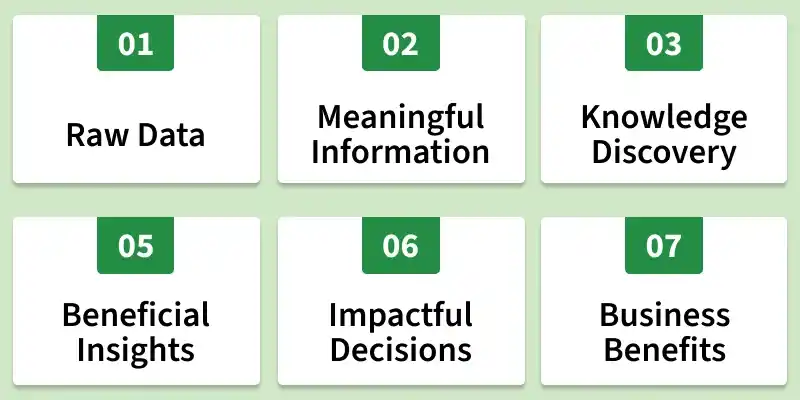
To sound short and clear Business Intelligence provides accurate information in the right and ethical format to the decision-makers of the organization. Some Important features of Business Intelligence are:
- Fact-based decision making.
- 360 degrees perspective on your business.
- Measurement for creating KPI (Key Performance Indicators) on the basis of historic data fed into the system.
- Identify the benchmark and then set the benchmarks for different processes.
- Identify market trends and also to spot business problems that need to be identified and solved.
Types of Users of Business Intelligence
- Analyst (Data Analyst or Business Analyst): They are the statistician of the company, they used BI on the basis of historical data priorly stored in the system.
- Head or Manager of the Company: Head of the company uses Business Intelligence used to increase the profitability of their company by increasing the efficiency in their decisions on the basis of all the knowledge they discovered.
- Small Business Owners: Can be used by a small businessman because it is quite affordable too.
- Government Officials: In the decision-making of the government.
Types of Decisions Supported by Business Intelligence
- Strategic Level: The strategic level is the level where the Heads of the company decide the strategies of any business.
- Tactical Level: Once the strategy is made though for handling all the details and matters have a tactical level where all the technologies and methodologies come under one umbrella. This level is further responsible for continuously updating the data.
- Operational Level: Operation decisions are made at this level. Operational decisions help in operating the system.
Applications of Business Intelligence
- In Decision Making of the company .
- In Data Mining while extracting knowledge.
- In Operational Analytics and operational management.
- In Predictive Analytics.
- In Prescriptive Analytics.
- In Executive Information System (EIS).
Comparison Table: Popular Business Intelligence Tools
| BI Tool | Overview | Deployment | Key Strengths |
|---|---|---|---|
| Tableau | Data visualization tool for dashboards and insights | Desktop, Cloud | Strong visuals, user-friendly, large community |
| Power BI | Microsoft BI tool for data analysis and reporting | Cloud, Desktop | Affordable, integrates with Microsoft ecosystem |
| QlikView | BI platform for interactive data exploration | Desktop, Cloud | Powerful data exploration, strong self-service BI |
| SAP BusinessObjects | Enterprise BI suite for reporting and analytics | On-premises, Cloud | Enterprise-grade, strong SAP integration |
| IBM Cognos | BI tool for reporting and performance management | Cloud, On-premises | Scalable, strong governance features |
| Oracle BI | BI suite for reporting and analytics | On-premises, Cloud | Robust analytics, Oracle ecosystem support |
| Looker | Modern BI tool for dashboards and data exploration | Cloud | Great collaboration, SQL-based analytics |