
A server is a program that listens to client requests and responds with data, such as web pages or APIs. Servers are essential for hosting websites, handling user requests, and serving dynamic content.
ExpressJS simplifies server creation in Node.js by providing an easy-to-use API for handling requests, responses, and middleware
- Fast & Lightweight: Express makes building servers quick and efficient.
- Simplified Routing: Easily handle different URL paths and HTTP methods.
Build Your First ExpressJS Server
Follow these steps to create a basic Express server with an HTML page.
Step 1: Create a Project Folder
Open your terminal or VS Code and create a new folder named root. Navigate inside it.
mkdir express-app
cd express-app
Step 2: Initialize a Node.js Project
Run the following command to create a package.json file, which manages dependencies.
npm init -y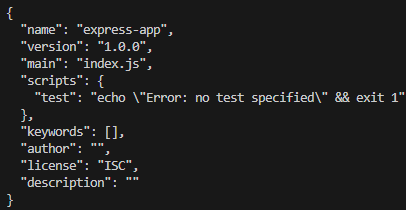
Step 3: Install ExpressJS
Install Express as a dependency to set up your server.
npm i expressDependencies:
"dependencies": {
    "express": "^4.18.2",
}
Step 4: Create the Server File
Create a file named server.js in your project directory and add the following code
const express = require('express');
const app = express();
const PORT = 3000;

app.get('/', (req, res) => {
    res.send('<h1>Hello, Geeks!</h1><p>This is your simple Express server.</p>');
});

app.listen(PORT, () => {
    console.log(`Server is listening at http://localhost:${PORT}`);
});
Step 5: Start the Server
In the terminal, start your server with the following command:
node server.jsOutput
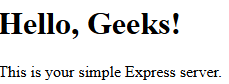
- Import Express: Loads the Express module.
- Create an App Instance: Initializes the Express application.
- Define a Port: Sets the port number to 3000.
- Set Up a Route: Defines a route for the root URL (/) that sends an HTML response.
- Start the Server: Begins listening on the specified port and logs a message to the console.