
Sentiment Analysis is an NLP technique used to identify emotions, opinions, and attitudes expressed in textual data. It helps classify text as positive, negative, or neutral for better understanding of customer feedback and public opinion.
- Detects emotional tone and opinions from textual data
- Analyzes large volumes of text using machine learning and deep learning techniques
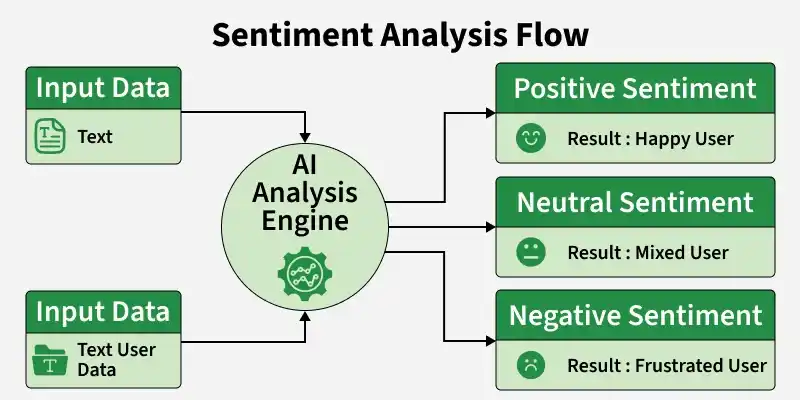
Types
1. Fine-Grained Sentiment Analysis
- Fine-grained sentiment analysis rates sentiment on multiple levels rather than just positive, negative or neutral.
- It can categorise text as very positive, positive, neutral, negative or very negative, often using a numerical scale like 1–5 stars.
- For example, product review ratings on e-commerce platforms.
2. Emotion Detection
- Emotion detection identifies specific emotions in text such as joy, sadness, anger, fear, or excitement.
- It helps understand deeper emotional context beyond simple positive, negative, or neutral sentiment classification.
3. Aspect-Based Sentiment Analysis
- Aspect-based sentiment analysis focuses on specific features or attributes of a product or service.
- For a smartphone review, it separately analyzes battery, screen, camera and performance to understand customer sentiment for each aspect.
4. Multilingual Sentiment Analysis
- Multilingual sentiment analysis works on text written in multiple languages.
- It is highly challenging due to variations in grammar, syntax and cultural expressions across languages but it is essential for global applications.
5. Intent-Based Sentiment Analysis
- Intent-based sentiment analysis identifies the underlying intention behind the text in addition to its sentiment.
- For example, Detecting purchase intent from reviews mentioning discounts, deals or offers in e-commerce.
Approaches to Sentiment Analysis
1. Rule-Based Approach
The rule-based approach relies on predefined lexicons and rules to classify text as positive, negative or neutral.
- Counts positive and negative words using a sentiment dictionary.
- Handles simple phrases well, including some negations like “not bad”.
- Easy to implement, interpretable, no training required.
- Hard to scale, limited accuracy for complex sentences, requires continuous lexicon updates.
2. Machine Learning Approach
The machine learning (ML) approach trains models to automatically learn sentiment patterns from labeled data.
- Algorithms include Naive Bayes, Support Vector Machines (SVM), Random Forest and others.
- Text is converted into numeric features using TF-IDF or Bag-of-Words.
- Can handle large datasets, captures complex patterns and relationships.
- Requires large labeled datasets, domain-specific models and retraining needed for new domains.
3. Neural Network / Deep Learning Approach
This approach uses neural networks to capture contextual and sequential information in text.
- Common architectures include RNN, LSTM, GRU and Transformers.
- Excels at handling long sentences and context-aware sentiment.
- High accuracy, captures context and nuances, state-of-the-art performance.
- Computationally expensive and hence requires significant training data.
4. Hybrid Approach
The hybrid approach combines rule-based and ML/deep learning methods to improve both speed and accuracy.
- Uses the lexicon-based rules for quick initial classification.
- Uses ML or deep learning to refine predictions and handle complex sentences.
- Better accuracy than individual approaches, adaptable.
- Complex to implement, requires integration of multiple systems.
Working
Step 1: Preprocessing
Preprocessing ensures text is clean and standardized for analysis:
- Text Cleaning: Remove HTML tags, special characters, numbers and emojis.
- Tokenization: Split sentences into words or tokens.
- Stop-word Removal: Filter out common words like "and", "the", "is."
- Stemming/Lemmatization: Reduce words to root forms.
- Handling Emojis and Slang: Convert emojis or slang to standard words for analysis.
Step 2: Feature Extraction
Convert text to numeric representation using:
- Bag of Words: Converts text into word-count vectors based on vocabulary.
- TF-IDF (Term Frequency-Inverse Document Frequency): Gives higher weight to important words and lower weight to common ones.
- Word Embeddings: Represent words as dense vectors that capture meaning and relationships. Similar words get similar vectors, helping models understand context better.
Step 3: Sentiment Classification
- Model Training: Use labeled datasets to train models.
- Prediction: Assign sentiment labels to new text based on learned patterns.
- Post-processing: Aggregate sentiment scores across multiple sentences or aspects.
Sentiment Analysis vs Semantic Analysis
Feature | Sentiment Analysis | Semantic Analysis |
|---|---|---|
Purpose | Determines emotional tone in text | Understands the actual meaning and relationships in text. |
Focus | Focuses on opinions, emotions and feelings. | Focuses on context, concepts and word sense. |
Techniques Used | Lexicon-based methods, ML models, deep learning | NER, semantic role labeling, dependency parsing, ontologies |
Context Handling | Limited ability to interpret context and sarcasm. | Strong emphasis on context and word relationships. |
Use Cases | Social media monitoring, reviews, customer feedback. | Chatbots, search engines, QA systems, knowledge graphs. |
Tools and Libraries for Sentiment Analysis
- Python Libraries: NLTK, TextBlob, VaderSentiment, SpaCy
- Deep Learning Frameworks: TensorFlow, PyTorch
- Pretrained Models: BERT, RoBERTa, DistilBERT
- Cloud Services: AWS Comprehend, Google Cloud Natural Language, IBM Watson NLP
Advantages
- Customer Feedback Analysis: Analyze reviews and surveys to identify issues and improve customer satisfaction.
- Brand Reputation Management: Track public sentiment across social media and review platforms in real-time.
- Product and Marketing Improvement: Evaluate product features and campaign performance using customer reactions.
- Scalable and Cost-Effective Analysis: Process large volumes of text quickly with reduced manual effort.
- Improved Decision-Making: Support better business strategies and personalized customer experiences using sentiment insights.
Limitations
- Domain Dependency: Models trained for one domain may fail in another.
- Handling Slang and Emojis: Informal language and emoticons are often difficult to interpret accurately.
- Neutral or Mixed Sentiments: Hard to classify statements expressing both positive and negative opinions.
- Data Quality Issues: Noisy or unstructured text can reduce accuracy significantly.