
Machine Learning (ML) is a branch of artificial intelligence that enables systems to learn from data and make predictions or decisions without explicit programming. It helps computers identify patterns, improve performance over time, and automate intelligent tasks across various industries.
- Learns patterns and relationships from large amounts of data
- Automates predictions, recommendations, and decision-making processes
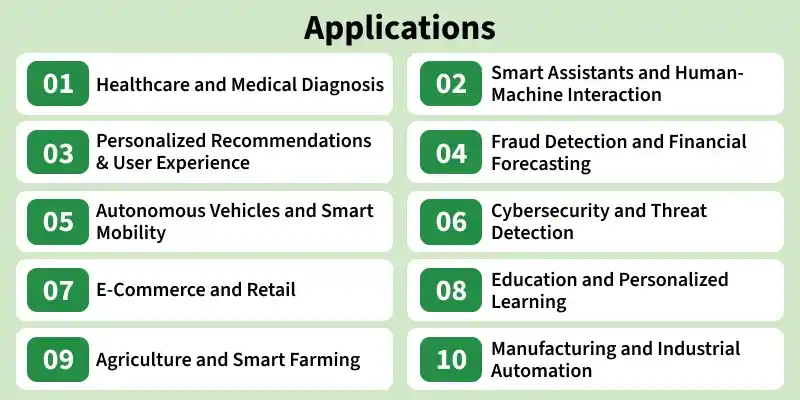
1. Healthcare and Medical Diagnosis
ML algorithms can analyze large volumes of patient data, medical scans and genetic information to aid in diagnosis and treatment.
- Disease Detection: ML models are used to identify diseases like cancer, pneumonia and Parkinson’s from medical images. They often achieve accuracy comparable to or better than human doctors.
- Predictive Analytics: By analyzing patient history and symptoms, models can predict the risk of certain diseases or potential complications.
- Drug Discovery: ML accelerates the drug development process by predicting how different compounds will interact, reducing the time and cost of research.
2. Smart Assistants and Human-Machine Interaction
Virtual assistants systems rely on natural language processing (NLP) and speech recognition to understand commands and respond intelligently.
- Voice Assistants: Tools like Siri, Alexa and Google Assistant convert spoken input into actionable commands.
- Voice Search & Transcription: ML enables users to perform hands-free web searches and get transcription during meetings or phone calls.
- Chatbots: Businesses use AI-powered chatbots for 24/7 customer support, helping resolve queries faster and more efficiently.
3. Personalized Recommendations and User Experience
Modern digital platforms uses personalization which is done by using recommender systems. Machine learning models analyze user behavior to deliver relevant content, improving engagement and satisfaction.
- Streaming Platforms: Netflix and Spotify suggest shows and songs based on your watching or listening history.
- E-commerce: Sites like Amazon recommend products tailored to your preferences, browsing patterns and past purchases.
- Social Media: Algorithms curate content feeds, prioritize posts and suggest friends or pages.
These systems use techniques like collaborative filtering and content-based filtering to create personalized digital experiences.
4. Fraud Detection and Financial Forecasting
In finance, vast sums of money move digitally and machine learning plays a important role in fraud detection and market analysis.
- Transaction Monitoring: Banks use ML models to detect unusual spending behavior and flag suspicious transactions.
- Loan Risk Assessment: Credit scoring models analyze customer profiles and predict the likelihood of default.
- Stock Market Prediction: ML is used to analyze historical stock data and forecast price movements. Stock markets are complex, algorithmic trading uses these predictions for better decision-making.
5. Autonomous Vehicles and Smart Mobility
Self-driving vehicles use ML to understand their environment, navigate safely and make immediate decisions.
- Computer Vision: Recognizing lanes, pedestrians, traffic signals and obstacles.
- Sensor Fusion: Combining data from cameras, LiDAR and radar for a 360-degree view.
- Behavior Prediction: Anticipating how other drivers or pedestrians may act.
Autonomous vehicles are capable of operating with minimal human input. Beyond cars, ML is also being used in traffic optimization, smart navigation systems and predictive maintenance in transportation.
6. Cybersecurity and Threat Detection
Machine learning helps identify cyber threats, detect suspicious activities, and improve digital security systems by analyzing network behavior and user activity patterns.
- Spam and Phishing Detection: ML filters detect spam emails, phishing links, and malicious attachments.
- Intrusion Detection: Security systems monitor unusual network activity to identify cyberattacks in real-time.
- Malware Detection: ML models analyze software behavior to detect malicious programs and ransomware.
7. E-Commerce and Retail
E-commerce platforms use machine learning to optimize customer experience, inventory management, and sales strategies.
- Demand Forecasting: Predicts product demand to improve inventory planning and reduce shortages.
- Dynamic Pricing: Adjusts product prices based on demand, competition, and customer behavior.
- Customer Segmentation: Groups customers based on interests and purchasing behavior for targeted marketing.
8. Education and Personalized Learning
Machine learning improves learning experiences by adapting educational content to individual student needs.
- Personalized Learning: Recommends customized study materials and learning paths.
- Automated Grading: Evaluates quizzes, assignments, and objective answers automatically.
- Student Performance Prediction: Identifies students who may need additional academic support.
9. Agriculture and Smart Farming
ML-powered systems help farmers improve productivity, monitor crops, and optimize agricultural resources.
- Crop Disease Detection: Identifies plant diseases using image analysis and computer vision.
- Yield Prediction: Predicts crop production using weather and soil data.
- Smart Irrigation: Optimizes water usage based on environmental conditions and crop requirements.
10. Manufacturing and Industrial Automation
Machine learning enhances industrial efficiency through predictive analysis and automation.
- Predictive Maintenance: Detects equipment issues before failures occur.
- Quality Inspection: Uses computer vision to identify defects in manufactured products.
- Robotics Automation: Enables intelligent robots to perform repetitive industrial tasks efficiently