
Digital Forensics in Cyber Security involves identifying, preserving, analyzing and presenting digital evidence from electronic devices. It is used to investigate cybercrimes such as hacking, fraud and data breaches, ensuring evidence is legally admissible for court proceedings.
- Recovers deleted, hidden or corrupted data from digital devices
- Maintains integrity and proper handling of evidence for legal use
- Investigates cyber incidents including fraud and data breaches
- Analyzes system logs, files and network activity using forensic tools
- Identifies attackers and reconstructs attack patterns
Working of Digital Forensics
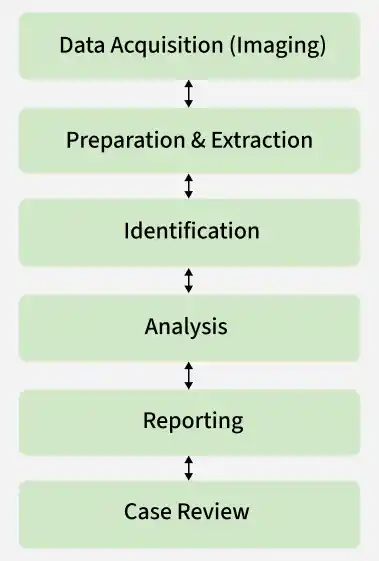
1. Data Acquisition (Imaging)
- A complete copy (image) of the original data is created
- Ensures original data remains untouched
2. Preparation & Extraction
- Set up forensic tools and environment
- Extract system files, logs, deleted data and network information
3. Identification
- Filter and identify relevant evidence from large datasets
- Focus on important files, emails and logs
4. Analysis
- Examine data to understand attack patterns
- Determine who accessed data, when and how
5. Reporting
- Document findings with proper evidence and methodology
- Maintain chain of custody for legal validity
6. Case Review
- Re-evaluate findings to reach a final conclusion
- Ensure accuracy and completeness of investigation
Purpose of Digital Forensics
- Identify the cause of cyber incidents: Digital forensics helps determine how a cyberattack or security breach occurred, including the entry point, vulnerabilities exploited and systems affected.
- Analyze attack patterns and methods: It involves studying malware behavior, hacker techniques and system logs to understand how the attack was carried out and whether it is part of a larger pattern.
- Recover critical data and evidence: Forensic experts retrieve deleted, hidden or corrupted data from devices and networks, which can be crucial for investigation and restoring operations.
- Support legal actions against attackers: The collected digital evidence is documented and preserved in a legally acceptable manner so it can be used in court to identify and prosecute cybercriminals.
Types of Digital Forensics
1. Computer Forensics
- Investigates data from computers and storage devices
- Recovers deleted or modified files
2. Mobile Device Forensics
- Extracts evidence from smartphones and tablets
- Includes call logs, messages and app data
3. Network Forensics
- Monitors and analyzes network traffic
- Identifies suspicious data transfers and attacks
4. Email Forensics
- Investigates email-based attacks like phishing
- Tracks sender, content and delivery path
Digital Forensics Tools
- Autopsy: Open-source tool for disk and file analysis
- FTK Imager: Used for data acquisition and disk imaging
- EnCase: Advanced forensic investigation tool
- Wireshark: Network traffic analysis tool
- The Sleuth Kit: Command-line forensic analysis suite
- Cyber Triage: Incident response and live forensics tool
- Bulk Extractor: Extracts useful information from disk images
Skills Needed for Digital Forensics in Cyber Security
- Strong technical knowledge: A digital forensics investigator should have a solid understanding of computer systems, operating systems, software, hardware, programming languages and computer networks.
- Tool proficiency: They must know how to use various forensic tools effectively to extract, recover and analyze data from digital devices.
- Data extraction and analysis skills: The ability to retrieve hidden, deleted or encrypted data and carefully analyze cybercrime cases is essential.
- Documentation skills: Investigators should be able to clearly record findings, maintain proper evidence logs and prepare detailed reports.
- Presentation and communication skills: They must effectively present evidence and explain technical findings in a clear and understandable way, especially in legal or investigative settings.
Impact of Digital Forensics on Cyber Security
Digital forensics plays an important role in cyber security by helping investigate cybercrimes using advanced tools and techniques. It supports security teams in understanding attacks and strengthening systems against future threats.
- Helps reconstruct the timeline of cyber incidents to understand how an attack unfolded
- Assists in identifying digital traces that link suspects to specific activities or devices
- Supports incident response by providing structured evidence for decision-making
- Improves organizational security policies through forensic insights and findings
Challenges in Digital Forensics
- Encryption Techniques: Strong encryption makes it difficult to access or recover protected data without proper keys or permissions.
- Large Data Volume: Investigators often need to analyze huge amounts of data, which is time-consuming and requires advanced tools and resources.
- Rapid Technological Changes: Constant advancements in technology require forensic tools and techniques to be regularly updated to remain effective.
- Legal Restrictions: Data privacy laws and regulations can limit access to certain information, making investigations more complex.
- Complex Environments: Modern systems like cloud computing, IoT devices and distributed networks add layers of complexity to evidence collection and analysis.