In the 24 November, 2012 edition of The Week there is a page devoted to the new Archbishop of
Showing posts with label Religion. Show all posts
Showing posts with label Religion. Show all posts
Wednesday, 5 December 2012

Wednesday, 4 July 2012
Thank You Letters
We went the other day to a monastery in Romania where Patrick Leigh Fermor spent a night or two:

 In a little corridor to the side of the main church there was a display of the paintings people have donated over the years to say thank you for prayers answered. This one dates from 1934, the date Leigh Fermor was at the monastery:
 There are others that are older as well as some of a similar vintage and many more that are quite recent. They are touchingly naive. The recurring themes are bad driving and agricultural accidents:


 This one has a strange sense of Janet and John about it:


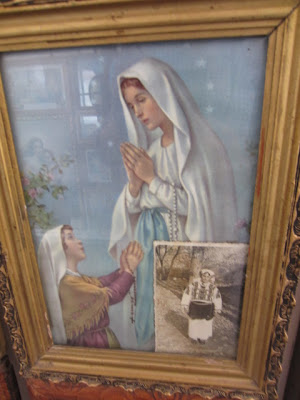

I think this is my favourite:


Thursday, 19 January 2012
Once More, with Pictures
Sometimes, when you have been ill and are now better but somehow cannot quite shake off the last traces of the germ you had, the only thing to do is to go on a trip. If you don't have much time and you live in Canberra, then the closest place to go is Sydney and, since we do live in Canberra, Sydney is the place to which we have just been.
And while we were in Sydney, among the many things we did, one was to revisit St James's Church, which I wrote about some time ago. This time I took my camera with me on the visit, so now I can repost my earlier post, but this time including photographs of some of the things I saw inside the church:
"Miss Marsh, our school scripture teacher, had two catchphrases. She began each lesson with one - 'Pull up a pew, girls', (bellowed as she strode into the room) - and wound things up with the other, which was delivered as part of a slowly swelling valedictory sermon, intended to sustain us through the days until she saw us again. Its subject was the virtues of the bible, which she claimed was jampacked with excitement. Within its pages we could find everything, she told us - adventure, romance, tragedy, history, madness - if only we would just 'dip in.'
I thought of Miss Marsh's advice when I went into St James's Church yesterday morning. Built in 1819 and intended as a courthouse, it is Sydney's oldest church now. It stands opposite the lovely Hyde Park Barracks and, like them, was designed by Francis Greenway, of whom more another time (he needs at least a post to himself). Whereas the bible, upon being dipped into, has not always fulfilled Miss Marsh's promise of excitement, it turns out that the walls of St James's certainly do.
For a start we have history in the plaques to Ensign Henry Middleton Blackburn, Captain John Shaw Phelps and Lieutenant George Philpotts, all of whom died in the Maori Wars - an episode most of us barely realise Australia ever took part in, (it certainly wasn't mentioned in any school history I did.)

Then there are the the inscriptions, such as the one praising Commodore Sir James Brisbane for his efforts in 'the submission of the Burmese empire'.

Such a confident phrase that, expressing an unquestioning belief in European cultural superiority - although not quite as astonishing as the one we saw in a Belgian town called Chateauneuf: it was on a memorial to soldiers who had died in the Belgian Congo, and read, quite simply: 'Morts pour la civilisation'.
The fairly casual view we once took of foreigners and their rights is also on display in St James's in the form of a framed bit of mosaic tiled floor, which, according to the inscription, the desert mounted corps helped themselves to in August 1918, when they 'discovered' an ancient church near Jericho, in which the tiled floor lay.


The plaque 'To the memory of the Reverend Richard Hill, the first minister of this church, who expired suddenly in the performance of his duty within its walls,' brings us the drama that Miss Marsh promised.

The mind boggles at the thought of what that service must have been like. Did he lean out of the pulpit and drop like a stone or was he administering Holy Communion when he 'expired', the goblet flying from his hand, wine splashing across the lace fronted panelling of some pillar of the community's best Sunday frock?
There's tragedy in the plaque 'In memory of Robert John Birch, who was accidentally drowned at Clontarf, Middle Harbour, Dec 7th AD 1865, aged 8 years'.

The poignance of this incident is increased by the fact the plaque was erected by his playmates 'in affectionate remembrance of their beloved school fellow.'
More tragedy follows in the commemoration of 'James Green, Commander of the ship Dunbar, who perished with all his passengers and crew save one by the wreck of that vessel at the Sydney Heads in a fearful gale on the night of 20th August 1857.'

This event, sometimes referred to as 'Australia's Titanic', shocked Sydney at the time. According to marinewatchnsw.com, after an 81 day voyage, the clipper was driven into the reef at South Head and began to break up immediately. Only one able seaman survived, by clinging to a cliff face for 36 hours. A mass funeral was held for the victims and a monument to them can still be seen in Camperdown in Sydney.
Finally, there are the several plaques which refer to conflict with the original inhabitants of the land. There is one that is 'Sacred to the Memory of Capt Collet Barker, of His Majesty's 59th regiment of foot, who was treacherously murdered by the Aboriginal natives on the 30th April 1831 while endeavouring in the performance of his duty to ascertain the communication between Lake Alexandrine and the Gulf of St Vincent on the South West coast of New Holland.'

Another pays tribute 'to the memory of Lieutenant Edward Murray Tupper Rn Aged 22 years and William Kennedy Seaman aged 43 years, both of HM Ship Iris who were killed by the natives of Tana on the 1st July 1858 whilst on service on shore.'
A monmument headed 'Dulce et decorum est pro scientia mori' hangs near the door. It is dedicated to 'John Gilbert, ornithologist, who was speared by the blacks on the 29th of June, 1845, during the first overland expedition to Port Essington by Dr. Ludwig Leichhardt and his intrepid companions.'

Beside it a tablet with a carved scene of Aboriginals with spears in the background and a dying man being held in the arms of another in the foreground tells a wild story from which some of the subtle complexities of white Australia's relationship with the original dwellers of the land emerge.

Erected 'in testimony of the respect and gratitude of the inhabitants [of New South Wales]' it 'commemorates the active service and early death of assistant surveyor Edmund Besley Court Kennedy who after having completed the survey of the River Victoria was chosen by the government to conduct the survey of York Peninsula, where, after the most patient and persevering exertions to overcome the physical difficulties of the country, and the destructive effects of consequent disease, by which the expedition, originally consisting of thirteen persons was reduced to three, he was slain by the Aborigines in the vicinity of Escape River on 13th December 1848, falling a sacrifice in the 31st year of his age to the cause of science, the advancement of the colony and the interests of humanity.' So far the dividing lines between natives and settlers seem clear and undeviating, but the tablet goes on to memorialise a survivor of the expedition, 'Jackey Jackey, an Aboriginal of Merton district, who was Mr Kennedy's sole companion in his conflict with the savages and though himself wounded tended his leader with a courage and devotion worthy of remembrance, supporting him in his last moments and making his grave in the spot where he fell.'
Aside from the very touching story this tells, which gives us a glimpse of a less simple world than the usual one we are taught about, in which whites oppressed blacks and blacks hated whites, it is interesting that only in this final passage, in which they are actually praising an Aboriginal individual for his - to western eyes at least - noble behaviour, do the writers of the inscription stray from neutral terms such as 'blacks' or 'natives' and describe the Aboriginal attackers as 'savages'.
Sometimes it seems to me that it is no easier to see into the past with any clarity than it is to look into the future. Certainly, the story of Kennedy and Jackey Jackey indicates that history - especially Australian history - is never as straightforward or clearcut as we're sometimes led to think."
And while we were in Sydney, among the many things we did, one was to revisit St James's Church, which I wrote about some time ago. This time I took my camera with me on the visit, so now I can repost my earlier post, but this time including photographs of some of the things I saw inside the church:
"Miss Marsh, our school scripture teacher, had two catchphrases. She began each lesson with one - 'Pull up a pew, girls', (bellowed as she strode into the room) - and wound things up with the other, which was delivered as part of a slowly swelling valedictory sermon, intended to sustain us through the days until she saw us again. Its subject was the virtues of the bible, which she claimed was jampacked with excitement. Within its pages we could find everything, she told us - adventure, romance, tragedy, history, madness - if only we would just 'dip in.'
I thought of Miss Marsh's advice when I went into St James's Church yesterday morning. Built in 1819 and intended as a courthouse, it is Sydney's oldest church now. It stands opposite the lovely Hyde Park Barracks and, like them, was designed by Francis Greenway, of whom more another time (he needs at least a post to himself). Whereas the bible, upon being dipped into, has not always fulfilled Miss Marsh's promise of excitement, it turns out that the walls of St James's certainly do.
For a start we have history in the plaques to Ensign Henry Middleton Blackburn, Captain John Shaw Phelps and Lieutenant George Philpotts, all of whom died in the Maori Wars - an episode most of us barely realise Australia ever took part in, (it certainly wasn't mentioned in any school history I did.)

Then there are the the inscriptions, such as the one praising Commodore Sir James Brisbane for his efforts in 'the submission of the Burmese empire'.

Such a confident phrase that, expressing an unquestioning belief in European cultural superiority - although not quite as astonishing as the one we saw in a Belgian town called Chateauneuf: it was on a memorial to soldiers who had died in the Belgian Congo, and read, quite simply: 'Morts pour la civilisation'.
The fairly casual view we once took of foreigners and their rights is also on display in St James's in the form of a framed bit of mosaic tiled floor, which, according to the inscription, the desert mounted corps helped themselves to in August 1918, when they 'discovered' an ancient church near Jericho, in which the tiled floor lay.


The plaque 'To the memory of the Reverend Richard Hill, the first minister of this church, who expired suddenly in the performance of his duty within its walls,' brings us the drama that Miss Marsh promised.

The mind boggles at the thought of what that service must have been like. Did he lean out of the pulpit and drop like a stone or was he administering Holy Communion when he 'expired', the goblet flying from his hand, wine splashing across the lace fronted panelling of some pillar of the community's best Sunday frock?
There's tragedy in the plaque 'In memory of Robert John Birch, who was accidentally drowned at Clontarf, Middle Harbour, Dec 7th AD 1865, aged 8 years'.

The poignance of this incident is increased by the fact the plaque was erected by his playmates 'in affectionate remembrance of their beloved school fellow.'
More tragedy follows in the commemoration of 'James Green, Commander of the ship Dunbar, who perished with all his passengers and crew save one by the wreck of that vessel at the Sydney Heads in a fearful gale on the night of 20th August 1857.'

This event, sometimes referred to as 'Australia's Titanic', shocked Sydney at the time. According to marinewatchnsw.com, after an 81 day voyage, the clipper was driven into the reef at South Head and began to break up immediately. Only one able seaman survived, by clinging to a cliff face for 36 hours. A mass funeral was held for the victims and a monument to them can still be seen in Camperdown in Sydney.
Finally, there are the several plaques which refer to conflict with the original inhabitants of the land. There is one that is 'Sacred to the Memory of Capt Collet Barker, of His Majesty's 59th regiment of foot, who was treacherously murdered by the Aboriginal natives on the 30th April 1831 while endeavouring in the performance of his duty to ascertain the communication between Lake Alexandrine and the Gulf of St Vincent on the South West coast of New Holland.'

Another pays tribute 'to the memory of Lieutenant Edward Murray Tupper Rn Aged 22 years and William Kennedy Seaman aged 43 years, both of HM Ship Iris who were killed by the natives of Tana on the 1st July 1858 whilst on service on shore.'
A monmument headed 'Dulce et decorum est pro scientia mori' hangs near the door. It is dedicated to 'John Gilbert, ornithologist, who was speared by the blacks on the 29th of June, 1845, during the first overland expedition to Port Essington by Dr. Ludwig Leichhardt and his intrepid companions.'

Beside it a tablet with a carved scene of Aboriginals with spears in the background and a dying man being held in the arms of another in the foreground tells a wild story from which some of the subtle complexities of white Australia's relationship with the original dwellers of the land emerge.

Erected 'in testimony of the respect and gratitude of the inhabitants [of New South Wales]' it 'commemorates the active service and early death of assistant surveyor Edmund Besley Court Kennedy who after having completed the survey of the River Victoria was chosen by the government to conduct the survey of York Peninsula, where, after the most patient and persevering exertions to overcome the physical difficulties of the country, and the destructive effects of consequent disease, by which the expedition, originally consisting of thirteen persons was reduced to three, he was slain by the Aborigines in the vicinity of Escape River on 13th December 1848, falling a sacrifice in the 31st year of his age to the cause of science, the advancement of the colony and the interests of humanity.' So far the dividing lines between natives and settlers seem clear and undeviating, but the tablet goes on to memorialise a survivor of the expedition, 'Jackey Jackey, an Aboriginal of Merton district, who was Mr Kennedy's sole companion in his conflict with the savages and though himself wounded tended his leader with a courage and devotion worthy of remembrance, supporting him in his last moments and making his grave in the spot where he fell.'
Aside from the very touching story this tells, which gives us a glimpse of a less simple world than the usual one we are taught about, in which whites oppressed blacks and blacks hated whites, it is interesting that only in this final passage, in which they are actually praising an Aboriginal individual for his - to western eyes at least - noble behaviour, do the writers of the inscription stray from neutral terms such as 'blacks' or 'natives' and describe the Aboriginal attackers as 'savages'.
Sometimes it seems to me that it is no easier to see into the past with any clarity than it is to look into the future. Certainly, the story of Kennedy and Jackey Jackey indicates that history - especially Australian history - is never as straightforward or clearcut as we're sometimes led to think."
Wednesday, 23 November 2011
Overnight Conversion
We are meeting friends we haven't seen for ten or twelve years and suddenly Islamic head-to-toe covering seems a highly appealing idea. Greying streaks of hair, forehead criss-crossed with two-inch deep indentations (also known as wrinkles), all rendered invisible by forgiving folds of hijab, (or burqa or whatever the correct term is - I'm sure I've got it wrong, but I don't really care), only the ever youthful personality still on view.
What lies beneath the intriguing layers of fabric can still be constructed by the imagination of the viewer, who one hopes will be kinder than daylight. Mind you, it is that element of Islamic garb that always seems to me to defeat the thing's purpose - my impression is that, in earlier days, when women's dress was much more modest than it is now, almost anything became erotic, because forbidden. I suspect there is something far more alluring, tantalising and all round exciting about a woman's form that you can only picture in fantasy than there is about one whose body - or reasonably large expanses of it - is revealed for all to see.
What lies beneath the intriguing layers of fabric can still be constructed by the imagination of the viewer, who one hopes will be kinder than daylight. Mind you, it is that element of Islamic garb that always seems to me to defeat the thing's purpose - my impression is that, in earlier days, when women's dress was much more modest than it is now, almost anything became erotic, because forbidden. I suspect there is something far more alluring, tantalising and all round exciting about a woman's form that you can only picture in fantasy than there is about one whose body - or reasonably large expanses of it - is revealed for all to see.
Monday, 15 August 2011
Loaves and Fishes for Me Please
As you leave the main body of Seville Cathedral and enter the side chamber where they now keep the silver and papal bling, you pass under an archway whose interior surface is covered with plaster reliefs. Looking at them more closely, I couldn't help wondering if the room the archway led to was originally used for a purpose other than display. Could it once have been a canteen for monks or worshippers and were those decorations the world's first ever illustrated menu:


Tuesday, 21 June 2011
Phew
Well, after the frightful vulgarity of all that ornament in the Alhambra, what a relief it was to move on to Seville Cathedral and the restrained approach of the Spanish Catholic Church to interior decoration:


 And, ooh look: here we have some holy bling:


Subscribe to:
Posts (Atom)