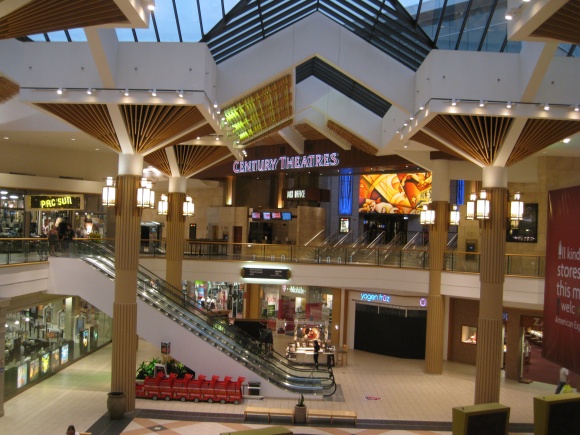
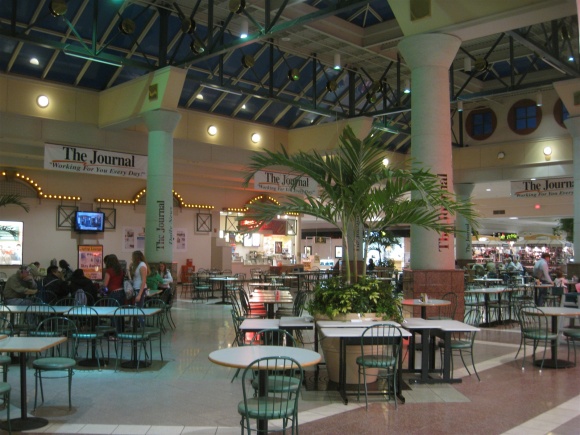
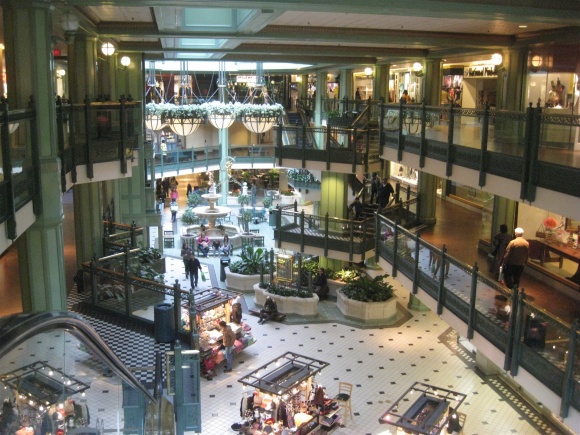
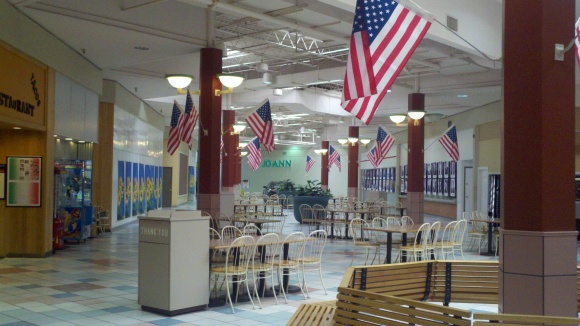
Park Central Shopping Center; Phoenix, Arizona

I promised a few months ago that I went to every single mall in the Phoenix and Tucson areas–and you were all quick to point out at least one omission, at an outlet mall in Mesa–but by and large I think I made it to all of them, and I plan to bring them all to you, one by one. It is happening, I swear! If we’re gonna do this, let’s start with the oldest.

The Park Central Shopping Center opened as Park Central Shopping City in 1957, way back when Phoenix was still a fairly small city of a little over 100,000 people. This was still the early days of air conditioning–the innovation that made places like Phoenix feasible to inhabit–and Phoenix hadn’t yet grown into the desert behemoth that it is today. Park Central Shopping City was initially built by the Burgbacher brothers on the site of a former dairy farm on what was then the edge of town, in a brand new “edge city” 2 miles north of downtown Phoenix (the area would later become known as Midtown Phoenix). At the time, the development was seen as overly speculative and foolish, and located too far from the city’s center of population–a seemingly laughable assumption today.

The mall, which is completely open air and always has been, opened in 1957 with three anchors: a two-level Goldwater’s (founded by the same family as former Republican presidential candidate and modern conservative godfather Barry Goldwater), a two-level Diamond’s, and a J.J. Newberry 5 and dime store. Laying to rest the initial skepticism about the mall’s potential, both Goldwater’s and Diamond’s soon both shuttered their downtown locations in favor of operating the new midtown stores as their main locations, and JCPenney also joined the roster as another anchor. For a time, Park Central was the center of the Phoenix retail scene. During the 1960s, a number of new high-rise office and apartment buildings sprang up in the immediate vicinity of the mall, pulling the city’s center of gravity north and quickly becoming the de facto “city center” of Phoenix.

Phoenix exploded in population in the decades following world war II (and, realistically, continuing until only very recently), causing most development in the low-density, auto-oriented city to fan out for miles and miles in every direction. Due to these patterns, more people moved to far-flung newer regions of the city only partially accessible by freeways, and eventually the Midtown neighborhood came to be seen as slightly tired and inconvenient. During this time, Park Central experienced the normal slate of changes that any major shopping center tends to see, mainly in shifts in tenants: Robinson’s replaced Goldwater’s and Dillard’s replaced Diamond’s, both sometime in the mid-late 1980s. But by the end of the 1980s, Park Central was failing, losing many of its tenants to other, newer locations, and to enclosed, climate-controlled centers. JCPenney and Dillard’s were the last of the anchors to leave, gone from the mall by the mid-1990s.

Despite its failure as a retail center, the mall still sat at the very center of the city’s business district, surrounded by towering modern skyscrapers. Realizing the potential of the property, the mall’s management began to convert the center to a mixed-use, office-focused facility not long after the closure of Dillard’s. The former Diamond’s property became home to Catholic Healthcare West, Banner Health Systems moved into the Goldwater’s, and United HealthCare replaced the former JCPenney space. With so many office workers occupying the mall’s 3 largest spaces, some of the smaller spaces were able to be re-leased to low-level retail tenants, including Starbucks, Qdoba Mexican Grill, The Good Egg, and even a bevy of local businesses (including several small delis and even Kobalt, a gay bar). A Hampton Inn also opened on the corner of the property.

Although Park Central isn’t a mall by any definition now, the center has seen almost no cosmetic changes during its transformation and is completely open for perusing, so it’s a good opportunity to get a glimpse of Phoenix’s oldest retail establishment. It’s a little weirdly quiet now, and there aren’t any traces of old retail storefronts, but the facades on some of the original anchor stores are fairly neat and worth checking out if you’re in the area. Also, the area itself has changed somewhat of late: while the mall failed in part because Phoenix had turned its eyes towards the sprawling suburbs, the city has seen (like many others) a revival in interest in urbanism, and a new light rail opened along Central Avenue in December 2008 giving direct transit access to the mall. Much of the dense and centrally-located Midtown neighborhood has become popular with young, upwardly mobile types who want access to nightlife and restaurants that aren’t just formula-based chains, and much of the city’s alternative culture thrives within blocks of Park Central (hence the mall housing a gay bar), so there’s even some remote chance that someday there will be a newfound interest in dense, pedestrian-oriented retail at the site.

Stratford Square Mall; Bloomingdale, Illinois

Stratford Square Mall is a large, super-regional center serving west and northwest-suburban Chicagoland. Located in the village of Bloomingdale, the mall is about 30 miles from downtown Chicago. With 5 anchor slots and 1.3 million square feet of leasable space, Stratford Square is one of the larger malls in the Chicago region; however, the mall has faced recent struggles as it adapts to the economic downturn and general decline of large, enclosed malls nationwide. Opened on March 9, 1981, Stratford Square Mall was the end result of a planning strategy from one of suburban Chicago’s oldest settlements. Bloomingdale, which was located on maps as far back as the 1840s, is so old that the origin of its name is a mystery. The early settlers were German farmers, and Church services were held in German in the village as late as the 1960s.

Stratford Square Mall is a large, super-regional center serving west and northwest-suburban Chicagoland.  Located in the village of Bloomingdale, the mall is about 30 miles from downtown Chicago.  With 5 anchor slots and 1.3 million square feet of leasable space, Stratford Square is one of the larger malls in the Chicago region; however, the mall has faced recent struggles as it adapts to the economic downturn and general decline of large, enclosed malls nationwide.

Opened on March 9, 1981, Stratford Square Mall was the end result of a planning strategy from one of suburban Chicago’s oldest settlements. Bloomingdale, which was located on maps as far back as the 1840s, is so old that the origin of its name is a mystery.  The early settlers were German farmers, and Church services were held in German in the village as late as the 1960s.

Here’san ad from Stratford’s opening, from the Bloomingdale library:

Things changed dramatically for Bloomingdale and northern DuPage County in the 1970s.  The building boom around Chicagoland was in full swing, and Bloomingdale sat directly in the path of growth moving westward.  As the original German pioneers established the small village core of Bloomingdale some 100 years earlier, suburban pioneers fleeing the city of Chicago began to move westward in the 1960s and 1970s.  The core of the old village was very small, and located along Lake Street (U.S. Highway 20) at Bloomingdale Road.  Suburban Chicago began to envelop the small village, and the residential suburbs of Glendale Heights, Roselle, Addison, and Carol Stream sprang up around it.

By the late 1970s, Bloomingdale wished to capitalize on all this growth and make itself a regional hub for suburban-style retail.  The center of this hub was to be a super-regional mall, located on the west side of the village at the intersection of Gary Avenue and Schick Road, just north of Army Trail Road.  In building Stratford Square, developers sought to fill in this retail hole in the western suburbs, between the malls in Lombard and Aurora to the south, Oakbrook and the city of Chicago to the east, and Woodfield to the north.

Stratford Square opened to instant success, and became the anchor it was intended to be for a massive retail corridor on the west side of Bloomingdale.  After Stratford Square opened, many big box-anchored strip malls opened in the coming years to complement the mall, mostly along Army Trail Road and Gary Avenue.

Here’s a photo taken of Stratford Square in all its glory, not long after it opened, also from the Bloomingdale library website.  This is center court.  Note the columns and high ceilings, which are still present today.  Sadly, the trees and stepped fountains are not:

Unfortunately, though, this retail synergy between the mall and its retail environs peaked sometime in the 1990s.  Beginning in the 2000s, Stratford Square and its retail corridor began to slide, punctuated by the departure of original anchor Wards in early 2001.  The slide was precipitated by competition, access, and national trends, and during the balance of the 2000s Stratford Square developed more vacancies and began a slide toward obsolescence.

Let’s explore the impetus for Stratford Square’s decline, beginning in the 1990s with the arrival of fiercer competition and moving towards changing trends in retailing in the 2000s, with a separate focus on Stratford’s locational analysis.

First, Woodfield Mall completed an overhaul and expansion in 1996, adding many new stores and a new two-level wing.  Following this expansion, Woodfield’s market dominance has continued to today.  Woodfield’s dominance can also be attributed to a centralized location in Chicago’s northwest suburbs, located near the intersection of Interstates 90 and 290.

In contrast, Stratford Square’s location is slightly maligned.  Like some other struggling Chicago-area super-regional malls (Randhurst, Charlestowne) Stratford Square is not located directly on any expressway or interstate highway.  The closest major routes to Stratford Square are U.S. 20, a slow surface road with many lights, located a couple miles away, and I-355, a major north-south thoroughfare through Chicago’s western suburbs, located about 4 miles to the east.

Also, national trends beginning in the 90s and 2000s rallied against super-regional malls, especially those that aren’t the top of their game like Woodfield, Oakbrook, Old Orchard, Orland Mall, and Fox Valley Center.  During the seemingly unending growth during the same period, too, many new strip malls and Lifestyle centers were constructed in the region, causing an overbuilding of convenience and leaving many of the older centers in and around the Stratford area to develop vacancies.

All of these processes created a perfect storm for decline at Stratford.  Basically, Stratford has become a regional center in the husk of a super-regional mall.  While parts of the mall are still successful and contain many popular national stores, other areas of the mall contain vacancies and many lower rent local and temporary stores.  This is especially true of the Burlington Coat Factory/Carson’s wing of the mall, though it’s also visible in the Marshall Field’s wing.  The center of the mall, which houses a popular food court, new mega-theater, and access to anchors Sears and Kohl’s, seems to be faring better.

Many anchor changes and additions have taken place since Stratford Square opened 30 years ago. Wards was replaced in 2001 by Burlington Coat Factory, while another original anchor, Wieboldt’s, departed Stratford Square in 1987 but was quickly replaced by JCPenney.  Also, Sears was added as the sixth anchor to Stratford Square in 1990, and during the 1980s a Main Street store was added to the mall, which became Kohl’s in 1989. Original anchors Marshall Field’s and Carson Pirie Scott have remained, though Marshall Field’s became Macy’s in 2006.  A Steve and Barry’s also operated at the mall from about 2006 until 2009, until that chain folded as well.

Stratford Square was most recently sold in 2005 to Feldman Properties, who immediately embarked on repositioning the aging center. They bought the mall for just over $93 million, and at the time the mall’s occupancy rate was 90%.

In 2006, Feldman purchased the mall’s JCPenney anchor for $46 per square foot, leasing it to JCPenney. The mall was renovated, and the existing 4-screen movie theater was quadrupled in size to a mega-sized all digital 16-screen experience, featuring a cappucino bar, marble flooring, and stadium seating.  The theater opened July 4, 2007.

In addition to the theater, Feldman hoped to transform some of the exterior entrances into clusters of popular restaurants, much like The District on France, a strategically-positioned cluster of destinational restaurants at Southdale Center in suburban Minneapolis.

Unfortunately, though, the envisioned clustering never fully materialized; however, several restaurants have opened, like Orchid (Asian), Ballydoyle (Irish Pub), and Red Robin (Burgers).

Also rather unfortunate is the economic downturn of 2007 and beyond, which robbed Feldman of access to capital and put it in some real trouble.  In 2008, Feldman attempted to dump Stratford Square, as well as several other malls in their portfolio, to a company called Inland American.  In early 2009, however, the deal fell through, and Feldman ultimately kept Stratford Square as well as a mall in Ohio, until it was put into receivership.  Today, Feldman still owns Stratford Square as the only property in its portfolio.

Feldman also operates an outdated leasing website for Stratford Square, including a slide show featuring the completed movie theater and some of the proposed changes; however, many of the touted “high-profile” tenants have since left the mall under Feldman’s tenure, including Abercrombie and Fitch, Forever 21, Gap, Disney, and American Eagle.

One slide in their presentation (fast forward a few slides, it’s a Flash page) does strike a chord with potential viability, though.  It outlines the hub and spoke structure of Stratford compared with its environs, outlining the incomes, population, and traffic counts in the area.  It also labels all of the strip malls and big box anchors along Gary Avenue and Army Trail Road near the mall.  Strikingly, the household income in the area is around $100,000, and the 5-mile radius population is 263,000.  At 5 miles, these residents are far closer to Stratford Square than any other retail center, so the center should be able to easily capture these residents and thrive as a regional mall.  The only problem with this is that Stratford is built to be a super-regional center, and draw shoppers from 10+ miles.  While the 10 mile radius population is over 850,000, many of these residents are closer to Woodfield, Yorktown, Geneva Commons, and other options.

A possible solution, when the economy allows for it, would be to complete Feldman’s idea of creating destinational restaurants, and possibly adding more entertainment venues.  I know the Ballydoyle here has popular musical acts and is open late, sometimes even featuring American Idol alum Gina Glocksen.

We’ve visited Stratford Square several times over the years, and have also noted the slow decline in popular national brands.  And while this mall is far from defeat, we’re a bit saddened at the lack of focus for its renaissance.  While it’s true that Stratford isn’t that close to expressway/interstate access, it is the center of a densely populated, relatively wealthy suburban region.  A little TLC can go a long way in these cases, and once the economy perks up I fully expect Stratford to rise from the retail ashes.  Hopefully Feldman, or whoever owns it at that point, can find more capital to perk the place up, and diversify its offerings to get people in the door.  I have every confidence that it’s possible.

I captured these photos of Stratford Square Mall in Fall 2010, except for the three older ones I took from the Bloomingdale library’s site.  Feel free to leave your own comments and thoughts on the mall.


Regional Malls Not Dying; Rather Rising Like a Phoenix

I’ve been sitting on this story for nearly a month now, but Retail Traffic had an excellent piece in their last issue outlining a trend that most readers of this blog have likely suspected–that malls, especially the big, super-regional centers–have not only proven resilient in the economic downturn but have been performing strongly:

“As the Great Recession unfolded, regional malls—rather than being pushed to the brink—weathered the storm better than any of their supposed replacements. The very things that made fortress malls seem so outdated—their size, their enclosed environments, their dependence on anchors—proved to be powerful assets instead.

Quarter after quarter, U.S. regional mall REITs have outperformed shopping center REITs, beating analyst estimates and occasionally posting NOI growth. By 2010, class-A regional malls shot up to the top of both retailers’ and real estate investors’ list of preferred product types.”

It’s easy to make the case for why this happened. Big box centers relied on too few tenants in number, so when one went belly up, the entire center suffered (and was hard to repurpose). Malls carried a certain sense of place and offered entertainment value (our favorite argument -Ed.), while these other centers didn’t, so they thrived. Most (though not all) of the new “lifestyle centers” failed to achieve a critical mass. Whatever. The point is that we’re seeing a paradigm shift that’s being noted by one of the foremost publications in the industry.

Retail Traffic’s blog did a follow-up after the fact as well. If you don’t follow them, you should–they’re the best source for news in the industry.

*On a related note to the TITLE of this blog post, I made a trip to Phoenix and Tucson, Arizona a few weeks ago, and managed to visit every single mall in those two cities. Look for more content on these in the future.


Reno Town Mall (Old Town Mall); Reno, Nevada

Reno is most famous as “The Biggest Little City in the World,” and the west’s original gambling town and the place long ago where wealthy easterners came to get divorced. With around 400,000 people in the metropolitan area, it has long since faded as the main gambling destination in comparison to Las Vegas, though it still has many casino resorts and still does a decent tourist trade. In recent decades, like many western cities, it has become more of a bedroom community for people seeking a high standard of life for a relatively low cost.

As Reno’s tag would suggest, some of the physical form of the city is still suggestive of a small place. The main commercial drag through the city, Virginia Street, cuts a roughly north-south swath through the middle of downtown, and on the south side it long ago became the city’s main suburban commercial corridor, home to several newer (mega?) resorts and all 4 of the enclosed malls to ever call Reno home.

Of the four enclosed malls, one, the Park Lane Mall, is long gone, demolished years ago and replaced by a rather lovely barren windswept lot. Another, the Meadowood Mall, is the only truly large super-regional mall in the metropolitan area, though several newer and fairly large “outdoor malls” have sprung up either further south on the strip or over in Sparks. That leaves two more enclosed malls along South Virginia St., and both of them are small, strange, dated little centers.

The Reno Town Mall opened in 1972 as the “Virginia Center,” at the corner of South Virginia Street and Peckham Lane. The original anchors were a Raley’s-owned “Eagle Thrifty” superstore and a Breuner’s furniture store, at opposite ends of the center. The owners would quickly declare bankruptcy, however, and in 1975 the mall as sold and renamed the “Old Town Mall” instead. During this time a movie theatre opened in the center and Gray Reid, a popular downtown Reno retailer, moved into the mall. But its fortunes refused to turn around and by the early 80s the center was mostly vacant and dubbed the “Ghost Town Mall” by many in Reno.

In 1982, the mall began a renovation to reposition itself, adding a Marshalls store as a new anchor, and attracting more tenants to bring occupancy up to 23 retailers. The mall continued to falter through the 80s however, and fills vacancies with non-traditional tenants such as a Washoe County Library, which opened in the rear of the mall in 1987, or a community college that opened in 1989. Around the same time, a small strip of outdoor stores was tacked on to one end of the mall.

In 1989, Marshalls left the mall and it quickly fell into foreclosure, failing yet again. Roter Investments of Nevada snatched the mall up in 1992, leasing as much of its 280,000 square feet as possible, and brought the Old Town Mall up to 100% occupancy by 1995. In 1999, Burlington Coat Factory replaced now-defunct Breuners as the largest anchor in the center.

In 2000, deciding that “Old Town Mall” had bad connotations (good thinking), the center was renamed to its current moniker, the “Reno Town Mall.” More recently, Raley’s converted their store to the budget-oriented, warehouse-style “Food Source” concept.

The Reno Town Mall’s design and architecture is actually very strange. From the outside, the center appears to be a fairly small strip center, with a tiny enclosed portion wedged between the Burlington Coat Factory and Raley’s anchors. Once inside, however, it becomes apparent that the mall slices lengthwise between the two stores–going back a ways from the front–and splits almost immediately into two separate levels, giving it quite a bit more of significance than it would appear from the street. The interior is also deliciously ’80s garish, a sea of browns, coppers, and oranges with planters and fountains galore. I thought it was a real treat.

As you can see from the pictures, the decidedly mixed-use center (there are still a ton of civic functions inside, including a library, community college, civic center, dmv, and more) actually generates a fair amount of foot traffic, and the collection of mostly mom-and-pop shops seem to do at least somewhat okay. Granted, things seem a bit more hopping than you’d expect in these photos because there was a little girl dance-off, or something, so I had to try harder than usual to not look like a creep. (A creep walking around by himself photographing little girls). The center is a bit small to be a real destination–and the collection of stores is just a bit too weird to encourage much cross-shopping–but it’s a pretty unique one of a kind gem nonetheless.

Martinsburg Mall; Martinsburg, West Virginia

Crown American’s Martinsburg Mall debuted in 1991, located west of downtown directly along I-81. When it opened, the mall was anchored by Wal-Mart, JCPenney, Sears, and Allentown-based Hess’s, with space for about 60 additional retailers, and, according to ICSC, 556,000 square feet in total. Interestingly, Crown American owned Hess’s at the time, so putting a store here was a natural fit. This one level mall also features a food court, and was Crown American’s signature period mall design, similar to the centers they built in Lancaster (which we’ve featured on this site) and Newark, Ohio. All of these malls are designed with two main hallways and a “loop” at one end containing the food court area.

Martinsburg, West Virginia is located in the fast-growing eastern panhandle of the state.  With a population of 17,000, Martinsburg is the hub of the eastern panhandle and the county seat of Berkeley County.  It’s also part of a larger corridor that stretches along I-81, linking the Shenandoah Valley to western Maryland, including the cities of Winchester, Virginia and Hagerstown, Maryland.  Recently, the eastern panhandle of West Virginia has become subject to an influx of new residents from the more populated and nearby Baltimore-Washington metropolitan area.

Martinsburg was a relative late-comer to the mall scene, for a few reasons.  First off, malls were built in nearby Hagerstown in 1974, and in Winchester in 1982.  Both cities are a short 20-minute drive from Martinsburg.  In addition, Martinsburg simply didn’t have the population to support a mall until fairly recently.  As late as 1990, Berkeley County only had about half the residents it does today.

In the late 1980s, Pennsylvania mall developer Crown American decided Martinsburg could support a mall, independent of the offerings in nearby Winchester and Hagerstown.  At the time, the quiet economy of the eastern panhandle of West Virginia was projected to soar with new businesses (like United Airlines) moving in to capitalize on West Virginia’s business-friendly tax model in tandem with the close proximity to both Washington and Baltimore, which are both about 80 miles away. The anticipated business growth was expected to fuel a massive population boom in Martinsburg, and this eventually did happen; however, it was not because of the business growth that never really materialized, but due to planning policies supporting the massive growth of exurbs and suburban sprawl.  The population in the eastern panhandle grew mostly from commuters who were priced out of the Washington/Baltimore markets, wanted more house for their money, a pastoral rural setting, lower crime and taxes, more space, better schools, or any or all of the above.  To support this growth, MARC  began daily regional train service from Martinsburg, ferrying commuters into Union Station in downtown Washington.

Crown American’s Martinsburg Mall debuted in 1991, located west of downtown directly along I-81.   When it opened, the mall was anchored by Wal-Mart, JCPenney, Sears, and Allentown-based Hess’s, with space for about 60 additional retailers, and, according to ICSC, 556,000 square feet in total.  Interestingly, Crown American owned Hess’s at the time, so putting a store here was a natural fit. This one level mall also features a food court, and was Crown American’s signature period mall design,  similar to the centers they built in Lancaster (which we’ve featured on this site) and Newark, Ohio.  All of these malls are designed with two main hallways and a “loop” at one end containing the food court area.

However, unlike some of Crown American’s other malls, Martinsburg Mall was never notably successful.  Wal-Mart was always big draw, especially in the mall’s early days when Wal-Marts were new to the national scene.  Initially scared about the presence of a new mall in Martinsburg, the malls in both Winchester and Hagerstown fared much better than expected with their brand new competition.  Also, both Winchester and Hagerstown built extensive retail strip areas and large power centers surrounding each of their malls, which became regional draws in themselves.  By comparison, Martinsburg had fewer ancillary retail centers; so, even though Martinsburg had the mall, area residents still went to either Winchester or Hagerstown to do other shopping.

In 1994, Crown American sold off its Hess’s stores, and the Martinsburg Mall location became a Bon Ton.

Wal-Mart made a contentious decision affecting Martinsburg Mall in 1998, and it became an obvious wound to the center.  Wal-Mart renovated its store into a Supercenter format that year, and subsequently shut their entrance to the mall entirely.  Because Wal-Mart likely owns their parcel separate from the mall, this decision was apparently allowed with no say from Crown American.  I’m sure W-M probably even studied that their loss would be mitigated by not operating two separate entrances, and that they’d continue to do business there just fine, but this has to be annoying and inconvenient for shoppers who value convenience and want to visit other businesses in the mall.  If it’s snowing, raining, too cold, or too hot outside I’m sure people would have appreciated the connection.  Wal-Mart continues to be the most popular destination at Martinsburg Mall, and requiring shoppers to go outside and go back in to visit any of the other stores, to me, seems kind of rude.  I’m sure it was a major blow to the mall itself, dropping foot traffic considerably.  Here’s Wal-Mart’s former mall entrance – they boarded it up and put up a mystery structure to tease us:

In 1999, Hagerstown’s Valley Mall embarked upon a major expansion project, adding a wing of stores and a new Hecht’s (later Macy’s), Old Navy, and a multiplex cinema.  As I mentioned earlier, big box power centers and retail strip began to pop up in Hagerstown, and in Winchester, but not so much in Martinsburg.  Visiting popular national stores like Target, Kohls, Petsmart, Borders, Circuit City, Office Max and Dicks required driving to Hagerstown and/or Winchester, and probably helped the malls in those cities due to synergy.  This same lack of synergy disallowed Martinsburg Mall to reach its full potential, if it had any to begin with.

By the 2000s, the outlook for Martinsburg Mall continued to be bleak, though far from completely dead.  In 2004, Crown American was sold to another Pennsylvania company, PREIT, who promptly unloaded Martinsburg Mall and a bunch of other “non-core assets”. The mall’s new owner, Lightstone Group, operated the mall under its subsidiary Prime Retail, and ended up defaulting on the mall by 2008, returning it to its lender in early 2009.

Meanwhile, the retail synergy that Martinsburg Mall hoped to possibly capture finally came in the form of a massive power center that opened in 2009, an exit south of the mall and on the other side of I-81.  The Commons, owned by AIG Baker, is a multi-anchor power center featuring Target, Best Buy, Dick’s Sporting Goods, Books-a-Million, Five Below, Staples, Michaels, TJ Maxx, Bed Bath and Beyond, and Petsmart, with many smaller stores and restaurants to boot.  The Commons is clearly a slap in the face to Martinsburg Mall, who would have probably gladly welcomed some of those tenants.  On the other hand, the growing WV panhandle probably appreciates not having to drive 20 minutes to Winchester or Hagerstown to shop anymore.

In early 2010, Mountain State University, based in Beckley, West Virginia, a considerable distance from Martinsburg, bought the mall from receivership with plans to expand into the mall and hold classes there. MSU had already operated a Martinsburg campus from a former outlet mall it purchased in 1999.  As of early 2011, though, the campus has not yet moved from its current location into Martinsburg Mall.

Today, Martinsburg Mall is far from dead, and seemingly not in rapid decline.  Yet, the offerings here have always been meager, and it seems though for its size it isn’t – and hasn’t ever – reached its full potential.  Maybe Martinsburg didn’t need a mall – even despite all its growth there are two formidable ones only twenty minutes away, and the entire Washington-Baltimore metropolitan area is just over an hour’s drive.  There are still national stores here, but also quite a bit of vacancy.  The college hopes that synergy can be achieved by opening up disused parts of the mall to classes, and that’s not a terrible idea.  College students are certainly an appropriate demographic for malls, so hopefully it’s not too late.

I visited Martinsburg Mall in April 2011 and took the pictures featured here.  I was very entertained by some of the folks at the mall, as well as by some of the local stores that operate here.  In the food court, one popular stand offering ice cream was named “55-60s Ice Cream” – not sure what that means, but it looked good.  Can anyone explain?  Also, look at this man, whose advertisement is placed on a dead storefront. He’s really excited about home improvement:

Also roving the mall the evening I visited were two very amorous young gay men and their female friend, who had no qualms about public displays of affection.  And giggling.  And lastly, not to get anyone in trouble, but the sight of the girl working the customer service/information booth totally engrossed in FarmVille on a giant, outdated CRT monitor made me giggle.  I actually always appreciate and absorb the people watching, culture, and local color in a mall, for better – or even sometimes – for worse.  It’s amusing, and it’s something that isn’t usually transferred by the myriad of strip or outdoor malls that lack public gathering spaces.  Food for thought. As always, feel free to leave your own comments and experiences concerning this mall.

Photos from April 2011:


Palm Springs Mall; Palm Springs, California

The Coachella Valley is a desert region in eastern Riverside County, California, stretching through the desert north of the Salton Sea. One of the fastest-growing metropolitan areas in the country (with an estimated 2010 population of around 600,000 permanent residents, plus hundreds of thousands of seasonal residents), the region has been a popular tourist destination since the 1920s when many in Hollywood were drawn to the hot, sunny weather and seclusion. The region’s anchor city and historic heart (though not the largest community) is Palm Springs, at the far western edge of the valley.

Development patterns in the Coachella Valley are more or less what you would expect of a region developed almost entirely in the 20th century (and very significantly in the last few decades). The region is criss-crossed with a network of wide grid-pattern arterials and a sprawling network of low-slung housing developments, many of them resort-style communities for part-time residents. Like most places that have exploded in this manner, there are dozens of strip malls and big box centers scattered across a 25-mile wide swath of the valley stretching from Palm Springs to Coachella. Buried within that mess, there are no less than four enclosed malls, and shopping in air conditioned comfort makes sense when the region is known for it searing heat and blinding sun. However, 3 out of 4 of these malls are dying (and one of the four is shuttered entirely). We posted the Fiesta Mall in Indio, at the eastern end of the valley, about a year ago. Today’s mall is 25 miles to the west: Palm Springs Mall, while technically still open for now, is one of the near-dead.

Located on Tahquitz Canyon Way about 2 miles northeast of downtown Palm Springs, the Palm Springs Mall is a relatively small, T-shaped community center, with an extension on one side that housed a Von’s supermarket and several smaller outdoor-facing stores. Architecturally, the exterior almost looks like a fairly standard strip mall, but the interior still has terra cotta tiles and other trappings of malls from several decades ago. There are also some interesting soaring ceiling features and skylights that clearly date the mall to its original construction in the late 1960s, even if it otherwise appears to have gotten a facelift sometime in the 80s. Until the middle of this past decade, it was relatively successful, with Gottschalks, True Value, Ross Dress For Less, and Office Max all functioning as the mall’s most recent anchor stores.

The Palm Springs Mall opened with San Diego-based Walker-Scott in 1970, who lasted in the space until the entire chain folded in 1987. Long Beach-based Buffums’ replaced them, but they also folded in 1991. Gottschalks took over the space right up to that company’s demise in 2009. The large anchor at the southern end of the mall was for a time a Kmart store, but that space was subdivided into True Value and Ross Dress For Less at some point later. I can’t find if there was a tenant in that space before Kmart, and to add to the confusion many news articles on the internet seem to confuse this mall with another dead mall in Palm Springs, so there is some question as to whether this mall or the other ever had a JCPenney anchor store. Just over the last few months (since these photos were taken in February, even!) the True Value fled the mall for a new location.

Rumors of a redevelopment have been swirling since at least 2007, when the mall was at least still somewhat viable (and still had its main anchor store in Gottschalks). There continue to be rumors of *something* to happen at the property, but in the meantime it continues to bleed tenants. The location is also somewhat strange and off Palm Springs’ main arterials, so it may make more sense to repurpose the property as something other than retail though the empty lots that dot the nearby area seem to indicate there isn’t a ton of demand.

Like a lot of dying malls in growing sun belt cities, we couldn’t find much about the Palm Springs Mall online–there probably aren’t that many current residents who remember much about the glory days. Do you know more about the history? Use the comments section to fill us in.


Jordan’s Furniture to Open Mall Store

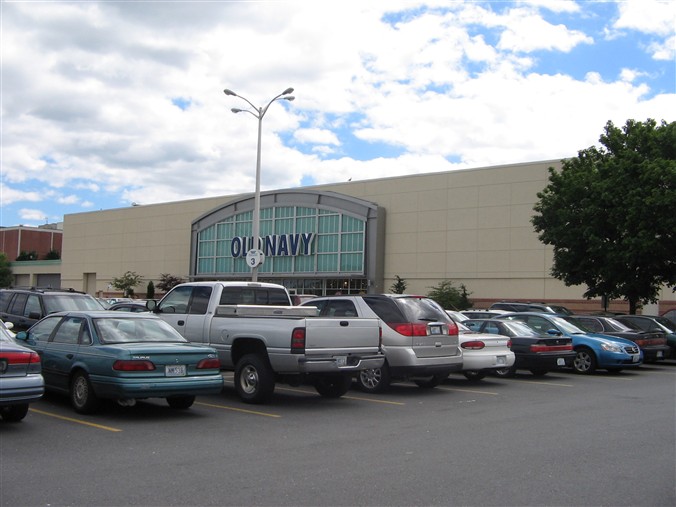
Former Caldor/Old Navy Store at Warwick Mall

Jordan’s Furniture, a New England chain of large, destination-oriented furniture stores, is moving into the former Caldor/Old Navy store (pictured above) in the Warwick Mall in Warwick, Rhode Island.

Last spring, the Warwick Mall was heavily damaged by a flood and was closed for months. As a result of the renovations, many retailers either left the center entirely or moved to new spaces. As part of the process, Old Navy–who had occupied part of the first floor of the massive, two-level former Caldor store at the mall’s center court–decided to move to a more appropriately-sized in-line space instead of moving back into their too-large digs. The second level of the store has been unused since Caldor shuttered the store in 1999. This created a space for a new anchor to move in, and enter Jordan’s:

Furniture shopping remains a tactile experience, according to an industry spokeswoman, as American consumers still like to see and touch furniture pieces before buying them.

“It’s not unusual in midsized cities for there to be a cluster of home furnishing stores in proximity. It’s happening all over” the country, said Jaclyn C. Hirschhaut, of the American Home Furnishings Alliance, a furniture manufacturers’ trade group. “Ultimately, to the consumer, it makes the process of shopping for furniture so much easier.”

Typically, furniture stores make for sleepy mall anchors–we’ve all seen a dying mall here or there with an Ashley or Bob’s Discount Furniture store clinging on to one of the darkened anchors for cheap rent. Jordan’s, however, is a bit of an anomaly in that their stores are destinations in and of themselves, and often feature a variety of attractions and eateries (many with a local focus) to draw people to them even when they’re not looking to buy a sofa:
Jordan’s is well known for its splashy store layouts — one has an IMAX theater, another has a trapeze school. Eliot Tatelman, Jordan’s president and chief executive officer, declined to say what people will find in the Warwick store when it opens later this year.

Jordan’s stores are typically very, very large, so this will be one of the smallest stores (if not *the* smallest store) in their portfolio, and their first in Rhode Island.

In other news, it was announced only a few weeks ago that the adjacent, long ailing, and almost completely vacant Rhode Island Mall–the oldest two level mall in New England and the only one designed by Victor Gruen–will finally be put out of its misery and shuttered on April 30.


Help “Malls Across America”!


A few weeks ago, we posted about Michael Galinsky’s photo project of 1990 shopping mall photos. The project got so much attention that Galinsky began a Kickstarter campaign to raise money to produce a high-quality book of his collection.

Kickstarter, if you’re not familiar with it, is a project aimed at “pre-funding” art and music projects by expressing your level of financial interest up front, and similarly getting extra goodies for paying more. In this case, Galinsky is offering things like high-quality prints of certain photos or signed copies of the book.

Galinsky also goes into greater depth on his Kickstarter page about what inspired the project–and also that it isn’t just photos of the Smith Haven Mall:
In 1989, following in the footsteps of Robert Frank, Garry Winogrand, and William  Eggleston, I drove across the country and documented malls across America.  I had a cheap Nikon FG-20 and an even cheaper lens – but I had a lot of passion.

I shot about 30 rolls of slide film in malls from Long Island to North Dakota to Seattle.  It was hard to tell from the images where they were taken, and that was kind of the point. I was interested in the creeping loss of regional differences.  I thought a lot about Frank’s “The Americans” as we drove from place to place without any sense of place.

Visit Galinsky’s Kickstarter page to help his project and pre-order your copy of his book. He’s also blogging regularly (under the “updates” tab) with new photos we haven’t yet seen. As of the time of this post, he’s 32% of the way to his goal to be able to publish the book.

The Shops at Georgetown Park; Washington, D.C.

on September 27, 1981, a 100-store retail mall called The Shops at Georgetown Park opened adjacent to phase one with 128 additional condominiums. The mall contains three full levels and a mezzanine level, houses a food court in the basement, and is listed at just under 450,000 square-feet of leasable space according to the International Council of Shopping Centers. The mall is visually stunning, yet slightly dated, with wood floored hallways, skylights, cast-iron braces, brass and glass elevators, and hand-built oak kiosks. It feels a little darker than it should in there, even during the day.

The neighborhood of Georgetown is located within Washington, D.C., only a couple miles from the White House, Pentagon, Capitol, National Mall, and all its monuments. Originally a separate city founded in the 1700s, Georgetown’s early residents included big names like Thomas Jefferson and Francis Scott Key, and George Washington also worked here while he acquired land for the country’s new federal city.

Georgetown is the only significant, established place within Washington that predates it. The modern city of Washington, planned by Pierre L’Enfant in the 1790s and later completed by Andrew Ellicott, actually came later and eventually swallowed Georgetown completely. As it was the only actual organic city within Washington, Georgetown has always been a center of culture and commerce, with historicity and legitimacy that Washington originally lacked. Georgetown was officially amalgamated into Washington in 1871, and its streets were renamed to coincide with Washington’s streets in 1880.

After a period of decline during the 19th and early 20th centuries, Georgetown rose up once again in the 1920s and 1930s after a series of efforts and a growing Washington put it back on the map. A bridge was built in 1915 along Q Street, connecting Georgetown with the rest of the city, making subsequent development inevitable. However, smart urban planners quickly began drafting documents and planning policies to make Georgetown a historic preservation district, which was eventually codified into legislation in the 1950s.

About the same time, the last vestiges of old school industry that powered Georgetown closed, and there was renewed interest in neighborhood redevelopment. As Georgetown gentrified, it transitioned from a largely African-American and blue-collar demographic to house the Washington white-collar elite. Elite families became interested in the neighborhood’s historical nature, and big names returned to the neighborhood. The John F. Kennedy family moved into the neighborhood in the 1950s while he served as Senator, and by 1960 the area was widely known for its fashionability as a result of Jackie Kennedy’s elaborate and well-publicized parties. From the 1960s onward, Georgetown has retained this cachet as the most exclusive, upscale neighborhood in all of D.C., and is the best shopping district as well.

The major retail corridor in Georgetown centers around the corner of M Street and Wisconsin Avenue, with a retail critical mass at this intersection. Today, walking down K Street is a place to see and be seen on weekends, and the roster of stores rivals the better shopping districts of any major world city. From local boutiques and restaurants to national chains, Georgetown is the by far the best cohesive shopping area in all of D.C.

There’s even a significantly sized mall here – The Shops at Georgetown Park – located directly at the intersection of critical mass at K and Wisconsin. An anchorless mall, The Shops at Georgetown Park was developed in 1975 and opened in 1981 as the planned centerpiece of the Georgetown shopping district. After years of success, in recent years the mall has fallen on hard times and has a nearly 50 percent occupancy rate. The mall is currently considered a failure, and redevelopment is pending. But how did this happen? How could a retail entity that seemed like a turnkey operation fail, in the middle of the best shopping district in one of the largest and most important cities in the country.

The site where the current mall stands, located in the middle of historic Georgetown, is naturally ripe with history. In the 1830s, the site was a tobacco warehouse which opened directly up onto the Chesapeake and Ohio Canal, located right behind it. Part of the modern structure today includes pieces from this original use. In the 1850s, the site became home to stables for the horses that powered the first horsecar line between Washington and Georgetown. Later, the site was converted into a shop for streetcar maintenance, and became disused after Washington abadnoned its streetcar lines in 1962. Thereafter, the United States Defense Communications used the building for secret-God-knows-what until the 1970s.

In 1975, Donohoe Construction Company, in partnership with Western Development Corporation, got a hold of the site with plans for a mixed-use retail and condominium project. The project was said to be one of the largest on the East Coast at the time, and included preserving the 100-plus year old facade on Wisconsin Avenue, building a 300-space underground parking garage into solid rock, and adding superstructure to the 10-foot thick, 35-foot high wall which was used to build the C&O Canal.

The partnership’s plans went ahead, and phase one of the project, which included a Conran’s home goods store and 35 condominiums above it, opened in 1980. The next year, on September 27, 1981, a 100-store retail mall called The Shops at Georgetown Park opened adjacent to phase one with 128 additional condominiums. The mall contains three full levels and a mezzanine level, houses a food court in the basement, and is listed at just under 450,000 square-feet of leasable space according to the International Council of Shopping Centers.  However, a recent article in the Washington Post cites the mall only has 300,000 square-feet of space.  Hmmm.  The mall is visually stunning, yet slightly dated, with wood floored hallways, skylights, cast-iron braces, brass and glass elevators, and hand-built oak kiosks.  It feels a little darker than it should in there, even during the day.

When it opened, the mall housed many upscale national retailers as well as local boutiques, restaurants, and most of the stores were in line with Georgetown’s upscale atmosphere. Original stores included the East Coast’s first Abercrombie and Fitch, Godiva, Ann Taylor, and a small branch of D.C.-based Garfinckel’s department store.

The Shops at Georgetown Park was an instant success. Many people came from all over the D.C. metro area to shop at the mall. A well designed mall, access was given to all four sides of the mall, to all levels, meaning no part of the three-level mall was a functional dead end. In addition, the stores along M Street, a popular pedestrian corridor with retail boundaries far in excess of the mall’s footprint, were given separate entrances, allowing M Street’s retail corridor to retain cohesion and seamless facade of continuous retail. In fact, the mall is almost too camouflaged from the street; its entrances aren’t as grand as at suburban malls.

Georgetown Park retained its glory even well into the last decade, the 2000s. In 1994, it was even featured prominently in the hit movie True Lies, where Arnold Schwarzenegger’s character has a chase scene and an ensuing shootout erupts throughout the mall. According to web.archive.org, many popular stores were even present at the mall in 2001, including Abercrombie, Aeropostale, Ann Taylor, Casual Corner, Benetton, FAO Schwarz, The Limited, Godiva, Polo, Talbots, Victoria’s Secret, Waldenbooks and Sharper Image.  By 2007, many of these were gone, and today only a handful of national stores remain.

Many of the stores in Georgetown Park today are local, and the center sports a nearly 50 percent occupancy rate, down drastically from recent years.  According to a 2010 Washington Post article, the mall was only 10% vacant at the beginning of 2009, and that jumped to 56% by April 2010. This isn’t shocking at all, but Yelpers have even taken notice.

Why did the mall clear out so quickly?  The mass exodus is at least partly the result of a squabble between two real estate giants in the area.  Western Development, who originally helped build the mall, purchased the mall in 2006, and inked a deal for Bloomingdales to come to the mall in 2008.  Unfortunately, the economy also collapsed about the same time, and Bloomingdales backed out.   Western defaulted on their loan and the mall went into foreclosure.  It was eventually sold at auction to a New York firm, with Vornado brought on to manage.  Adding another wrench to the situation, Georgetown developer Anthony Lanier also lay legal claim to the mall.   Western said that in claiming a right to the property Lanier prevented the owners from refinancing it for redevelopment or from signing leases with retailers, which caused the mall to empty out.

In 2011, renewed interest in the mall has sparked rumors about redevelopment solutions.  According to the Georgetown Current, a local paper, both Target and Bloomingdales are indeed coming to the troubled mall.  An interesting combination, it will surely spawn debates about the appropriateness of the modification as well as the onerousness task of including these stores without disturbing the local character and charm of Georgetown itself.  Also, surely some people feel that Target doesn’t necessarily belong in Georgetown, though others will disagree and say that Target has enough of a hip cachet and vibe to belong here. Some even feel that a shopping mall of any scale here is not only unnecessary, it’s bad, and they have a point too. Places like Georgetown don’t really need malls.

Personally, I feel adding Target and Bloomingdales is forward-thinking for a mall.  In today’s retail climate malls can’t afford to be universally upscale  – or downscale, for that matter.   Adding a mix of retailers will get more people in the door, and having the second Target in the District will certainly prove popular here.

A major question remains, though, regarding the redevelopment rumors:  how will the additional anchors stack in the mall?  I’ve read that Target will occupy the lower level, where a moribund food court now sits, but what about Bloomies?  At the very least, half of the mall’s retail space will disappear.  What will become of the other half?  Will it remain an enclosed mall?

We’ve visited Georgetown Park a few times in the past 10 years, and have seen the decline first-hand.  Even a few years ago, the mall seemed to be doing a lot better.  It’s kind of interesting that it didn’t die due to consumer preferences, and instead emptied out due to bickering between owners.  At least now the redevelopment is apparently back on track, and the mall will be rejuvenated with these new anchors.

Pictures from Spring 2011:

Orchards Mall; Benton Charter Township, Michigan

The Orchards Mall in Benton Harbor, Michigan opened in October 1979. The mall was built on the site of a former apple orchard, giving it its name. The location of The Orchards Mall is less than a mile from Interstate 94. In 1979, when the mall opened, most of the area surrounding the mall was vacant or farmland. Benton Harbor is located next to the city of St. Joseph, Benton Harbor’s twin city, home of The Whirlpool Corporation.

The following submission came to us from Michael Winford of Michigan.  If you have any questions about his submission or wish to contact him, please email him here.

The Orchards Mall in Benton Harbor, Michigan opened in October 1979. The mall was built on the site of a former apple orchard, giving it its name. The location of The Orchards Mall is less than a mile from Interstate 94. In 1979, when the mall opened, most of the area surrounding the mall was vacant or farmland. Benton Harbor is located next to the city of St. Joseph, Benton Harbor’s twin city, home of The Whirlpool Corporation.

Prior to the opening of The Orchards Mall, locals from Benton Harbor and St. Joseph shopped at Fairplain Plaza. The plaza was located less than a mile away from The Orchards Mall. Fairplain Plaza was the usual open air plaza of the 60’s/70’s era. When The Orchards Mall opened the Plaza was still doing decent, but past its prime. The plaza featured a Woolworth, Goldblatts, as well as a Kroger grocery store, Rite Aid Drug store, a five screen cinema, and a Big Boy restaurant. A good handful of merchants made the move from the plaza to the mall. Other merchants would continue to move from the plaza to the mall in the years to come, leaving the plaza to become a ghost town by the late 1980’s.

When Orchards Mall opened it featured three anchor stores: J.C. Penney, Sears and Walgreen’s. J.C. Penney and Sears both moved from their downtown Benton Harbor locations. Downtown Benton Harbor had been seeing some large economic decline for some time. Also located in the mall was York Steakhouse along with approximately 10 food outlets in the food court. Adjacent to the food court was an arcade.

The Orchards Mall has always been a mid scale mall, nothing too fancy. No fountains or marble and only one story. The mall used to have quite a bit of live plants and trees indoors, but over the years they have all disappeared, most likely due to cost cutting measures. There are four entrances that lead directly into the mall, with about 60 to 70 retail spaces. The Orchards Mall has always featured a food court, something that didn’t become common in malls until the 1980’s. The mall’s color scheme was the typical 70’s/80’s brown and orange.  I remember my parents taking my brother and I there quite often, especially during back to school time and Christmas. I remember the shiny brown tile on the floor and the orange fabric on the benches. There was also something like a dugout in front of J.C. Penney. This was always a fun place to play as a kid. This dugout area was where they would have special events such as Santa at Christmas time.

The mall remained quite busy throughout the 1980’s. The closest malls are the University Park Mall in Mishawaka, IN located about 40 miles southwest and Crossroads Mall located in Portage, MI about 47 miles east of Benton Harbor. With both malls being so far away, they were not too much of a threat to Orchards. By the late 1980’s the poverty and crime from downtown Benton Harbor started to carry over into the area of the mall. It didn’t become a major problem until the mid to late 1990’s when things really started to take a turn for the worst.

Over the years the mall featured many stores including Gap,County Seat, The Hang Up, Baker Shoes, Fox Jewelers, Carlton Cards, Glamour Shots, Card America, Hallmark, Chess King, Kinney Shoe store, Famous Foot ware, So Fro Fabrics, Jean Nicole, Lerner New York, Banner Books, Foot Locker, Spencer’s, Recordtown, Camelot, FYE, Imperial Sports, Hickory Farms, K B Toys, Gordon’s Jewelry Store, The Original Cookie, Sherman’s Ice Cream, Afterthoughts, Command Performance, Regis, Candy Candy, Foxmoore, Richman’s, Gem Dandy’s,Casual Corner, Shoe Sensation, Factory Brand Shoes, Thom McAn Shoes, The Buckle, Radio Shack, The Great Steak and Potato Company, and Subway.

York Steakhouse went out of business in the mid to late 1980’s. That location sat empty until around 1990 when Bonanza filled that spot. A year or two later Bonanza changed it’s name to Ponderosa Steakhouse. Ponderosa stuck around until the mid 1990’s when they closed their doors. Walgreen’s moved out of the mall in the early 90’s when they built a bigger location about a 1/4 mile down the road from the mall. The former Walgreen’s location remained vacant for quite a few years. In the early 1990’s a few empty store fronts became visible, but the mall was still running at least at a 70/80 percent occupancy rate.

A little hope for The Orchards Mall came when Elder Beerman, a department store from Dayton, Ohio, announced plans to build a store connecting to the mall. Some said Elder Beerman was a bit too upscale for the mall, while others were happy to see a third anchor store moving in. The Elder Beerman store opened in the fall of 1992. The store was much nicer than the J.C. Penney and Sears at Orchards Mall as well as a little bit pricier than the two other anchor stores. Prior to the opening of the Elder Beerman store the mall underwent a major renovation. The mall was completely re tiled in white, mauve, and teal flooring. The dugout areas were filled in to be made level with the rest of the mall’s surface. All the orange fabric benches were removed, and were replaced with oak benches. Palm trees were placed throughout the mall and new tables and chairs were put in the food court. With the remodel complete and 3 anchor stores in the mall it seemed the Orchards Mall was making a bit of a come back, which unfortunately only lasted for a few years.

By the mid to late 1990’s the crime and poverty from downtown made its way into the area of the mall. Robberies in surrounding businesses drove away customers. The Aldi store located on an outlot near the mall was robbed at gun point, and the manager at a Red Lobster located in an outlot right in front of J.C. Penney was murdered. Shortly after the murder at Red Lobster, Darden, the parent company of Red Lobster, chose to close this location, leaving the building empty. All of this was not good business for the mall, and many shoppers started driving to the two other malls which were a ways away but were in better areas, with more stores to offer. There were also a few reports of muggings of mall shoppers in the parking lot. The 3 anchor stores remained through the 1990’s, but many of the smaller stores in the mall closed their doors.

By 2000, the mall was only running at about a 50% occupancy rate, and most of the national chains within the mall had closed their doors for good. One exception was Bath and Body Works, which opened in the mall around the mid 2000’s. In the late 2000’s Jo Ann fabrics moved into the mall, filling the former Walgreen’s space and overflowing into a few of the neighboring vacant stores. It took the mall nearly 15 to 20 years to fill the former Walgreen’s location. For a brief time, The Orchards Mall boasted 4 anchor stores, although many of the stores in the mall remained vacant.

In 2009 Sears announced they would not be renewing their lease and closed their doors, leaving the mall with only 3 anchor stores. The owner of the Sears building was a different owner than the rest of the mall. The owner of the former Sears building decided to donate the building to a local church. The owners of the mall tried to fight it, but they lost the fight and the building was awarded to the church. Because of this situation, there is no hope for the mall to attract another anchor store to that location. The Sears optical and driving school still remain but they moved into empty stores in the mall near J.C. Penney.

The Buckle closed their doors in January 2010 as well as B. Dalton bookstore. As of February 2011 the 3 anchor stores still remain. J.C. Penney is in desperate need of updating, dirty carpet that looks worn out in spots, mismatched linoleum that looks like it has been there since the early 1990’s.

Also, the decor in the mall continues to show its age with a bland color scheme from the 1990’s. All of the live plants are gone, and some of the oak benches look like they have seen better days. The Orchards Mall has not seen any updating in almost two decades. The food court is a very sad site with only one food outlet remaining – a small independent Mexican restaurant and some vending machines placed in front of the former Sherman’s ice cream location. Most of the tables and chairs have been removed, since they are no longer needed.

Beyond the 3 remaining anchor stores the national chains that are still currently located inside the mall are AT&T, GNC, Payless ShoeSource, The Finish Line, Bath and Body Works, Rainbow Fashions, Claire’s, Deb, Zales, and Man Alive. I believe this mall was one of the first locations for The Man Alive mens store chain. That most likely explains why they are still open at this location. Most of the mall storefronts are empty and a handful of the empty locations are now spaces for non for profit organizations to raise awareness for their cause. There are also a few independent retailers in the mall such as a travel agency, a nail boutique, a store called This N That, a store called Odds and Ends, and a cowboy/leather store called Off the Edge, just to give you an idea of what type of interesting independent stores this mall has to offer.

I very rarely go to this mall anymore due to the lack of what they have to offer. I drive about 47 miles in the opposite direction to The Crossroads Mall located in Portage, Michigan. I did, however, make a trip to the Orchards Mall yesterday and that is when the current pictures were taken. It’s sad to see this mall die such a slow and painful death.  I wish there was some type of redevelopment plan in the works, but, no word of that. The future of the mall doesn’t look too bright, with the poverty and crime levels still somewhat high for the Benton Harbor area. Michigan also has one of the highest unemployment rates in the nation. I figure they will just let the mall continue to die with its empty store fronts and 1990’s decor.  As for J.C. Penney, Elder Beerman, and Jo Ann Fabrics, I don’t see them putting much money into these stores in the near future. On the same token, if it wasn’t for these 3 anchor stores I believe this mall would have closed a long time ago. Lucky for the mall, these 3 anchor stores still remain, but who knows for how long?

I have included some pictures of The Orchards Mall, some from the past and some from the present day. I apologize for the glare on a few of the pics but I had to take a picture of pictures of the mall’s past. If anyone has any more info or pics of the mall I’d love to hear from you. I was born in 1981 so I was just a child in the 1980’s. I tried to do some research about this mall but wasn’t able to find much on the Internet. Most of what I have written had to come from memory and from family and friends who were around before the mall’s opening.

Prangeway: I’ve also been to this mall several times.  The first time was over ten years ago when Caldor and I visited together, and we were amazed, even then, at the lackluster offerings.  I haven’t been back in recent years, but from the looks of it the mall has gone downhill fast.  Now that Sears has departed, I fear that the situation here is grim.  One comment on Yelp regarding this mall sums it up pretty succinctly:

“Sorry to be so harsh, but this is the worst mall I’ve ever seen. Only about 40% of the stores are actually occupied, there are shady characters constantly roaming around, and the last time I was there there was a petting zoo with animals peeing all over the floors. Honestly, I will never go back if I can help it.”

What’s most interesting to me about this area are the demographics and the sharp juxtaposition between Benton Harbor and its twin city, St. Joseph.  The two cities are similar in size and located next to one another, on either side of the St. Joseph River, yet otherwise they’re completely different.  St. Joseph is 90% white, and has a vibrant downtown commercial district with many shops and restaurants, and is popular with tourists.  Benton Harbor is 90% black, and while the downtown has experienced a nascent renaissance of sorts, it’s not yet to the level of St. Joseph.  Furthermore, Benton Harbor has been frought with socioeconomic problems and blight.  For such a small city, Benton Harbor has been dealt a fiercely hard blow, especially as the economy of Michigan at large suffers with stagnation and unemployment at a pace greater than the national level.

While The Orchards Mall and its surrounding retail corridor is commonly thought to be in Benton Harbor, it is actually in Benton Charter Township, not in the city itself.  Benton Charter Township is an incorporated township with home-rule advantages, making it as separate from the city of Benton Harbor as can be.  The demographics of Benton Charter Township indicate a 50/50 split between blacks and whites, and the income levels are more favorable.  In addition to the large retail district around the mall, Whirlpool Corporation is also within the township.  If these entities were within Benton Harbor itself, the addition to the tax base would probably help the city recover greatly.

As far as other retail competition, there are the two better malls Michael indicated, both located about 40 miles away near Kalamazoo and South Bend, Indiana.  There’s also another mall in Michigan City, Indiana, also about 40 miles away, but that mall isn’t anything anyone would drive that distance for, and we’ve featured it here.  Michigan City also has a popular outlet mall, though, and both Grand Rapids and Chicago are located an hour to an hour and a half away.  In addition, downtown St. Joseph also has many popular shops and restaurants that attract both locals and tourists alike.

The Orchards Mall also suffers from a small trade area, serving only Berrien County.  With a population of 160,000, Berrien County isn’t large enough to sustain a regional mall anymore, especially as it’s hemmed in on two sides by better malls just 40 minutes away.  Even though super-regional malls like the ones in South Bend and Kalamazoo continue to have success, smaller malls like this one have fallen out of favor on a national level.

As always, feel free to leave your own comments about The Orchards Mall.

Elsewhere on the web:

Vintage photos of Orchards Mall (Taken as photos of photos in March 2011 by Michael Winford):

Photos from March 2011 (Taken by Michael Winford):