USA Shopping Malls, Summer 1990

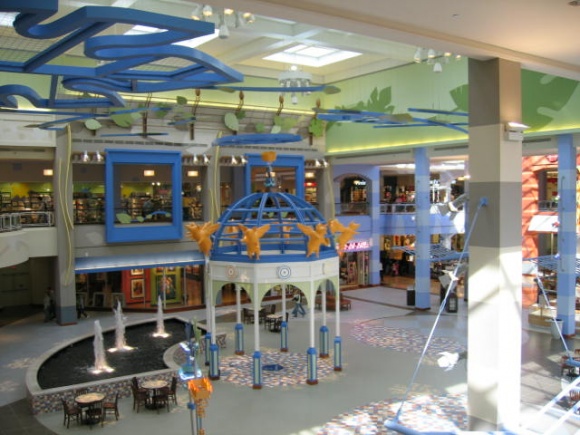
Just wanted to share this neat collection of photos from ex-Sleepyhead bassist Michael Galinsky, all taken at various malls in the summer of 1990. The fashions play more prominently than the malls themselves, but you can still get plenty of glimpses into a blur of Tape Worlds and Jarmans and Patrick Swayze posters. Mall department store junkies won’t find too much to latch onto here–the only anchor that features prominently is an old Sears, though I think there’s a “Harris” logo visible in the reflection of one shot.

Can anyone identify the malls in these pictures?

EDIT: Apparently many of the photos, if not all, were taken at the Smith Haven Mall on Long Island, which we’ve featured on the site before. It looks a little different now.

Retail News Digest for Monday, March 14, 2011

Comings and goings:

Other retail news:

  • An article on Bloomberg.com investigates the growing trend of putting grocery and upscale/foodie vendors in malls.  The grocery thing isn’t new, though.  Early malls frequently had a grocery store anchor, and most closed by the 1970s-1980s.   Malls in other parts of the world, even Canada, often currently feature a grocery anchor.  It’s neat that the trend is coming back though, because I’m not entirely sure why it left.
  • According to WSB-TV in Atlanta, the Atlantic Station project will be changing from a ‘mall feel’ to be ‘more like Atlanta’.  I’m not sure exactly what this means, but they plan to retenant about 25% of the development and give it a more local, personalized feel.
  • Westfield’s Warner Center development is underway in the San Fernando Valley region of Los Angeles. When complete, the area will be a new ‘downtown’ node for the area, if not for the entire valley.
  • According to The Atlantic, Facebook.com will be the mall of the future.  Is this entirely a new idea?  On one hand, many people do spend an inordinate amount of time surfing Facebook, but does aggregating online retail purchases from many sites into one somehow completely usurp bricks-and-mortar establishments?  I think being able to go to a store and physically feel merchandise will always be the trump card for keeping actual retail stores in business in many sectors.
  • A blogger on Allbusiness.com explores the implications of sameness in malls across the country, and the reasons why fewer local stores exist in malls today.
  • Maplewood Mall in the suburban Twin Cities is getting a much-needed renovation to compete with Goliath, also known as the Mall of America.

Tampa Bay Center; Tampa, Florida

Opened in August 1976, Tampa Bay Center was one of Tampa Bay’s biggest and brightest shopping destinations. Centrally located north of downtown Tampa along Martin Luther King Jr Blvd (called Buffalo Avenue then) east of Dale Mabry Hwy, Tampa Bay Center was next to Tampa Stadium, home of the NFL’s Tampa Bay Buccaneers. It was the place to be during the late 1970s and 1980s; but, despite rapid growth in the fruitful Tampa Bay area over the coming years and decades, Tampa Bay Center’s fate was ultimately sealed by far too much competition. When it opened, Tampa Bay Center had over 700,000 square feet of retail space and two anchors: Tampa’s first Burdines store and Sears, which actually opened before the mall did, in March 1976. The two anchors at Tampa Bay Center were arranged at each end of the structure, and a two-level mall corridor connected them.

This one’s long gone, so enjoy.

Opened in August 1976, Tampa Bay Center was one of Tampa Bay’s biggest and brightest shopping destinations.  Centrally located north of downtown Tampa along Martin Luther King Jr Blvd (called Buffalo Avenue then) east of Dale Mabry Hwy, Tampa Bay Center was next to Tampa Stadium, home of the NFL’s Tampa Bay Buccaneers.  It was the place to be during the late 1970s and 1980s; but, despite rapid growth in the fruitful Tampa Bay area over the coming years and decades, Tampa Bay Center’s fate was ultimately sealed by far too much competition.

When it opened, Tampa Bay Center had over 700,000 square feet of retail space and two anchors: Tampa’s first Burdines store and Sears, which actually opened before the mall did, in March 1976.   The two anchors at Tampa Bay Center were arranged at each end of the structure, and a two-level mall corridor connected them.

Due to the mall’s early success, Montgomery Ward was added as a third anchor near center court in 1980, bringing the center to almost 900,000 square feet.  It was the first and only major addition to the mall during its entire history.

A piece of random trivia: Tampa Bay Center opened one day after another long-gone Tampa mall, Eastlake Square, which was similarly sized and located 6.5 miles away.

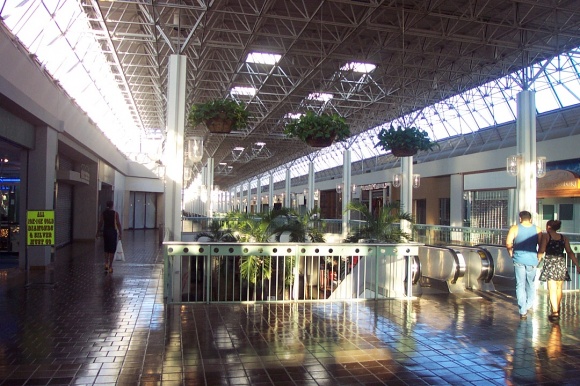
Designed by Maryland-based Rouse, Tampa Bay Center featured a tall, latticework trussed ceiling design, flanked on both sides by skylights, which bathed the entire center in natural light during a time when dark, drab colors and drop ceilings were common.  However, the dark tile floors at Tampa Bay Center were more period-appropriate, as were the fountains and the tall trees placed throughout the first level.  In addition, a glass elevator at center court was the mall’s centerpiece, and a unique-for-Florida design included a slope to the property, which meant shoppers could enter either level of the mall directly from the parking lot.

In terms of competition, Tampa Bay Center’s biggest foe was nearby WestShore Plaza, which opened in 1967 as the Tampa Bay area’s first mall and was located only a couple miles away.  WestShore and Tampa Bay Center had complementary anchors and thrived nearly side by side for years; however, WestShore was always the more upscale, more conveniently located counterpart to Tampa Bay Center’s stadium-adjacent austerity.  Eventually, WestShore began to emerge as the winner while Tampa Bay Center slowly spiraled downward.

By the late 1990s, Tampa Bay Center was in serious decline.  WestShore Plaza announced plans for a dramatic expansion, beginning in 1997, which was basically the beginning of the end for Tampa Bay Center.  A larger WestShore, directly on I-275 and centrally located within the Tampa Bay area, would spell disaster for Tampa Bay Center.

In addition to the WestShore expansion, a huge brand new mall, Brandon Town Center, opened in 1995 to serve the fast-growing sprawl in eastern Tampa, and in 1999 another massive mall called Citrus Park Town Center opened to serve Tampa’s north and northwest areas.

Meanwhile, in June 1998, Burdines announced they were leaving Tampa Bay Center, due both to building a new Citrus Park store as well as having a store just a few miles away at WestShore.  For eight years, Burdines had operated stores at both WestShore Plaza and Tampa Bay Center after Burdines took over the Tampa-based Maas Brothers chain in 1991, which had a WestShore location.  In 1999, Burdines closed their Tampa Bay Center store in favor of opening one at the new Citrus Park Town Center.

In late 2000, Montgomery Ward issued Tampa Bay Center another blow, by going out of business nationwide.  With only Sears remaining, stores began leaving in droves, favoring either Citrus Park or WestShore locations.

As if all this competition weren’t enough already, regional mall-developer Taubman swooped in and decided to develop yet another large mall, located adjacent to Tampa’s airport and directly in between Tampa Bay Center and WestShore Plaza – only a mile from each.  Called International Plaza and Bay Street, Tampa’s newest mall to date was another large, two-level behemoth, and with Dillard’s, Nordstrom, Neiman Marcus, and Lord and Taylor as anchors, it was proposed to be even more upscale and successful than WestShore.

With International Mall and Bay Street set to open in 2001, Tampa Bay Center faced an incredibly challenging uphill battle.  By early 2001, many stores had already left Tampa Bay Center, and by Summer 2001 the remaining few stores were on month-to-month leases.

The final death knell came in Fall 2001 when Sears, Tampa Bay Center’s final anchor, announced it was leaving.  Recognizing they were underwater in the deluge of competition and no longer under the obligation to maintain the 892,000 square-foot mall after Sears announced its departure, Rouse kicked out the mall walkers and whatever stores were left and closed the interior of the mall in January 2002.  Sears, the final anchor at Tampa Bay Center, closed in September 2002.  Though, with the mall already closed, Sears wasn’t anchoring much.  Sears left due to opportunity: International Plaza lured Dillard’s away from WestShore, WestShore had a vacancy, and Sears saw an opportunity to jump from a sinking (sunken?) ship.

After Sears left, Rouse decided to market the mall for sale, and DeBartolo indicated interest in purchasing the mall to build an open-air retail center, but ultimately declined.  Rouse came to the conclusion the site was no longer viable for retail given so much area competition. Rouse then sold the mall on December 31, 2002 for $22.8 million in cash to the Glazer family, owners of the Tampa Bay Buccaneers, who intended to turn about half the site into a training facility to complement the neighboring stadium.

Of course, this meant no more mall, and Tampa Bay Center was demolished 2005.  The Bucs moved into the training facility in time for their 2006 season.  The rest of the site became home to an overflow lot for Bucs games, and in 2007 the Hillsborough Area Regional Transit West Tampa Transfer Center opened to wow bus crowds near and far, but probably mostly near?

I visited Tampa Bay Center in May 2001 and took the pictures featured here, a short time before the mall closed permanently – please ignore my teenage mug in one of them.  Tampa Bay Center, while once a successful retail pillar of Tampa, ultimately succumbed to one of the fiercest levels of competition we’ve seen yet.  As usual, feel free to leave your comments and experiences.

Elsewhere on the web:

Photos from May 2001:


Green Acres Mall; Valley Stream, New York

The Green Acres Mall is a large, old shopping mall located just barely outside of New York city limits on Sunrise Highway in Valley Stream, a Long Island suburb. At 1,635,000 square feet, it’s one of the largest malls on Long Island, and also the second oldest, after Roosevelt Field.

Some of the most popular malls on this site have been in the tri-state area, so rather than keep you waiting, I’m offering up another:

Green acres is the place for me.
Farm livin’ is the life for me.
Land spreadin’ out so far and wide
Keep Manhattan, just give me that countryside.

The Green Acres Mall is a large, old shopping mall located just barely outside of New York city limits on Sunrise Highway in Valley Stream, a Long Island suburb. At 1,635,000 square feet, it’s one of the largest malls on Long Island, and also the second oldest, after Roosevelt Field.

The Green Acres Mall was developed by the New York-based Chanin corporation, and first opened in 1956 replacing Curtiss Airfield, and was one of the first suburban shopping centers in the New York metropolitan area. The mall’s name is somewhat indicative of the post-war optimism of the time; it was an era when this area’s population was rapidly exploding, and it was necessary to provide more out-of-town shopping options to the sprawling Levittowns of Long Island. A four-level, 266,000 square-foot Gimbel’s (the westernmost anchor) was the only initial anchor to the center, but a Lane’s opened at the mall’s east end four years later. JCPenney also opened a smaller inline store at the mall’s center court at some point, and they remain in this location to today. In 1967, a 320,000 square-foot Alexander’s department store opened in the front of (but apparently not connected to) the mall. Initially, the center was open air, but in 1968 the entire center was enclosed, as was the trend at the time.

The original center was a more basic dumbell design. but a 3 level expansion and renovation in 1983 added the wing closest to Sunrise Highway along with a new Sears store. A brand new food court was added to this wing at some point as well, though I have my doubts it was right in the original 1983 expansion. In 1986, the Gimbel’s store became an Abraham & Straus (and here’s a GREAT photo of it), which would remain until 1995 when the nameplate was retired in favor of Macy’s. The Lane’s store, at the mall’s east end, would be home to many different nameplates over the years. The store became a Love’s in the late 1960s, before becoming an S. Klein for ten years or so. EJ Korvette’s then replaced the S. Klein store, which in the 1980s became a location for Queens-based Gertz before being rebranded as a Stern’s. Stern’s lasted until 2001, before becoming half of the Macy’s location at the mall, which it remains until now. The Alexander’s store closed in 1992 and was completely demolished, and replaced somewhat nearby by a Caldor store, which, well, geez, that didn’t work out so well either. Gone by 1999. It’s a Target now.

In 2003, a Walmart opened in a strip center on the mall’s outlots, replacing an old Kmart store. Although this wouldn’t normally be big news, this particular Walmart was the site of a major news story in fall of 2008, when a Walmart employee was trampled to death by a mob obsessed with Black Friday bargains.

The mall was again renovated in 2006-2007 to remove a lot of the neon accoutrements left over from the 1983 re-do: our two sets of photos date from 2001 (I think) and 2007, so before and after this most recent remodel. I’ll let you guess which is which because let’s be honest, it’s not that hard.

Despite all of the changes to Green Acres Mall over years, it has remained successful. It’s still one of the largest/only malls serving the adjacent part of Queens, and it is a vital shopping destination for the older inner ring suburbs not far from JFK Airport. Even though it seems the demographics have evolved over the years–from the post-war GI Bill-driven veteran sprawl to a plethora of ethnic and racial groups that shop at the mall today–it seems to be largely similar, serving a large middle income audience in the older suburbs of this part of New York.

The mall’s anchors today are Macy’s (two stores), JCPenney, Sears, and Kohls.

More on the mall:

Retail News Digest for Sunday, February 27, 2011

Comings and goings:

Other retail news:

Retail News Digest for Sunday, February 6, 2011

Comings and goings:

Other retail news:

Forest Fair Mall / Cincinnati Mills / Cincinnati Mall; Cincinnati, Ohio

The phrase “If you build it, they will come” was coined in the classic 1989 film Field of Dreams, and, for the most part, it holds true to form. A mall can be built in the middle of nowhere and succeed; however, sometimes this is not the case. The infamous Dixie Square Mall was successful for a decade before it went to hell. Forest Fair Mall, located in north-suburban Cincinnati, was never that successful. It had a few moments when it was a decent mall, but ultimately it failed again and again.

Editor’s note:  The following write-up was based on a submission by reader and contributor “Jonah Norason” in December 2010.  It was summarily edited for clarity, and sparingly for content – I added some dates and a few contributory facts where appropriate.  Enjoy it, this is one of my favorites.  The pictures accompanying the post are mine.

The phrase “If you build it, they will come” was coined in the classic 1989 film Field of Dreams, and, for the most part, it holds true to form. A mall can be built in the middle of nowhere and succeed; however, sometimes this is not the case. The infamous Dixie Square Mall was successful for a decade before it went to hell. Forest Fair Mall, located in north-suburban Cincinnati, was never that successful. It had a few moments when it was a decent mall, but ultimately it failed again and again.

The era was the late 1980s. Shopping malls, long past the “climate controlled shopping cities” era of the 1960s, were glorified by TV shows and movies. And of course, value malls were built too, for those who wanted to spend less than at the higher-priced “real malls”. LJ Hooker, an Austrailian company, decided to team up with Cincinnati-based Hyper Shoppes Inc., which had created a new hypermarket called bigg’s and was interested in taking it nationwide. Hypermarkets were a relatively new concept at the time, combining supermarkets (grocery, butcher, bakery, etc.) with general merchandise (clothing, electronics, etc.). Their joint venture (Editor’s note:  How awesome would it have been if, when they teamed up, they called themselves Hyper Hooker?) was to construct a mall in Cincinnati that was both value and mid-range, featuring bigg’s, Dayton-based Elder Beerman, and Higbee’s, a Cleveland-based department store (you’ve probably seen the flagship in A Christmas Story when Ralphie asks Santa for a Red Ryder BB gun) that was to enter the Cincinnati market.

But somehow, along the way, enough just wasn’t enough. During Forest Fair’s planning process, the CEO of LJ Hooker, George Herscu, decided to add upscale tenants Bonwit Teller, Sakowitz, B. Altman and Parisian to the mall, creating a “supermall” template that would feature a larger mixture of tenants, and run the gamut from value-oriented to upscale. Herscu hoped malls like these would be built across the nation. However, there was a snag: the aforementioned upscale department stores Herscu planned didn’t want to locate in Forest Fair Mall, a blue-collar suburb of Cincinnati. In response, Herscu’s solution was to buy controlling shares of them, integrating them into LJ Hooker and forcing them to locate there.  Might makes right, but what results can you expect when you force the market?

Bonwit Teller was a posh New York department store with its flagship store in Trump Tower (the original flagship was demolished). B. Altman was was an old fashioned, established department store, also based in New York on 5th Avenue. Altman’s had a “reputation for gentility and conservatism“. Sakowitz was never even in that area of the United States, as it was based in Houston and had locations from Houston to Phoenix. Unlike B. Altman and Bonwit Teller, it never preferred malls. Parisian was a Birmingham-based store that had other locations in Ohio, but mostly was located in the south. Higbee’s did not show up, as it was bought by Dillard’s and pulled out of the project entirely.

The overzealous mall ran overbudget and was forced to open in phases. bigg’s and a few other stores opened in the eastern corridor in 1988. This was the “value” end of the mall, and shoppers could take shopping carts from store to store. In March 1989, the rest of the mall opened, and oh, what a mall it was! The “Y” shaped two level corridor opened with B. Altman and Parisian anchoring the two variant branches of the “Y”, along with a two-level food court. Elder Beerman rested on one outside corner of the mall, while Time Out rested on the other.  A full-service amusement park, featuring mini-golf, bumper cars, a carousel, a ferris wheel, and space for 200 inline stores rounded out the mall.

In addition, Sakowitz and a two-level store called Sports USA took up in-line space. The center of the Y had a sunken area for an amphitheater, and, on the east end of the lower level, the corridor ended with the Forest Fair 8, an eight-screen movie theater.

According to DeadMalls.com, Forest Fair Mall was “absolutely ornate… far more so than anything else in Cincinnati. It featured arched copper roofs (still on the mall!), enormous skylights with brass bars running across them featuring a dizzying amount of tiny light bulbs. Also at the time I believe there were many large fountains, and an enormous center court featuring an ornately detailed ceiling”.  The mall also cost $200 million.

Forest Fair’s grand opening extravaganza featured celebrities, including Phyllis Diller and country music group Exile.

Featuring everything from posh hundred-dollar suits to bananas, there was no end to the shopping possibilities at Forest Fair. Or was there?

Despite the visible Interstate-friendly location and optimistic outlook, Forest Fair was doomed before it opened, according to one analyst.

“Retail observers predicted Forest Fair — then Ohio’s second-largest mall — was doomed before it even opened in March 1989. They didn’t like its mix of value retailers in one wing and high-end stores in another. They argued its chi-chi department stores, B. Altman and Bonwit Teller, were too upscale and unfamiliar to the Cincinnati shopper.” —The Cincinnati Enquirer, 1999

Herscu was arrogant about his project, saying people would call him a “damn fool” if he failed. Indeed, within several months the mall lost its upscale anchors, about 50% of its stores, and filed for bankruptcy. How could this happen? For starters, the nearby median income was $36,921: not the demographic who could afford the fine retailers on the west end of the mall.

In addition to arrogance and misjudging the market, competition was another factor in Forest Fair’s failure. Two malls, located close to Forest Fair, launched impressive remodeling and expansion plans, causing a retail surplus in north Cincinnati. Tri-County Mall, located a few miles from Forest Fair along I-275, added a second level and anchor store McAlpin’s to round out a solid retail roster. Northgate Mall, also located just a few miles away from Forest Fair, in the other direction, finished an early 1990s remodel.  Both Northgate and Tri-County were the anchors to larger retail corridors featuring numerous strip malls, restaurants, and big box stores; Forest Fair had far fewer of these complementary stores nearby because it was between the other malls and their established corridors.

In addition, Kenwood Plaza, a strip center in an affluent part of northeast Cincinnati was torn down and rebuilt as a two-level enclosed mall called Kenwood Towne Center between 1987-1988. It had Lazarus, JCPenney, and McAlpin’s, and would become the Cincinnati area’s best mall.

The departure of upscale anchors rattled Forest Fair. Sakowitz closed and was replaced by Parisian. B. Altman closed its Forest Fair store and went out of business. Bonwit Teller was sold to the Pyramid Companies of Syracuse, New York in 1990, and the Forest Fair store closed due to unprofitability.  Parisian disconnected from LJ Hooker and kept the Forest Fair store open.  bigg’s and Elder-Beerman held on as well.

Unfortunately, LJ Hooker plunged into bankruptcy (guess he was a damn fool after all), and Forest Fair was sold in 1991 along with Herscu’s other two malls: Thornton Town Center, a small mall in the Denver area anchored by little more than a bigg’s and a large amusement area, and Richland Fashion Mall of South Carolina. Thornton has been demalled, while Richland Fashion Square has been renamed to Midtown at Forest Acres and is not successful.

The early 1990s were an empty, sad time at Forest Fair, culminating in a restructuring period after the mall was sold. According to DeadMalls.com, a bizarre chain of events occurred, consisting of marketing twists, gang wars, and a fire in the food court. However, there were some small victories during this period. The Bonwit Teller was gutted for a new concept, The Festivals at Forest Fair, which opened in 1993. The Festivals at Forest Fair opened inside the mall featuring entertainment and nightclubs. With stone tiles imported from India to invoke an “outdoor experience”, the entertainment district offered several bars, nightclubs, and other shops. The two-level section included America Live!, Gator’s Beach Bar, and America’s Original Sports Bar, among other venues.

The theaters also became a dollar theater, which, after a few name changes, remain today.

The Festivals entertainment district wasn’t as successful as planned, and the mall continued to limp along. A stalwart group of existing tenants and new anchors, including the addition of Kohl’s in late 1994 in much of the former B. Altman and a CompUSA in the bigg’s wing, brought the mall to 75% occupancy. It was nowhere near the success it was designed to be in 1989, nor the competition-crushing behemoth it was expected to be.

In 1996, Forest Fair was sold again to Gator Investments Group, a Miami-based company that promised to make it the mall it was designed to be. It was going to be hard work, especially since CompUSA and Parisian pulled out within months of each other in 1998.  However, Guitar Center signed on, and by 1999, Forest Fair Mall had secured a lease with the giant outdoor chain Bass Pro Shops Outdoor World, which opened in the former Parisian space. Ambitious plans were drawn, and Gator started signing new tenants for the mall through Glimcher Properties Trust, their leasing agent. There were some significant losses, though, as the Time Out on the Court amusement park closed.

By 2001, the mall was on the slow road to recovery. The food court was nearly full. Media Play, a big-box retailer selling electronics, books, music, videos, video games, and DVDs, opened. Off Fifth, the outlet form of Saks Fifth Avenue, opened. Babies R Us opened (though it was temporarily occupied by Stein Mart Outlet prior to this). Berean Christian Stores signed on as another junior anchor. A nightclub complex opened next to Kohl’s (disconnected from the mall concourse) called Metropolis. It replaced the last Festivals nightclub, Bourbon Street, as the whole Festivals annex was gutted for Burlington Coat Factory, which filled in the rest of the B. Altman space. A large amusement area for children, Namco WonderPark, opened and functionally replaced Time Out. Showcase Cinemas opened in the former spot of the theme park with Ohio’s first Steve & Barry’s University Sportswear below. Moore’s Fitness World opened on the top level of the old food court. The mall was to feature a mix of off-price and mid-line stores; however, only off-price, value-oriented stores showed up.  This wasn’t necessarily a bad thing, but it wasn’t the realized vision promised by Gator Investments.

Finally, by the end of December 2001, things at Forest Fair were looking up. The mall was going to be renamed to “Forest Fair Fashions”, and it was home to Ohio’s first Bass Pro Shops and its first Steve & Barry’s University Sportswear.

“We’re spending almost $15 million renovating almost all of the storefronts and putting in a grand staircase,” said Michael Dunham, senior vice president of leasing and Gator’s top executive at Forest Fair. “We’re putting in giant billboards below the ceiling with fashion graphics. The entire Kohl’s concourse will have hardwood floors.” (Cincinnati Enquirer)

In addition, the amphitheater was backfilled to allow for some cafés in the space.

Gator also hinted they planned to sign Just for Feet and an ice rink, but that never happened, because Gator Corporation lost interest in the mall after a dispute involving Polaris Fashion Place in Columbus. So, the mall got a new owner again.

Enter The Mills Corporation. The Mills built its fortune constructing huge, sprawling mega-malls in large metropolitan areas across the country. They were always branded the same and named [_____] Mills.  The first part of each Mills’ name was the name of the city, suburb, or state it was built in (Katy Mills, Gurnee Mills, Arizona Mills, St. Louis Mills, Grapevine Mills), or even a significant landmark or cultural/historical name (Franklin Mills in Philadelphia, Potomac Mills in Washington DC, or Opry Mills in Tennessee). One, Discover Mills near Atlanta, was even named after a credit card. These malls would often feature a floorplan that resembled a racetrack (with a few exceptions, Sawgrass Mills in Florida, the largest, was originally supposed to resemble an alligator). They all had big theaters, outlet stores, many anchors, entertainment, and one more thing: they were all one story.

The Mills bought Forest Fair Mall in 2002 and decided to convert it to its Mills prototype, giving it an extensive remodel. This was the first (and last) time Mills bought a mall to totally convert it; soon afterward, Mills began buying larger, big-ticket malls, adding their own unique spin of entertainment and dining. Also, rather than peacefully converting Forest Fair, Mills decided it would completely shut Forest Fair in order to gut it and embark on the remodel. Unfortunately, this required giving all interior tenants the heave-ho, including original 1989 charter tenant Nadler Mens Store.

By February 2003, the entire mall closed, save the anchors. Elder Beerman decided not to stick around either, leaving only bigg’s as the last original tenant. bigg’s, Steve and Barry’s University Sportswear, Bass Pro Shops, Wonderpark, Kohl’s, Burlington Coat Factory, Berean Christian Store, Media Play, Off 5th, Babies R Us, and Guitar Center remained for business as usual.

In July 2004, the inside of the mall reopened with great fanfare, as Cincinnati Mills. It opened at 75% occupancy, 93% occupancy by early 2005. It was probably the mall’s biggest success to date. The top level of the old Elder Beerman also became home to Cincinnati’s own Johnny’s Toys.

As with all of the other times reinvention was attempted, problems soon began to befoul Cincinnati Mills. Mills malls were starting to become known as places where trouble-making teenagers would hang out. So, Cincinnati Mills enacted a dress code and enacted a harsh rule of no groups more than three in the mall.

But, as it turned out, The Mills was a terrible manager as well, and major success did not materialize for long. Johnny’s Toys closed down and Steve & Barry’s took the entire former Elder Beerman, while the old Steve & Barry’s was sold to Urban Behavior. Stores began to trickle out. Media Play was the first casualty in 2005 and was not replaced.

Here’s a Cincinnati Mills mall directory from 2005, courtesy archive.org:

Meanwhile, The Mills itself had problems on its own and was bought by Simon in April 2007. Simon continued to keep The Mills malls as a separate unit, though Mills’ two other projects (Tewksbury Mills in Massachusetts and Candlestick Mills in San Francisco) were cancelled entirely.

The mall was two-thirds full in 2007, but mall officials believed the future was bright.

As always, they were wrong.

By May 2007, things began going south at Cincinnati Mills, beginning with the loss of bigg’s. The 245,000 square foot bigg’s, the largest tenant in the mall, was losing money. The lease was almost up, and bigg’s was not looking to renew it. In addition, the other Midwest hypermarket, Meijer, had opened way too close for comfort, and bigg’s had previously converted to a smaller “outlet” format.

As 2007 ended, the mall began to spin out of control. Wonderpark closed in March 2008 after the manager was discovered paying his employees (who were minors) to pose for sex videos. bigg’s closed in July, leaving the huge space vacant. Simon began discussing selling the mall.

The disappointing holiday sales of 2008 did not fare well for the mall either. Guitar Center and Urban Behavior high-tailed it out of the mall. Steve & Barry’s, which occupied the former Elder Beerman, went out of business as well. The structure once designed for 150 stores was now 40% vacant, emptier than ever.  Not that it looked bad, either. Due to the 2004 remodel, the condition of the mall was great, except for the total lack of stores and shoppers.

Simon dumped Cincinnati Mills in March of 2009, selling it a realty company called North Star Port Authority.  The “Mills” name was officially dropped, having not transferred with the sale of the mall, and the mall was renamed Cincinnati Mall. The new company had non-demolition redevelopment in mind, though some plans did indicate that the bigg’s end would be demolished. They managed to attract totes ›› ISOTONER Warehouse Clearance to the old Urban Behavior a few months later, only to have Off 5th move out a few months later for (get this) an outlet mall!

Cincinnati Mall, as you may expect, did not turn the mall around. The totes ›› ISOTONER Warehouse Clearance closed, Showcase Theaters was bought by Rave Theaters, but it pulled the plug on it before conversion (it closed in March 2010). The bigg’s wing is now closed entirely.

SOURCES:
This topic on UrbanOhio
CityData.com
DeadMalls.com
The Cincinnati Enquirer
The Wikipedia article, which I helped contribute to prior to this article
Shopping Mall Museum

Editor’s note:  I visited Cincinnati Mall most recently in November 2010.  I arrived slightly after dark, around 6 or 7 at night.  My first assumption was that the mall was closed.  There were no cars in any of the lots nearest the mall entrances, the only cars I saw were located in front of Bass Pro.  Thinking I’d give it a try, I parked at one of the ghostly, empty mall entrances and walked up to the door.  The lights inside the mall appeared to be off, but I approached the doors anyway.  Surprisingly, the mall was unlocked, and I hesitated for a moment before entering.  Was I supposed to be here?  Is it really open?  The regular lights still appeared to be off, but nighttime lights were on, basking the interior of the mall in an eerie moonglow.

As I entered the doors, I noticed a couple people walking around in the dim corridor that approached Bass Pro, whose entrance was closed off to the mall.  I actually wondered if I was supposed to be in there because it was so dark, but I kept going after seeing others.  After walking down the corridor leading from Bass Pro toward center court, I noticed not one store was open except for Babies R Us, an anchor.  Nearing center court, the crux of the Y, I discovered something that gave me pause.  A Claire’s store was open on the lower level, in the dark.  Yes, in the dark.  Look at the photos, I did no camera tricks here; it was really this dark in there while open.  I had never encountered this before, and it was both creepy and alarming.  After reaching center court, there were some normal, brighter lights on, and a few more people milling around.

I continued past center court, and walked toward Kohl’s.  Darkness again.  The Kohl’s wing was just as dark as the Bass Pro wing, and parts of it were sealed off with rope.  Kohl’s had also closed off one of its entrances to the mall.  Coming back from Kohl’s to center court, I saw another store open in the darkness on the lower level, Payless ShoeSource.  Again, I’ve never seen anything like this before!

After reaching center court again, I haded down the third and last corridor which used to go to bigg’s.  I encountered the ‘Picnic on the River’ Food Court area on the lower level, which surprisingly still had Gold Star Chili in operation, but little else.  Auntie Anne’s and Game Stop were still open on the second level.  The info desk on the second level had been abandoned, and the entire upper level of the mall in this wing was fenced off from the former bigg’s store onward. In addition, throughout the mall, large portions of entire wings were sealed off.  Burlington Coat Factory and the Danbarry Dollar Cinemas were still open in addition to Kohl’s and Babies R Us, but I can’t imagine the interior stores in this mall can sustain much longer.

More recently, In January 2011, Cincinnati Mall has turned up in the news again.  According to the Cincinnati Enquirer and Columbus Business Journal, owners of the mall recently presented suggestions to revitalize the site from its current sorry state.  Some of the suggestions included a Candlewood Suites hotel, an agricultural museum (!?), a hockey arena, other entertainment venues, and an indoor mountain bike park.  At this point, the ideas are not solid plans, because none of the ideas carry financing deals.  Locals are probably cautiously optimistic, at best, because the site has changed hands so many times in the past decade.

At any rate, World Properties, the New York-based firm who has owned the mall since March 2010, hopes to have these non-retail entities in mall within the next 2-3 years.  They probably also hope the four current anchors don’t plan on leaving, so they can get retailers back in the mix as well.  The new owners, on paper at least, seem committed to the site and we hope they aren’t just blowing smoke.  After a string of absentee owners and bad decisions, hopefully an eclectic, creative mix of non-retail entities can achieve the balance needed for success here.  I think owners were wise to realize the site is not marketable as retail-only, and also considered the failure of the previous entertainment district, so adding more options is a worth at try, provided they can get financing for it.  We’ll keep an eye on the progress here, and, as always, feel free to leave your comments and reactions.

Elsewhere on the net:

November 2004:

November 2010:

Retail News Digest for Sunday, January 16, 2011

This is a relatively new feature to our site.  While we’ve periodically reported retail news throughout the years, we’d like to establish a regular digest of major retail events on a bi-weekly or as-warranted basis.  We’ll see how it goes.

As with our mall articles, interactivity is key.  While we’d like to try to cover all major news stories, this is not possible for practical purposes.  There are some stories we will inherently miss – we live in a big world full of a lot of information.  As such, you can help us gather the news by posting relevant recent happenings to the comments page for these news features.  And, as always, you can post specific news items to their individual mall posts, if we have one. So, feel free to add stories you’d like to discuss and leave comments on the ones we’ve listed.

Comings and goings:

Other retail news:

Irondequoit Mall / Medley Centre / Lake Ridge Centre; Irondequoit (Rochester), New York

We round out our Rochester features with the region’s newest mall, Irondequoit Mall. Opened in 1990, Irondequoit Mall was located in Rochester’s northeast suburb of the same name, Irondequoit, a town of 50,000 residents located immediately northeast of the city. When it opened, Irondequoit Mall had three anchors: Sears, JCPenney, and Pittsburgh-based Kaufmann’s. The Kaufmann’s was originally slated to be Rochester-based department store Sibley’s, but May Company decided to consolidate their nameplates and ousted Sibley’s in favor of regional brand Kaufmann’s. This switch took place during Irondequoit Mall’s construction. (Is this correct? A couple sources say that Sibley’s acutally opened here very briefly.)

We round out our Rochester features with the region’s newest mall, Irondequoit Mall.  Opened in 1990, Irondequoit Mall was located in Rochester’s northeast suburb of the same name, Irondequoit, a town of 50,000 residents located immediately northeast of the city.

When it opened, Irondequoit Mall had three anchors: Sears, JCPenney, and Pittsburgh-based Kaufmann’s.  The Kaufmann’s was originally slated to be Rochester-based department store Sibley’s, but May Company decided to consolidate their nameplates and ousted Sibley’s in favor of regional brand Kaufmann’s.  This switch took place during Irondequoit Mall’s construction. (Is this correct? A couple sources say that Sibley’s acutally opened here very briefly.)

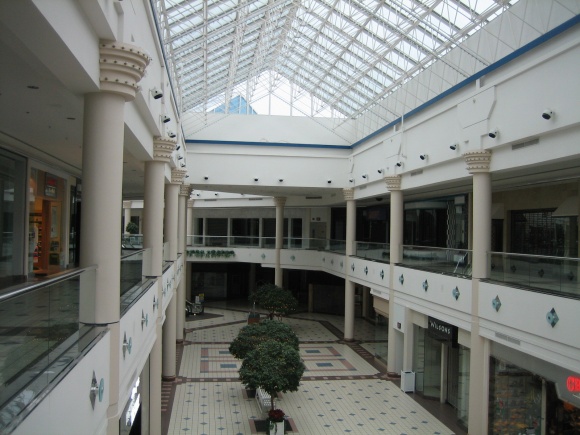
Irondequoit Mall’s design was a modified U shape, with Kaufmann’s as the west anchor, JCPenney in the middle, and Sears on the north end.  The mall was two level, had two main courts, and contained space for 125 stores.  The food court was located on the upper level of the mall, in a court formed by the intersection of 3 hallways.  JCPenney had the best access of any of the anchor stores, having two exits into the mall: one at center court, and one to a hallway leading directly to the food court.  A scanned directory of the mall is located here.
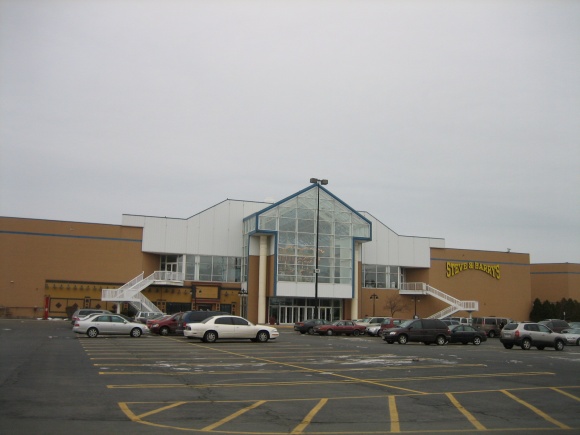
Irondequoit Mall was built by Rochester-based retail developer Wilmorite, the same firm that developed three other malls in the Rochester market: Greece Towne Mall in Greece (1967), Eastview Mall in Victor (1971), and Marketplace Mall in Henrietta (1982).  Irondequoit Mall was built in 1990 to complete a geographic trapezoid of sorts consisting of malls around the perimiter of the Rochester area, with downtown stalwart Midtown Plaza at the apex.

While only 2 miles from downtown Rochester, Irondequoit Mall was built with the intention to draw shoppers from middle and upper-middle suburban areas north and east of the city, like Irondequoit, Webster, East Rochester, Pittsford and Fairport.  Instead, Irondequoit Mall failed and ultimately succumbed to an unintended set of circumstances.  However, its story is interesting and still in progress, and definitely worth sharing.

Irondequoit Mall enjoyed early success in its first years and even embarked on an expansion in 1993, adding Rochester-based McCurdy’s as a fourth anchor.  This store didn’t last very long, however, and was replaced with Bon Ton in 1994.  May Company, which already owned the Kaufmann’s anchor in the mall, purchased the McCurdy’s chain and didn’t want to operate two stores in the same mall, so they divested McCurdy’s to Bon Ton.

The biggest changes for Irondequoit Mall came after 1995, and didn’t even occur there at all.  That year, two other Rochester-area malls expanded dramatically.  Eastview Mall, located 15 miles away in Victor, added two anchors and upscaled to become the Rochester area’s best mall.  Greece Ridge Mall, located 7 miles away in Greece, was a new mall created that year by sewing together 2 smaller adjacent malls, Long Ridge Mall and Greece Towne Center.  Ironically, both of these projects were Wilmorite’s, the same company that built Irondequoit Mall only 5 years earlier.  The competition from these two expansions, combined with a perception of crime and dab of racism, would soon slide Irondequoit Mall into obsolescence.
During the mid-90s, about the same time Eastview expanded and Greece Ridge opened, Rochester’s inner-city mall, Midtown Plaza, began to die.  Shoppers who used to go downtown began to shift their preferences toward suburban malls, and Irondequoit Mall was the closest mall to most of the city of Rochester.  Many residents of the city of Rochester, especially the area closest to Irondequoit Mall, are low income and minority.  In typical ‘white flight’ fashion, the more affluent suburban shoppers Irondequoit Mall so desperately wished to court began to avoid the mall, citing a perception of crime that ironically wasn’t really there.  A whisper campaign about the mall and its shoppers began among the sheltered, white suburbanites in eastern Monroe County, despite the fact that the perception of crime was mostly untrue, blown wildly out of proportion.

With the writing on the wall, Irondequoit Mall quickly began to lose retailers.  After the Eastview expansion was complete, shoppers in Fairport, Pittsford, and East Rochester had no reason to go up to Irondequoit at all.  Eastview was much better, and much closer to them.  In fact, Eastview quickly became super-regional, drawing shoppers from not only its home trade area, but from beyond the region as well.  Other Rochester malls retained shoppers for other reasons.  Greece Ridge held on mostly due to largesse and a unique mix of big box and traditional anchors, and Marketplace Mall’s success hinged on its location near Rochester’s undergraduate population of over 50,000 students.

By 2000, Irondequoit Mall was only 10 years old and already in dire straits.  The beautiful, modern, glassy two-level mall began to lose national chain stores, first at a trickle and then as a flood.

The first anchor to leave the mall was JCPenney in 2003, but by this time the mall’s staggering 20 percent occupancy rate made it already a lost cause.
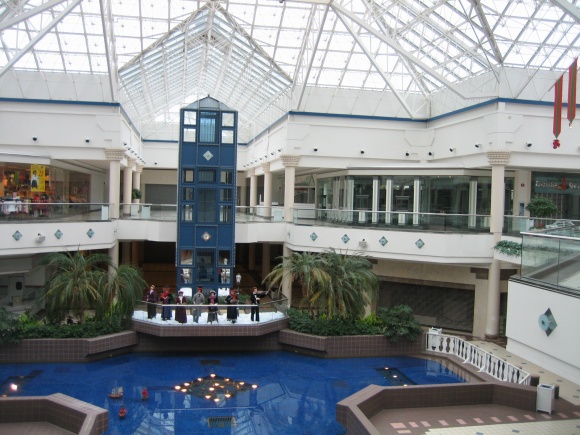
Rumors even began to surface about a new mall to be constructed in Webster, the next town east of Irondequoit.  This would have certainly been a terrible idea, but I guess the idea was to keep the minority riff-raff from the city of Rochester out of the mix in order to retain wealthy white shoppers.  Not cool, but at least it never happened.

In 2005, Wilmorite finally threw in the towel on their dwindling investment and put Irondequoit Mall up for sale.  Their divestiture of Irondequoit was tantamount to an admission of failure, as their own efforts expanding Eastview and building Greece Ridge were probably the biggest reasons Irondequoit failed, combined with changing shopper demographics and a misinformed perception of crime due to racism.

That same year, Adam Bersin, a Syracuse developer, purchased Irondequoit Mall for just $5 million and a wheelbarrow of tax incentives from the town of Irondequoit, whose coffers had been dry ever since the mall went downhill.  Bersin re-christened the mall with a new name, Medley Centre, and new promises, along with a new logo indicating the mall was “New York’s Shopping Spree”.

One of Bersin’s first changes was to install an anchor to the former JCPenney space, which he did by attracting fast-expanding fly-by-night retailer Steve and Barrys, a warehouse of cut-rate, low-quality clothing, which opened in 2005.
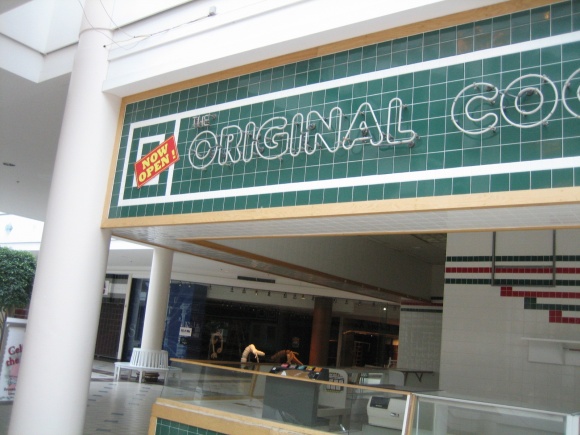
In 2006, Bersin brought a large-scale Halloween event to Medley Centre, which attracted a healthy crowd and filled an entire wing of the mall, but who knows how many of them stayed to shop in the mostly empty mall.  On October 8, 2006, Target opened outside in the mall’s parking lot, but it isn’t clear if Target helped the mall or just ciphoned from it, driving it even more into the ground.  If Target had opened IN the mall where Steve and Barry’s was, using the former JCPenney anchor, it might have helped more.  That fall, another anchor change occurred as Kaufmann’s became Macy’s when Macy’s parent, Federated, purchased Kaufmann’s parent, May, and consolidated all of the regional nameplates under the Macy’s banner.

Despite the small victories in landing Target and Steve and Barry’s, Bersin’s tenure as Medley Centre’s owner wasn’t very successful overall.  Mall directories were woefully out of date, still displaying advertisements that were several years old and listing stores that had long departed; however, some progress occurred in the right direction, as the mall’s upkeep became visible through rebuilt entrances, healthy plants, cosmetic repairs, and general maintenance.  Bersin also expanded the MedleyKids soft play area, so that it encompassed a huge space in the mall’s western court, underneath the food court.

Mall occupancy, however, remained woefully low.  Most of the chain stores left, leaving a weird, eclectic mix of mom-and-pop stores and non-retail entities.  Some of the parcels in the mall were given over to a dog obedience school, an english-as-a-second-language institute, a summer camp, and a town meeting space.  One former store became home to a model train track, and another store was used as a combination travel agency and security guard training school.  So, after you were done riding the HO-scale rails, you could be sure you were extremely safe while planning your trip to Cancun.

Along with the cosmetic updates at Medley Centre, Bersin made a controversial decision regarding the mall’s patrons, issuing a divisive edict regarding who was welcome there.  Signs were posted throughout the mall, especially near the food court area, indicating that cards and chess games were prohibited, which was considered a low blow by many.  I saw the signs when I visited the mall in December 2007, and was puzzled by them, especially considering there wasn’t anybody in the large food court area at all.

Here’s a photo of the rules.  These were posted throughout the mall.
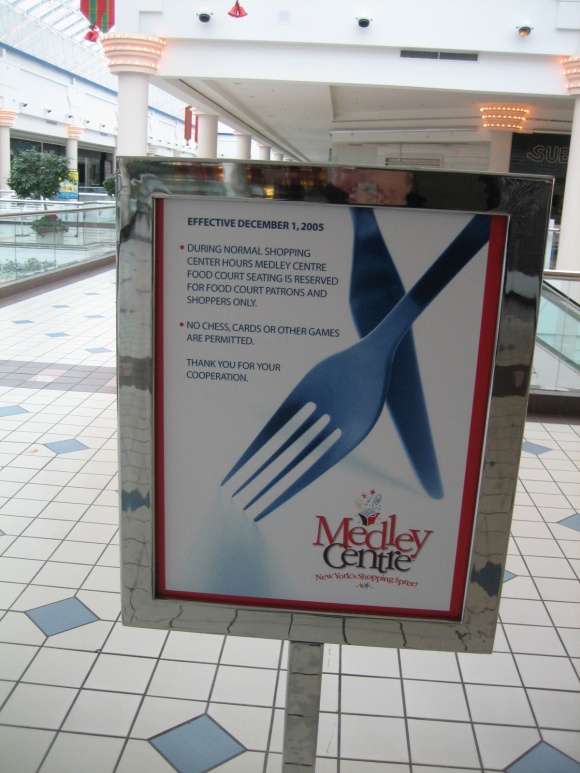
Ever since the mall opened, the food court had been a gathering place for local seniors, who regularly got breakfast and loitered in the mall, using it as a social gathering place to chat and play games.  Bersin’s new rules removed them in order to establish a “family-friendly” atmosphere in the mall.  They asserted the group of seniors, who played games and socialized, actively discouraged others from being there, which I find patently ridiculous.  The new rules created deep-seated resentment from a large customer base, and was probably not the greatest decision.  Who’s to say these seniors didn’t also shop at the mall?  I’m sure many patronized at least Sears and Bon Ton?  Seniors are a strange group to alienate, considering their loyalty and purchasing power, and the grapevine effect probably alienated more people than Bersin expected.  Also, what if some of the food court vendors relied upon this group for breakfast or lunch revenues?

In addition to alienating seniors, mall security also became more vigilant against groups of kids in the mall, banning those who frequently loitered and were seen as a nuisance to regular shoppers.  Mall walkers were still welcome, because they weren’t seen as intrusive to shoppers.  What shoppers?  Many saw these measures as extreme and unnecessary, and questioned whether they would further harm the mall rather than help it.

I agree with policing groups of minors who get out of hand, and this is a big problem at every mall, but ousting seniors from their regular breakfast gathering spot seems brutal and short-sighted.  Seeing a completely empty food court and empty corridors is certainly less inviting than an active mall with people conversing and enjoying each other, even if they aren’t necessarily buying.  To me, an active mall is a continuous feedback loop of success, and welcoming benign groups such as seniors promotes more activity.  Rather than discouraging people from coming, management should have become more creative and proactive in seeking better marketing solutions to reach these people.  At the very least, the presence of people in a mall makes it more welcoming and encourages visiting longer, while an empty mall is creepy and alarming.  Malls should tread lightly on restricting access to benign social gathering, and realize that their role as a social place mostly helps, rather than harms.

Check out these ads in the mall that I photographed in December 2007.  Keep in mind the mall had changed its name in 2005 from Irondequoit Mall to Medley Centre.
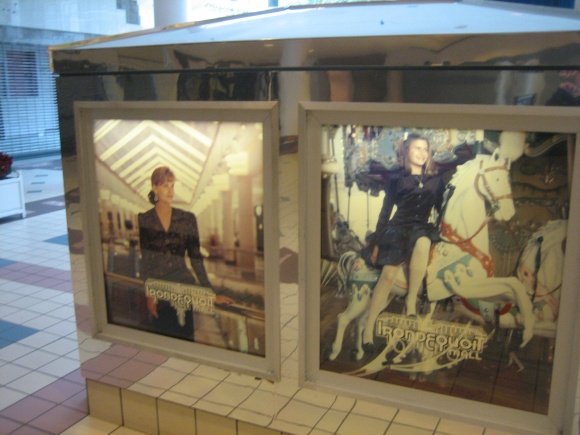
In 2007, Medley Centre met even more challenges, with the departure of both anchor Bon Ton and also Adam Bersin as the mall’s owner.  Bersin tacitly gave up on Medley Centre, and sold it to Scott Congel, a former developer from Syracuse’s Pyramid Companies, in March 2007.  Congel paid $4.7 million for the mall, slightly less than the $5.4 million Bersin paid just two years prior.  Pyramid is the Syracuse counterpart to Rochester’s Wilmorite, and has also developed malls throughout the northeast.  Bersin initially remained to manage the property during the transitional phase of changing ownership, but has since left the project completely.

At first, Congel remained tight-lipped about his plans, or lack thereof, for Medley Centre, until rumors surfaced in April 2008 of a deal between the mall and Regal Cinemas.  A Memorandum of Lease was filed with Monroe County on April 22 of that year, citing a lease agreement between the mall and Regal to develop a 66,000 square-foot 16-auditorium theater complex on two levels, using the former Bon Ton space.  The document also leaked Congel’s longer-term plans for the site, indicating a mixed-use project consisting of retail, residential, restaurant, entertainment, office space, and other venues.
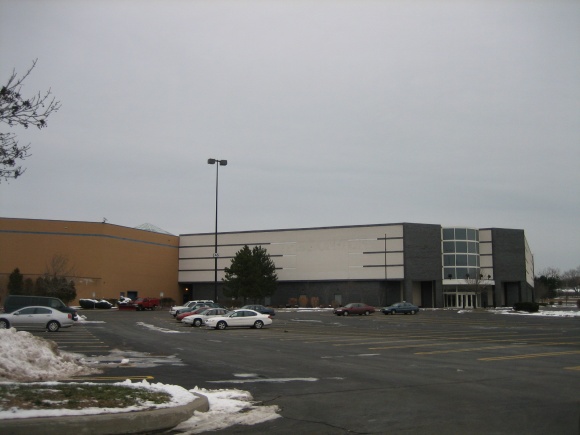
Congel’s plans were initially vague, though, and the vaguery led to questions.  Would Congel demolish the mall as part of his master plan?  What was the scope of the project?  How did he expect to succeed with a mixed-use development in a mall that was the newest in town and already failed?  Meanwhile, Steve and Barry’s departed the mall in May 2008, likely a decision made following a March 2008 visit by Steve and Barry themselves, who must have said something like “WTF? Why do we have a store here?”  They promptly moved to a “better” location at a nearby strip mall, West Gates Shopping Center.  Shortly thereafter, though, the entire Steve and Barry’s chain went out of business, so in the end their early departure was moot concerning the mall’s success.

In November 2008, Congel finally released more information regarding his plans to redevelop Medley Centre.  The aforementioned Regal Cinemas would go where the former Bon Ton store was, along with 194,000 square feet of office space, a 421-room, 30-story hotel as the centerpiece of the development (wow!), 330 residential units, and 1.2 million square feet of retail and restaurant space.

In her response to the plan, Irondequoit Town Supervisor Mary Ellen Heyman called it “sketchy”, which we couldn’t have said any better.  Why would 1.2 million square feet of retail and restaurant space succeed here?  The problem this development doesn’t address is that Rochester massively overbuilt its retail options.  The region isn’t in the Sun Belt – it’s not growing that fast, and the problem wasn’t with the structure.  Built in 1990, it’s a bright, glassy, modern looking mall and one of the newest in the state of New York.  Also, I’m not sure a 30-story hotel is needed here either, as most of the area’s hotels are clustered elsewhere, logically clustered near major businesses and the universities.  Residential might work, but I really think that the developer is a little wide-eyed at the possibilites for the site, and should consider down-scaling to a neighborhood center rather than constructing something super-regional, which will ultimately just ciphon from other businesses in the area.  On the taxpayers’ dime, no less.
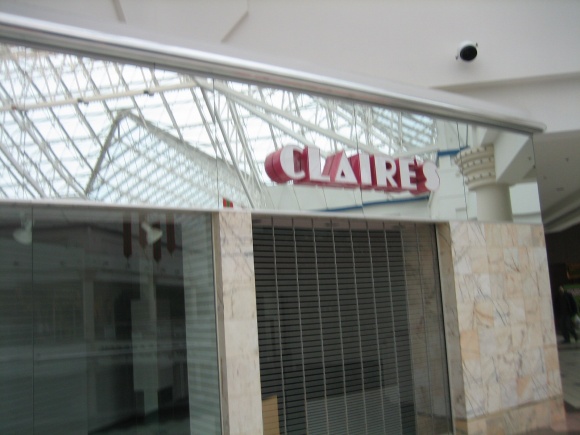
Nonetheless, in March 2009, Congel received approval for tax abatement from Monroe County, which included the consent of the Town of Irondequoit and the East Irondequoit School District.   After clearing regulatory hurdles, including changing the zoning for the site, Congel kicked the remaining 20 or so tenants out of the mall in January 2009, and sealed the mall.  This left only Macy’s and Sears as the remaining tenants, and they remain open as of December 2010.  The name of the mall was also changed in 2009 to signify its rebirth, from Medley Centre to Lake Ridge Centre.  Apparently third time’s a charm.

With the redevelopment project ready to begin, the only problem became obtaining financing.  Unfortunately, with the economic slowdown of recent, this proved to be extremely difficult, especially as banks are still relatively new to financing mixed-use developments and don’t quite have the process or metrics down to a science like they had for traditional businesses, like enclosed shopping malls.

Meanwhile, in November 2009, the Rochester Broadway Theatre League (RBTL) chose the mall’s redevelopment as a possible site for a new, 3,000 seat Broadway-style theatre.  The new theater would have some on-street parking and a two-level parking garage adjacent to it, and would also include 6,000 square feet of rehearsal or meeting space and a smaller event space for up to 200 guests.  Shortly after being elected, Irondequoit’s Supervisor-Elect Mary Joyce D’Aurizio initially vocalized dissent for the theatre’s location, hoping that it went to downtown Rochester in order to help that area sustain its own renaissance rather than locating it in the suburbs.  However, within a few months she changed her tune, recanted those thoughts and expressed support of it being located in Irondequoit.  Flip flop.

In April 2010, nothing was going on at the site, which at this point was becoming an eyesore, and Congel met with D’Aurizio to chat with her about repositioning some of the tenants in order to reduce remodeling costs, which will in turn make it easier to acquire financing to begin the project.  Congel also had to reapply for demolition and other permits that he already purchased but had lapsed.  Oops, but fair enough.

Then, during Summer 2010, the only major development regarding Lake Ridge Centre was a blow for it: the RBTL theater was awarded to the former Midtown Plaza in downtown Rochester.  This was a boon for that development, though, and for downtown Rochester.

As of December 2010, no work has yet begun on the redevelopment, and the mall sits empty except for Sears and Macy’s, who are still open for business as usual.  If that wasn’t bad enough, the only other recent news is also ominous.  A lawsuit filed in 2009 by the snow removal contract company the mall hired to remove its snow (and Rochester gets a ton of snow) was settled a few days ago for almost $50,000, because the mall refused to pay the company.  Oops again.

Ultimately, this development is a terrible gamble and a lose-lose situation for metro Rochester.  I don’t wish failure on many businesses, and I don’t wish failure on this one, either, but it’s either greediness or short-sightedness, or both, that leads otherwise intelligent government officials to give tax breaks to projects that carry a lot of risk and will add nothing to the region’s economic development.  If Congel fails, and Lake Ridge Center fails, it’ll just be another publicly-financed eyesore on the landscape.

Even if Congel succeeds, and the development is ultimately a success, it will only steal business from elsewhere in the region.  The retail development will cause a dearth at other malls, the hotel will take business from a hotel somewhere else, and the other businesses will steal from businesses elsewhere in town.  Greater Rochester doesn’t need more retail.  There are plenty of underused and dead shopping plazas littered across town, and Midtown Plaza, a large mall downtown, closed in 2008 after over 40 years in business.  Rochester isn’t growing by any significant measure, so any new business is just going to steal from existing development. So what gives?  The only people to benefit from this development are those involved in the development itself, and possibly the Town of Irondequoit if it can improve their tax base and add some jobs there.  From a big-picture regional planning standpoint, it is only going to harm Rochester as a whole.

We visited Medley Centre in December 2007.  Steve and Barry’s was still in business there, and the mall had about 25/125 stores,  feeling very empty.  Some interesting highlights included the fully-intact signage on many dead stores, and the McCurdy’s labelscar that appeared after the Bon Ton sign was removed.  Check it out, and feel free to leave your own comments and experiences.