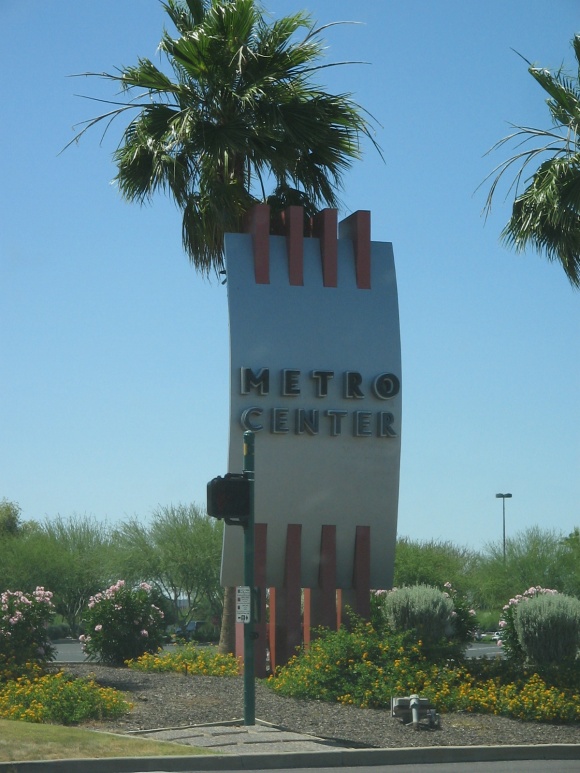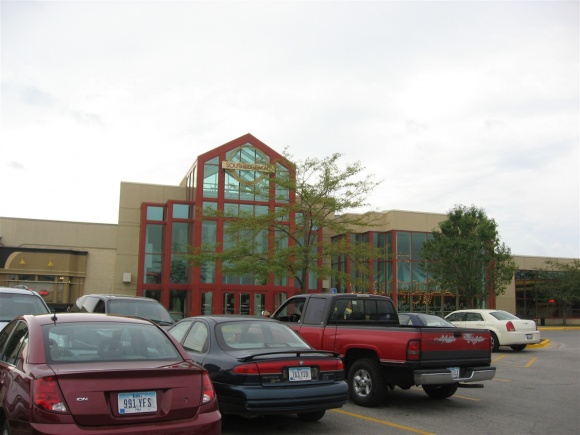
Des Moines is Iowa’s capital and also its largest city. With a population of over 500,000 residents, metro Des Moines has four malls that can be classified as regional or better: Valley West and Jordan Creek Town Center, both located in West Des Moines, Merle HayMall, located in northwest-suburban Clive, and Southridge Mall, located on the southeast side of Des Moines.
Southridge Mall was the second major mall built in metro Des Moines, after Valley West, and both malls opened within weeks of each other in 1975. The two malls also complemented each other geographically, with Valley West serving the west portion of Des Moines and Southridge driving the retail corridor on the south side. Valley West was constructed by a firm from Minneapolis, and Southridge was built by General Growth Properties.
 Before Southridge opened, the project was named Army Post Plaza, after the adjacent Army Post Road as well as an actual army post; however, the name was changed to Southridge before the mall opened.
When it opened in October 1975, Southridge was anchored by just one store, Younkers, which still sits at center court today. Sears opened as the second anchor on the east side of the mall in 1977, and Montgomery Ward became the third anchor in 1978, located on the west side of the mall. In 1982, Omaha-based Richman Gordman became the mall’s fourth anchor, opening a store on the southwest side of the mall adjacent to Wards.
In 1984, General Growth sold Southridge to Equitable Life, an insurance company, and General Growth continued to manage the mall until 1998. At that time, the mall was acquired by an equitable partnership between Simon and Macerich, who continues to manage the mall today.
It seemed Southridge was primed to add a fifth anchor in 1987, when Arkansas-based Dillards wished to open a store in the Des Moines market and chose Southridge. However, a spat ensued when Younkers sued Southridge management over the Dillards addition, arguing that its lease called for only four anchor slots at the mall. A federal judge finally ruled against Younkers in 1990, but by this time Dillards had lost interest. Dillard’s tried again in vain to open at Valley West Mall in 2000, but that never materialized, However, this outcome wasn’t the end of it, as the judge’s decision to allow a fifth anchor opened the flood gates for other interested parties to build, which led to the addition of Target in 1992.
Dillard’s tried again in vain to open at Valley West Mall in 2000, which never materialized, but they did finally open in Jordan Creek Town Center in 2004.
Meanwhile, Richman Gordman went bankrupt in 1992 and closed their store at Southridge. It was filled in 1994 by JCPenney, which moved from downtown Des Moines. 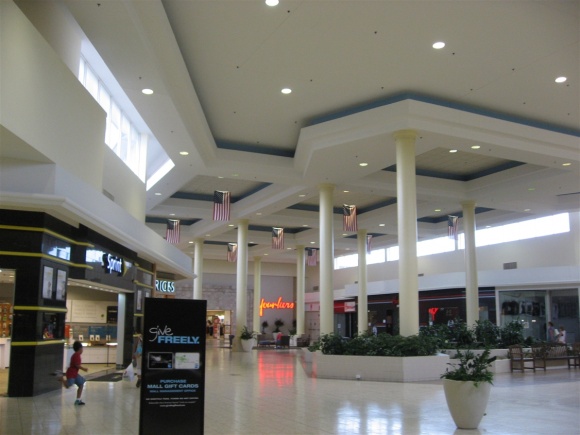
The 1990s were less than kind to Southridge, as the decline of many regional malls and the nature of overbuilding retail space finally caught up to metro Des Moines. Southridge became the ‘odd man out’ as retail boxes and new construction favored clustering around the major hub on the west side. By the late 1990s, Valley West Mall, which had originally opened in tandem with Southridge on seemingly equal footing, was clearly the dominant winner in the regional market.
The retail hub for the south side, anchored by Southridge, which had visibly taken a toll to the west side’s retail dominance, was also hit by emerging retail corridors in fast-growing Pleasant Hill, Altoona, and Ankeny to the north. The south side wasn’t growing as fast, and furthermore, it didn’t have the transportation access the north and west sides enjoyed, sitting adjacent to or directly on Interstates 35, 80, and 235. A new southerly freeway bypass (US 65/IA 5) of Des Moines opened in 2002 close to Southridge, but it was a bit late to reclaim its status as a successful regional mall.
In 1999, Southridge lost again when Montgomery Ward announced it was leaving Des Moines as part of its first round of bankruptcy closings. The building remained vacant until it became clear it wasn’t going to be retenanted,and was demolished in 2006 as part of a larger renovation of sorts.
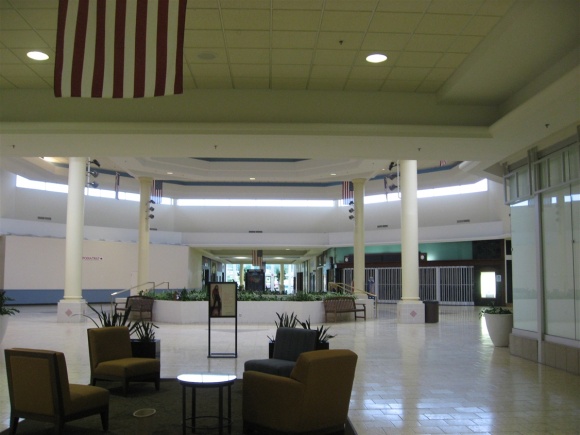
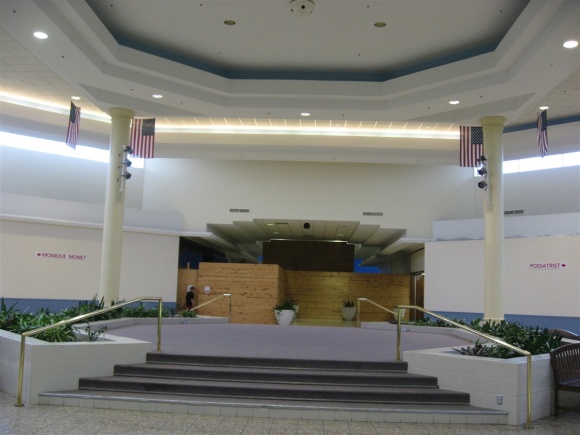
Caldor and I visited Southridge around this time, and although it was not the most successful mall in the region, it was a solid performer and seemingly not in danger at the time. One of our best memories from that trip is from Southridge, as while we exited the mall we heard a teenage girl on a payphone (yes, a payphone) very obviously and loudly discussing with her friend about a sexual encounter the friend had. In vivid details. About the most vivid you can imagine, in fact.
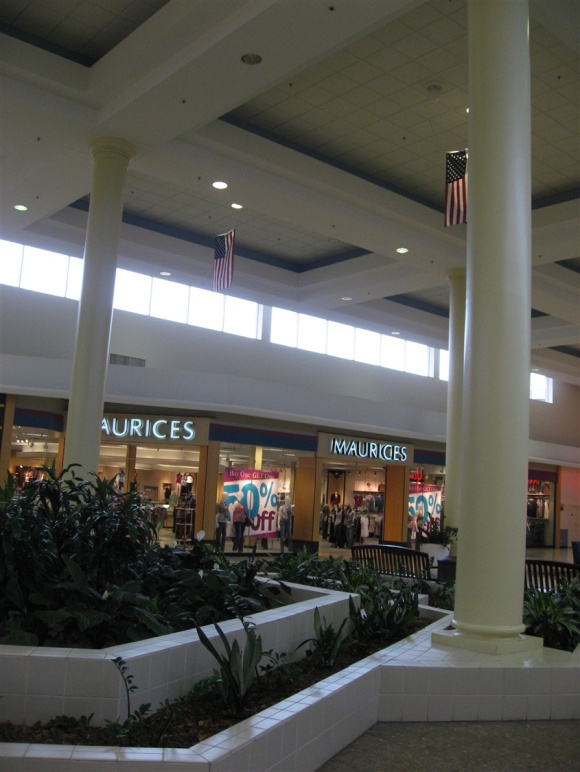 The 2000s were a sad, continuous downward spiral at Southridge Mall, culminating in a high vacancy rate of 40 out of 91 possible stores, or a 44 percent occupancy rate, by December 2009.
In 2004, yet another blow rocked the potential viability of Southridge, pushing it faster toward oblivion, as a brand new enclosed mall opened in West Des Moines, Jordan Creek Town Center. Jordan Creek, surrounded by a complementary brand new retail corridor of big box, strip malls, and destination restaurants, was one of the last super-regional enclosed malls to open in the United States. As Jordan Creek is located on the opposite side of the Des Moines area as Southridge, 0ne might expect the two malls on the west side of Des Moines to suffer and for Southridge to flourish; instead, the opposite happened.
Interestingly, because of synergy and proactive management on the part of both Valley West and Merle Hay Malls, these centers have been able to work together with Jordan Creek Town Center to remain viable and successful. Much more viable than Southridge, in fact, which has become a repository of vacancy and an odd collection of many local mom and pop or ethnically-focused shops, with few popular national chain stores and restaurants.
In its management’s defense, though, Southridge isn’t going down without a fight. Much needed renovations commenced in 2006, which involved the demolition of long-vacant former Wards, sprucing up the food court, as well as adding a new children’s play area. Mini-anchor Steve and Barry’s arrived on the scene in 2007 to breathe new life into the center; unfortunately, that store closed the very next year when the entire chain went bankrupt in 2008 due to a crazy overzealous expansion that ironically put the store there in the first place. Nothing lost, nothing gained, I guess.
By 2009, Southridge was identified in an article about the downfall of the enclosed American mall by U.S. News and World Report as one of 84 malls in danger of failure, due to its low sales per square foot and vacancy rate.
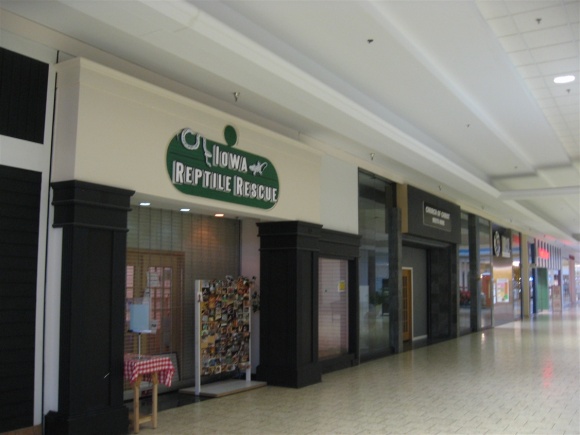 In 2011, another direct hit came as JCPenney announced they were bailing on the sinking Southridge ship in June. We last visited Southridge in August 2011 and took the pictures featured with this post. The last few stores leading to the former Wards (now demolished) are boarded up now, and this end of the mall seems to be the most vacant. The bright spots of the mall are near center court, and although the food court was remodeled, it didn’t appear to attract more businesses into it.
There are a few national chain stores (Fashion Bug, Vanity, Radio Shack, GNC, Regis) still breathing life into the mall, but by far the balance of the 40 or so stores still kicking around, other than the anchors, are mom-and-pop local stores. Many of these stores are geared toward a specific ethnic population (Filipino Store) or service a small interest group (Iowa Reptile Rescue). I have no doubt that these stores help serve a niche and I wish them well, but their sole presence unaccompanied by a mix of popular chains is just not enough to get people in the doors and accomplish the synergy necessary for an enclosed regional mall to succeed.
Or maybe, just maybe, this cat at the Animal Rescue League had the right sentiment about this mall. Mouth open, sound asleep, and snoring as loud as can be. He was really tired from shopping at Shag, Spike, and Canton. At least the reptiles next door at Iowa Reptile Rescue didn’t get him. I hope you got adopted, because you were adorable:

The only saving grace for Southridge are the remaining anchors: Sears, Younkers, and Target. Their popularity will probably keep the place afloat for a while, but a 40% vacancy rate in the mall combined with a lack of popular brands does not bode well for sustainability.
So what’s on the horizon for Southridge? As of Fall 2011, a career academy sponsored by Des Moines Area Community College has been proposed for a portion of the recently closed JCPenney space. We’re hopeful that the plan goes through, because Southridge’s days as a retail-only venue are numbered. Creative mixed-use schemes have a better potential to draw people into the mall, helping to retain the stores that are already there while reducing blight.
Pictures from August 2011:


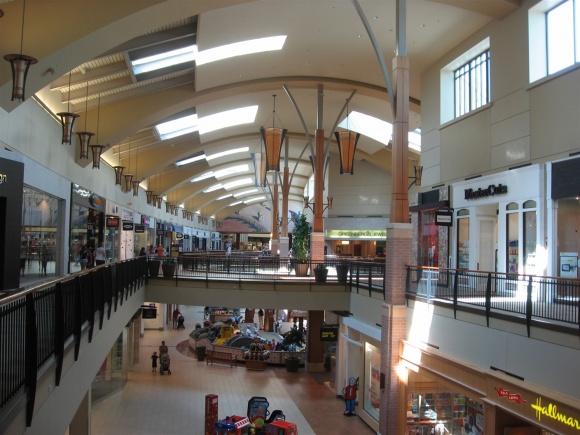 Located in West Des Moines, Iowa, Jordan Creek Town Center is the newest super-regional mall in Iowa and, as of early 2012, one of the most recently constructed enclosed malls in the United States. Opened in 2004, its construction was the culmination of over ten years of planning, resulting in not only a mall but an entire retail resort encompassing destinational shopping, dining, entertainment, recreation, and lodging, becoming one of the biggest shopping destinations in the midwest.


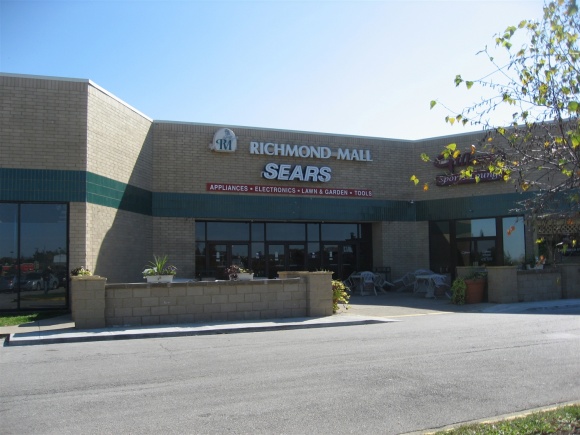 Richmond Mall opened in September 1988, a relative latecomer to the regional scene, as nearby Lexington’s three regional malls opened in the 1960s and 1970s. Richmond Mall enjoyed success for two decades, despite the eventual dominance of Lexington’s


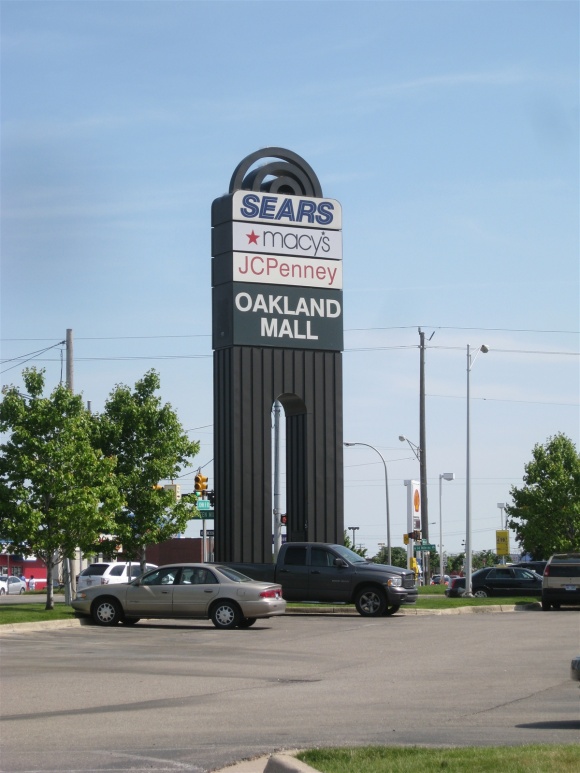 Oakland Mall opened in 1968, flanking the northwest corner of 14 Mile Rd. and John R. Rd., adjacent to Interstate 75, which was completed just prior to the mall’s construction. The mall was built on the southern edge of the city of Troy, a large northern suburb of Detroit located in Oakland County, the mall’s ostensible namesake. Troy is located 15 miles north of downtown Detroit, and has a population of 80,000 as of 2010. Troy is home to numerous corporations and white collar jobs that have been purged out of the city over the past fifty years or so.


 Southridge Mall was the second major mall built in metro Des Moines, after Valley West, and both malls opened within weeks of each other in 1975. The two malls also complemented each other geographically, with Valley West serving the west portion of Des Moines and Southridge driving the retail corridor on the south side. Valley West was constructed by a firm from Minneapolis, and Southridge was built by General Growth Properties.


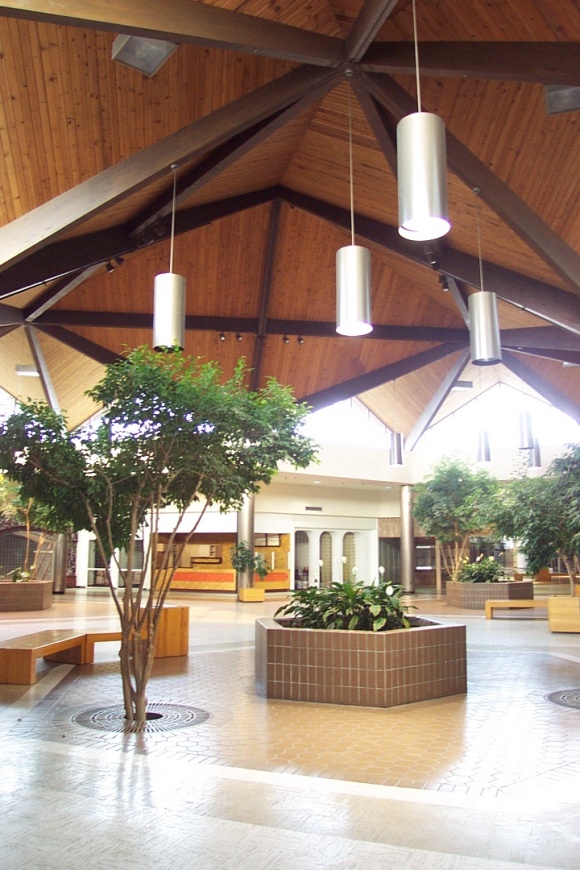 Fort Wayne’s first mall, Glenbrook Square, opened in 1966 on the north side of town. Three years later, Indianapolis-based Simon decided that Fort Wayne’s recent and projected growth indicated it could support a second enclosed regional mall. Located on the south side of town, Southtown Mall opened in July 1969. Southtown’s single-level complex debuted with a 100,000 square-foot Montgomery Ward and a 114,000 square-foot Fort Wayne-based Wolf and Dessauer department store, which was acquired that same year by Indianapolis-based L.S. Ayres. When Southtown opened, it had 567,000 square feet of retail space, including the anchors. In addition, G.C. Murphy operated a 60,000 square-foot junior anchor store, and there was a single-screen cinema, which was twinned in 1972 and expanded to a triplex in 1982.