-->

Showing posts with label streets. Show all posts

Wednesday, September 13, 2023

Nobody wants to administrate anymore

One thing that's become clear over the course of the last decade is that the absolute worst thing you can do for this generation of "public service" leaders is put them in a situation where they're actually expected to do the public service.

New Orleans' public works department is again without a leader after acting director Sarah Porteous resigned her post a little more than a year into the job.

The city has been without a permanent public works director for two and a half years. Porteous replaced the previous acting director, Josh Hartley, who left in August 2022. Hartley took over in the spring of 2021, after the last permanent director, Keith Lagrange, left to work for the City of Mandeville.

Porteous submitted her resignation Sept. 6, and her last day is Sept. 27. A spokesperson for Mayor LaToya Cantrell said a replacement has not been chosen.

The public works director manages some of the city’s most vexing infrastructure challenges, including clogged catch basins and old drainage pipes, blinking traffic lights and a $2 billion road repair program that has dogged Cantrell throughout her tenure.

Oh no, we have all this money that we're supposed to use to fixed the pipes and roads and stuff!  Nobody in politics... or, really, upper management anywhere.. wants a job like that. They all went to school and trained to manage the "doing more with less" con. The gig is supposed to be about cutting services and reducing staff through "innovation" and contracting things out then taking that resume and bolting to the next job.

The context that makes that seem appropriate is supposed to be a permanent austerity regime. You can't give anyone in leadership who was educated after the 1980s a big pile of money and tell them to go build some infrastructure. All they know how to do is strip it down and sell it off. Don't ask any of these people to actually deliver anything. That isn't what they're here for.

Saturday, July 10, 2021

Whose idea was it to do the Separate But Equal Blvd scheme?

In this story we find the Toussaints saying they were approached by Jared Brossett about considering it at least. In response, Jared says that's not what he wants. Either way both sides seem to agree they did discuss the idea.

Alison Toussaint said Brossett suggested in April that the stretch of Robert E. Lee in his district could have one name, while the part in neighboring council District A could have another.

Brossett on Friday evening disputed that, saying he called Alison Toussaint to say he did not support the idea of two names for one street.

Allen Toussaint, who died in 2015, lived on Robert E. Lee Boulevard in Gentilly.

Reginald Toussaint said he viewed the idea of a street with two names as one that not only crossed political boundaries, but racial ones as well.

“We're not going to be involved in a street that's split in half by color,” he said.

Joe Giarrusso is also mentioned in the story and he spent some time yesterday on social media also denying that he has proposed splitting the street to the Toussaints. 

We first read about this plan to segregate the name of what we now call Robert E Lee Blvd back in January.  This article seems to say it came either from the Street Renaming Commission itself or from comments or suggestions submitted to it. 

The commission has also received recommendations to divide some of the more prominent streets, picking different names depending on the neighborhood - an idea with significant racial overtones. For example, the commission’s current recommendation is to rename Robert E. Lee Boulevard for musician Allen Toussaint, but an alternative would call it Toussaint in the Black neighborhoods of Gentilly and Hibernia or Lake Boulevard in the majority-white areas of Lakeview.

I scanned the Commission's final report and found only two public comments suggesting a "Hibernia Blvd."  Both of them seem to favor that name for the entire length.  One suggests putting Toussaint's name on nearby Leon C Simon Blvd instead. But I don't see anything about dividing Robert E Lee between its Lakeview and Gentilly sections. Doesn't mean it's not in there. Just means I couldn't find it putting what I thought were good search terms into CTRL-F. 

The suggestion could have come from lots of different places. But the "split the baby" approach does sound like something somebody either working for or talking to a city councilperson would try.  And it isn't hard to believe that Brossett and/or Giarrusso or their staff , once having received such a suggestion, would then mention it to stakeholders in discussion just to feel them out even if, as Jared claims, they do not explicitly endorse the plan.  (Note: Giarrusso maintains that he has not spoken to the family at all about this.)

In any case, since, according to the Toussaints, this is clearly still being talked about by somebody we should probably keep asking who that is.

Monday, April 26, 2021

Feels like a Monday

Try not to go too hard out there

A vehicle fire in the eastbound high occupancy vehicle (HOV) lanes of the Crescent City Connection is snarling traffic on the West Bank, Monday morning.

The Louisiana Department of Transportation and Development reported the fire just after 8 a.m.

I'm certainly not one of these people declaring a return to post-pandemic normalcy yet.. especially with only 25 percent of Louisianians fully vaccinated (31% with at least one shot) as of today.  But certain of the old familiar comforts of home, such as everything being on fire, do seem to be returning. 

Oh also, was there an election over the weekend or something? I found all this trash laying around. 

Carter signs

We'll definitely have to talk about this one later. There are so many bad takes flying around today it's hard to pick out the absolute worst. But this is a contender

James Carville, the New Orleans-based political strategist, believes the outcome has national implications, noting that Peterson had the advantage of her side spending more money and a low turnout special election (16.6%) that typically favors candidates who seek to excite their party’s most fervent supporters.

“Voters voted against wokeness,” said Carville. “They just did. Woke did very, very poorly.”

I mean, it isn't very surprising that Carville has adopted the pejorative form of "wokeness" to mean any political platform to the left of, say, Ronald Reagan.  But he's also wrong (or lying, if you prefer to call it what it is) to claim this result is a rejection of such a platform instead of a candidate.   But, more on that later.  

In the meantime try to avoid getting exploded by anything.

Thursday, January 28, 2021

Segregation Street

 Look at that. The both sides came together and found a compromise solution

The commission has also received recommendations to divide some of the more prominent streets, picking different names depending on the neighborhood - an idea with significant racial overtones. For example, the commission’s current recommendation is to rename Robert E. Lee Boulevard for musician Allen Toussaint, but an alternative would call it Toussaint in the Black neighborhoods of Gentilly and Hibernia or Lake Boulevard in the majority-white areas of Lakeview.

This project that was begun in order to correct a shameful legacy of white supremacy now proposes to do that by coding the notion that all the Black people live over here and all the White people live over there right into the name(s) of the street. That's what this was all about, right?

Tuesday, December 01, 2020

Taylor Circle

Last week we moved a step closer to removing symbols of the city's legacy of white supremacy from its streets and public spaces. The committee charged with coming up with new things to call all of this stuff published its list of suggestions.  There are still a lot of things that need to happen before any of this becomes official, but the results so far are pretty good compared to what we expected. This could have ended up as a slapdash of bland cliches thrown together by tourism marketers. And maybe some of that is still evident but, mostly, this list has real depth. Rather than focus solely on entertainers, it highlights figures who fought for civil rights and escaped or defied slavery. Remember the purpose of this exercise in the first place was to counter a century's worth of damage inflicted by Jim Crow era propaganda. This list does fit that aim.  Heck, Mama D is on there. Who woulda thought?

Of course, it would fit that aim even better if the commissioners had taken our advice and renamed the traffic roundabout formerly known as Lee Circle for Dorothy Mae Taylor.  According to this, they did at least try. 

Commissioners initially considered naming Lee Circle for Dorothy Mae Taylor, the City Council member who was instrumental in desegregating Mardi Gras parades. But that plan failed to get enough votes from the commission. A proposal for Jazz Circle or Music Circle also was rejected.

“I definitely respect us trying to get a win for everyone by going with something generic but the whole purpose of forming this commission was to right wrongs and to acknowledge harm,” Commissioner Gia Hamilton said. “ I personally feel like it would be against my own personal beliefs to vote on something that’s generic.”

Before settling on (Leah) Chase, some commissioners sought to include Taylor as well and name the circle after both women jointly. That effort didn’t gain traction, either.

Nothing wrong with Leah Chase, to be clear. She belongs on this list somewhere. But it would make more sense to honor her in the Sixth or Seventh Ward neighborhoods her memory is best associated with.  Uptown was Dorothy Mae's territory. There really should be a statue of her scowling down at Rex as he passes around the circle every year (well... in the years to follow 2021, that is.) 

Anyway, despite our best efforts, and until  the"Chase Circle" designation is approved, it seems for now that the more appropriate Taylor to name it after is Phyllis.  After all she does own, or control, most of the property there. 

When Circle Bar co-owner Dave Clements arrived for an Oct. 8 meeting at the office of the bar’s landlord, prominent philanthropist and energy company executive Phyllis M. Taylor, he didn’t expect the dramatic good news/bad news dynamic that was about to play out.

The good news: Taylor would cancel the Circle Bar’s rent for the remainder of the year, and not seek back rent dating to March, when the coronavirus pandemic forced the storied Lee Circle bar/music venue to close. That gesture saved the Circle Bar, already cash-strapped before the pandemic, nearly $70,000.

The bad news: The bar would be required to start paying rent again in January, and its lease would not be extended past December 2021.

Taylor, whose fortune derives from a company responsible for one of the largest - and longest running - oil spills in US history, owns, through various companies and LLCs, the Circle Bar, the parking lot next door, and the office building across the way. She also purchased the property for and funded construction of the Greater New Orleans Foundation's massive "Center For Philanthropy" building that sits diametrically across the Circle from the bar.  

Given this information plus the fact that the "philanthropic" non-profit industrial complex completely dominates not only our economy but our entire system of government in 21st Century New Orleans,  it only makes sense that this be reflected in the nomenclature.

As for the New Orleans of the 20th Century, well, that is mostly gone now. Its old landmarks are dying away one after the other this year.  Oh well, goodbye to all that. Can't wait to find out all the exciting entrepreneurial ventures Gayle Benson is going to fund during the post-COVID phase of late capitalism. So much free real estate out there all of a sudden.

Monday, July 13, 2020

Never turn left on Tulane ever again

What if it were not just legally prohibited but also physically impossible?
And then there are candidates that could lead to other, much more significant name change fights, most notably Tulane Avenue, named after Paul Tulane.

Tulane is most often remembered as a philanthropist, and technically that’s true; he funded higher education. But according to the city researchers, the New Jersey native was also the largest donor to the Confederate States of America. He also bought the University of Louisiana — which would unsurprisingly be renamed after him — and privatized it.
Surprised to see this one on there only because it opens a wider discussion about the intersection of racism and "philanthropy" particularly with regard to New Orleans's social and political hierarchy that I would certainly love to see us have out in the open. But I wonder if any of these decisionmakers really want all that stuff aired out fully.

Thursday, June 18, 2020

Just make sure I get a decent map

I am, of course, very much in favor of striking as many confederate and white supremacist place names from the cityscape as we can.  But, considering how many there are, I'm going to need help getting around for a while after we are done.  One thing that might help is if we take care to see that the new names make some geographical sense. Like this, for example.
Anselmo would like to see Robert E. Lee Boulevard renamed Allen Toussaint Boulevard.

Philosophical arguments aside, Anselmo also sees a geographic rationale: In the decade between Hurricane Katrina and Toussaint’s death in 2015, the Rock & Roll Hall of Fame songwriter, producer and pianist lived and worked in the 1400 block of Robert E. Lee Boulevard.

Anselmo believes Toussaint’s decades of contributions to popular music more than merit a prominent street name.

“He stayed in New Orleans and lived on Robert E. Lee Boulevard,” Anselmo said. “I think it would be appropriate.”
Also, Dorothy Mae Taylor Circle would be pretty cool. 

Thursday, December 20, 2018

Send the bill to Gayle

The Mayor's office is (at least it is posturing as though it is) thinking about playing hardball with the Superdome commission.
After arguing for months that New Orleans’ powerful tourism and sports agencies should shift some of their tax revenues to help fund the city's aging and sometimes crumbling infrastructure, Mayor LaToya Cantrell is demanding $3.6 million in rent from the Superdome's governing body for its use of a city-owned portion of Champions Square.

The city and the Louisiana Stadium and Exposition District, also known as the Superdome Commission, have been trying for years to conclude a land-swap agreement that would include the 1400 block of LaSalle Street that runs between the Superdome and Champions Square.

Because of a disagreement over the land’s value, those talks have fizzled. So on Tuesday, Cantrell sent a letter to Superdome Commission Chairman Kyle France that said the city is owed $3.6 million in back rent, plus $488,000 in rent annually.
They probably owe significantly more than that, actually.  Take a few minutes and review the original AZ story about this from a few years ago. 

Anyway, I don't know what will come of it. Probably nothing. But it's been fun these past few months to watch LaToya at least try to hold some of these tourism-focused state entities to account for all the money they suck out of the city every year.

Saturday, December 01, 2018

I guess they really just love branding

A couple of months ago, the city acquired a grant from Domino's for a whopping $5,000 to participate in a cynical marketing campaign fix a few potholes. There were those among us at the time who protested a bit at the crassness of this arrangement. The city was agreeing to turn the public streets into pizza ads in exchange for temporary, superficial repairs to what roughly works out to about 50 potholes. The only significant benefit produced is cheap publicity for Domino's.

Moreover by entering into the deal, city leaders were tacitly endorsing the false argument that essential public services like infrastructure maintenance could best be achieved through the optional benevolence of private entities who receive a benefit in kind. They weren't just selling out a few public spaces, they were signing on to an entire ideology of corrupt corporatism. 


To those of us who raised this objection, though, it was pointed out that the city did have the option of accepting the grant and applying it to roadwork without actually agreeing to do the ads.
The grant also comes with a stencil kit to mark up the grant-funded pothole work with the Domino's logo, and a magnet to apply to the vehicles completing the work. Bulger said using those brand materials was optional.

“We give it to them and hope they use them,” she said. “People are passionate about pizza and about potholes, so it goes together.”
So it would be stupid not to just take the money. It's not much but it's fine if there are no strings attached. We were asked to have a little faith in our leaders that they wouldn't allow themselves and our streets to be exploited for this propaganda stunt.

Oh well.


Monday, October 15, 2018

Just taaakee the moneeys

The Advocate editorial board doesn't like LaToya's idea for funding critical infrastructure. They haven't got any helpful advice in that regard. But they do know they don't want anybody taking all the moneys away from their friends at the Convention Center.
The mayor’s chief quarrel is with the convention center board, which is proposing a subsidized 1,200-room hotel project at the upriver end of the massive hall to help draw conventioneers away from the French Quarter. The nonpartisan Bureau of Governmental Research estimates the subsidies at $330 million, but the convention center’s consultants say the value is about half that — and negotiations should trim the sum further. The hotel would benefit the city, and the project has support from the tourism industry. But the center has its work cut out to sell the public on the idea of a subsidy.

If the mayor wants to rebuild the Sewerage & Water Board, though, it may call for more disruptive thinking than just trying to grab at tourism dollars. The S&WB’s water and sewerage functions are largely financed by user fees — which would work just fine if the agency could calculate customer bills correctly.
There are several questionable assertions in that passage.  The Editors tell us the convention center hotel "would benefit the city," without saying how.  A $330 million public subsidy toward a private for-profit venture seems like the opposite of a public benefit.  Maybe they just mean it publicly benefits Joe Jaeger as the Gambit editorial board pointed out earlier,
It’s also ironic that one of the local developers behind the proposal is businessman and hotelier Joe Jaeger. During this year’s regular legislative session, when Harrah’s New Orleans casino sought to build a high-rise hotel entirely with private money — and pay hundreds of millions of dollars in taxes to boot — in exchange for extending its license for 30 more years, Jaeger led the charge to kill the proposal, arguing it was being rushed through to passage. Now Jaeger and fellow developer Darryl Berger seek approval for a much sweeter deal, though the mayor’s letter and media scrutiny seem to have slowed this project’s timetable. Rodrigue says the Convention Center board is waiting for an outside analysis of the proposed project (due later this month or in September) before taking a vote.
Aside: Should note also that during Jaeger's crusade against the Harrah's hotel, the Advocate ran this glowing profile of him and his cause.  The Gambit and Advocate are the same company now.  They say Gambit maintains editorial independence and this episode seems to bear that out.  But one wonders if that is sustainable over the long term.  For a while I thought maybe the plan was to position the two as a lame right/left "both sides" presentation. But that hasn't been developed as fully... or... as the mayor would say... as intentionally as expected.  Instead, they're just kind of co-existing for now. 

The Advocate piece talks a lot about "disruptive thinking" but never really explains what that might mean. The mayor is a "disruptor" we are told. Her proposal to take money away from the tourism agencies "displays her disruptive side." But they also explicitly argue against that plan so we have to wonder whether they actually mean it as a compliment.  Maybe they're saying LaToya is just doing the disrupting wrong.

Typically when we hear that word, the context has to do with regulatory arbitrage. "Disruption" in our modern economy happens most often when a company creates and exploits loopholes in labor and consumer protection laws to position itself as a middle-man in new and legally dubious markets.  The social consequences of this activity are almost always negative. "Disruptors" profit by the subversion of laws meant to protect employees from exploitation or housing prices from out of control speculation.  Another example would be a private company who takes over a municipal water system.  And President Trump's infrastructure plan is deliberately pushing more cities to sell their utilities off to these "disruptors."
Those financial priorities are crystallized in the new guidelines established by the White House. The ability to find sources of funding outside the federal government will be the most important yardstick, accounting for 70 percent of the formula for choosing infrastructure projects. How “the project will spur economic and social returns on investment” ranks at the bottom, at just 5 percent.

In this new competition for federal funds, a plan to, say, build a better access road for a luxury development — a project with the potential to bring in more dollars from private investors — could have a strong chance of getting the green light. By comparison, a critical tunnel overhaul that has trouble getting new money might not be approved.

“Instead of the public sector deciding on public needs and public priorities, the projects that are most attractive to private investors are the ones that will go to the head of the line,” said Elliott Sclar, professor of urban planning and international affairs at Columbia University. “Private investors will become the tail that will wag the dog, because they’ll want projects that will give returns.”
In the midst of all its disruption talk, the Advocate editorial also suggests that the mayor and SWB look to Washington for guidance. "They can also explore whether there is a federal role in the rebuild, since Washington has spent a lot of money cleaning up after flooding in New Orleans," it says. I wonder if the Advocate Editors read the Times-Picayune this weekend, though.  Because it says here that our $2 billion in federal infrastructure funds are basically spent already.  And most of that isn't going to modernize our drainage system. It's going to #FixMyStreets.
According to Green, the city plans to move forward with the first rounds of federally funded road reconstruction projects, even though they may not involve the water-holding features Diaz advocates. That's because many projects have already been designed and risk running up against a 2022 FEMA deadline to wrap up the $2 billion settlement work.

Green also said New Orleans residents and businesses have lived long enough with crumbling streets that have already been earmarked for improvements.

"Do we want to do traditional street paving in this city in the way it's done in other places that don't have this problem? I would say absolutely not," Green said. "But I would also say you have to balance that with the desire that neighborhoods and citizens have to get their streets done quickly ..."
But let's at least give the Editors the benefit of the doubt and assume they pay some attention to the national news.  If they understand that future federal infrastructure funding is going to be predicated on privatization then their argument in that case becomes this. Cantrell is a "disruptive thinker" and that's good.  But she should not think to "disrupt" a status quo where Louisiana taxpayers subsidize Joe Jaeger's private hotel. That would be bad. Instead they prefer she consider disrupting public ownership of S&WB so that some other private actor can profit by that as well.  At least they're consistent.

If the mayor wants to disrupt something for real, she would push on with this idea to take all the moneys from our local tourism oligarchs and put it into something we can all benefit from. Or she could agree with the Advocate and the Trump administration that the only good disruption is the kind that makes rich people richer at everyone else's expense. 

Thursday, August 30, 2018

How many potholes does $5000 fix?

I realize this is a second consecutive post about math but it's worth asking. I can't imagine it's very many potholes. Like maybe three? I mean, that's fine. We'll take the money. Especially seeing as how we don't actually have to do the commercial if we don't want to.
Do not get any hopes up for a sweeping infrastructure revolution, however. Where this ad campaign meets the road, the program takes the form of a $5,000 grant from Domino's to City Hall, the body already responsible for street maintenance in the first place.

“We approached the city about the grant and they accepted,” said Domino’s spokeswoman Danielle Bulger. “We leave the details to the city, so where they want to pave and when to do it is up to them.”

The grant also comes with a stencil kit to mark up the grant-funded pothole work with the Domino's logo, and a magnet to apply to the vehicles completing the work. Bulger said using those brand materials was optional.
So to be clear on this. If you see a Domino's ad in the street, it will be because the City specifically decided it would look nice there. 

Tuesday, August 07, 2018

Pothole pizzagate

$5,000 is going fix, like, what? Three potholes?  
Last week, the New Orleans City Council agreed to accept a "Paving for Pizza" grant from Domino's, according to WDSU-TV. The City Council is expected to vote on the $5,000 grant on Thursday (Aug. 9). If approved, the money will go to the city's Department of Public Works. 
Turns the streets into little Domino's billboards, though.  Gets the truck on the news, too.  All in all it's a pretty good ad buy for them.  The last time a corporation tried to spray graffiti ads all over New Orleans, people didn't take too well to that.  Seems like $5,000 is a pretty low price to sell out at now.

Thursday, April 12, 2018

Taylor Circle

Save All Monuments
An all-monuments-matter type household tells us how they feel during Carnival 2016  

Ever since the Confederate statues came down last year, a parlor game has blossomed on our city's op-ed pages and at public meetings and candidates' forums and whatnot over the question of what to do next with the space they occupied.  Why bother to do anything?  We just wanted the Jim Crow monuments taken down.  It's perfectly fine to just strip the name Lee off of the circle (return it to Tivoli or whatever) and just leave it alone after that. There's no pressing reason a person should be commemorated there at all.

On the other hand, if we do re-name the circle, the way to do that would be to give it a name that directly speaks back at the propaganda we have removed.  The Confederate monuments were themselves a political statement made by the white supremacists in power at the time of their erection.  If we choose to continue using that public space to express our political purpose, we should do so in a way that rebuts the original statement.

The reason I had given up on rededicating the circle at all is most of the ideas I've seen bandied about fail to address the definitive conflict that makes the space significant in the first place. Some attempt to sanitize it with tourist-friendly symbols drawn from entertainment. Some would replace monuments to the exploitative capitalism of the 19th Century with monuments to the exploitative capitalism of the 20th and 21st.  One idea that might have been acceptable was the suggestion that we acknowledge resistance to Jim Crow and rename the circle after Homer Plessy. But Plessy is already being honored in a location more appropriate to his historic act of protest.

Perhaps the worst argument I've read has been this suggestion by Arthur Hardy to create a "Mardi Gras Circle."  Hardy's stated intention to "bring us all together," is, like many of the other lame ideas,  an inappropriate attempt at sanitizing the space.  But his idea is actually even worse than that given that his subject is freighted with much of the same social and racial conflict as the Lee Monument itself.  This isn't a knock against Mardi Gras. Far it be it for us to speak against that. But re-naming Lee Circle "Mardi Gras Circle" as Hardy suggests and for the reasons he gives, degrades the social and historical significance of the circle and of the holiday.

It's fair enough for Hardy to say that the celebration of Carnival "brings people together." But that is a superficial assertion. Mardi Gras brings us together, yes. But as it does that it also heightens and  illuminates our contradictions. It's actually the underlying social and political discord that makes the communal experience of Mardi Gras such a powerful act of civic catharsis. And, sure, that's a bit more than most people are consciously grappling with while screaming at the Nyx "Dancing Queen" float for a bedazzled purse.  But any reflective treatment of the pageant, say in the form of a monument, that does not evoke this idea does not do the subject justice.  Except Hardy isn't interested in a symbol of social conflict. He's interested in something that has a benign "healing effect." In trying to do this with a Mardi Gras Circle, he confounds his own purpose.

It's a bad purpose anyway.  Twisting our own uncomfortable history into myths intended to please the powerful is how we got into this mess in the first place.  Case in point, Hardy's supporting argument is so far off base it necessitates paying reverent homage to a white supremacist organization.
As New Orleans celebrates its tricentennial, it is worth noting that Mardi Gras has been an essential part of the city’s history for more than half these 300 years. Street masking and private balls occurred in the late-1700s. In 1857, the Mistick Krewe of Comus presented the first organized Mardi Gras parade in New Orleans.
Of course it was the very members of the "Mistick Krewe" and associated Old Line Carnival organizations who established the revanchist Jim Crow government in the first place.  These clubs comprised (and in fact still comprise) the cream of the city's elite business and political class. After the fall of the Confederacy, they turned their street parades (these "bringing people together" activities Hardy is on about) into acts of un-subtle racist protest against the Reconstruction government.
During Reconstruction, New Orleans’ white elites used the pomp and ceremony of Mardi Gras to reassert symbolic and political control after the Confederacy’s defeat. The Louisiana Constitution of 1868 ushered in desegregated schools and public transportation, recognized the citizenship of African Americans, and granted the right to vote and hold office to African-American men without property requirements. Local white men perceived this new racial equality as a threat and were eager to recapture their former power.

Carnival krewes took their political arguments to the streets and manipulated their festive displays to provide evidence of the illegitimacy and incongruity of black citizenship.

The Crescent City Democratic Club, later renamed the Crescent City White League, whose stated goal was to prevent the “Africanization” of New Orleans and Louisiana, formed the city’s second krewe in 1870. The Twelfth Night Revelers regularly caricatured African-American lawmakers as bumbling crows or backward strongmen.

Comus presented its infamous “the Missing Links to Darwin’s Origin of Species” and “the Aryan Race” themes in 1873 and 1877, respectively. The former theme culminated with an anthropomorphic crowned gorilla standing in contrast against a white Comus, suggesting the innate inferiority of black men holding civic office. In like fashion, the Knights of Momus displayed comical yet grotesque representations of mixed-race people among equally grotesque animal hybrids in its 1873 parade themed “the Coming Races.”

Mardi Gras had become a mode by which former slaveholders and Confederate sympathizers could maintain symbolic power and communicate ideas of white supremacy, social Darwinism and the “Lost Cause” even under the city’s interracial Republican government.
After Reconstruction, it was these organizations who raised the funds and political will to create and install the monuments.
Two decades after occupying Union soldiers had made camp at New Orleans' Tivoli Circle, a monument to Confederate Gen. Robert E. Lee was dedicated at the site. Among the guests at the ceremony on Feb. 22, 1884, were former Confederate President Jefferson Davis, former Confederate Gen. P.G.T. Beauregard and Lee's two daughters.

Four days later, Mildred and Mary Lee attended the Comus ball.
By looking past all of this, Hardy suggests it is no longer of any relevance.  But nothing could be further from the truth.  To begin with, Comus and his acolytes continue to exert massive influence on the city's social and political hierarchy.  For proof of this, one need only observe attendees at the annually televised Rex Ball and compare those names with those that appear on campaign finance reports, or the boards of our local "philanthropic organizations" and the corrupt financial institutions that connect them.

Furthermore, the Krewes continue to militate in favor of their "Lost Cause" propaganda to this very day. Comus and Momus no longer parade in an ongoing protest against a thirty year old anti-discrimination ordinance. But their membership does through associated successor organizations.  Over the three years (yes it took that long) of debate over the monuments, Chaos and D'Etat repeatedly ran floats "satirizing" the movement to take them down.

Hardy breezes past all of this context regarding the Old Line Krewes vis a vis Confederate monuments.  Worse than that, he implicitly takes their side of the anti-discrimination dispute which he characterizes as an "attack" on the celebration itself.
Even when the celebration itself was under attack in the early 1990s when reaction to an anti-discrimination ordinance caused temporary battle lines to be drawn, it was Mardi Gras parades that brought the community back together. I’m betting that Mardi Gras Circle will have the same healing effect as we move past the recent controversies over statues and monuments.
Also, lol at that bit about the battle lines being "temporary."  The Krewes still haven't let it go.

Nor have they let go of their beloved Confederate monuments. And they appear to have the sympathetic ear of the incoming mayor on this matter. Last week she told Gambit she's willing to let the krewes "people who care about"  the Confederate monuments display them in a cemetery because, in her words, "Reverence, you know, matters."

That an African American mayor of New Orleans in 2018 is still obligated (and willing) to kiss the rings of the white supremacist Carnival royalty like this is stunning. That Hardy would write their own self-victimization white resentment bullshit into his version of the narrative tells us enough to distrust his proposal.  Our city's most famous Mardi Gras historian is a.. nearly literal, I guess.. court historian. That's not a huge surprise, of course. The niche media career he's carved out for himself depends on a willingness to tell us a top-down version of history.  Nobody rises very far in our little town without flattering a few oligarchs.

Luckily, a letter to the T-P this week provides us with what might be a solution.  
With all the public hullabaloo about Lee Circle, there have been many suggestions about renaming it. While most of those suggestions seem good, I believe I have a better one. Dorothy Mae Taylor was a longtime civil rights advocate before she was elected as the first African-American woman on the New Orleans City Council in 1986.

Taylor became famous (and some would say infamous) when she proposed an ordinance in 1991 to desegregate the gentlemen's luncheon clubs that had been the public face of the Mardi Gras krewes.

Here is a way to address every elephant in the room.  Hardy wants the circle's name to reflect the fact that Carnival parades pass there every year. This certainly does that.  Better, it does so in a more honest and meaningful way than Hardy's bland obfuscation of history would. More generally, we said we would like the re-christening of the space to directly speak back at history in a way that better reflects the best of our present values.  Well, Taylor Circle would do that too.

The only question now becomes, how would we pay for it?  I don't suppose Frank Stewart wants to chip in, does he?

Monday, September 18, 2017

"Mistakenly"

Whoops!
Grease that's a byproduct of restaurant cooking is supposed to be trapped before water leaves the drain system. And even if it does escape -- usually the product of a faulty or overfilled grease trap -- it's supposed to go into the closed sewer, not the stormwater system, where it can clog and stink up catch basins.

One source of some of the grease has been identified: Red Fish Grill, the longtime Bourbon Street restaurant that's part of the Ralph Brennan Restaurant Group. Construction workers found dirty water -- often described as grey water -- pouring out of pipes that were connected to the storm drain. The Sewerage & Water Board was called in and determined that Red Fish Grill had been mistakenly connected to a storm drain.
Aren't they supposed to meet some sort of standard for grease discharge though? And they have to pay the disposal contractor a disposal fee by volume, right? And I'm pretty sure S&WB is already under an EPA consent decree to get all this in order.  But here's a Brennan just dumping shit into the storm drains. By mistake, of course.

Friday, August 18, 2017

Slow and store

Looks like there's a problem with the money pump.
In its most recent financial tracking report from June, the U.S. Department of Housing and Urban Development labeled the city of New Orleans a “slow spender” because it had yet to tap into the National Disaster Resilience Grant – an award the city won in January 2016 following a ballyhooed national competition.

More than $100 million of the $141 million New Orleans received is supposed to go to eight so-called urban water – or green infrastructure – projects across the Gentilly section of the city. Some add retention ponds to parks, water-absorbing landscaping and sunken-garden neutral grounds similar to those seen on Canal Boulevard in Lakeview.
The "green infrastructure" in question here is a number of projects in the city's Urban Water Plan which you can check out here. Interestingly these projects are based on the "slow and store" concept of water management which also turns out to be what's happening with the grant money.  Although, the reasons for this seem pretty understandable.
Hebert said it took a year to get a final agreement to use the HUD money. It was finally signed on former President Barack Obama’s last full day in office, Jan. 19. Then, Hebert said, the city was afraid to start spending its own money to get reimbursed by the feds because President Donald Trump announced plans to defund some HUD programs.

Hebert said the city didn’t feel comfortable spending any of the HUD money until the Trump administration gave final approval to the plan in June.

“We didn't want to encumber city funds before we got that document because we did not know what the Trump administration was going to do at HUD,” Hebert said.
That's a pretty reasonable approach given that the Trump Administration recently threatened to claw back $2 billion designated for street repairs.  But since it doesn't look like there's much of a federal infrastructure plan forthcoming any time soon, we might as well get on with things around here.

Anyway there's a fair amount of talk about this and other drainage issues in the new one of these.

Wednesday, July 26, 2017

Un-Fix My Streets

That federal inspector general's report we first learned about back in January has been made official.   
A federal inspector general is recommending that the Federal Emergency Management Agency take back the entire $2 billion global settlement earmarked to help New Orleans repair city streets and underground pipes damaged by Hurricane Katrina's floodwaters.

Were the agency to accept the central recommendation of an eye-popping report released Wednesday, it would devastate the city’s hopes of improving its creaky infrastructure. The $2 billion lump sum is the bulk of what the city has on hand as it starts work on an estimated $9 billion backlog in repairs.

City officials said Wednesday that they have spent $350 million of the aid — money that would have to be repaid were the IG's recommendation followed.
According to this story, nobody seems to think a clawback of the money is actually going to happen.  But keep in mind these are Trump times and crazy things are not to be discounted off hand. 

Thursday, July 13, 2017

Delicious but deadly

That good ol Crescent City Clear 
The New Orleans Sewerage and Water Board and Mayor Mitch Landrieu's office are notifying residents citywide of the possibility of temporary elevated lead levels in drinking water as crews begin to dig up roads in coming months. The work, which has started in earnest in Lakeview and ramps up citywide headed into fall, affects a number of neighborhoods including New Orleans East, Gentilly, the Lower Ninth Ward and the Audubon area Uptown.
Extremely Mitch voice: Hey y'all wanted y'all's streets fixed, right?

Tuesday, April 25, 2017

Just give us our money

Score one for the #FixMyStreets trolls.
A state representative is proposing to redirect about $16 million a year in taxes from the Ernest N. Morial Convention Center to an independent board that would spend the money on fixing streets in New Orleans.

The proposal, by state Rep. Stephanie Hilferty, would take the revenue from two existing taxes away from the center. The taxes, a 1 percent tax on hotel rooms and a quarter-cent sales tax on food and drinks sold citywide, were put in place by the Legislature in 2002 to fund an expansion of the Convention Center that has not taken place.

“I understand that tourism is one of the backbones of our economy, but our city can’t crumble around our tourism district,” said Hilferty, a Republican whose district includes Lakeview and parts of Metairie.
Yeah get 'em! We've been clamoring about this for years. This is revenue raised off the backs of restaurant, hotel, and casino workers, musicians, cab divers, everyone who makes the "tourism economy" go. That includes pretty much all of us who make this place our home. Even if you aren't a celebrity chef or a busker with heart of gold or whatever, you probably take in your share of parades or Saints games or you know that one way to cook that one thing your grandma made.  It takes a whole city to "bear a culture." We're all New Orleans. Some people are in the business of selling a version of our life to tourists. We deserve to share in the benefits of that.  Some stupid board of political insiders shouldn't get to decide....  oh wait a minute... 
The money would be overseen by a nine-member board including representatives from each City Council district, to be be appointed by the state lawmakers from those districts, plus representatives of the city’s Department of Public Works, the Sewerage & Water Board, the Regional Planning Commission and Louisiana Associated General Contractors.
Oh dear... always a catch. Have to say, though, if we're choosing between rackets, this might be the slightly better one. 

Saturday, April 01, 2017

Hadn't thought of that?

It seems highly unlikely that anyone involved in planning the Bourbon Street excavation would not have already thought about how it might affect Jazzfest check-in
But the possibility of major work during some businesses' peak tourist seasons worries some on Bourbon Street.

Chuck Schroeder, of Bon Maison Guest House in the 800 block of Bourbon, said his busiest months are between April and October, as tourists come in for Jazz Fest and other events.

“How are you going to handle ADA compliance and guests checking in during Jazz Fest, our most productive month of the year?” he asked.

“Let me give that some thought,” Jernigan replied.
On the other hand, the city does seem to have a blind spot where ADA compliance is concerned so maybe that better explains things. 

In any case, the more interesting question about this project is that it's largely funded though money set aside to enact the mayor's controversial "security plan." That is both good and bad news.  The good news is it means the mayor has successfully wrested money away from the Convention Center, and applied it directly to maintaining vital city infrastructure. It's unfortunate that we have take these kinds of bank shots in order to put our public money to good use but congratulations are in order for getting something done in that regard.

The bad news is, it's also a pretext for shutting the street off from traffic entirely thus removing us one step further from whatever remains of the French Quarter as an organic urban place. 
In fact, the portion of the security plan most closely tied to the roadwork — installing bollards at intersections to prevent vehicles from entering Bourbon Street — won’t even be finalized until after the roadwork starts, though it’s possible some of that work could be integrated into the latter phases.
Not everybody was on board with the bollards. But the decision to throw them in as almost an afterthought to the road work apparently makes them a done deal. Very clever.

Maybe Jernigan still needs to give some thought to the problem of keeping the tourists comfortable. But rest assured, no one is thinking about how to maintain a city that works for people who actually live here.

Wednesday, January 25, 2017

I just needed to post something

I'm writing some long-ish posts right now about (1) The Trump style in public corruption (2) Mitch's plan to go full Giuliani on Bourbon Street (3) Carnival season (4) Miscellaneous. But that's all taking a very long time and I just started to feel that CONTENT NOW blogger's itch. So look! They're almost done with the SELAwork on Napoleon.

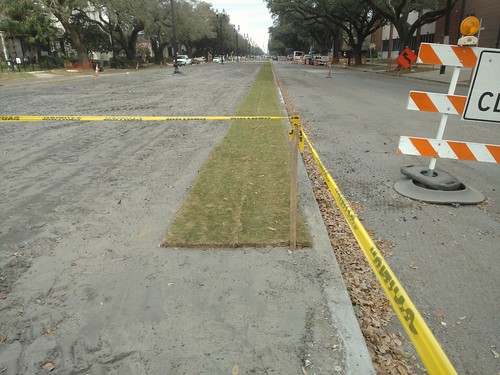
Sod strip

They were out laying sod samples along the edges of the neutral ground last week. It's not clear whether they're going to do the whole thing yet. I thought I'd read they were going to leave it entirely until after parade season. So it was a little suprising to see this rolling out at all.

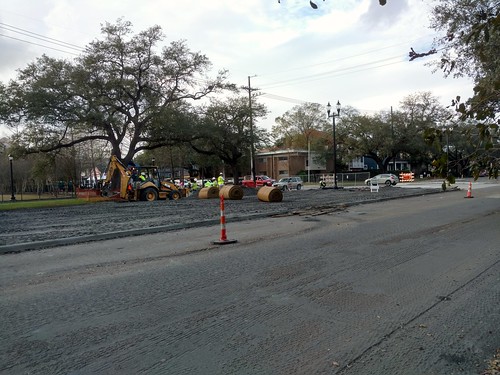
Sod

This week the crown of the median is still bare. In the meantime they have moved on to actually paving the street.

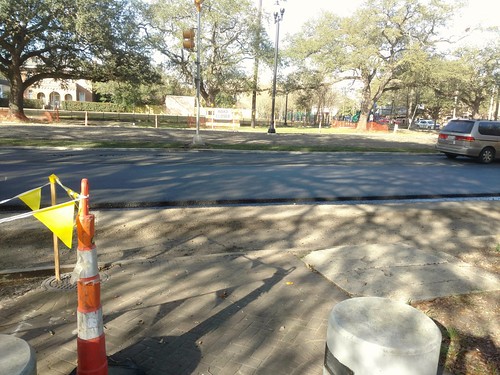
Paving

From the looks of things, the work on Napoleon could all be wrapped up in about a week or so if the weather cooperates. But the Great Walls dividing Uptowner from Uptowner will stay with us on Jefferson and Louisiana Avenues for at least another year, probably longer. So let's not schedule that Scorpions concert just yet.