-->

Showing posts with label crime. Show all posts

Wednesday, February 14, 2024

When a fraud policing tech gets taken down, does it make a sound?

Chicago is finally ditching ShotSpotter. (Although, you might notice here that Johnson is dragging his feet a bit.)

Mayor Brandon Johnson announced Tuesday that he won’t renew the city’s controversial contract with ShotSpotter, making good on a key campaign promise to do away with the gunshot detection system that has come under heavy fire for allegedly being overly costly and ineffective.

After the Sun-Times reported on the decision earlier in the day, Johnson’s office issued a statement saying the city “will decommission the use of ShotSpotter technology on September 22,” meaning cops will have access to the system throughout the historically violent summer months and the Democratic National Convention.

"During the interim period, law enforcement and other community safety stakeholders will assess tools and programs that effectively increase both safety and trust, and issue recommendations to that effect,” the mayor’s office said.

The move comes after several years of mounting evidence that the technology is ineffective and, in fact, actively harmful. 

He insisted the technology is “unreliable and overly susceptible to human error,” adding that it “played a pivotal role” in the fatal police shooting of 13-year-old Adam Toledo in March 2021.

Many of those concerns were reiterated by critics of ShotSpotter, who frame it as a costly surveillance tool that has led to overpolicing in minority communities. Proponents argue it’s a lifesaving resource that gives cops another much-needed tool to respond to gun violence.

Last week, the Sun-Times reported the Cook County state’s attorney’s office had conducted a review of ShotSpotter that found the technology had a minimal effect on prosecuting gun violence cases.

ShotSpotter was previously slammed in a May 2021 report by the MacArthur Justice Center at the Northwestern School of Law, which found that nearly 86% of police deployments to alerts of gunfire prompted no formal reports of any crime.

In another scathing report that August, the city’s Office of the Inspector General concluded the technology rarely leads to investigatory stops or evidence of gun crimes.

Ever behind-the-curve, though are New Orleans public figures who reflexively promote the fraudulent technology as a "solution" whenever crime and policing is missing. (Here's JP Morrell doing that not even a scant two years ago, for example.) The more cynical among us would posit that this has something to do with the presence of local political and business personages on the company's board.  But it doesn't have to be that.  This city is backwards enough on its own.

Sunday, February 26, 2023

Keep Doing What You're Doing

This is not just Dennis Allen's motto, or even Gayle Benson's apparent marching orders to her coach this offseason.  It's also a favorite creed of city governance. We can change the elected mayors and councilmembers around as many times as we like. We can vote them out of office, put them in jail, threaten to recall them, and we've tried all of these. But as long as there is no popular political movement animating any of this turnover, then, in the words of Joe Biden, nothing will fundamentally change about how the actual business is done. 

For most of the last year, through the exercise of a fraudulent recall movement, among other things, the ruling elite of the city have been playing a game we might call, "This here mayor we created and elected is bad now. Very much unlike the next mayor we will create and elect on very much the same platform."  Something similar happens to all of our second term mayors, lately. It's a kind of blood ritual where our entrenched powers purge themselves of responsibility for the last demon they summoned so that they may move on and call upon the next one. 

Last week, we pointed out the example of Forward Together New Orleans. This is the non-profit created by current sacrificial goat, LaToya Cantrell in order to administer the very large privatized section of city expenditures off budget and as far away from the scrutiny of governmental transparency, accountability or civil service rules as possible.  There was a time when that was the new vehicle created so that a new mayor could pretend to do things differently from the previous one. But now that mayor is being exorcised so we have to pretend something different will replace that too. 

What's replacing it, however, is more of the same

New Orleans health director Dr. Jennifer Avegno went before the city council last month to present a vision for a new “public health” driven approach to gun violence — describing the killings in the city, which have reached the highest levels in years, as an epidemic.

She emphasized the need for robust programming to address the underlying conditions of violence, along with targeted interventions to interrupt conflicts before they escalate to violence and provide services to those most likely to be involved.

 “There must be a community-wide, public-private collaborative with real infrastructure and capacity that works solely on a violence reduction strategy and can implement it quickly,” Avegno told the council. “This group should survive political administrations. It should be highly resourced.”

 It was presented as a new approach. But it sounded remarkably similar to the plan Mayor LaToya Cantrell rolled out when she created the now-embattled Office of Gun Violence Prevention just two years ago.

The health language is the trendy branding now, which is why councilmembers have asked the Health Department to come in on this. But really we're just proceeding along the same path as ever. "Ultimately" it won't be the Health Department, or any city department anyway. 

Currently, she said, she is working on a “landscape analysis” of existing public health and intervention programming in the city meant to address violence to determine what should be continued and what could be scrapped — including, ostensibly, those programs previously being run by the Office of Gun Violence Prevention.  

“What programs do we have?” she said. “Who are they serving? How many people are they serving? Do we have evidence to suggest that they’re doing what they’re supposed to be doing? Or that they’re effective? What are the gaps?” 

Initially she plans to advocate for several initial allocations of federal funding to get started on “catalytic” programs that she believes already have shown evidence of effectiveness — mostly money from the American Rescue Plan Act. Like past iterations of violence reduction programs in the city, she said that ultimately she anticipates that much of the funding will be routed to independent non-profits to do the work of violence prevention

We're just setting up to drop all the public money down to the same old non-profit industrial complex through a slightly different chute.  What will it do when it gets there?  Well, we already know that too.  Same thing it's been doing. 

Perhaps the most robust program included in the report is an initiative launched in Chicago in 2017 called the Rapid Employment and Development Initiative (READI), which uses referrals from community organizations, along with an analytics tool based on law enforcement data to identify individuals with the “highest risk for violence involvement” and provides them with twelve months of programing that includes subsidized employment, cognitive behavioral therapy, skills training, and other support services. According to Asher’s report, participation in READI significantly reduced the likelihood of arrest for homicide or shooting, as well as the possibility of victimization. That program costs around $20,000 per participant.

The READI program claims that the list of individuals they develop is never shared with law enforcement, but the use of similar predictive data analytic tools has proved controversial in New Orleans in the past

The "most robust" program involves taking federal money intended to help people suffering the effects of the pandemic economic displacement and not actually doing anything to help them.  Instead of addressing basic needs, instead of working to make people housing and food secure, we're going to put them on a pre-crime list and subject them to "behavioral therapy and skills training."  In other words we're not helping the victims of the disaster so much as we're keeping them from getting out of line or becoming less compliant workers. 

And, of course, as the article goes on to explain, this isn't anything new or different from what's been going on for years through successive administrations. 

In 2018, The Verge revealed that Mayor Mitch Landrieu’s administration had been quietly using software developed by the technology company Palantir to produce a list of individuals to target as part of the Group Violence Reduction Strategy — part of his broader NOLA for Life murder reduction effort. Some of those individuals were “called-in” with social service providers and various law-enforcement agencies and given the option to participate in social programs or be subject to “enhanced prosecution.” 

After the agreement with Palantir lapsed in 2018, The Lens obtained emails showing that the Cantrell administration was working to develop another tool utilizing law enforcement data to identify individuals with the help of sociologist Andrew Papachristos — this time to target for “impactful social interventions.” But little was made public about the effort, and civil liberties groups again raised transparency concerns, along with questions about how the information would be used and whether or not it would be shared with law enforcement. 

It is unclear what, if any, new tools might be utilized in the new effort being developed by the health department to identify individuals.

The reason it's unclear what might be new is... none of this is new. We're all just going to keep doing what we're doing: Handing out public money to privatized formations of political cronies create phony "anti-crime" programs that, in reality, only continue to harm people.  If anyone ever starts to get wise to this grift, there's always another mayor to symbolically slaughter so we can start it all over again.

Wednesday, April 27, 2022

Going with the feels

 Incredible work by these highly literate lawmakers

With the committee's action to advance SB418 without anyone objecting, the legislation now heads to the full Senate. If repealing the "Raise the Age" is approved in the upper chamber, the measure then would head for consideration by the House.

Murders increased 30% nationally, 35% in Louisiana in 2020. But Louisiana has had highest murder rate for 32 straight years, testified Jeff Asher a data analyst for AH Datalytics that does work for New Orleans law enforcement agencies. The statistics show large increases for violent crimes in red and blue states, big cities, small towns, and suburbs. The rates of murders started increasing in early 2020, accelerated in May 2020, and have stayed elevated since.

Those under the age of 18 account for 4.4% of all murder offenders in Louisiana in 2020 – down from 5% since 2018.

Asher said the data shows no evidence that the implementation of "Raise the Age" contributed to the statewide increase in murder or gun violence.

“You’re saying that for every 100 murders committed in this country roughly five are done by juveniles,” Talbot said. “These statistics don’t make me feel better. Tony Clayton makes me feel better.”

Sunday, April 10, 2022

Solving the wrong problem

Today's noladottimespicayadvocate is running a feature article on the carjacking phenomenon. The local one, anyway. The general fact that property crime seems to be up nationally is not surprising given two years of global economic shocks met with a policy response characterized by austerity, abandonment, and reactionary policing. But the particular types of behavior and the networks through which each flows have localized characteristics. This article is the first attempt by a local news organization to examine what's actually been going on in New Orleans. 

Most significantly, the investigation suggests that the local spike in carjackings isn't connected to an organized network of "chop shops" and parts dealers or anything like that.  This isn't to say that such things don't exist. It's just that most of these stolen cars aren't ending up there. Instead, most of them (72 percent last year, in fact) are being recovered, often abandoned not very far from where they were taken. Prior to this information, there had been much talk online and from police and politicians about "car theft rings" run by adults who would supposedly recruit minors to steal cars for them.  This narrative has already been deployed to pressure DA Jason Williams into breaking his campaign promise not to try children as adults. 

But, as it turns out, that story isn't true. Will that change the policy response from our chronically reactionary and out of touch political leadership.  Seems unlikely. 

Because the carjackers may not be profiting from their crimes, it's not clear whether there’s a short-term policy that can address the current surge. State Rep. Jason Hughes has proposed legislation, which passed the House unanimously this week, that would add new penalties for adults who recruit juveniles into carjacking rings, though there’s little sign that’s what’s driving the increase.

Instead, those that work with at-risk youth say that the problem will only abate with more significant and systemic changes: better schools, more activities for teenagers, better wages to give them hope and work healing broken communities.

Hughes's bill, which doesn't actually address the problem is rapidly on its way to passage. But what about these "more significant and systemic changes" that might be of some help?  "Better schools?"  Right now the legislature is considering a bill that would abandon the very concept of public education altogether.   "More activities for teenagers?" Nope! Instead, the legislature is moving a bill that would shame and persecute teens who seek to participate in high school sports on the basis of their gender. "Better wages?"  Louisiana is one of only five states with no minimum wage law, meaning only the federal minimum of a mere $7.25 applies here. (In non-tipped positions, anyway. Service workers have it even worse.) Kyle Green's HB 229 would establish a state minimum wage of $11.25. Denise Marcelle's HB 311 would gradually raise it to $12.00.  Neither measure is even remotely sufficient assuming it passes. Neither will pass in any case. 

So once more we're "solving" a problem that doesn't exist in order to avoid doing anything to help anyone. Which means, among other things, the carjackings are likely to continue.  But hey at least more of the stolen cars are being recovered now. So we've got that going for us. 

Friday, January 28, 2022

What did John Bel know and when did he know it?

 It's looking more and more like the Governor deliberately covered up this murder

What the governor knew, when he knew it and what he did have become questions in a federal civil rights investigation of the deadly encounter and whether police brass obstructed justice to protect the troopers who arrested Greene.

“The question is: When did he find out the truth?” said Sen. Cleo Fields, a Baton Rouge Democrat who is vice-chair of a legislative committee created last year to dig into complaints of excessive force by state police.

The FBI has questioned people in recent months about Edwards’ awareness of various aspects of the case, according to law enforcement officials who spoke on condition of anonymity to discuss the probe. Investigators have focused in part on an influential lawmaker saying the governor downplayed the need for a legislative inquiry.

The governor’s spokesperson said he is not under investigation and neither is any member of his staff.

Edwards kept quiet about the Greene case through his reelection campaign in 2019 and through a summer of protests in 2020 over racial injustice in the wake of George Floyd’s killing. Even after Greene’s family filed a wrongful-death lawsuit that brought attention to the case in late 2020, Edwards declined to characterize the actions of the troopers and refused calls to release their body-camera video, citing his concern for not interfering with the federal investigation.

You may have noticed also that the city of New Orleans is the throes of yet another mass panic over crime stoked by the media and by political leaders who are thrilled as ever to ride the wave of pubic hysteria but have nothing but the same old counterproductive responses to offer.  This week at city council we saw politicians demand  more cops, tougher cops, cops who will stop and frisk you if your car looks a little dirty, cops who will put you in jail for marijuana possession.  The same politicians have also called for an end to consent decree and its requirements that police at least appear as though they mean to act in accordance with the constitution.  Or, failing that, they have called for more policing by entities not bound by that restriction. One councilmember even suggested calling in the National Guard.  The State Police are already here a lot of the time, of course.  

All of this can only increase the danger to New Orleanians.  But it's clear from the statements of the local leaders, and the actions of the Govenor, that none of them actually care about any of that.

Thursday, June 24, 2021

The end of the criminal legal reform era

 Just how big an industry is the tax farming business now

Across the United States, court debt has ballooned as states have turned to court costs, fines, and fees as revenue streams. A recent report by watchdog group Fines and Fees Justice Center found that court debt in the U.S. now totals at least a staggering $27.6 billion. That figure is a low estimate, the group noted in the report, because it relied on incomplete data collected from only 25 states.

To handle the collection of that debt, states and municipalities — as well as the Internal Revenue Service — are increasingly turning to private firms, which in some states can add up to 40 percent surcharges onto the fees. In aggregate, that can translate into billions of dollars of payouts for the debt collectors.

Those of us old enough to remember the birth of the Black Lives Matter movement following the murder of Mike Brown in Ferguson, Missouri will recall the central role that municipal fines and fees played in the system of predatory racism against which the people there rose up.  And here we are a thousand years, and several cycles of murderous police actions and uprisings later and still very little has fundamentally changed. 

In New Orleans, one could argue there has been some progress. But what's happened has been slow and slight. A 2020 law re-directs court fee  revenues away from control of the judges who impose them but does not abolish them altogether.  The City Council appeared to at least try and defy that law when it resolved to return the fees collected but I don't think we've been updated on how that's worked out.  As of this April, a series of lawsuits have resulted in a system whereby Orleans Criminal Court judges promise a kinder, gentler bail regime

A joint order from the judges in February formalized new bail rules that paved the way for the settlement. The agreement comes after drawn out wrangling over how judges in New Orleans can impose bail or fines and fees on thousands of defendants each year, the vast majority of them poor.

Under the new order, defendants must have an attorney when their bail is set. The judges also promise to inquire into defendants' ability to pay, to consider alternatives to cash bail and to explain their reasoning when they do keep defendants behind bars.

We'll see how that goes.  Last week, the City Attorney announced a mass dismissal of some 385,000 cases of municipal violations which should reduce the likelihood you will be ensnared by an attachment from some unpaid traffic fine from 10 years ago. That's all good news. But it's minimal compared to what is needed here and in every city where billions of dollars worth of bounties are still hanging over the heads of highly vulnerable people. 

Meanwhile the time for further progress is running short.  Local media is already daily beating the drums of crime wave panic and the tide is beginning to turn toward reaction. (In fact, here is WDSU specifically blaming lax collection of court fees.) Our newly elected "reformist" DA is already breaking his promise not to try children as adults. Major candidates jumping into the marquee race in this fall's municipal elections are already taking up demagogic "tough on crime" rhetoric in their initial messaging.  All of this is only going to get worse as that election approaches.  Afterwards, this group of politicians will go back to work with a new mandate to "get tough" and new rules that will allow them to do just that.  

Mr. Biden emphasized that state and local officials in areas experiencing surges in gun violence can use $350 billion in Covid-19 relief funding to hire more law-enforcement personnel, even if it raises the total number beyond its pre-pandemic level.

The window of opportunity to make real and lasting change is always so short. And when it shuts it can stay that way for a long time. Business as usual, on the other hand can last... well that's why they call it business as usual.

Monday, January 27, 2020

Nobody wants to be D.A. apparently

Is Leon just grandstanding and fearmongering to hear himself talk?
Orleans Parish prosecutors lost almost as many trials as they won last year, a steep drop in convictions from just two years ago, when prosecutors secured guilty verdicts in three out of four of the 60 cases that produced a verdict.

In response, and amid an exodus of mid-level prosecutors, Cannizzaro has asked senior litigators once assigned solely to major felonies to train recent law school graduates.

“Our crime-weary citizens rightly expect the prosecutors of our office to be determined, competitive and proficient in the courtroom,” Cannizzaro said in a recent interview. “We have recognized where our trial numbers have deviated from the usual standards, and that is why we implemented in December a temporary reorganization plan.”
In a better world we might think a declining conviction rate is a good thing since it means, at the very least, that the District Attorney has slightly less leverage to go around bullying people than he currently does.   It also would mean we wouldn't have to allocate so much money to Leon's office which, as we can see, is what he's really pushing for here.
The DA blames the city.

He says that a $600,000 annual budget cut — roughly 5% of his overall budget — imposed by the City Council in 2017 and 2018 prompted lawyers to leave. The funding was restored in 2019, and in the 2020 budget his office has received a $500,000 increase.
But as long as Leon is free to assume that people really are "crime weary" (and the media does nothing to discourage them from feeling that way, he'll continue to push for more money to spend on putting more people in jail.

One would also assume that he's in the news making all this noise because he's gearing up to run for reelection but... there are these "rumors."
Some courthouse observers speculate that prosecutors are leaving because of the uncertainty ahead of this fall’s district attorney election. Cannizzaro hasn’t said whether he’s running, and the one contender who has announced, City Councilman Jason Williams, promises to be a formidable candidate.

The rumors change from day to day” as to whether Cannizzaro will run, said Gregg Carter, a criminal defense attorney.
Yeah, well, there were similar rumors the last time he was up for reelection too.  Also there are similar rumblings that maybe Williams is thinking about backing out of the race himself. 

If so, it's odd to find him running around downtown with a bullhorn and getting on TV and stuff.  Is there a trick to running for D.A. that involves really seeming like you don't want to run for D.A.?

Wednesday, October 16, 2019

Joe Georgusis's expensive obsession

Not the thing on the top of everyone's mind today but this came up last week and I want to make sure I had it bookmarked somewhere.

It may be true that justice is nothing more than a cruel lottery but some people do get to buy a lot of tickets.
Georgusis scored a quiet coup in 2015, a decade after his son’s death, when then-Coroner Jeffrey Rouse -- a major recipient of campaign cash from Georgusis -- changed the classification of Joey’s death to “unknown.”

The revision, reported to the state, was unknown even to the staff of the Coroner’s Office until this newspaper discovered it in state records.

Rouse has hardly been the only official to give the case fresh legs. Others who have probed the case over the years include former Jefferson Parish Sheriff Newell Normand, former St. Bernard Parish Sheriff Jack Stephens, former St. Bernard Parish District Attorney Jack Rowley and current Orleans Parish District Attorney Leon Cannizzaro.

Joe Georgusis’ crusade to prove his son was murdered and hold others accountable for it continues today. Yet another new probe is unfolding now: a federal grand jury investigation overseen by the U.S. Attorney’s Office in New Orleans.
Georgusis' company, River Park One, owns interest in commercial real estate all over the metro area. He bought the Iroquois Theater jazz landmark in 2016. He owns strip malls in St. Bernard and Jefferson. He was also involved in some of these "spillionaire" settlement deals after the Macaondo disaster. But that's not important right now.  The point is he's a guy who has a lot of money to throw around pursuing stuff like this.  And he can buy as much local government assistance as he needs. 


Saturday, October 27, 2018

Are we absolutely certain this wasn't Kenneth Landrieu?

Those cereal box badges are everywhere.
The unidentified man approached the lawn-care workers and identified himself as a police officer, showing a badge described as a silver star featuring a pelican. He then began questioning the workers about their employer, their places of origin and whether they had any marijuana or cocaine in their possession, the NOPD said.

The robber next called both men over to their work truck and began patting them down and frisking them. He then reached into their pockets and took their wallets, police said.

Sunday, May 06, 2018

Resilience accomplished?

Today is Mitch Landrieu's last day as mayor.  I have no idea how he's decided to spend it.  There's a big Pelicans game this afternoon. It's also the last day of Jazzfest.  Of course there's always at least a 30 percent chance he might be in Aspen anyway.  If you happen to run into him, see if he will sign your yearbook.

By now the local news outlets have published their big obligatory retrospectives. WWLTV filmed a soft-focus chat with Mitch and Eric Paulsen framed in front of a fireplace in Gallier Hall. Gambit sat down for an "exit interview." NOLA.com took a very NOLA.com approach and asked its readers/commenters to "grade" the mayor's performance.  The Advocate took a thorough look back focusing on "key indicators" having to do with crime, housing, "the economy," and the city budget.

To paraphrase George Bush, being mayor is hard work. Okay, not really.  You mostly just go around taking pictures with Mardi Gras Indians at Costco openings and whatnot. But it is a job where you are held accountable for a lot of things. Some of those things you even have a degree of control over. But not necessarily in the way the public perceives that you do. There are conditions a mayor is subject to that are beyond his control. A mayor's "grade" depends less on the change in such conditions than it does on what sorts of values are reflected in his policy responses.  

It's unfair, for example, to blame the mayor for the crime rate. But we can ask who benefited from Mitch's crime policies. Signing on to the NOPD consent decree was the right move for Mitch. (We can argue he didn't have much choice there but at least he didn't put up a fight over it.) Other decisions; installing surveillance cameras everywhere, allowing Sidney Torres to launch his app patrol or whatever, working with shady contractors like Trident Services and Palantir; were less good. Crime was bad in New Orleans when Mitch took office. It is still bad as he leaves. If the bulk of his choices under those conditions leave us with a more intrusive and unaccountable police state, are we better or worse off?

Mitch happened to be mayor when there was a lot of federal money available to do a lot of big capital projects. He'll be remembered for the new airport, the new hospital, the streets he really did fix, the stuff he spent FEMA money on. But should he be credited for those things?

At least he didn't entirely screw them up. He clearly handled the nuts and bolts of it better than Nagin had been doing at the end of his term. But I would wager that much of it was going to get done one way or another. It's what happens when a city is supported by a big pipeline of federal money dedicated to infrastructure. In fact, there should always be such a pipeline in the "richest nation on Earth" and it is our continuing shame that it takes a catastrophic event in order to free resources that should be readily available in every city all the time.

As I've said many times, though, it was Mitch's job to ensure that the process of rebuilding "the city we always wanted to be" benefited those who most needed the help rather than those best positioned to take advantage of it. And on this count, not only is Mitch an unmitigated failure, he can be counted as a malevolent actor. Of all the words in the long Advocate retrospective, these are the most relevant.
In a poor city, the median household income hasn’t registered any measurable increase during Landrieu’s tenure, and black households have actually seen a decline. More than half of local renters are spending at least 30 percent of their income on housing, and some residents complain that ineffectual city policies and enforcement against the rampant use of sites like Airbnb have turned their neighborhoods into virtual tourist districts, with few places for permanent residents.
Of course it can always get worse. I've got a feeling we're about to find out how much worse. But that's a subject for another post.

Thursday, November 30, 2017

What if your best practices are actually the worst?

Leaving aside the general corruption, arrogance and preference for predatory capitalism that characterizes all of American politics at all levels, is there anything more annoying than the common reliance on groupthink driven circular rhetoric?  Few have mastered this idiom more thoroughly than Waning Mayor Mitch Landrieu.  Nobody condescends more confidently and less substantively than he does.
Landrieu first described his public safety initiative after a shooting on Bourbon Street in November 2016 left one dead and nine injured. Paid for with money from the city and the Ernest N. Morial Convention Center, the plan focuses heavily on increasing surveillance, both by adding city-owned cameras and by accessing feeds from cameras owned by private individuals and businesses, though the latter policy still needs City Council approval.

Officials cut the ribbon on the central hub for monitoring all those feeds last week, and Landrieu responded to questions about the potential privacy implications.

"If you’re out in public, it is highly likely in this day and age you’re going to be filmed by some camera or somebody holding a phone," he said. "I just think that’s the new day and age that we’re in, and people should conduct themselves accordingly.
You may have concerns about abuse of state power, threats to privacy, civil liberties, etc. Maybe some of those concerns are legitimate. Maybe some aren't as bad as you might think at first. There's a lot to discuss. Maybe you thought politics was the process by which you raised this discussion.  But that's not how it works.

Politics is, in fact, the process by which elite class individuals like Mitch Landrieu instruct you on the things you have to get used to now. We call these, "best practices."  A best practice, loosely defined, is the lowest common denominator derived from the set of things everybody is already doing.  A best practice is self-legitimizing. If it happens to be a horror, it is your responsibility to adjust. We call that resilience.

Maybe the Independent Police Monitor disagrees but it hardly matters. At least they tried.
In a public letter issued Wednesday, the Office of Independent Police Monitor also questioned whether the $40 million plan, which the mayor first unveiled almost a year ago, will have a substantial impact on crime.

“As with any law enforcement data system housing private information about citizens, there is a potential for mismanagement, poor information security, public record law compliance challenges and user abuse,” the letter warned.

It added that while surveillance capabilities are being beefed up, the plan does not "earmark resources or personnel to monitor the implementation of the plan.”
The IPM's letter didn't just raise these questions, it also examined some of these "best practices" in other cites where similar surveillance systems are installed.  It cites evidence of abuse in Great Britain where, unfortunately, only Benny Hill was available to operate the cameras.
A review of 592 hours of government-run CCTV monitoring system footage in London found that 10% of surveillance of women lasted more than one minute, and 15% of surveillance of women for shorter periods was voyeuristic. In 2007, a police supervisor in Worcester, England was suspended after improperly manipulating surveillance cameras to focus in on women’s breasts and buttocks.
It also lists instances of stalking, assault, and evidence tampering by police using surveillance systems in New York, California, and Ohio.  It points out the racism inherent in the way the systems are deployed. Here is a congressional study referenced in the letter which found that even the cameras themselves are racist.
According to a 2017 study from the House Committee on Oversight and Government Reform, other technologies implied by the plan but not explicitly mentioned, such as facial recognition cameras, have been shown to disproportionately misidentify black people as suspects.
There are other issues raised. How long will data be retained? Is it available to third parties? Does it make sense to spend public money on this stuff when there are other budgetary priorities? Most importantly, there's no clear evidence the cameras reduce crime. The letter also cites multiple studies to make this point.
A 2008 study by the University of Southern California (“USC”) found that Los Angeles’ camera network made no statistically-significant impact on reducing violent crime, property crime, or quality of life crime, such as prostitution or public drunkenness. Similarly, a 2009 study by the University of California at Berkeley found that San Francisco’s cameras made no statistically significant impact on reducing violent crime, drug crime, or quality of life crime, while only making some impact on reducing property crime. A 2005 review of 13 studies in England found no statistically-significant impact on reducing violent crime, and a statistically-significant reduction in property crime in only two of the thirteen locations studied, one of which was a parking lot. A 2008 review by USC of 44 studies in the United States and abroad concluded that none of the domestic studies found a statistically-significant impact on reducing crime, and that any impact found in foreign studies was limited to property crime.
So the "best practices" are actually quite problematic and behaviors aren't changing despite the fact that everybody is on camera now.  "People should conduct themselves accordingly," says Mitch to all that. But, even if we accept this as a desirable outcome, it still isn't happening no matter how many times he asserts that it should.

Waxing Mayor Cantrell just finished up a campaign where she hammered hard on the theme of "listening" to people.  Will she be more likely to take legitimate complaints about surveillance seriously? She isn't starting from a very encouraging position. 
Landrieu said his administration is working with the City Council to write legislation that would require bars to install surveillance cameras that will feed into the center.

Landrieu mentioned the possibility of consequences if businesses don't allow the city security cameras to be placed outside on public streets. He said the cameras are in businesses best interests.

"This is public safety and it really matters both inside and outside. Of course as soon as something happens outside an establishment they call the police, they want them there," Landrieu said. "I can't imagine them not cooperating. It would just make a lot of sense for them to do that and we'll work on what the consequences … in unison with the City Council."

“It’s better and better than I ever imagined,” Mayor-elect LaToya Cantrell said of the center and its capabilities. “This is the right step in the right direction at the right time.
Oh dear.

Friday, November 24, 2017

"Pushed or poked"

Basically what this story says is lawyers don't handle low level confrontation the way most humans do. Also they take themselves extremely seriously.
Accounts vary as to the intensity of the confrontation between Strasser and Assistant U.S. Attorney Myles Ranier. But Strasser, a former federal prosecutor who was representing accused 39'ers gang member Damian Barnes, either pushed or poked Ranier in the chest.

Few people actually witnessed the incident because it occurred during a break in the trial, when the judge and most of the lawyers involved were out of the courtroom. Deputy U.S. marshals quickly came over to settle things down.

This much is clear: No one was hurt. But the dust-up was significant enough that it got the attention of then-U.S. Attorney Kenneth Polite Jr. and was mentioned in a written document.

“Given that this is a personnel matter, I will decline to comment specifically as to these troubling allegations,” Polite said Tuesday. “With that said, the top priority of any good leader should be to protect, not harm, those under his supervision.”
Oh no! Somebody was "pushed or poked." This was a serious murder and racketeering case.  There were very long prison sentences on the line for the defendants.  God forbid anybody get heated enough to "poke" someone over it.   

Tuesday, November 21, 2017

"Better than I ever imagined"

Remember back in January when Mitch got the convention center to pay for a bunch of "anti-crime" stuff in the Quarter?  There were a number of controversial points to that plan. Among these were restricted access to Bourbon Street, a 3 AM closing time for bars, and a requirement that all bars equip themselves with cameras feeding into NOPD's panopticon.

After some public outcry, the mayor's people walked back the 3AM thing. And they said they weren't interested in doing the interior cameras. But it turns out, today, they're still working on getting that to happen.
Landrieu said his administration is working with the City Council to write legislation that would require bars to install surveillance cameras that will feed into the center.

It’s better and better than I ever imagined,” said Mayor-elect LaToya Cantrell. “This is the right step in the right direction at the right time.”
Nice of LaToya to throw in her two cents there. Just so we know what side she's on.  Not that we had much doubt from the beginning.
The department won’t specify where the cameras will be located, but said they would be stationed first in high-traffic areas and crime hot spots.

“Crime is out of control, shootings are up,” said Councilwoman LaToya Cantrell. “We need to be proactive in terms of catching criminals and deterring crime.”

Cantrell stresses that the readers are not for profiling or harassing people on the street, but for tracking vehicles used in crimes.

“It has nothing to do with profiling at all,” she said. “It doesn’t show you who’s in the vehicle, what they’re wearing, their skin color. It’s totally focused on that license plate as well as the make and model of the car.”

Cantrell said it will be a tool in the crime-fighting arsenal that the city so badly needs.

“My constituents are saying that crime is their number one issue. They not only want to feel safe, they want to be safe.”
LaToya is exactly the sort of bullying simple thinker who shouldn't be anywhere near police powers. But even our supposed liberals are pretty fascist these days so it's no surprise we elected her mayor. Anyway the surveillance state is "better than she could have imagined."

Meanwhile, speaking of keeping the public under constant uncomfortable surveillance, this came out during today's press conference.


Well that's different.  Just a few days ago, she was a definite "Y" on dumping the cameras altogether. Wonder what happened.

LaToya and traffic cameras has been a long and interesting saga.  It's pretty funny that she spent so much time talking about her vast "experience" in city government when it turns out her experience as a camera opponent only began when the campaign kicked off. Also, even at that point, nobody on the campaign, including the candidate seemed to know what their actual position was. 
On Tuesday evening (July 18), Cantrell delivered a wide-ranging speech on her platform as one of 18 mayoral candidates. Here's what the City Councilwoman said in that speech.
"We don't know if traffic cameras are making our streets safer," Cantrell said. "As your mayor, I will suspend the use of the cameras until it can be proven that they actually work as intended."

But then, The Advocate reported that Cantrell said after the speech she only wanted to suspend part of the traffic camera program. Mayor Mitch Landrieu expanded enforcement by 50 cameras earlier this year.

The significance of that statement apparently hadn't become apparent to her campaign, however, because spokesman David Winkler-Schmit on Wednesday morning spoke to NOLA.com | The Times-Picayune about how the program's suspension could affect the budget. Tickets issued through traffic cameras are projected to generate about $24 million for the city this year.

During the debates she was adamant in saying the city's estimate of $24 million in traffic camera revenue is wrong.  Is she going to "evaluate" that again now too?  When she does that, will she take into account the contributions of camera contractor American Traffic Solutions to her campaign?  If she does that would be incredibly disappointing.  I mean, Boysie Bollinger and Leslie Jacobs put together a whole PAC to warn us that the other candidate was the corrupt one.  You don't think they were being less than up front with us about that, do you?  Why would they do that?

Wednesday, November 15, 2017

Okay but what if I just want to mute the crime?

This seems like a fantastic idea
NEW ORLEANS -- The New Orleans Police Department introduced a new system Wednesday that allows residents to report certain crimes online.

Now, residents can reports crimes like property damage, lost property, thefts, and additions to existing cases without having to call or wait for a police officer to make a report. There is also an option to download police reports for free.
Overreacting to everyday annoyances has never been easier. Soon we will have all the data on everyone's neighborhood lawn maintenance disputes in one convenient place. Can they sell that to creditors, maybe? Should solve some budgetary problems that way.  What about partnering with NextDoor? The platform for this already exists over there.

Sunday, November 05, 2017

Zombies and monsters

Hugo Holland is the prosecutor/lobbyist who succeeded at watering down this year's criminal justice reform package during the legislative session. He has a fascinating origin story.
The incident that cost Holland his job started in December of 2011, when he and another prosecutor, Lea Hall, falsified documents in an attempt to obtain eight M-16 rifles for themselves through a Pentagon program that gives surplus military equipment to police departments across the country. Caddo Parish Sheriff Steve Prator said that the two prosecutors ordered the guns without his knowledge, and that he wouldn’t approved if they had asked.

This raises the question of why a couple of prosecutors would want a cache of M-16s in the first place. Back in 2009, Hall and Holland formed what they informally called the “Zombie Response Team.” It began as a bunch of prosecutors who got together on their days off to shoot guns and engage in tactical training. It eventually morphed into something quasi-official. Citing deposition testimony, the TV station KTBS reported in 2015 that the prosecutors had “equipped their vehicles with emergency lights and sirens, pulled motorists over, conducted surveillance work and accompanied police officers when warrants were served.” Some members of the “team” also began wearing SWAT-like clothing during work hours, and had designed a patch and license plates with the zombie team’s logo. (One member of the team is now a district court judge.) KTBS quoted from the deposition of one Caddo prosecutor who found it all pretty disturbing: “I went to law school. I’m supposed to go stand in court. I’m not supposed to be at crime scenes … I’m thinking about how stupid it is that they want to go out and play cop.”

He didn't stay "fired" for long. In fact, you could say it was, as the cliche goes, the best thing that ever happened to him.  Holland quickly resurrected his career. And, much like a zombie, perhaps, it became all the more terrifying.
But that forced resignation would prove to be a boon to both Holland’s career and his bank account. Holland recently told the Advocate that he was idle “for about two days” after his resignation before he began to receive freelancing offers from other DAs. Even Caddo, the same parish that fired him, quickly hired him back on a contractual basis. By the end of 2014, a year and a half after his resignation, six parishes were paying Holland between $8,000 and $24,000 to prosecute or review cases. He made at least $126,000 from freelance prosecuting in 2014, already more than the $120,540 he made during his last fiscal year as a full-time prosecutor.
From there it only gets worse. Holland's lobbying on behalf of the Louisiana Distict Attorneys has blunted or beaten back most statewide efforts at sentencing reform, has preserved the death penalty in Louisiana, and placed greater fiscal stress on the state's already underfunded public defenders. It has also greatly supplemented his "freelancing" income. That Post feature itemizes Holland's various billings he has charged to taxpayers along the way in the employ of this or that Parish DA.

In short,  Holland is a monster and a major obstacle to true criminal justice reform. There's much more in this article to keep as reference. I'd encourage you to bookmark it.

For example, there is this helpful summary of the exploits of our friend Leon.
Orleans Parish DA Leon Cannizzaro, for example, has often been touted as a reformer. In 2014  He set up a conviction integrity unit in the office to work with the New Orleans Innocence Project to uncover wrongful convictions. Given the legacy of Harry Connick, that seemed like a welcome break from the old culture.

But Cannizzaro hasn’t strayed far from his predecessor. Since taking office in 2009, he too has been accused of withholding exculpatory evidence in murder cases. His office was recently found to have been knowingly (and illegally) issuing fake subpoenas to intimidate witnesses, and was just hit with a lawsuit on the matter. He has also recently come under fire for locking up rape victims to compel them to testify, and faced accusations that he had a defense investigator arrested in retaliation for that investigator’s exposure of misconduct in Cannizzaro’s office.

As much of the country talks about decarceration, Cannizzaro has locked people up at a rate far exceeding even his punitive predecessors. New Orleans has seen a 15 percent increase in state prisoners since he took office, even as the state’s overall prison population dropped by 5 percent. Cannizzaro too spoke out againstreforming the state’s marijuana possession laws, and once used the state’s habitual offender law to argue for a life sentence for a man arrested for stealing $15.

A report published last year concluded that Cannizzaro “chooses to transfer children to adult court in almost every possible instance,” including children with mental disabilities, and children who played a minor role in the alleged crime. And a 2015 report from the Phillips Black Project found that only Los Angeles handed down more life sentences to juveniles than New Orleans in the past five years.

Cannizzaro eventually stopped asking for funding for his innocence unit, and the entire project was scrapped barely a year after it started.  Since then, when defense attorneys have produced witnesses who recant their testimony in potential innocence cases — often attributing their wrongful testimony to threats from police officers — Cannizzaro has had those witnesses arrested and charged with perjury. Perhaps it’s not surprising, then, that Connick himself recently wrote a letter to the editor praising Cannizzaro.

Monsters everywhere.   In a recent interview with NOLA.com Governor Edwards suggested there won't be much effort to push further on this year's incomplete criminal justice reforms in the next legislative session.  Which is to say, the monsters are winning.

Monday, October 23, 2017

How to lose an election Part 1: Crime and cynicism

The mayor's race is over.  LaToya Cantrell's campaign worked harder and smarter than Desiree Charbonnet's in the primary such that the situation for the latter is pretty much unrecoverable.  In the next few weeks, we'll have to watch a runoff campaign unfold knowing its conclusion is already a fait-accompli.  So rather than fixating on the surely irrelevant daily back and forth, I'd like to post a few observations about how we got to this point and what it says about city politics right now.   I've got a lot to say about that so I think it would be best to break it out into a series of posts.  Later, I'll talk about the candidates' differing strategies for voter turnout, how they handled key policy questions like flood control and economic development, and how each candidate embodies the persistent racial and class divide that defines New Orleans politics.  But to start things off we may as well look at what every candidate and pundit tells us over and over is supposed to be the "number one issue" on voters' minds always and forever.  Of course we are talking here about Confederate monuments public masturbation  crime.

The first thing we need to be clear about here is both of the remaining mayoral candidacies are deeply cynical operations. But it's the Desi campaign that has the added distinction of also being lazy. Charbonnet's advisors started with a basic idea about how to win a generic New Orleans mayoral election but never bothered to think about how the particulars of this election fit into that template. Nor did they do any of the groundwork necessary to connect their campaign to any actual human voters. This showed on primary night. Not only did Desiree finish second, she ceded key sections of her presumed base districts in the process to a harder working (though, of course, equally cynical) opponent.

After the WDSU debate, I said Desi's campaign style was reminiscent of  Hillary Clinton's.  I believe her campaign's strategy is flawed in similar ways to Hillary's as well. Desi's advisors are playing a detached, elitist brand of politics that considers voters as manipulable market segments instead of people with actual concerns and interests. The campaign has no message or purpose. It only has calculated pitches to specific demographics.  It's an incoherent approach that separates the question of how to get voters to your side from an honest consideration of why they should be there.  In 2016, Hillary took struggling working class voters for granted in pursuit of white suburban Republicans who were never going to vote for her in the first place.  Similarly, Desiree is chasing after a block of voters who are actively campaigning against her while ignoring others she may have had a better chance of persuading. 

This morning we read that her campaign is doubling down on this losing strategy.
Charbonnet argues that she can make headway in winning Bagneris backers and other voters by highlighting her plans to fight crime. In an interview last week, she said the primary campaign taught her that public safety remains the No. 1 issue for voters.

“I’m going to continue to let citizens know that if they are concerned about crime, I am the candidate,” she said.
They have no idea what they're doing.  Polling says voters consistently rank crime among their chief concerns.  But not all "crime" voters are alike. If your plan is to move voters who are "concerned about crime," you had better first understand which segment of those voters are yours to move and why.  The Desiree campaign is treating all "crime" voters as though they are Bagneris voters.

But the "Bagneris vote" is an explicitly anti-Charbonnet vote. There is no possible way to reach it.  The fact that the campaign still thinks it's as simple a matter as talking about "crime" tells you everything you need to know about how little effort they've put into this.  Their biggest miscalculation by far was the assumption that Leon Cannizzaro's endorsement would prove to be some kind of asset.
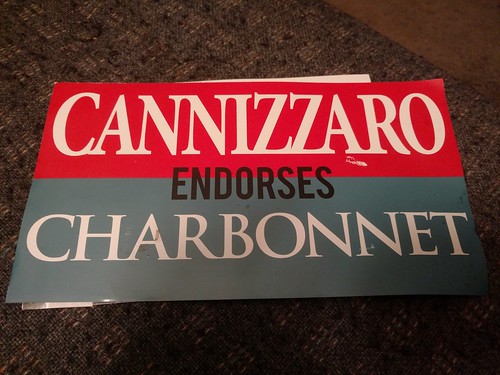

Cannizzaro endorses Charbonnet


Instead it is a millstone around Desiree's neck as Cannizzaro's outrageous abuses continue to draw the ire of criminal justice reformers who, only a year ago, were pointing to Charbonnet as an example of someone who took their cause seriously. She's lost those votes now.  And, while, it's probably fair to say the "Bagneris backers" really do want to see NOPD go out and crack skulls with Leon's blessing, they still wouldn't come out for Charbonnet if she announced this program from the base of a restored Liberty Place Monument.

More to the point, there are significant numbers of  "crime" voters who are appalled by Cannizzaro's retrograde tactics. There are an even larger number of voters whose neighborhoods and families are directly harmed by them. These voters also say they are "concerned about crime" when polled. We're all concerned about crime.  We have vastly different ideas about what policies address these concerns. By and large, Desi's approach has been to pander to the hard-liners while expecting her base to understand that it's just politics.  That's not gonna fly.  

Meanwhile, the Cantrell campaign developed a more sophisticated (if still cynical) way to play all sides of the crime issue.  The slogan LaToya borrowed from this early 2000s Los Angeles anti-gang campaign "Nothing Stops A Bullet Like a Job," positions her to the left of Cannizzaro but not too much so. It tells some voters that the candidate feels their pain by superficially acknowledging the relationship between crime and poverty. Meanwhile it subtly speaks to conservative Bagneris voters too by suggesting Cantrell will make those people get a job.

Cantrell took this message out on a "listening tour" of neighborhoods and various civic organizations several months prior to the primary where she managed to make inroads with voters in precincts Charbonnet's spreadsheets determined would be hers by default. Charbonnet didn't talk to anybody about anything until well after qualifying day.

It's strange that this issue should have opened such a wide gap between the two candidates. There is little substantive difference in how we should expect either to approach it as mayor. The Cannizzaro endorsement, like the similarly disappointing Charbonnet "crime plan," is all about campaign positioning.  It's right and good that criminal justice reformers criticize her for running on those planks. But they could just as soon lean on Cantrell for her platform which is scarcely any sort of improvement. Or they could interrogate Cantrell's support of tactical gear for police or surveillance cameras in the French Quarter. Or they could talk about her father-in-law's role in the exploitative cash bail system they've pegged some of Charbonnet's supporters for. Charbonnet has been slammed (again, rightly) for a nonsensical ad in which she proposes to make some sort of Uber but for police app.  But in perhaps the most shameful moment of the campaign to date, Cantrell praised Sidney Torres's app to Sidney Torres when asked by Sidney Torres to talk about Sidney Torres's app at Sidney Torres's sham forum

Frankly, both of these campaigns are nothing short of shameful in their approach to an issue most voters put at or near the top of their priorities list. At a time when more progressive movements are making surprising gains in local races across the country by taking serious stands against abusive and racist police tactics, the top candidates for mayor in New Orleans offer only smarmy platitudes and insincere triangulation. Voters deserved a thorough public debate about our dysfunctional, dangerous, and corrupt criminal justice system.  Instead we've had to settle for a dismal contest of cynical tactics.  And in that contest, Cantrell's more competently deployed smarm has been enough to weather Charbonnet's ham fisted flailing.

We're no nearer to solving this problem. But we are nearer to electing a mayor with no clearer mandate to right the ship than the previous one had. And, really, isn't that what it's all about? It's been an inspiring year. This is only the first of post of this series and already I want to drown in a flooded street.

Next we'll continue to draw inspiration by looking at how the infamous "natives vs transplants" dynamic has managed to distract from more serious and relevant issues to practically everyone's detriment... except LaToya's.

Saturday, September 23, 2017

Uberize

It's fair to say every candidate for mayor has been unseemly in their fetishizing of both the tech driven "sharing economy" and of local law enforcement.  But only Frank Scurlock managed to distill the essence of this in a single word and act.
New Orleans mayoral candidate Frank Scurlock is facing a misdemeanor count of lewd conduct in Santa Monica, California, where he is accused of masturbating in an Uber vehicle in February.

Scurlock, whose splashy campaign ads have pledged to “Uberize” the New Orleans Police Department, was allegedly caught masturbating by a driver taking him to a hotel in West Hollywood on Feb. 10, Santa Monica Chief Deputy City Attorney Terry White said.
If you had been wondering what a candidate might mean when he says he wants to "Uberize NOPD," well, now you know it is even worse than you thought.  What's worse than even that, though, is it's not just Scurlock who wants to go around Uberizing over cops.

Desiree Charbonnet is doing it too.  This absurdly stupid ad even mimics Scurlock's cops-but-with-an-app-or-something premise. Her website puts it in even more alarming terms. There we find proposals to defund consent decree compliance monitoring as well as the Neighborhood Housing Improvement Fund in order to pay for more police. It also doesn't help that her plan has the support of New Orleans's proto-facist District Attorney as well as some of its notoriously corrupt bail bondsmen.

The Cantrell campaign took a few minutes away from promoting prison labor to try and make some hay out of that last point recently. We're still trying to figure out how they ever thought they had any room to talk, though. Anyway, Cantrell is as Uber-enthused over tougher policing as any of these candidates.  Maybe not as intense as her Uberizing over Airbnb but it's close.

Troy Henry is also doing it. At the most recent forum, he indicated his vision for NOPD would involve creating a "strike force" that goes after "bad dudes." He and Charbonnet also criticized consent decree restrictions on paid details. Charbonnet even said that NOPD officers are "demoralized" by the fact that Saints game detail gigs go to Jefferson Parish law enforcement.  We agree. It was extremely demoralizing when a Jefferson Parish Levee Authority officer told us to stop banging on the wall during the Saints-Patriots game last weekend. The way that game was going, we'd have much preferred to have NOPD just come by and shoot us.

And, of course, Michael Bagneris is Uberizing over the police as well. His website features a plan to hire 300 more cops by recruting heavily among military vets, install more surveillance cameras, and create a not-at-all scary sounding "Crime Analytics Department" to  "proactively identify violent criminals."

Yesterday Scurlock said he was going to "evaluate" the status of his campaign after having grossed everybody out this week.  If he drops out, he won't be missed. But we do have to thank him for leaving us this word with which to describe how grossed out we are by the rest of the field as well.

Monday, August 07, 2017

Dare to be stupid

This is gonna be a fun week.
The New Orleans City Council will hold a special meeting at 1 p.m. Tuesday (Aug. 8) to discuss the flooding that resulted from as much as 9 inches of rain falling in parts of the city Saturday afternoon. It was the second extreme downpour in as many weeks that put storm water in vehicles, homes and businesses in multiple neighborhoods.

President Jason Williams summoned council members Sunday to call the meeting. Officials with the Landrieu administration, the Sewerage and Water Board, and the Army Corps of Engineers are expected to respond to questions about the city's vulnerability to quick inundations.
Well that was quick. Must be an election on. Actually, despite the obvious politically motivated buffoonery of it all, I'm glad to see city councilpersons and candidates all asking questions about the drainage. I mean, sure, they are asking a lot of dumb questions so far 
City Councilwoman LaToya Cantrell posted to Twitter early and often, going on a tweet storm as she talked about policy in the context of the flood. She had videos and photos to illustrate her point.

" ... We all deserve functioning infrastructure, and ensure that adequate infrastructure across our city is a TOP priority. We can do better, and we will. Rain events like this are more than Orleans Parish. We need to think and act regionally. NOLA gov't leaders have worked hard on this issue, and we will continue to work on this."
When they string it together like that, it sounds like it almost makes sense, even if it doesn't mean a whole lot.  But watching the candidates spit stuff out in real time this weekend was more like following a bunch of bots meant to spit empty phrases at random.  Here is LaToya working in "small businesses" to her rant.  Michael Bagneris seems almost more worried about "the biomedical corridor that will be a powerful economic driver for our city and region," than he does about anyone stuck in a stalled car or watching the water come into their home.  They all leave the impression that either none of them knows what they're talking about with regard to drainage or that they just fumbling for a way to shoehorn their lame ass campaign themes into the story, or both. It is both, actually. 

But as embarrassing as all that is for them, and as shameless and stupid as they all are, it is kind of their job to do this sort of thing and they have to start somewhere. There has to be a public conversation about what happened. Even a dumb one.

When flooding like this happens repeatedly something has to be done. And no amount of smug condescension about the designed capacity of the current system will change that. We know the rainfall was greater than what the pumps are designed to handle. But shut the fuck up about that for a second and consider that it is still worth asking:

1) Did the system actually perform even up to its presumably inadequate capacity? There's nothing but Cedric Grant and Ryan Berni's word to confirm that. Maybe you like ... um.. carrying water for those assholes. I don't see the use.

2) If this is the best the system can do and this kind of flooding keeps happening anyway, isn't that a problem too? There is a whole world of inquiry to be made into the efficacy of our proposed "resilience" strategy for re-thinking our drainage system. Right now there are some compelling ideas on the verge of implementation but it's important to stress what we're talking about in that regard can mostly be described as pilot programs. What we actually need is a total systemic reevaluation and overhaul and we need that to happen like several years ago.

Point is we aren't where we want to be. Something needs to change and the way to start the ball rolling with that is to let your idiot councilpersons ask their grandstanding and clumsy questions. And then try to help push whatever momentum that starts in the right direction.  Until today, the game in this election was seeing who could promise to throw the most "public safety money" away on more police, surveillance, and prisons.  But what if we had a chance to talk about spending that money on actual public safety instead?  Flood control seems like a great opportunity to have that conversation.

Wednesday, July 19, 2017

Voice Of The People

Sidney is finding the efficiencies and making the synergies happen through disruptive innovation as he often does.
In his post on Friday, Torres said little about why he eventually decided not to run but took aim at the city’s political establishment as he announced the creation of his PAC, “The Voice of the People.”
Already getting results
Charbonnet also calls for increased use of technology, including license plate readers, crime cameras and equipment that can detect gunfire and direct officers to the source. In addition, her plan calls for tracking NOPD vehicles and issuing officers cellphones whose GPS can be monitored to determine their location.

The proposal calls for better community policing and cites as an example the private patrols set up in the French Quarter by businessman Sidney Torres, who flirted with an entry into the mayor’s race for months before bowing out last week.
That is one strong Voice, Sidney has brought to bear. Seems like everybody who is anybody is listening. 


Congratulations to Sidney on hacking our democracy with his Voice.  How does he do it?

Monday, July 10, 2017

Do not keep a handgun, just in case

Just in case John Kennedy, who famously told you you'd better keep one, decides stop and frisk, instead of love is actually the answer.

Update:  One more thing here.  What is Gambit's opinion on Stop and Frisk?  The way this is worded suggests they have issued a ruling.
Though "stop-and-frisk" is controversial, it's not unconstitutional, though in 2013 a federal  judge ruled part of New York's implementation of the practice to be unconstitutional. An analysis of the New York Police Department's stop-and-frisk policy, conducted by the New York American Civil Liberties Union, found "innocent New Yorkers have been subjected to police stops and street interrogations more than 5 million times since 2002, and that black and Latino communities continue to be the overwhelming target of these tactics. Nearly nine out of 10 stopped-and-frisked New Yorkers have been completely innocent." The department has gradually stepped down the practice since 2011.
Not sure why that is written, "it's not unconstitutional" rather than the more accurate, "it has not technically been ruled unconstitutional."  The explanation is fine but also sort of incomplete.  In the New York case, the judge ruled that the NYPD police "as applied" was most certainly unconstitutional because 1) It violated Fourth Amendment protections against reasonable search and seizure and 2) The clear racial bias evident in the NYPD stop and frisk operations violated the Fourteenth Amendment's equal protection clause.

The FactCheck.org bit Gambit cites allows that the judge did not technically rule all "stop and frisk" policies are inherently unconstitutional allowing for a standard established by precedent.
In fact, Judge Scheindlin pointedly wrote in her opinion that she was “not ordering an end to the practice of stop and frisk.” She said they could continue if the city complied with court-ordered remedies to make sure that the stops and frisks did not violate the Constitution. (Scheindlin called these “Terry stops,” referring to Terry v. Ohio, in which the U.S. Supreme Court in 1968 ruled that a police officer can stop and frisk individuals where there is a reasonable basis for suspicion.)
But the Terry standard is itself controversial. So much so, in fact, that it's difficult to see how it prevents the sort of abuse the judge ruled against in the New York case. Note Justice Douglas's dissent quoted here.
In theory, this (Terry) seems like a reasonable compromise. But applying the standard in practice is fraught with potential dangers. Chief Justice Warren warned that "in determining whether the officer acted reasonably in such circumstances, due weight must be given not to his inchoate and unparticularized suspicion or 'hunch.'" But it's hard to avoid the conclusion that vague hunches are in fact responsible for many stop-and-frisk searches. As Justice William O. Douglas warned in his dissent, without ongoing vigilance, it's easy for the stop-and-frisk regime to devolve into a norm where "the police can pick [someone] up whenever they do not like the cut of his jib."
It's easy to see how any stop and frisk policy quickly opens the door to casual everyday violations of civil liberties. The New York case happens to be one where the data made the story crystal clear.  This is different from the experience in other cities such as, say, New Orleans where, yes, in fact, Stop and Frisk has been in open operation already.  Unfortunately for us, our Inspector General was either unable or unwilling to make a strong case against its application. From 2013:
The purpose of the IG's report was to determine whether officers "were compliant with legal requirements to stop individuals only when there was reasonable suspicion" and whether "when conducting stops and frisks, NOPD appeared to apply the constitutional standard of reasonable suspicion equally to all persons, regardless of their age, gender or race."

But auditors were not able to do so, the report says, because of various holes in the data. Though officers are required to fill out field information cards for each stop, they often did not complete the forms in full, the report says, and they sometimes listed multiple subjects on a single form.
The cops aren't filling out the form so I guess... ¯\_(ツ)_/¯ (the pose one assumes when stopped for a search)

It's worth noting also that Kennedy specifically refers to the New York practice in his whining. In other words he is arguing for the very application of the policy that has definitely been ruled unconstitutional. His argument, like Michael Bloomberg's is, basically, "This works so STFU, everybody."
"Throughout the trial that just concluded, the judge made it clear she was not at all interested in the crime reductions here or how we achieved them. In fact, nowhere in her 195-page decision does she mention the historic cuts in crime or the number of lives that have been saved."
Leaving aside the validity of Bloomberg's assertion, it isn't the judge's task to weigh the effectiveness of a law against the fundamental civil rights if violates in order to achieve its effect. Does Mitch Landrieu's "mentor" not understand this or does he just not care?  In any case, it's probably not a good idea for Gambit to issue its own legal opinion. No reason to embolden these bad actors.