Kathy Sullivan says:
Here’s my Moluccan cockatoo, Bayla, standing near The Star Beast novelization by Gary Russell.

Photos of your felines (or whatever you’ve got!) resting on genre works are welcome. Send to mikeglyer (at) cs (dot) com
Kathy Sullivan says:
Here’s my Moluccan cockatoo, Bayla, standing near The Star Beast novelization by Gary Russell.
Photos of your felines (or whatever you’ve got!) resting on genre works are welcome. Send to mikeglyer (at) cs (dot) com

(1) WORLD FANTASY AWARDS BALLOT UPDATE. Awards administrator Peter Dennis Pautz today announced that The Essential Patricia McKillip , which had been nominated in the Collection category,has been removed from the ballot. No reason was given. The vacant slot on the ballot has not been backfilled.
(2) LESS THAN 24 HOURS LEFT TO VOTE FOR HUGO AWARDS. LAcon V Hugo Awards Administrator Tammy Coxen reminds people that Hugo Award nominations will close TOMORROW, Saturday, August 8, 2026, at Noon Pacific Time/ 3:00 pm Eastern Time/ 7:00 pm GMT. Access to the Hugo Voter Packet will be removed at that time.
(3) HEAR FROM NEW WINNIPEG SFF BOOKSTORE OWNER. The Winnipeg Free Press interviewed Didi Chanoch about their new sff bookstore: “Out of this world”.
A new chapter has begun in Winnipeg’s literary landscape with the opening of science fiction and fantasy bookstore Other Places Books….
…The bookstore is the brainchild of Didi Chanoch, who moved to Winnipeg from Israel in 2025 after the Canadian federal government began offering work permits to those in Israel and Palestine looking to leave the area due to the conflict….
…Prior to opening Other Places, the 54-year-old Chanoch, whose pronouns are they/them, worked in translation and purchasing of science fiction books in Israel, and has long been active in the online sci-fi community. So it didn’t take long to land on the idea of opening a niche bookstore — particularly once they looked at the landscape of booksellers in the city….
…Chanoch has found the city’s independent bookstores to be supportive on the path to opening Other Places — especially the fellow genre bookstores.
“Raven’s End invited me to their book club so I could tell their customers about my store. They have a fantasy book club, so that’s a perfect marriage — and they’re also a pretty queer bookstore,” says Chanoch.
The intersection of queer writers and readers with sci-fi and fantasy is a natural one, Chanoch reckons.
“A lot of people really identify strongly with the genres, for obvious reasons — they have always explored identity in ways that either are directly about queerness or could easily be interpreted as such and can be absorbed by a reader as that. I was able to pretty much a fill a bookstore with books that are in some way queer.”
As an example, Chanoch mentions Arkady Martine’s Teixcalaan duology — both books from the series, A Desolation Called Peace and A Memory Called Empire, won Hugo Awards, the sci-fi and fantasy world’s top prize.
“These are queer science fiction books written by a lesbian author married to another lesbian author whose books we also carry,” Chanoch says. “These books both won the best novel prize at the Hugo Awards. If you look at the list of Hugo finalists for best novel in the past decade, you’ll see a huge number of queer authors and queer books.”….
(4) HWA MEMBER NEWSLETTER EDITOR RESIGNS. Andrew Robinson has told the Horror Writers Association Facebook group that he is “stepping down as volunteer compiler of the HWA member news and stepping back from the organization because I showed poor judgment and I am concerned that staying on in this role would just do more damage.” Here is an excerpt from his much longer statement:
…I want to apologize to each of you for the inclusion of the In the Trenches op-ed in the recent newsletter, and I take full and sole responsibility for the decision. The HWA has a strict AI policy in place, and the op-ed doesn’t reflect that so it should not have been included, even just for the sake of discussion. I also want to apologize to the leadership of the HWA who trusted me with this position when I volunteered to revive the newsletter after it had been gone for so many months.
My goal has been to add new content like the Indie Bookstore spotlight, the HWA Publication Spotlight, and special features and resources designed to inform and assist our members, and this month, I worked against that by not taking more time to consider all of the content. These efforts also mean that the newsletter has become quite a big one, and, likely, unmanageable for me as one person with my own full-time job and responsibilities.
I have always seen In the Trenches as a space where the trustees share their own thoughts and opinions on writing. As I rushed to get this issue out, I didn’t use enough critical thinking or follow my usual process of having some other members proofread the content and give feedback, which in this case would have been invaluable.
Sephera sent in her piece, and told me she had written an op-ed on how quickly people get attacked/’cancelled’ over some discussions, especially related to AI use. As her friend, and knowing she was a board member, I did not push back. I know now that I should have.
My own position on AI is that it has no place in the creative arts….
(5) BOSTON COSPLAYERS VISIT HOSPITAL REHAB PATIENTS. [Item by Daniel Dern.] “Superheroes visit young patients at Spaulding Rehabilitation Hospital” in the Boston Globe.
Is that a bird? Is that a plane?
No … it’s a group of superheroes from the Marvel and DC universes visiting pediatric patients at Spaulding Rehabilitation Hospital.
Cosplayers dressed as Batman, Spider-Man, Captain Marvel, Supergirl, and Thor stopped by the hospital Thursday afternoon to tell jokes, sing jingles, and wrap plastic capes around the children’s backs.
In a room with long windows overlooking the water, the superheroes and the children added jewels to paper masks. A girl in pink shoes and a pink cape giggled as Supergirl helped her decorate a pink mask.
“We’ve got the silliest goose,” Supergirl said, sliding the mask over the girl’s face as they finished.
“We’re going to take on a bad guy,” Batman said, approaching.
“Get away!” the girl said, swinging her walking stick toward him. “Wham!”
The cosplayers were participating in Fan Expo Boston, a festival scheduled for this weekend that connects hundreds of thousands of comic, sci-fi, horror, anime, and gaming fans.
“Pretty much all the kids know the superheroes, love the superheroes,” said Leah Terrill, 34, a child life specialist at the hospital. “[The reaction], I think, sometimes, is shock. They’re like, ‘How are you here?’ I had one kid ask, ‘They’re really superheroes?’”
Matches Malone, who was dressed as Batman for the event, said that for him, the kids always come first.
“It’s always about the kids. If they really believe that you’re the character that you’re portraying, you can get them to believe in themselves and be the hero that they want to be,” said Malone, 57, a retired military personnel from Dorchester who now works in security….
Dern says: It’s not clear from the text “Matches Malone, who was dressed as Batman for the event” whether that’s actually (but unlikely-y) the cosplayer’s real name — or the reporter is not aware that “Matches” Malone was initially a small-time Gotham City criminal, and then a name/personna used at times by Batman when the Bat wanted/needed to be somewhere/someone other than his Bat-self or as Bruce Wayne.
See Matches Malone for more than enough info; see “After 53 Years, DC Kills Off the Bat-Family’s Most Underrated Hero” at ScreenRant for even more than enough info including info from DC’s current “Absolute” universe/line (similarish to what Marvel’s Ultimate line began as, way back when (today, don’t ask 🙂 or ask Tom Galloway.
(6) TAROT HISTORY EXHIBIT. [Item by Andrew Porter.] Gorgeous artwork! “Tarot Was a Courtly Card Game. How Did It Become a Tool for Divination?” Link bypasses the New York Times paywall.
Around 1442, the Duke of Milan gave his daughter a deluxe set of handcrafted playing cards for the courtly game of tarot.
The cards, featuring meticulously illustrated figures like Death, the Chariot and the Emperor on gold- and silver-leaf backgrounds, were created by a renowned Renaissance workshop. They cost about 1,500 ducats, 10 times the annual salary of an average courtier.
Before its use in spiritual divination, tarot was a card game played by Italian nobility — mostly women — and each card was a hand-held work of art.
The Morgan Library & Museum in New York is presenting surviving cards from that tradition in “Tarot! Renaissance Symbols, Modern Visions.”
The show explores the 600-year evolution of tarot from a game to an occult practice and popular entertainment, from those early gilded exemplars through decks made by artists including Salvador Dalí, Leonora Carrington and the contemporary British painter Chris Ofili….
… In their original form, tarot cards were used for a game played a bit like bridge, O’Driscoll said, but the concept of the game was partly inspired by Petrarch’s “Triumphs,” a 14th-century allegorical poem that set out moral hierarchies.
“Chastity defeats Love, Death defeats Chastity, Fame defeats Death, Time defeats Fame,” he explained. “The last one is Eternity, which defeats them all.” Along with teaching morality, “it was a game of the intellect,” he said. The word “trump,” which was used in the game, he noted, comes from the Italian word “trionfi,” or “triumph.”…
… In 18th-century France, a few occultists fabricated an origin story for the cards, linking their symbols to Egyptian hieroglyphics, because they were both considered to be mystical and indecipherable image-based languages.
Although the story was invented out of whole cloth, this shift altered the course of tarot’s history, giving it its persistent esoteric aura.
The set that popularized tarot cards for divination in the English-speaking world was the Rider-Waite-Smith set, created in 1909 by the artist Pamela Colman Smith, under the direction of Arthur Waite. Waite, a poet and scholarly mystic, wrote an accompanying guidebook, “The Key to the Tarot.”…
Waite was a leading figure in the Modernist occult movement known as the Golden Dawn, whose adherents included the poet William Butler Yeats and Bram Stoker, the author of “Dracula.” The key thinker behind the tarot occultist movement was Aleister Crowley, the English magician and author, who made his own deck, the Thoth Tarot.
(7) ROBERT REED Q&A. Asimov’s latest “From Earth to the Stars” feature is a “Q&A with Robert Reed”.
AE: What is your history with Asimov’s?
RR: Now and again, my work has been published in your magazine. Someone’s keeping a running tally. Not me. But last I heard, nobody was close to my title total.AE: What is your process?
RR: I start each project with a clear idea of where I’m going. And when my characters tell me that I’m wrong, I listen to them. Oliana, for example. She delivered a nice surprise in the end.AE: What inspired you to start writing?
RR: It was the 1970s, and I was a child who thought writing would bring easy money….
(8) UPDATING THE THREE LAWS. [Item by John A Arkansawyer.] A Guardian op-ed writer says, “One of science fiction’s greatest writers warned us about AI. Could his ideas help us avoid a dystopian future?” This seems like wishful thinking to me:
…What might a modern day equivalent of Asimov’s laws of robotics look like to avoid a dystopian future? Here, guided by Asimov’s three law of robotics, I propose a possible formulation of Three Laws of AI: 1) An AI must not directly or indirectly harm or deceive a human being, nor act in a way that supports an unlawful or unethical activity; 2) An AI must obey the lawful and ethical orders given to it by a human being except where such orders would conflict with the first law; 3) An AI may operate autonomously as long as its autonomous operations do not conflict with the first or second law….
I’d like to be wrong
(9) TODAY’S BIRTHDAY.
[Written by Paul Weimer.]
August 7, 1933 — Jerry Pournelle. (Died 2017.)
By Paul Weimer: Jerry Pournelle was the first author I wrote a fan letter to. True story. I am, if you have met me, shy and introverted as all get out. (No, really, stop laughing. I am). Anyway, back in the 80’s I got hooked on Pournelle. I’d read The Mote in God’s Eye, and a few of his standalone novels and stories. But it was the There Will Be War anthology series (this was before Theodore Beale and Castalia House got their paws on it) that really ramped up my interest. I think I’ve mentioned the series before, connecting me to a number of authors and author worlds in the process of reading straight up military fiction, pure grade A stuff. Those versions of the anthologies back then really were a premiere set of stories.
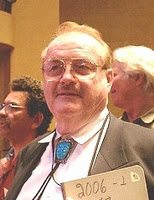
So, one day, I got it into my head to write a fan letter to Pournelle to thank him for editing the anthologies. I didn’t get a response back from him, but I did get one from editor John F. Carr, who thanked me for my letter, and suggested I might like the War World series next. (Those are the military stories set in the Mote universe on the planet of Haven). I didn’t quite like that series, being almost too focused on one planet, albeit in different times and locations, but I appreciated the letter back.
As time has gone on, my opinions of Pournelle’s work, unfortunately, have soured. I think it was finally The Burning City that did it for me, since the novel was very thinly disguised polemic against the government and the city of Los Angeles in particular. I knew that Pournelle was conservative, ultra conservative and as shocking as, say, the use of poison war gas in Todos Santos was, I finally had decided I had enough of Pournelle and stopped reading anything new by him.
I do think however, that a little dated as it is now, the original The Mote in God’s Eye, which he co-wrote with Niven, is his best work, and the work that possibly has stood up the best. Oh, I was thinking of his Janissaries work not long ago when I was reading the latest from Stirling, but it is the space opera of Mote that has stood the test of time the best. And it’s explicitly Monarchy in Space, so the politics are going to skew that way, anyway. And the Moties are an interesting species, with interesting character throughout.
I kind of wish I could get a hold of the original There Will Be War volumes, without the taint of Castalia House. Alas.
(10) COMICS SECTION.
(11) WHAT THEY KNOW THAT AIN’T SO. John McWhorter eviscerates “Three Myths People Love to Believe About English” in the New York Times. Link bypasses the NYT paywall.
Three things that people often mention to me, as a linguist, leave me wondering whether to just nod politely or disappoint them with the truth. In this space, I feel that I should deal only with the truth, so if I may, prepare for some fun-fact disappointment! Here are those things people share with me with bright eyes.
Here’s the first —
English has a long list of fancy names for groups of animals. Not just the boring old herd of cows, flock of birds and gaggle of geese. There is also a murder of crows, a flamboyance of flamingos, a tower of giraffes, a charm of goldfinches, a conspiracy of lemurs, an ostentation of peacocks, a dazzle of zebras and so on.
These collective words always seemed a little suspicious. Almost none of them are actually used. When is the last time you heard someone talking about a smack of jellyfish?
In fact, many of these words were made up. The collective fun was kicked off back in 1486 by a prioress, Juliana Berners, in an arch tome cataloging the activities of a gentleman, “The Book of Saint Albans.” In the list of animal collectives, Berners was clearly having a little fun, as in coming up with group names for humans like a “blast of hunters” and a “melody of harpers.” There were new editions of the book into the 17th century. The ones about flamboyant flamingos and ostentatious peacocks are of later vintage than the original book.
These words are certainly fun, but ultimately most of them are less words than jokes. Comprehensive dictionaries list neither a peacock-related definition of “ostentation” nor one of “bloat” referring to hippopotamuses. These words are a part of the English language in much the same way that I possess an Estonian translation of the book “Ragtime” and an ocarina, neither of which I ever touch, though I am vaguely pleased that they are around….
(12) DINO DOCUMENTARY. Animation World Network tells “How Milk VFX Built the Lost Worlds and Creatures of ‘Surviving Earth’”.
Combining natural history documentary with visual effects to recreate the deep past has become a genre of its own. Walking with Dinosaurs pushed the boundaries back in 1999 and received a serious technological upgrade in 2025, and Prehistoric Planet, Life on Our Planet, Planet Dinosaur and Earth have all contributed since.
The latest is Surviving Earth, which premiered on NBC on June 11 and is now streaming on Peacock. Tim Haines, the producer behind Walking with Dinosaurs, created the eight-part miniseries for Loud Minds and Universal Television Alternative Studio, with Josh Goodman narrating and a score by Nitin Sawhney. It tracks life through six mass extinction events, from the early seafloor to the first caveman. Haines partnered with Milk VFX, Lola Post, FIN VFX and Floating Rock to bring to life the massive environmental extinction and rebirth events that have reshaped the planet, with Milk delivering roughly 1,000 visual effects shots across the eight episodes.
“Surviving Earth is not just about dinosaurs,” notes He Sun, Visual Effects Supervisor, Milk VFX. “It’s a lot more variety than that. It features six extinction events and goes from the early seafloor and all the way to the first caveman. There are a total of 73 types of creatures and 55 variations on top of that, including insects, mammals, reptiles, marine life and dinosaurs.”
The production adopted a more naturalistic approach to creature behavior. “This is a lot more locked-off cameras and studying the creatures rather than directing; that was quite important,” remarks Joe Tarrant, Animation Supervisor, Milk VFX. “There’s a narrative structure to the story, but as animators, what you’re trying to do is to catch things in their most natural way in their most natural environments. Whereas in Jurassic Park it’s got to burst through that wall and the cameras are dynamic. Surviving Earth is not like that at all.”…
…Damage such as wounds had to be tracked for continuity. “It’s clear in the Ischigualastia episode,” remarks Sun. “The juvenile got hurt and had a scar on the forehead, and that was kept all the way even when he became an adult. There is definitely a continuity of things that we constantly had to make sure it was flowing between the sequences, such as not using the wrong variant in the wrong shot.”…
(13) ‘IS THIS CALL NECESSARY?’. “Man makes 1,700-mile round journey to save rare phone box on Scottish island” – BBC tells why. (Subscription required by readers outside the UK.)
A man has travelled from Cornwall to the Isle of Lewis to make 52 calls from a rural telephone box in order to keep it in service.
William Arnold, who works as an artist and photographer, took the 1700-mile (2,735km) round trip to visit the rare phone box in Einacleit as part of a project to preserve phone lines in rural communities.
Ofcom guidelines state a minimum of 52 calls have to be made from a phone box each year in order for it to remain operational.
“The project is slightly ridiculous and comedic,” said William. “But there is also a serious point about how we communicate with each other and how these phone boxes are often vital rural lifelines.”
The 43-year-old has been working to save phone boxes since 2022.
“It all started on the Isle of Lewis when I was working on a photographic project and I wanted to call my partner who was staying back at the house to say I was going to be back late,” he said. “My mobile phone battery was nearly dead and I came across this pristine looking phone box that had the old yellow British Telecom branding from the 1980s. There was a phone in there and I was really excited because I hadn’t used a phone box for years. But when I picked up the receiver, the line was dead and I was so disappointed.”…
(14) DALEKS ENDORSE COUNT BINFACE. [Item by Jim Janney.] The Clacton by-election just keeps getting sillier. “Vote Dalek – 2026 Clacton By-election”.
[Thanks to Steven French, Mike Kennedy, Andrew Porter, Paul Weimer, Daniel Dern, Jim Janney, John A Arkansawyer, John King Tarpinian, Cat Eldridge, SF Concatenation’s Jonathan Cowie, Chris Barkley, Mark Roth-Whitworth, and Kathy Sullivan for some of these stories. Title credit belongs to File 770 contributing editor of the day Daniel Dern.]

Clarion West has announced the 2026 Deep Dive Series, placing an author of speculative fiction in a moderated conversation with a scientist or other expert in subject matter relevant to the author’s work. Each event includes a VIP reception, conversation, and book signing with the featured authors.
Saturday, September 12 — Post-Dystopia Space Exploration at 7:00 PM at Town Hall Seattle. Space exploration has always been the product of imagination, science, and perseverance! Join moderator K Wilson (The Astro Stud) in conversation with author Mary Robinette Kowal (The Calculating Stars) and retired commercial astronaut Dr. Sian Proctor about the current state of global space programs and our possible futures among the stars. In person tickets are $10. Attend the VIP Pre-reception for $150.
Thursday, September 24 — Mycology, Decay, and Metaphors for Community at 7:00 PM at the Seattle Public Library. Author T. Kingfisher (What Moves the Dead) and naturalist and author Daniel Winkler will discuss fungus to slime molds, and nature’s lessons in collapse, renewal, and connection—sometimes sticky, sometimes horrifying, always a little weird. Moderated by Clarion West board member Dominica Phettaplace. This event is free, please RSVP in advance! Attend the VIP Pre-reception for $150.
Thursday, October 15 — A.I. in Medicine at 7:00 PM at the Seattle Public Library. Author Justin C. Key (The Hospital at the End of the World) and Lakshmi Krishnan discuss data privacy, innovation in treatments, and the promises and the horrors of unregulated futures in healthcare tech foretold by science-fiction. Moderated by Clarion West board member Alexandra Manglis. This event is free, please RSVP in advance! Attend the VIP Pre-reception for $150.
All three events are hybrid and begin at 7:00 P.M. Pacific Time. The streaming link is $5.
Learn more at Clarion West Upcoming Events.
Clarion West is a nonprofit literary organization that supports emerging and underrepresented writers with world-class instruction and opportunities for connection. We run the acclaimed six-week workshop every summer, a nine-month novel writing workshop, online and in-person classes, a library of on-demand classes, public readings and panels, and other events throughout the year.
[Based on a press release.]

Behold the legendary artistry of Alex Ross in an all-new collection of Timeless Variant Covers. Returning this September, the popular series of variant covers spotlights more of Marvel’s most iconic heroes in Ross’ signature and unforgettable style.
The latest lineup features stunning depictions of fan-favorite heroes like Hercules, Hellcat, Crystal, Moondragon and many more. Capturing the timeless appeal of Marvel storytelling with beautiful, painted portraits of its beloved characters, Ross’ masterful illustrations continue to be must-haves for fans and collectors alike.
Like previous Timeless collections, Alex Ross’s new pieces will also be available as Sketch Variant Covers. Check out all 12 covers following the jump. For more information, visit Marvel.com.
Continue reading(1) HWA DEFENDS VOLUNTEERS. Horror Writers Association Executive Director Maxwell Ian Gold posted an update from the HWA Board on Facebook today. (For context, see yesterday’s post “Horror Writers Association Removes Sèphera Girón as Trustee”.)
The HWA Board of Trustees and Executive Leadership stands behind the countless volunteers who devote their time, energy, and dedication to make this organization a special place. The HWA recognizes that any volunteer, regardless of the role they hold choose to step into these positions and every person should be treated with dignity and respect. Additionally, the Board and Executive Leadership will not condone any personal attacks on volunteers of the organization.
In each month’s “In the Trenches” column, a member of the HWA board provides a behind-the-scenes look at the work being done by the Board, committees, and your fellow members to promote and elevate the Horror genre. Going forward, all columns will be reviewed by the HWA Vice President, who is in charge of all publications, and Executive Director before heading to publication.
(2) THINKING ABOUT AWARDS. Abigail Nussbaum participated in a Critical Friends podcast. There’s a transcript at Asking the Wrong Questions: “Podcast: Talking About Awards With Critical Friends”.
Abigail Nussbaum: To bring us back to what Amritesh was saying about the Commonwealth Award—which we know was quite shocking, that whole situation—it occurs to me that there’s a difference between an award you argue with and an award you distrust.
I’m gonna do something really unexpected and make a sports metaphor, but we’re in the middle of the World Cup, so: If you’re a fan of a team, then maybe you hate the coach and you hate the player and you believe very strongly that you could win the game much better than any of them could, but you’re still a fan of the team.
And at some point—this doesn’t happen with football fans I believe, but with other pursuits—at some point an organization like that, even if you argue with it, it can lose your trust completely.
So if you look, for example, at the Clarke Award this year, a lot of people are arguing with it mainly because of Dungeon Crawler Carl. But for the most part, I don’t think that there is loss of trust in the award. There’s people saying you have let down the award, or simply I disagree with you. And my response to the Pulitzer as well: I don’t think that there was any underhand funny business going on there; I think that the jury and the board and I have very different taste and I disagree with theirs.
That doesn’t mean I have tremendous trust in the Pulitzer. It’s not the first literary award I turn to, but it’s not an award I distrust. And at some point, if you make enough bad decisions and if you make enough bad decisions for the wrong reasons, then the award loses trust and then it becomes useless.
And that was of course the danger, if we’re going to bring this back to the Hugos, that was a danger with the Sad and Rabid Puppies. They brought the award into disrepute. That was the danger with the Chengdu shenanigans where votes were thrown out. That also brought the award into disrepute. And that is much more important to me in the end than whether I agree with the decisions that the award makes.
I often don’t agree with the decisions that the Hugo makes, but I trust it to reflect a group of people whose tastes often do not coincide with mine….
(3) THERE’S AN APP FOR PATRIARCHY. Lyz Lenz reminds everyone “AI can’t fix a shitty partner” at Men Yell at Me.
…But that same ethos seems to be driving a lot of the aspects of AI innovation: steal human labor (generative AI, of course, quite literally steals the work of writers, artists, scientists, and more), and sell it back to people as a shortcut.
As tech companies try to get women to buy into generative AI, one marketing angle is to brand it a solution to the systemic failures of the patriarchy. To sell women, for a fee, the kinds of love and care their partners should giving them.
Why pay $9.99 a month for love when you can just break up? It worked for me.
Other apps claim they’ll save women their own time and labor. But never in the history of technology has an invention for women actually saved them time. In fact, the more technology has taken over women’s domestic roles, the higher the expectations of them as parents and partners.
… But the bigger picture to me is about care. Showing up for the labor of home and family life is about how we express care for our partners and family. Absenting yourself from that or offloading it onto an AI assistant might save time, but it strongly suggests you don’t care enough to do the work yourself.
In a culture like this, attention and affection are commodified. Ordering flowers, making a dinner reservation — that shouldn’t happen because your partner subscribes to an app; it should happen because they care. But the reality is some men (many men) would rather outsource that care work than do it themselves.
Back in May, I shared an anecdote about a friend whose partner had outsourced writing long love notes to her to ChatGPT. She’s not a purist about generative AI, but it frustrated her that the person she loved would use AI to write her love notes. She wanted from him something real, not something perfect.
They’re now in the process of getting divorced….
(4) PITT, THE FINAL FRONTIER. “Noah Wyle To Star As Captain Kirk In Live Star Trek Event Featuring The Pitt Cast” reports TVLine.

Well, this is certainly one way to spend Dr. Robby’s sabbatical!
Emmy winner Noah Wyle is set to lead a live reading of the classic “Star Trek” episode “The Man Trap” — the first episode of the original series ever broadcast — as part of a Writers Guild Foundation event celebrating the 60th anniversary of the iconic franchise, TVLine has learned.
Wyle will channel his inner William Shatner, taking on the role of Captain James T. Kirk. Better yet, he’ll be joined by several of his co-stars from “The Pitt,” including Taylor Dearden, who will step into Leonard Nimoy’s shoes as Spock, and Katherine LaNasa, who will step into DeForest Kelley’s shoes as Dr. Leonard “Bones” McCoy.
Fiona Dourif, Shabana Azeez, and Ayesha Harris will also take part in the live reading. Though their roles have not been disclosed, a poster provided by the WGF (see below) appears to identify Harris as Lt. Nyota Uhura, the role originated by Nichelle Nichols.
The event also celebrates a shared milestone: Both “Star Trek” and the Writers Guild Foundation debuted in 1966, and series creator Gene Roddenberry served on the Foundation’s board during the organization’s early years.
WGF RetroReads Presents: Star Trek 60th will take place Sunday, August 30, at 7 p.m. PT at the Lodge Room in Los Angeles. Tickets to attend in person are available at lodgeroomhlp.com for $81 each.
The event will also be livestreamed and available on demand until midnight on Monday, September 14. Livestream and on-demand access, which costs $20, is available at thirdbest.tv.
Proceeds from the event will benefit the Writers Guild Foundation and its public programs, including its library, Writers Access programs, Veterans Writing Project, and educational events.
(5) JOSHI Q&A. James Machell interviews S. T. Joshi for Encyclopedia of Science Fiction in “A Recognised Tradition of Weird Writing”.
…In this interview, Joshi reflects on the origins of his lifelong engagement with weird fiction, from his early encounters with Lovecraft to his sustained efforts to map the genre’s boundaries. He discusses the necessity of the supernatural to the weird and examines how it has evolved from Edgar Allan Poe and Arthur Machen to Ramsey Campbell, Stephen King, and Thomas Ligotti. He also examines the New Weird and the mist which has arisen around the genre from attempts at modernisation. What emerges is a portrait of a critic and editor, deeply committed to the exploration and promotion of literary excellence….
JM: Firstly, why did you choose to make weird fiction the focus of your career?
STJ: I have no idea why I was led to read and then study weird fiction. I came to the US from India when I was 5, settling in the Midwest. I didn’t even like reading until my sister dragged me to the public library in Muncie, Indiana, and ordered me to read something—anything. My thirst for reading was initially triggered by C. S. Lewis’s Chronicles of Narnia, but I soon switched from fantasy to horror—the anthologies of Alfred Hitchcock and Rod Sterling, the work of Poe and Bierce—and then (at about the age of 14) Lovecraft. It was Lovecraft who, through his treatise “Supernatural Horror in Literature” (1927), led me to explore many other writers—Machen, Dunsany, Blackwood, etc. I then felt the need to examine weird fiction of the post-Lovecraft era, ranging from Shirley Jackson to Stephen King (who did not inspire me) to Ramsey Campbell (who very much did so) to Thomas Ligotti and many others….
(6) TODAY’S BIRTHDAY.
[Written by Lis Carey.]
August 6, 1926 — Janet Asimov. (Died 2019.)
Janet Opal Jeppson earned a medical degree from New York University Medical School, completed a residency in psychiatry at Bellevue Hospital, and in 1960 graduated from the William Alanson White Institute of Psychoanalysis, where she continued to work, practicing psychiatry and psychoanalysis until 1986. She continued to practice and publish medical papers under the name of J.O. Jeppson, even after her marriage to Isaac Asimov.
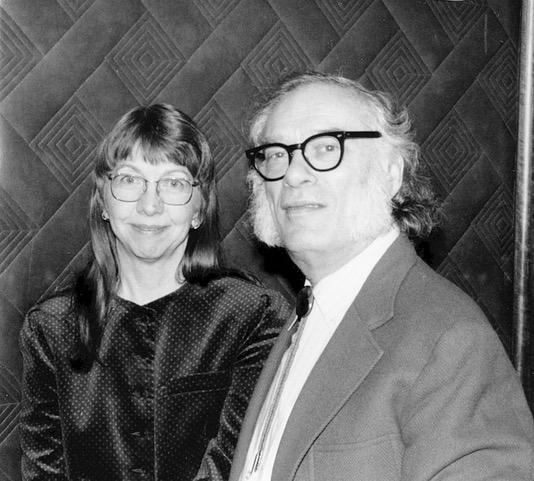
She started writing children’s science fiction in 1970, also published as J.O. Jeppson. The other change in Jeppson’s life that year was that she started dating Isaac Asimov, after he separated from his first wife. They married in 1973, after the divorce became final.
Some of Jeppson’s solo science fiction included The Second Experiment and The Package in Hyperspace. Together with Isaac, she wrote the Norby Chronicles series, which ran to eleven volumes. However, Isaac is reported to have said that the work was 90% Janet’s, with him just doing a final read-thru and polish, but his name “was wanted on the book for the betterment of sales”.
She was married to Isaac until his death in 1992, from complications of HIV, due to a transfusion during bypass surgery in 1983. Based on symptoms, Janet suspected HIV, and pushed for an HIV test, but doctors resisted until he was extremely ill.
They also pressured her to keep the results secret due to fear of public reaction, and so it was not revealed until ten years after his death.
Married to a strong personality, she kept her own space and her own career, while being a loyal partner, and a determined advocate for him in his final illness.
(7) COMICS SECTION.
(8) THE PERFECT IS THE ENEMY. [Item by Steven French.] Keith Stuart includes an apposite quote from TS Eliot in his critique of the push for ultra-realism in games: “The games industry’s obsession with visual fidelity is costing them money and talent” in the Guardian.
If social media platforms have taught us anything, it’s that we live in an age that values rapidly dispersed ideas over “perfect” realisation. If digital TV platforms have taught us anything, it’s that people struggle to wait two years for a new instalment in a beloved franchise. And yet the market is saturated with high-end content; it is everywhere, and it is losing. TS Eliot once wrote: “Humankind cannot bear very much reality” – in art, in games, in real-life, we like to stop just short. That is the sweet spot. An ultra-high-end graphics chipset is not required to get us there….
(9) CHERNOBYL’S WILDLIFE. SpaceDaily reports “Chernobyl’s exclusion zone, emptied of most human activity after the 1986 nuclear disaster, is now home to abundant populations of wolves, lynx, deer, and introduced Przewalski’s horses—with one major study finding several large mammals as numerous as in nearby uncontaminated reserves, while wolves were more than seven times as abundant.”
Forty years after the reactor explosion that emptied towns and farms around Chernobyl, the exclusion zone supports wolves, lynx, deer, wild boar and herds of introduced Przewalski’s horses. The landscape is still contaminated. It is also one of the most arresting large-mammal refuges in Europe.
The number that gives this story its force comes from a 2015 paper in Current Biology. In the Belarusian part of the zone, the researchers found that moose, roe deer, red deer and wild boar were about as abundant as they were in four uncontaminated nature reserves. Wolves were more than seven times as abundant.
That result deserves the attention it received. It also needs to be read precisely. This is one influential study, not a verdict that radiation is harmless, and the seven-times comparison applies to wolves rather than every species named in the headline….
… The researchers first asked whether mammal abundance fell as radiocaesium contamination rose. After accounting for habitat variation, they found no such relationship for moose, wolves, wild boar, roe deer, foxes or a combined group of other mammals….
… The 2015 researchers acknowledged that boundary. Their conclusion was that the zone held an abundant mammal community despite nearly three decades of chronic exposure, not that exposure had no biological effects….
… After 116,000 people were permanently evacuated, farming stopped across much of the zone. Fields moved through scrub towards forest. Traffic and construction largely disappeared. Hunting pressure fell sharply, even if poaching never vanished. Large predators gained prey and territory without the usual proximity to livestock and people….
(10) TRASH LANDING. The upper stage (section) of one of SpaceX’s Falcon 9 rockets that has been drifting free hit the Moon on August 5. The photographic evidence can be seen here: “Moon Impact Site Imaged by Korea’s Danuri Lunar Orbiter”.
The Korea Aerospace Administration (KASA) has released the lunar impact observation data acquired by the country’s Moon-orbiting Danuri spacecraft.
Danuri captured images of the pre-hit scene and after the impact of the roughly 4 ton upper stage of a SpaceX rocket.
The upper stage of the SpaceX Falcon 9 rocket struck the area near the lunar ‘Einstein Crater’ at around 3:34 p.m. on the 5th (Korean time)….
(11) LIONEL TRAINS. Here are some model train catalog pages of genre interest! (Click for larger images.)


(12) SUPERMAN FLAKES OUT. “George Reeves Superman Kellogg’s Corn Flakes Test Footage Commercial at his home” – from the mid-Fifties.
[Thanks to Kathy Sullivan, Steven French, Mike Kennedy, Lis Carey, Andrew Porter, John King Tarpinian, Cat Eldridge, SF Concatenation’s Jonathan Cowie, Chris Barkley, and Mark Roth-Whitworth for some of these stories. Title credit belongs to File 770 contributing editor of the day Cat Eldridge.]
Clive Barker and Joyce Carol Oates have been selected to receive World Fantasy Lifetime Achievement Awards.

Clive Barker is a British writer, filmmaker, and visual artist. He came to prominence in the 1980s with a series of short stories collectively named the Books of Blood, which established him as a leading horror author. Barker has previously been named a World Horror Grandmaster (1995), an International Horror Guild Awards Living Legend (1996), and received a Bram Stoker Lifetime Achievement Award (2013).
Barker’s paintings and illustrations have been shown in galleries in the United States, and have appeared in his books. He has also created characters and series for comic books, and some of his more popular horror stories have been featured in ongoing comics series.
He has won British Fantasy Awards in short fiction for “In the Hills, the Cities” (1985), and “The Forbidden” (1986), as well as the film Hellraiser (1988).
Clive Barker’s Books of Blood, Vols. I-III won the World Fantasy Award for Collection/Anthology in 1985. His Abarat: Days of Magic, Nights of War won the Bram Stoker Award for Work for Younger Readers in 2005.

Joyce Carol Oates is an American writer. Oates published her first book in 1963, and has since published 58 novels, a number of plays and novellas, and many volumes of short stories, poetry, and nonfiction. Her novels Black Water (1992), What I Lived For (1994), and Blonde (2000), and her short story collection Lovely, Dark, Deep: Stories (2014) were each finalists for the Pulitzer Prize.
Oates received the Bram Stoker Lifetime Achievement Award in 1994. She received a special Shirley Jackson Award in 2011 for editing the Library of America edition of Shirley Jackson: Novels & Stories.
She won the World Fantasy Award for short fiction of “Fossil-Figures” in 2011. She is a five-time winner of the Bram Stoker Award for her novel Zombie (1996), her short fiction “The Crawl Space” (2017), and her collections The Corn Maiden and Other Nightmares (2012), Black Dahlia and White Rose: Stories (2013), and The Doll-master and Other Tales of Terror (2017).
(1) WSFS TRIAL COMMITTEE REPORT NOW AVAILABLE. [Item by Kat Kourbeti.] The report of the Trial Committee is now available to read on the Lumi Platform for current WSFS/Worldcon members.
The full report is comprised of one main report document and one for appendices, which includes a transcript of an interview with Dave McCarty. Neither document will be available to download as they are only meant to be accessed by current WSFS members, but they will be viewable on the Lumi platform which people can log into through the LACon Portal.
The next virtual session of the Business Meeting will take place on Sunday 9th August at 9am PDT, and the report (as well as the Trial Committee’s resolutions) will be discussed in executive session, meaning none of the proceedings will be recorded or broadcast on LACon’s YouTube channel. The minutes (as well as the report itself) will only be available to WSFS members by request via the MPC after the Business Meeting is adjourned.
(2) HWA REMOVES TRUSTEE. The Horror Writers Association today removed Sèphera Girón as Trustee from its Board of Trustees. The action followed publication of Girón‘s comments about AI and its opponents in her “In the Trenches” column in the August 2026 installment of the HWA Member Newsletter. See HWA’s statement, quotes from Girón‘s comments, and excerpts from the social media response at the link: “Horror Writers Association Removes Sèphera Girón as Trustee”.
(3) SPSFC COMPETITION FINALISTS. The Self-Published Science Fiction Competition 5 named six finalists today. See the titles at the link.

(4) NPR FEATURE ON “THERE WILL COME SOFT RAINS”. [Item by John A Arkansawyer.] Just this afternoon. It’s not bad, and it’s got Bradbury talking in it, briefly: “Today is the day after Ray Bradbury’s post-apocalyptic world” – hear the NPR audio broadcast clip at the link.
(5) CHERRYH UPDATE. C. J. Cherryh posted some encouraging words about the Washington state wildfire on Facebook.
The air is clearing, finally. Smoke has given both Jane and me a nagging cough—not often, unless we’re trying to eat. I have an ionizer running. But you can see less haze on distant prospects.
We’re just staying tucked down to relieve the pressure on streets and facilities: WE have a kitchen and ample food in storage, where some don’t have that luxury and won’t for a while. The manager of our favorite pub lost his whole house.
Had my regular checkup with the doc—all good news. I’m doing fine, bloodwork and all. I’ve dieted off weight: she approves.
We’re still cleaning up from the sort we did when we hauled out emergency stuff—reorganization is in order.
Outside is still not pleasant, but getting there. The heavy smoke has blocked sunlight, so at least we do get cooler temperatures —at least that has been a relief. Otherwise we’d be in the mid-90’s.
(6) PLURIBUS Q&A. “Rhea Seehorn ‘Pluribus’ Interview & Season 2 Questions” at Deadline.
DEADLINE: In a very cheerful, upbeat reflection of whatever you want them to be. What were your thoughts when that landed for you, how incredibly relevant that was, whether by accident or not, and how did you and Vince [Gilligan] talk about it?
SEEHORN: I knew that Vince doesn’t write in themes. He’s not trying to speak to a specific theme. I also knew that he’s been mulling over some of these questions about humanity, society, all of the plethora of questions that the show brings up for 10- plus years.
So, believe it or not, I was surprised when we started doing the press junkets and people were bringing up, “Oh, this is a commentary on AI, right?” And I get it now and I know I look like an idiot, but I get so focused on playing the character in the story that she’s in, that I try very hard not to think about how I want it to be interpreted or what is this theme that this is speaking to. I didn’t think about the pandemic. Of course, that got brought up. Of course, there’s a comparison to be made there with isolation. And I’m a very extrovert-introvert, 50-50 person, and so I very much need my alone time, but the pandemic tested that, so be careful what you wish for, right? And I think Carol’s going through that.
(7) TODAY’S BIRTHDAY.
[Written by Cat Eldridge.]
August 5, 1966 — James Gunn, 60.
Director James Gunn, who you surely know if only for the Guardians of the Galaxy films, has a very interesting career which we’ll look at tonight.
His first film, decidedly not genre, was Tromeo and Julietwhich I’m sure you can figure what its source material was. It definitely would’ve made Shakespeare pale it as quite extreme levels of sex and violence characteristic of almost every Troma film, not to overlook Gunn revised the ending. Anyone here seen it? It has a rather decent 61% rating among audience reviewers over at Rotten Tomatoes.

Far sillier and not at all likely to offend lovers of classic literature, he scripted next Scooby –Doo and slightly later Scooby-Doo 2: Monsters Unleashed. Really he did. Rotten Tomatoes gives them, well, let’s just say stink, stank, stunk ratings, but sandwiched in between these, and definitely not silly, he penned Dawn of the Dead. Versatile writer, eh?
His first directing gig (which he scripted as well) was Slither in which the plot such as it is has a meteorite bringing an intelligent alien parasite to Earth. Naturally I looked it up on Rotten Tomatoes — it has a strong sixty percent rating among critics and audience reviewers with Allison Shoemaker of Fox 10 Phoenix saying, “Slither is a visceral experience from the first, but as the creature grows, so does the film’s daring.”
So what next? His final work before the film you him know for was Super, described as a black comedy superhero film, again was written and directed by him. A short order cook becomes a superhero without actually any superpowers. Huh. Let me repeat. Huh. It gets a decent 50% at the usual place.
Ok now Disney hires him to write (the first with Nicole Perlman who picked this film because her loved of science fiction, the next two by himself) and direct the Guardians of the Galaxy films. He entered negotiations just two years prior to the film premiering with the possible directors including future MCU directors Peyton Reed and the duo Anna Boden and Ryan Fleck.
Need I say all three films were extraordinarily successful films? At Rotten Tomatoes right now, they carry audiences review ratings of 92%, 87% and 82%. Yes, they did fall off slightly with each film, but an average of 87% is damn good.
Two years ago, Warner Bros. Discovery hired Gunn and Peter Safran to become co-chairmen and co-CEOs of DC Studios. That means they’re overseeing yet another reboot of the DC Expanded Universe. (I’ve lost track of how often this has occurred.) This starts with Superman out next year which, no surprise, he’s writing and directing.
Oh, remember that Warner Bros. Coyote v. Acme film still being a Schrödinger’s Roadrunner? (Try to catch that one!) He along with Jeremy Slater and Samy Burch wrote the story for it. Not the script as Burch did that.
What else should I mention? Well, he was one of the Executive Producers on Avengers: Infinity War and Avengers: Endgame; he’s the motion capture for Baby Groot in the first two of the Guardians films; and finally he was Doctor Flem Hocking in The Toxic Avenger IV. Yes, Troma Films produced The Toxic Avenger films.
So why am bringing this film to your attention? Because it is where we connect Gunn to Marvel. The narrator of this film was none other than Stan Lee himself so we can assume that two of them met and spent some time together while filming this, a reasonable assumption indeed.
(8) COMICS SECTION.
(9) ELECTRONIC ARTS SOLD. “The Sims and EA FC maker Electronic Arts sells for $55bn to Saudi-led group” reports BBC. (Subscription required by readers outside the UK.)
The sale of gaming giant Electronic Arts (EA) for $55bn (£41bn) to a group of buyers including Saudi Arabia’s Public Investment Fund (PIF) has been finalised.
The American company is known for making and publishing best-selling games such as EA FC, formerly known as Fifa, The Sims and Mass Effect.
The investors, who include Affinity Partners – led by President Donald Trump’s son-in-law, Jared Kushner – are taking EA private, meaning all of its public shares will be purchased and it will no longer be traded on a stock exchange.
It is thought to be the largest leveraged buyout in history, meaning a significant part of it is paid for with borrowed money, which the company will have to pay back.
This is because as well as the $36bn it has already put into the deal, PIF needs to borrow $20bn from investment bankers JPMorgan to close it, with the business taking on the debt.
How paying back this debt will affect EA as a business has been the source of much speculation from journalists and analysts.
Bloomberg’s Jason Schreier surmised it could lead to “mass layoffs, more aggressive monetization, and other big cost-cutting measures“, for one of the industry’s biggest companies….
… While the Saudi Arabian government has spent years denying such claims, Osborn said the EA deal could present another way of allowing it to project its influence.
“If the PIF’s football strategy limited them to ownership of Newcastle United and some Saudi Pro League teams, owning EA hands them a relationship with the 20,000 players, 750 clubs and 35 leagues at the top of the professional game,” he said.
“What is clear is that a state seeking to shape perceptions now owns an asset with proven reach to billions of people.
“How it uses it in the years to come is something we should watch closely.”
PIF is controlled by Saudi Arabia’s prince Mohammed bin Salman, whose government has been accused of human rights violations….
(10) JODRELL BANK SUPPORTERS. “Find funding and save Jodrell Bank, stars and academics say”. The BBC reports on a public letter. (Subscription required by readers outside the UK.)
More than 150 public figures have signed a letter calling for the government to reverse a “foolish” decision and “find funding immediately to save Jodrell Bank”.
About £2.8m has been pulled from the Cheshire observatory, leaving the University of Manchester needing to find alternative cash by 2028.
Signatories of the letter include astronaut Tim Peake, musicians Sir Brian May and Jarvis Cocker, Scotland’s Astronomer Royal Prof Catherine Heymans, physicists Prof Jim Al-Khalili and Prof Brian Cox, and Judy Spence, the daughter of the site’s founder Sir Bernard Lovell.
The UK Research and Innovation agency (UKRI) has said it had to focus on projects that delivered “the greatest long-term impact”.
The observatory, a Unesco World Heritage Site, is dominated by the enormous Lovell Telescope, a structure that was voted Britain’s greatest unsung landmark in 2006.
All scientific observations at Jodrell are expected to cease on the 1 April 2028 unless alternative funding can be found.
Twenty-eight jobs are at risk at the observatory, but its closure would also affect the work of nearly 3,000 scientists who use it in their research.
When the plan to cut funding was announced, Business Secretary Jonathan Reynolds said the UK’s world class research was “absolutely central to creating a better future for the UK”.
“I am committed to working with UKRI to ensure the UK remains able not only to sustain its world-leading research capabilities, but also to invest in the next generation of scientific facilities and infrastructure that will underpin discovery, innovation and growth in the years ahead,” he said.
The letter was signed by a number of figures who have presented TV shows at the observatory, such as Prof Jim Al-Khalili
The open letter was signed by a number of figures who have played concerts or broadcast from the observatory, including guitarist Johnny Marr, electronica pioneer Ralf Hütter of Kraftwerk, the bands New Order, Elbow and Doves, comedian Dara Ó Briain and poet laureate Simon Armitage.
It stated Jodrell Bank was “an icon in UK cultural and scientific history”, which was the “thriving, thumping heart of space observation, research and education in the UK”.
“This beacon of science is more ambitious than ever, with exciting plans already under way that will ensure the UK’s relevance and leadership in the rapidly evolving domain of space exploration and utilisation,” it said….
[Thanks to Mark Roth-Whitworth, Kathy Sullivan, Steven French, Kat Kourbeti, John A Arkansawyer, Mike Kennedy, Andrew Porter, John King Tarpinian, Cat Eldridge, SF Concatenation’s Jonathan Cowie, and Chris Barkley for some of these stories. Title credit belongs to File 770 contributing editor of the day Steve Davidson.]

The Horror Writers Association today removed Sèphera Girón as Trustee from its Board of Trustees. The action followed publication of Girón‘s comments about AI and its opponents in her “In the Trenches” column in the August 2026 installment of the HWA Member Newsletter. (Girón‘s comments are excerpted below.)
The HWA Board of Trustees published the following statement on Facebook.
Statement from the HWA Board of Trustees:
The Executive Leadership and Trustees on the Board of the Horror Writers Association has voted to remove Sèphera Girón from her position as Trustee effective immediately.
The Horror Writers Association is committed to the promotion of Horror and Dark Fantasy literature and the broadening of intellectual and cultural horizons by way of good works in these genres. In support of this mission, the Board established a robust artificial intelligence policy, following input from all levels of membership. This policy emphasizes the organization’s sincere commitment to not only uplifting creators but also protecting a culture of labor compensation in the arts, aligning with principles that safeguard our community.
To this end, the HWA Board firmly and resoundingly rejects the opinion piece of Trustee Sèphera Girón as included in the August 2026 installment of the HWA Member Newsletter in the “In the Trenches” column. This piece does not meet the standards of care and support to which we hold ourselves as elected members of this writer’s organization. We regret that it was published in our newsletter without proper vetting. The HWA will review all newsletter submission procedures, including those submitted by Trustees.
Further, we reject the assertions in the piece, particularly those calling authors with genuine and sincere concerns regarding the proliferation of genAI (more commonly referred to as simply AI) Luddites and/or gatekeepers. Additionally, in keeping with the organization’s ongoing commitment to the uplift and promotion of diverse voices in Horror literature, we firmly denounce the comparison of concerns over AI data center proliferation to the ongoing struggles over Indigenous water rights and ways. As the leadership of the Horror Writers Association, we sincerely apologize for the hurt that these words have caused.
We have heard your concerns and write today with a full understanding of the severity of the error made by way of this opinion piece’s publication. It is not in keeping with opinion of the HWA, the Board, and the general consensus of membership. In the future, we will do more to better to review and vet material included in the newsletter so that a repeat of this incident does not occur.
Given that the column in question fails to uphold the principles of the organization, does not reflect the consensus of leadership and membership alike on the subject, and demonstrates a failure to fulfill the responsibilities of a Trustee, the Board has voted to remove Giron from her position effective immediately.
We have always been an organization meant to protect writers and that is what we will continue to stand for.
— The Board of Trustees of the Horror Writers Association
While the newsletter is available only to members, Hailey Piper posted these screencaps from Girón’s article on Bluesky. [Correction: The HWA Member Newsletter August 2026 is accessible to the public.]
SÈPHERA GIRÓN


Here is a sampling of the response in social media.
RESPONSE
HAILEY PIPER
https://bsky.app/profile/haileypiperfights.bsky.social/post/3msciqp7z5k2g
DIANA WALLACH
GABINO IGLESIAS
MICHAEL PATRICK HICKS
“In Response to Sèphera Girón and the HWA’s Pro-Slop Stance”
…Sadly, it’s not much of a surprise to see Girón’s pro-AI missive in an HWA newsletter, even if they claim Girón views are not that of the organization or representative of the HWA as her role within the group as a trustee. In my estimation as a former HWA member, the Horror Writers Association has been willfully and woefully ill equipped to tackle issues surrounding artificial intelligence for some time now, and has appeared, more than once, to be both outright supportive of it and completely dismissive of its membership’s concerns over the use of AI in the creative arts. When news broke about the widescale book piracy perpetrated by Meta, Anthropic, and others, HWA authors demanded the organization take appropriate measures against these thefts and to establish appropriate anti-AI guidelines and policies. Their concerns, as I recall, were brushed aside with HWA leadership feigning a complete misunderstanding of the issues at hand and arguing that writers here in the 21st Century commonly use spellcheck in their word processing programs, which is AI, and that we were decades late in worrying about these issues. Too bad, so sad. Of course, this was then followed by a further and complete misreading of the room altogether, wherein they advertised an upcoming, and subsequently canceled, seminar they were holding in conjunction with some AI techbro or other. Naturally, I was more than happy to let my membership lapse immediately thereafter.
HWA’s apologia, obfuscations, and false equivalencies then are remarkably similar to Girón’s now. It reminds me a bit of the right-wing’s willful misunderstanding of the paradox of tolerance. Or, as author Chuck Wendig wrote in his blog post today, “We are the people that have had all our work stolen immorally and illegally. We’re the ones turned into Soylent Green, so it’s a little fucking rude to have an essay piped hot and fresh into our inboxes that dares to be mad at us for criticizing anyone who eats Soylent Green. We’re getting cannibalized, turned into sausages, and you’re mad that we’re mad about it.”…
CHUCK WENDIG
“Regarding The Pro-AI Tantrum In The HWA Newsletter”
… I don’t know that pumping gas and self check-outs are relevant technological innovations here, but okay. But talking about film vs TV, electric instruments, photography, and so forth, leads into an argument that pro-AI (“AI” — again, we’re talking LLMs and what Tobias Buckell calls LIMs, Large Image Models) really like to use a lot, which is, “You stupid Luddite, you’re just afraid of the new technology.” And then sometimes they say something about horse-and-buggy versus the car, or some other false equivalency.
(Also, please look up the actual story of the Luddites.)
The reason all of this is false equivalency is that prompting your way to art or to writing is not the same as having a new tool that allows you to make art or tell a story. AI, here, is not a tool —
It’s not allowing you to do the work. You’re allowing it to do the work. Which is to say, you’re the tool.
The AI makes decisions. (Not literally. AI isn’t smart. It knows nothing. But programmatically, it takes pathways based on the chaos of its code.) You don’t make the decisions. You may guide them. But you don’t make them….
… “Are you watching TV? Are you using Alexa? Do you have home security? What kind of car do you drive? Do you go to the doctor? Do you watch TV? Do you go to the movies? Do you have shopping apps on your phone?”
What?
What does this even mean?
Am I participating in society, you mean? I’m not new here. Yes, we’re all doing these things all the time. This is very shallow and quite silly. “DO YOU BREATHE AIR? DO YOU USE THE TOILET? ARE YOU CLAD IN FLESH AND ACKNOWLEDGE CORPOREAL REALITY? AH! THEN YOU EXIST IN THE SAME PLANE OF EXISTENCE AS AI! HYPOCRITE!”
Like, what are we even doing here….
MARK ALLEN
…I’ll admit I’m something of a Luddite, but I also realize, accept, and agree that AI is here to stay whether anyone likes it or not. I can see useful and beneficial functions and applications across multiple industries and fields of endeavor. Medicine, business, accounting, etc.
For reasons I see as artistic integrity, I do not utilize AI in my profession, but AI in and of itself is no different from a hammer, a screwdriver, or the internet. It’s a tool. Nothing more. How and where it is applied is where the rubber meets the road. In writing, editing, advertising and publishing, AI has already infused itself into our neck of the woods. You just can’t avoid it. Hell, MS Word spellcheck/grammarcheck has a certain amount of AI driving it now.
Where I draw the line, where I have a HUGE problem both personally and professionally, is the use of generative AI to produce novels, short stories, screenplays, etc. I ordinarily eschew making public statements regarding most issues of the day. I have opinions like anyone else, but I normally choose to keep my mouth shut in public. That’s just me.
But AI is a different animal altogether.
Let me be clear: When it comes to the writing profession, if someone uses generative AI to create blank diaries, writing journals, wall calendars, Day Planners, or something similar I think that’s probably all right.
HOWEVER… if someone uses generative AI to conceptualize, plot, and then generate for them something that they claim is a literary work, and then, without actually sweating out any of the WORK that goes into a novel or other work, they proclaim themselves a writer or an author — THEY ARE NEITHER.
They’re cheats. They’re hacks….
THE MIDNIGHT SOCIETY
The Self-Published Science Fiction Competition (SPSFC5) has announced its 6 finalists, selected by five judging teams from 124 entries.
Founded by Hugh Howey and Duncan Swan, the SPSFC is now in its fifth year as an all-volunteer competition championing indie sci-fi — the science fiction counterpart to Mark Lawrence’s SPFBO.
The finalists are:


LAcon V Business Meeting chair Jesi Lipp has posted a recap of the August 1 WSFS Business Meeting.
The full text of items mentioned below is available in the 2026 Business Meeting Agenda.
The next session of the Business Meeting is August 9 at 9 a.m. Pacific.
Second Main Business Meeting, held August 1, 2026
Average attendance at the meeting, based on users logged into the virtual platform, was about 115.
The results of the Mark Protection Committee election were announced: Alana Vincent, Andrew January, and Warren Buff.
The appointments to the Bidding Trust & Safety Committee were announced: Alana Vincent (chair), Anna Bradley, Brandon O’Brien, Chris Rose, Kathy Bond, Mara Michaud, Olav Rokne, and Steve Cooper.
The following items were addressed during this session:
Anyone wishing to serve on the F.6 Responsive Late Business committee should email [email protected] and indicate if they are willing to serve as chair of that committee.
The next session will take up the report from the Trial Committee related to the administration of the 2023 Hugo Awards. The proceedings of that meeting will be held in executive session. The report from the Trial Committee will be published on the Lumi platform by Wednesday, August 5th.
[Reprinted with permission.]
Video of the meeting session is available on YouTube here: WSFS Business Meeting Day 3.