Showing posts with label gumbo. Show all posts

Tuesday, September 30, 2014

Oysters & Gumbo? Ya! Ya!

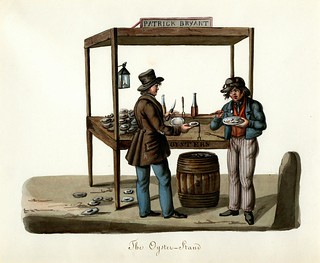
Calyo's Oyster Stand fig. a:  the oyster-stand

You heard right:  Oysters & gumbo.  
At the Foodlab.  This Friday, October 3rd, from 7:00 p.m. on.
And it's all for a great cause.

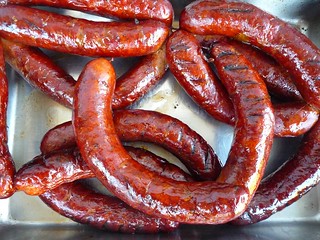
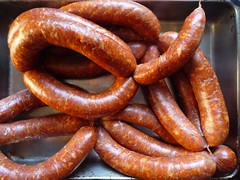
smoked andouille fig. b:  smoked cajun sausage
You see, Michelle & Seth will be shucking oysters all night and I'll be serving smoked turkey & sausage gumbo (while quantities last!), and all the proceeds will go towards the Ange-Aimée Woods Memorial Bursary at Concordia University.  
We've said it before, but we'll say it again:  Ange-Aimée was a fantastic journalist and a devoted friend.  She loved great food, and good parties.  She was also a big fan of the Foodlab.  We can't think of a better way to honour Ange-Aimée's memory and to benefit a bursary that will continue to share her incredible warmth & generosity with others for years to come.

Eat, drink, & be merry!  Give Generously!  And laissez bon temps rouler!

Oyster & Gumbo Feast
Friday, October 3, 2014
7:00 - 10:00 p.m.
Foodlab / Labo Culinaire
1201 St-Laurent Blvd. (3rd floor)

aj

Tuesday, November 05, 2013

Top Ten #52

1.  Joseph Conrad, Heart of Darkness

Mammane Sani, son orgue, et son ami

2.  Mammane Sani et son Orgue, La musique electronique du Niger (Sahel Sounds)

sample track:  "Lamru"

lola title

3.  Lola (1961), dir. Jacques Demy

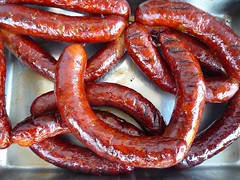
smoked andouille

4.  homemade smoked andouille sausage
Untitled

5.  bazaar season, Montreal

6.  outdoor screening of Pink Floyd:  Live at Pompeii (1972), dir. Maben, 2013 Montréal Festival du Nouveau Cinéma

sample track:  "Echoes"

Untitled

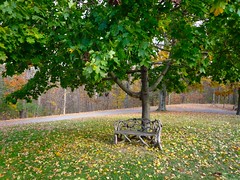
7.  Hudson Valley + the Catskills in the fall

8. Vin Vignerons Vinyles, SAT, Montreal, November 4, 2013 (whoa, Nelly!)

death family photo

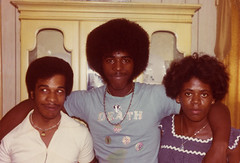
9.  A Band Called Death (2012), dir. Covino & Howlett

sample track:  "Politicians in My Eyes"

10.  leftover turkey, and the wonderful things you can do with it

aj

Tuesday, October 22, 2013

Thanksgiving Just Keeps on Giving

apple pickin' 1 fig. a:  apple-picker

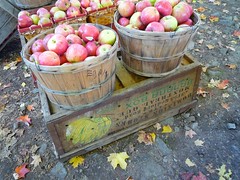
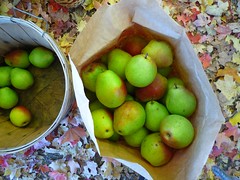
Canadian Thanksgiving 2013 began with our annual apple-picking excursion to Covey Hill.  There, we picked a couple of buckets of apples (Empires, Northern Spys, Russets, and Spartans, mainly), bought a couple of baskets more,

Untitled fig. b:  apples

and picked up some Flemish Beauty pears, as well.

Untitled fig. c:  pears

The sun was bright, the leaves were vibrant, and it was downright warm (felt more like peach-picking weather than apple-picking weather), and we got a chance to get all caught up with our good friend M. Safian.  And on the drive back we started thinking about all the possibilities we now possessed in the back of our car:  apple pie, baked pears, apple strudel, pear chutney, corn bread stuffing, squash soup, and so on.

The next day, when we actually got around to making our Thanksgiving meal, it was quite the spread.  Not surprisingly, both apples and pears played an important part.

The menu:

smoked Cajun andouille appetizer
sweet potato & peanut soup (with apple cider) 
roasted turkey
corn bread stuffing (with apples & pears)
roasted romanesco cauliflower
roasted Brussels sprouts
roasted carrots
mashed potatoes (with turnips and parsnips)
cranberry sauce
Georgian plum sauce 
mixed greens salad (with apples & pears
cheese plate (with pears
apple pie
pumpkin pie

Our turkey this year was a huge hit--it was also just plain huge.  When Michelle heard through the grapevine that Société Orignal was offering turkeys raised by the one-and-only M. Bertrand, she put through an order for a "small turkey" immediately.  The turkey that she received was beautiful, and unbelievably fresh (it had just been slaughtered two days before), but it was also almost 20 pounds (!)--the very largest we'd ever made, and not exactly the ideal size for our preferred high-temperature turkey method.  Nevertheless, we soldiered on.  And by now Michelle's got this approach down to such a science that the results were truly phenomenal.  Two tricks of the trade:
1.  Salt your bird generously, inside and out, at least one day in advance, and preferably two. 
2.  When you bring your bird to room temperature before roasting it, cover the bird's breast with ice packs to keep it cool.  Remove the ice packs right before roasting.  Doing so will ensure that the breast meat does not get overcooked, but instead will turn out juicy and succulent (already, even without this fix, we found that the high-temperature method produced the juiciest birds we'd ever encountered, but if you're roasting a larger bird, like we were, this step is essential).
Our cranberries were pretty special, too.  They came from Société Orignal, as well, and they were dry-picked, not wet-harvested.  Neither of us had ever tasted a cranberry sauce with a deeper flavour.

Our stuffing was also rather deluxe.  I've been trying to convince Michelle of the merits of corn bread stuffing for years, but she's always remained steadfastly loyal to stuffing made with white bread or sourdough.  This year amounted to a breakthrough, though.  Michelle officially declared this year's model to be her very favourite of all-time.*
AEB Corn Bread Stuffing 
1 extra-large 3x batch of corn bread
onion
celery
red sweet peppers
parsley
sage
roasted hazelnuts
2 chopped apples
2 chopped pears
bourbon
salt & freshly ground black pepper
butter 
Preheat oven to 425º F. 
Sauté the onion in butter until translucent.  Add the celery and red peppers and continue sautéing until softened.  Add the corn bread, the herbs, the nuts, and the fruit and mix gently but thoroughly (preferably with your hands, once you've allowed the onion mixture to cool slightly).  Adjust the seasoning with salt & pepper.  Spritz liberally with bourbon.  Pour a generous amount of melted butter over top and mix again.  The stuffing should be just slightly moistened by the combination of bourbon and butter.   
Place in a buttered baking dish and bake for 30 minutes covered in foil, and 15 minutes uncovered.
Anyway, we thoroughly enjoyed our meal, everyone ate heartily, and we had so much left over that we sent our guests home with doggy bags--and still we had copious leftovers.  The ultimate prize, however, was that massive turkey carcass.  It still had a fair bit of meat left on it, and it had been roasted to perfection--in other words, it had all the makings of a beautiful batch of turkey broth.  So I cut it up into portions, put them in bags, and froze them.

And the next week, when all the other leftovers had disappeared days ago, and my taste for turkey was coming back to me, I got to work on my new (since last year) favourite post-Thanksgiving ritual:  making turkey gumbo.

Thing is, because making turkey gumbo is "my new... favourite post-Thanksgiving ritual," I was already thinking about the gumbo before we'd even roasted our bird.  And because I knew I wanted to make my turkey gumbo with real Cajun andouille (a spicy, smoked Louisiana classic), and I was pretty sure locating real Cajun andouille would be a little difficult 'round these parts, I made my own.  Then, because I was smoking anyways, I decided to smoke some additional turkey legs, just for the hell of it (and in case my turkey gumbo needed to be bumped up a little).  So on Thanksgiving Sunday, while Michelle had the turkey in the oven, I had the smoker smokin' away--which is how we ended up serving freshly smoked andouille as an appetizer.

How, exactly, do you make Cajun-style andouille?  Well, I based my batch on a recipe from Bruce "America's Premier Sausage Maker" Aidells:
Cajun-style Andouille 
3 tbsp sweet Hungarian paprika
2 tbsp minced garlic
2 tbsp kosher salt
2 tbsp sugar
1 tbsp freshly ground black pepper
2 tsp ground cayenne pepper
1 tsp crushed red pepper flakes
1/2 tsp dried thyme
1/4 tsp ground mace
1 tsp curing salts (optional--for cold-smoking only)
5 lbs pork butt, fat and lean separated, and cut into 2" chunks
1/2 cup water
wide hog casings 
Mix all the spices and herbs in a small bowl.  Separate the meat and the fat into two bowls, and rub each thoroughly with the spice mixture.  Cover and refrigerate overnight. 
Grind the lean meat in a meat grinder using a 3/8 inch plate.  Grind the fat using a 1/4-inch plate.  Mix the meat and fat together in a large bowl, add the cold water, and knead and squeeze until the water is absorbed and the spices are thoroughly blended. 
Stuff the mixture into wide hog casings, and shape into medium-sized links. 
If you are hot smoking, dry for at least two hours in a cool place, then hot smoke at about 225º F, turning every 30 minutes, until an instant-read thermometer inserted in the end of a sausage shows 155º to 160º F.  This should take about 1 1/2-2 hours.
If you are cold smoking, you'll have to add the curing salts during the first step, and carefully follow instructions on how to cold smoke.  Aidells recommends an extra-long cold-smoking period for Cajun andouille:  "at least 12 hours" (!). 
Hot-smoked andouille sausages are ready to eat as soon as they've been smoked.  Cold-smoked sausages are not--they must be fully cooked first.
[recipe from Bruce Aidell's Complete Sausage Book]
Untitled
smoked andouille figs. d & e:  andouille:  before & after

While you're at it, might as well smoke a few turkey legs, right?  Just brine them for at least a few hours, and preferably overnight, then hot smoke them alongside your sausages, making sure to mist them with apple juice every 30 minutes or so.  Smoke until the juices run clear when you slice down to the bone, about 1 1/2 to 2 hours.

The results?  The skin turned out a little rubbery, but the meat was dreamy:  incredibly juicy and wonderfully smoky.  I just peeled the skin off and sliced the meat as thinly as possible before serving.  And I made sure to keep some for my gumbo.

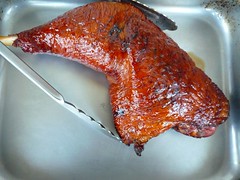
smoked turkey fig. f:  smoked turkey
AEB Turkey & Sausage Gumbo 
for the broth: 
1 turkey carcass (recuperate as much quality meat from this carcass as possible, and put aside for the gumbo)
onions
carrots
potatoes
celery
garlic
2 bay leaves
12 peppercorns
salt to taste 
Make yourself a rich turkey broth by adding all the ingredients above to a large stock pot, covering with water, bringing the pot to a boil, and simmering for at least a few hours.  Make sure to skim the fat thoroughly.  Turkey broth might be my absolute favourite, and this method ought to produce much more than the 4-5 cups of stock you need for the gumbo.  Freeze it and save it for another worthy occasion. 

for the gumbo: 
recuperated turkey meat from the carcass 
recuperated meat from home-smoked turkey pieces (optional, but highly recommended)    
bones from home-smoke turkey pieces (again, optional, but highly recommended)  
4 smoked Cajun andouille sausages (highly recommended), or some other quality smoked sausage (like a kielbasa, for instance), cut into 1/4" "coins"
1 batch Cajun roux (made with 1/2 cup vegetable oil and 1/2 cup AP flour [you can find complete instructions on making a true Cajun roux here])
1 large onion, diced
3-4 stalks of celery, diced
2-3 sweet red peppers
1 green pepper (preferably something flavourful, like an Italian fryer or a cubanelle)
4-5 cups rich turkey broth
2 bunches scallions, white & green parts, washed & chopped
1 small bunch fresh parsley, chopped
4-6 fresh sage leaves, julienned
kosher salt & freshly ground black pepper
1 tbsp gumbo filé 
As John Thorne would say, "First, you make your roux."  When your true Cajun roux is as deep and dark as you like it, add your chopped onions, turn the heat back up to medium or medium-low, and sauté until soft.  Add the celery and peppers and sauté for a few minutes more.   
Slowly add the broth and stir or whisk it in carefully, so that your roux doesn't separate. 
Add the bones from the smoked turkey pieces (if using), the scallions, parsley, and sage and bring to a boil, then turn down the heat and simmer your gumbo gently for about 1 1/2 hours, or until it shimmers.  Afterwards, if it needs to be skimmed of excess fat, do so.   
Add your turkey meat and your andouille.  Stir in the gumbo filé and simmer gently for another 30 minutes.  Adjust the seasoning, if need be. 
Serve over or alongside steamed white rice, with some cold beers, and have a bottle or two of hot sauce on hand for anyone who wants to bump up the spice quotient a bit higher.
Note:  Of course,  you don't absolutely need a leftover turkey carcass to make this gumbo, nor do you need to make your own smoked andouille.  You could easily make something that's nearly as tasty with fresh turkey or chicken pieces, some store-bought smoked sausage, and some chicken or poultry stock.  But making full use of your leftover Thanksgiving turkey and its carcass is pretty satisfying, and few dishes make it shine like a turkey & sausage gumbo.
[recipe inspired by one that appeared in the November 2011 issue of Garden & Gun, and that came from Justin Devillier of New Orleans' La Petite Grocery]
And when I'd eaten turkey & sausage gumbo for two days (and loved every minute of it), I made leftovers with my leftovers:  Cajun-style hot turkey sandwiches.  Mmm-hmm.  Laissez bon temps rouler!
AEB Cajun-style Hot Turkey Sandwiches 
leftover Turkey & Sausage gumbo, with lots of sauce
1 or more slices of white bread (preferably a homemade sourdough) 
Heat up your leftover gumbo.  Place a slice of white bread on a plate.  When the gumbo has been heated through, pour it over the slice of bread, making sure the entire slice is covered in sauce.  Serve immediately, preferably with boiled and buttered peas and mashed potatoes.
Talk about a harvest!  This year's Canadian Thanksgiving just keeps giving and giving...  Can't wait for American Thanksgiving!

aj

* Of course, I'm pretty sure she does that pretty much every time we make stuffing of any kind.  We're both huge fans of the genre.

Friday, December 19, 2008

Bringing it all back home

It's that time of year again.

good cheer 2 fig. a: good cheer!

So you send out your invites,

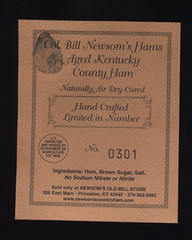
old no. 301 fig. b: ole No. 301

and you settle on a centrepiece (real sugar-cured country ham*) and a theme (Southern).

Then you put together your menu:

Glazed and baked country ham (Turner Ham House, Fulks Run, VA)
Shaved country ham (Col. Newsom's ole No. 301)
Buttermilk biscuits
Shrimp & Oyster Gumbo
Vegetarian gumbo
Oysters Rockefeller
Pimento cheese
Artichoke dip
Deviled eggs
Poor man's caviar
Cheese straws
Pickled corn
Spiced nuts

Rum punch

Dark fruitcake
Light fruitcake
Ginger snaps

michelle's huîtres fig. c: Michelle's huîtres

Oysters figure prominently on the menu, so you find yourself two small cases of oysters (one 24-count, one 48-count), and you roll up your sleeves and begin shucking and cooking up a storm.

Baked Artichoke Dip

I cup mayonnaise
1 cup Parmesan cheese, grated
1/2 cup onion, finely chopped
1 13 3/4-ounce can artichoke hearts, drained
1 tbsp fresh lemon juice
1/4 to 1/2 tsp ground black pepper
3 tbsp unseasoned breadcrumbs
1 tsp olive oil

Preheat the oven to 400º F. Stir the mayonnaise, the Parmesan, and the onions together in a medium bowl. Pulse the artichokes in a food processor until finely chopped. Stir the artichokes into the cheese mixture and add the lemon juice and the black pepper and mix well.

Scrape the artichoke mixture into a small baking dish. Combine the breadcrumbs and the olive oil and sprinkled them overtop. Bake until the top is browned, about 20 minutes.

Serve with crackers or toast.

[recipe from The All New All Purpose Joy of Cooking, by Irma S. Rombauer, Marion Rombauer, and Ethan Becker]

Baked Country Ham

1 whole 15-pound country ham
10 bay leaves
2 tbsp mustard seeds
3 cups cider vinegar
24 whole cloves
1 cup dark brown sugar

special equipment: a large stock pot capable of holding the entire ham

Clean your country ham with a stiff brush under warm running water. Place the ham in your stockpot and fill it with just enough water to cover the ham (it's okay if the ham hock protrudes above the water). Let the ham soak for 24 hours, changing the water as often as possible, ideally a minimum of four times.

Change the water a final time and transfer the pot to your stovetop. Add the bay leaves, the mustard seeds, and the vinegar and bring to a boil over high heat. Lower the heat to medium and simmer for 3 hours (or until the internal temperature of the ham reaches 160º F), topping up, as necessary, with fresh water.

Meanwhile, preheat the oven to 375º F.

Remove the ham from the stockpot and turn off the heat. When the ham is cool enough to handle, shave off the skin (but not that beautiful layer of fat characteristic of a country ham) with a sharp knife. Score the fat and exposed flesh in a diagonal pattern, stud it with a single clove in the center of each scored diamond, and pat in thoroughly on all sides with the brown sugar.

Place the ham in a roasting pan and bake for 45 minutes to an hour, or until the fat has crisped and the sugar has melted into a lovely glaze. Let the ham rest on a cooling rack for 15 minutes. Transfer to a cutting board and carve.

Serve with buttermilk biscuits and plenty of fixings (mustard, pickled corn, etc.).

[adapted ever so slightly from The Lee Bros. Southern Cookbook]

Southern Odyssey Mix

Preheat stereo to 450º F.

In a computer or MP-3 playing device of your choosing, mix together about 200 of your favorite Southern hits, especially all those having to do with Southern food and Southern drink (like Elvis Presley's "Crawfish," Dusty Springfield's "Willie & Laura Mae Jones," Bob Wills' "Roly Poly," Betty Davis' "They Say I'm Different," Memphis Minnie's "Good Biscuits," Hank Williams, Sr.'s "Jambalaya," Ann Peebles' "99 Pounds," Koko Taylor's "Wang Dang Doodle," Ted Hawkins' "There Stands the Glass," and so on). Mix well.

Place in stereo and bake for 6-7 hours, or until guests are fully loaded.

& c.


Invite 40-50 of your closest friends, and ask them to bring their own bottle to augment the festivities, as well as a canned food donation for a worthy charity (in this case, Dans la rue).

Hello, Abner! fig. d: Hello, Abner!

If you're lucky, your guests might arrive bearing gifts, like Abner Bauman's summer sausage from rural Ontario,

camilla's surprises 2 fig. e: C's candies

or C's gorgeous assortment of homemade/handmade candies (including my two favorites: Aunt Bill's Brown Candy and Neapolitan Strips).

If you're really lucky, you might just have enough baked ham left over to make some AEB ham & cheese sandwiches, the sandwich Michelle promptly declared "the best sandwich I've ever eaten!"

AEB ham & cheese fig. f: AEB ham & cheese

AEB Ham & Cheese Sandwich

fresh Portuguese rolls
leftover baked ham
red onion, sliced into rounds
thinly sliced cheddar cheese
mayonnaise
strong mustard (preferably Vve Tierenteyn-Verlen brand)
pickled corn

Compose and devour. Repeat as needed.


She ain't kidding. That Turner country ham's robust, gamy flavor plus that powerful, horseradish-y mustard, the pickled corn, and the bit of raw onion, makes for a ham & cheese sandwich that'll get up and talk to you.

how 'bout them apples? fig. g: how 'bout them apples?

And if you're especially lucky your generous guests will bring you enough canned goods to fill two large boxes, because as great as it is to participate in an event like Menu for Hope 5, it's important to try attending to the situation at home too.

Happy holidays! Eat well! Be well!

aj

ps--TY to all our generous guests!

* Which, in spite of what non-believers will try to tell you, if they're prepared according to time-honored Southern tradition (like both of our hams were), are 100% sodium nitrate- and nitrite-FREE.

Thursday, July 31, 2008

eat your greens 1

AEB portuguese kale fig. a: AEB Portuguese kale

It's never been all that difficult to get us to eat our greens, but ever since about March, we've been completely ga-ga for the green stuff. Part of it had to do with the long, snowy winter we had. Our poor bodies were crying out for additional nutrients and the Swiss chard and Belgian endives at our local supermarché started looking better and better (even if they were getting trucked in from California). But mostly it was because that's when we started making gombo zhèbes, that mysterious dish known in some circles as "the queen of gumbos."

Why "mysterious"? Well, gombo zhèbes (a.k.a. gombo aux herbes, gombo z'hairbes, and green gombo) may be "the queen of gumbos," but she's not your typical gumbo. In fact, she breaks with the two most hallowed tenets of gumbo- or gombo-making: she contains no okra and/or okra-like consistency (courtesy of gumbo filé) and she contains no roux.

If you had to boil it down (and some recipes require you to), Gombo zhèbes is a Creole version of that Southern staple "greens and pot likker," the principal difference being the addition of significant amount of herbs to the already heaping quantities of fresh greens, and a degree of complexity. In the Creole kitchen, gombo zhèbes was a dish associated with early spring--it was essentially a restorative dish, one that took advantage of the arrival of the newest greens, and it also was easily adapted to the Lenten diet (although sometimes it sure was hard to tell, because many traditional recipes included such extravagances as veal brisket in addition to the traditional ham).

Anyway, from the time we tasted gombo zhèbes' combination of greens, herbs, ham, garlic, green onions, and hot red pepper we were hooked and we immediately started planning our garden with gombo zhèbes in mind. That was the only problem with our earliest versions--we were living in Quebec and not Louisiana, we were still under a blanket of snow. But we knew that would soon change, and when it did we wanted to be ready. So we made plans and mapped things out, and in early May we broke with tradition (mostly tomatoes and peppers) and planted mostly herbs and leafy greens--savory, basil, thyme, and parsley on the one hand, oak leaf lettuce, mustard greens, cavolo nero, and Portuguese kale on the other. And now, we're happy to report, we're swimming in greens, and though this isn't the only way we've been enjoying our bounty, we've been eating a lot (a lot) of gombo zhèbes and gombo zhèbes-like creations.

AEB cavolo nero fig. b: AEB cavolo nero

gombo zhèbes

Greens: choose a sizable bunch per person from the following list: mustard greens, cavolo nero, Portuguese kale, spinach, endives, watercress, arugula, chicory, kale, collard greens, rapini, etc. The more elaborate the mix, the better. Just remember to make (at least) the equivalent to one bunch per person.

Herbs: a bay leaf, a healthy handful of parsley, and then whatever you like from the following list: basil, savory, thyme, oregano, marjoram, sage, tarragon, etc. Again, the more the merrier.

Aromatics: 2-3 cloves garlic, 1 medium sweet bell pepper (preferably red, yellow, or orange), 4-6 green onions (and/or chives, shallots, onions), 1 small hot red pepper (fresh or dried), Tabasco sauce, etc.

le vrai bacon fig. c: "le vrai bacon"

Finishing touches: 2 tablespoons olive oil, 1-2 teaspoons wine vinegar, 1/4-lb smoked ham (or bacon), and 1 cup uncooked white rice.

Equipment: one large skillet, one large pot.

Method: Cook the rice. When it's done, keep it in a warm spot on the stove. Clean, stem, and mince the herbs, leaving the bay leaf whole. Mince the garlic. Dice the sweet pepper (having already seeded and cored it, of course). Trim and finely chop the scallions. If using ham, cut it into slivers. If using bacon, cook the bacon in a large skillet until it has rendered its fat and become crispy. Remove the bacon and set it aside, and proceed using the bacon fat instead of olive oil. If not using bacon, heat the olive oil in a large skillet. When hot, add the ham, scallions, and sweet pepper. Cook these for a few minutes and then add the minced herbs, the bay leaf, and the crumbled hot pepper. Stirring regularly, cook over medium-low heat for another few minutes, until the herbs have all wilted. Now mix in the garlic and remove from the heat.

Pick over the greens, discarding the stems and any damaged portions. Tear the larger leaves into pieces. Wash carefully, using several changes of water if necessary. Put a cup of unsalted water in a large pot and bring to a boil. Add the greens, cover, and, when the water begins to simmer again, lower the heat to low. Cook until wilted and tender, about six to ten minutes, forking them over from time to time. Do not let the pot boil dry, of course, but at low heat there should be no risk of that.

Using a slotted spoon, transfer the greens into the skillet, spooning some of the pot likker overtop as desired. (The resultant mixture should be "wet" but not "swimming.") Cook everything together briefly until everything is hot and well blended. Taste for seasoning, adding the wine vinegar or lemon juice, along with salt and freshly ground pepper. Discard the bay leaf. Serve in bowls over the rice.

[recipe adapted from John Thorne and Matt Lewis Thorne's Serious Pig, with a little help from The Picayune's Creole Cook Book]


This makes a fine, healthy, and light meal on its own, but it's also a great accompaniment for a whole range of dishes, especially seafood (New Orleans "BBQ" Shrimp comes to mind). Obviously, this recipe can also be easily adapted into a 100% vegetarian version--the method is a keeper. We've found that as our greens have gotten better and fresher we've been adding fewer and fewer extras, so if you're making gombo zhèbes for the first time, and you're using top-notch greens straight from the farmers' market or, better yet, straight out of your garden, you might want to tone down the amount of vinegar/lemon juice and ham/bacon so that you can get the full greens experience. Then again, if you're making gombo zhèbes for the first time, you might very well want to stay close to the script--it's hard to argue with that combination of flavors.

aj

Sunday, May 11, 2008

Top Ten #25

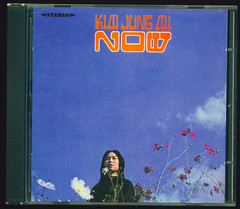
kim jung mi fig. a: the now sound

1. Kim Jung Mi, Now

king of kong fig. b: the good, the great, and the ugly

2. The King of Kong: A Fistful of Quarters, dir. Seth Gordon

3. potsticker potlucks (call a bunch of friends; have them each make a different potsticker filling; buy potsticker wrappers; assemble the potstickers posse to fill and seal the potstickers; steam and/or fry them to perfection; devour; repeat as needed)

"Okay. Act natural, boys..." fig. b: bang, bang

a mickie most production fig. c: a mickie most production

4. Terry Reid, Bang, Bang, You're Terry Reid + Donovan, "Wear Your Love Like Heaven"

5. Once in a Lifetime: The Extraordinary Story of the New York Cosmos, dir. Crowder & Dower

nigeria special fig. d: get off

6. V/A, Nigeria Special: Modern Highlife, Afro-Sounds & Nigerian Blues, 1970-1976

7. Peanut-Butter Destroyers

8. My Winnipeg, dir. Guy Maddin

9. chicken gumbo and gombo zhèbes

destroyer fig. e: just one of those days

10. Destroyer, Trouble in Dreams

Saturday, April 26, 2008

So you want to feed a rock 'n' roll band?

mmm, cake! fig. a: what, no keyboardist?

I wanna destroy you
I wanna destroy you
I wanna destroy you
I wanna destroy you

--"I Wanna Destroy You," The Soft Boys

Skeedle Lee Doo
That's all I do

--"Skeedle Lee Doo," Blind Blake

Then listen now to what I say:

Our friend C. once threw the travelin'-band meal to end all travelin'-band meals. A certain band she was fond of was coming to town. She wrote to them and invited them to stop by pre-gig and enjoy a meal at her place. They accepted. She cooked for an entire week. The prep filled two refrigerators. I know because one of them was mine. Then something happened and things didn't quite work out. Some of us still managed to enjoy the meal. A year or two later the band returned. C. had moved into this very apartment by that time. She got back in contact with said band and reinvited them. They reaccepted. She cooked for another entire week. This time things came off without a hitch. You shoulda seen the looks on the faces of said band. Awestruck. I'd tell you more, but it's a great story and I'm hoping that C. posts it herself on her blog. I'm picturing the menus. Both of them.

Anyway, inspired by our friend C. we devised a simplified three-point plan for entertaining a visiting rock 'n' roll band.

1. Drinks

Beer, wine, water, and peppermint tea. The first three are self-explanatory. You won't find any mention of that last substance in the pages of Hammer of the Gods (at least, I don't think you will--it's been a while), but it pays to have some on-hand (along with some honey) in case the lead singer shows up having lost his or her voice. Throat lozenges are a good idea too. Thayer's Slippery Elm, for instance. Although apparently Jonathan Richman uses Zand HerbaLozenges and, after 40 years in show business, he ought to know.

2. Home-cooked meal

Two words: comfort food. Two more words: spicy goodness. I've been all about the roux recently. I just can't wait to mix flour and fat and whip up some Cajun magic. So when I tried to imagine what kind of meal I might want to find if I was on the road, Chicken and Sausage Gumbo came to mind. It seemed like some pretty comforting comfort food for a hard-workin' band to arrive to.

Chicken and Sausage Gumbo

1 3-lb chicken, cut into pieces
salt, black pepper, cayenne pepper
1/4-lb smoky bacon
cooking oil
1/2 cup all-purpose flour
4 medium onions, chopped
1 cubanelle or Italian frying pepper, seeded and chopped
2 stalks celery (including the leaf), minced
1 pound Cajun andouille, kielbasa, or chorizo sausage, sliced thin (we used chorizo because that's the neighborhood specialty and Cajun cuisine is nothing if not pragmatic)
1 bunch scallions, minced
2 or 3 cloves garlic, minced
several sprigs fresh parsley
1/2 tbsp smoky chili powder
1 tbsp filé powder

steamed rice

Season the chicken pieces with salt and pepper. In a large, heavy-duty cast-iron skillet, cook the bacon over medium to medium-high heat until the fat has been rendered and the bacon is crispy. Remove the bacon, set aside, mince when cool enough to handle, and reserve. Brown the chicken pieces in the fat for a few minutes on each side, until you've crisped the skin and given it a nice color. Remove the chicken and set it on paper towels to cool. Eyeball the amount of fat in the skillet, and the combined bacon fat and chicken fat doesn't appear to be about 1/2 cup's worth, add cooking oil to bring the amount of fat in the skillet to 1/2 cup and bring to temperature. Add the flour and make a true Cajun roux, taking the time so that it becomes mahogany (or darker) and taking the care to make sure it doesn't get scorched. When the roux is to your liking, add the chopped onion, cubanelle pepper, and celery, and simmer until the onion is translucent, stirring occasionally. After this stage, transfer the roux mixture to a large pot, bring to temperature, add the sausage and cook for a minute or two before adding the chicken pieces and the minced bacon. Cover and simmer for 15 minutes, stirring occasionally. Meanwhile bring 4 cups of water to simmer in a pot or kettle.

When the chicken and sausage combo has simmered for 15 minutes, pour the simmering water into the pot and stir in the scallions, garlic, parsley, and chili powder. Turn up the heat and bring the mixture to a boil, then turn the heat down low and simmer the gumbo gently for about 1 1/2 hours, or until the chicken slips easily from the bone. Remove the chicken pieces, debone them, discard the skin, and shred coarsely, then return the meat to the pot. Just before serving sprinkle the filé powder in and stir in gently. Remove from the heat and let rest for 5 minutes. Serve in deep bowls with steamed rice.

Serves an entire band and then some generously.

[recipe inspired by John Thorne's Chicken-Andouille Gumbo from Serious Pig]


You're going to need rice to go along with the gumbo anyway, so it makes sense to cook up a rice-friendly vegetarian option that has a similar warmth to it, just in case. Take Mexican Lentil Soup, for instance, a keeper of a recipe that we first featured in 2005.

Throw in a batch of cole slaw, and you've got yourself a complete meal.

3. Cookies

Go behind the scenes in the high-end restaurant world and you'll find that there's this whole annihilation fantasy that's a big part of the biz. Basically, some VIP party shows up, the kitchen finds out, and, led by the chef, they set out to "destroy" them. When the VIP party includes other restaurant biz people the stakes go higher. Way higher. It's kind of a combination punch. You're trying to slay these VIPs with the quality of your gastronomy. You're also trying to slay them with sheer quantity. Again, if the VIPs are restaurant people, especially fellow chefs, we're talking an all-out potlatch of destruction. Or so Michelle tells me.

Michelle designed these cookies with this annihilation fantasy in mind. She wanted the cookies to "give [a rock band] energy," but, let's face it, she also wanted them to be killer.

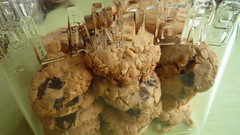
PBDs fig. b: peanut-butter destroyers just waiting to do what they do best

Peanut Butter Destroyers

3 sticks butter
2 cups rolled oats
1 1/2 tsp vanilla
2 tsp baking soda
1/4 tsp salt
3/4 cup sugar
3/4 cup brown sugar
3/4 cup crunchy peanut butter
2 1/4 cups all-purpose flour
100 g dark chocolate, coarsely chopped

Preheat the oven to 350º F.

Melt one stick of butter in a saucepan, add the oats, and toast them until golden and fragrant. Set aside to cool. Cream the remaining butter with the sugar and the brown sugar until light and fluffy. Add the vanilla and peanut butter and mix well. Add the flour, baking soda, and salt and mix. Finally, add the chocolate and the oats and mix until the dough comes together.

Drop the dough by tablespoons onto a parchment-lined baking sheet and bake 12-14 minutes until the bottoms are lightly golden. Cool on a rack.

Makes approximately four dozen cookies.


As it happens, some rock 'n' roll band friends of ours rocked and rolled through town just recently, so we tried out the menu on them.

Later, with bellies full, we headed down to a local rock 'n' roll club just in time to catch the last few songs by opening band #2, and not long before the headliners took the stage.

Having arrived late, we didn't exactly have the best view in the house,

ceiling psychedelia fig. c: mirror-ball madness

but the meal seemed to have worked because the band sure sounded great. And every once in a while, with the help of a high-powered lens, we caught a glimpse of the theatrics on stage.

travelin' band fig. d: rip this joint!

aj

Monday, November 05, 2007

Tuesday Night Gumbo, Sunday-style

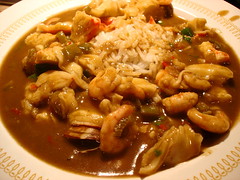
shrimp & oyster gumbo fig. a: late that night, Michelle sat down and started in on her bowl of gumbo

I suppose our 3rd anniversary celebrations here at "...an endless banquet" could have kicked off with the traditional 3rd anniversary gift (leather!), but we opted for gumbo instead. This means we've now celebrated our anniversary three different ways in three years. It also means that without even realizing it (until now, that is) we've been in the process of creating our very own set of food-related anniversary traditions, suitable for for all those who prefer apples over paper, barbecued ribs over cotton, gumbo over leather (or gumbo and leather over just leather). To recap:

1st anniversary
traditional: paper
modern: clocks
AEB: apples

2nd anniversary
traditional: cotton
modern: China
AEB: BBQ ribs

3rd anniversary
traditional: leather
modern: crystal
AEB: gumbo (and leather, if you so desire)

What tradition will AEB's fourth anniversary initiate? Stay tuned...

Anyway, there's obviously something about this time of year that gets me thinking about and a-hankering for gumbo, because although gumbo (in all its varieties) is seasonally-appropriate at any time of year, November has tended to be my most consistent gumbo month over the last few years (in fact, the last time I wrote on the subject was almost exactly two years ago). Weather is a factor, no doubt, but this time around it also had to do with the arrival of oyster season. I'd never made a gumbo with oysters before for some bizarre reason, even though a shared love of oysters is one of the strongest commonalities linking the cuisine of Cajun Louisiana with that of Quebec. Why? I wasn't 100% sure, but it probably had/has a lot to do with the fact that I'm such a big fan of oysters on the half-shell that I lack the self-control needed to shuck oysters for any reason other than immediate consumption. This time, however, armed with a new gumbo recipe (shrimp and oyster!) that I was eager to give a test-ride, I pledged to change all of that.

The recipe came from our good buddies the Lee Bros, who we still don't actually know, but at this point, having posted about a number of their recipes, we might as well. As I've mentioned before, a number of the Lees more classic recipes are offered up in pairs: "Tuesday night" versions versus "Sunday night" ones. Gumbo is no exception, and here not only does the "Tuesday night" gumbo amount to a simplified version of the "Sunday night" gumbo, but it's also a 100% seafood gumbo and that's what I was craving. [The "Sunday night" gumbo, by comparison, consists of what you might call a meat-lover's "home run": chicken (in the form of gizzards), beef (1 pound of beef round, beef shank, flank steak, or skirt steak), seafood (1 pound of shrimp, 6 blue crabs, and 24 oysters), and pork (in the form of Cajun andouille, or kielbasa)!] There were things about the "Tuesday night" version that I wasn't crazy about and that I intended to change--#1 being its lack of a roux*--but it also contained a trick or two that I found mighty intriguing.

Shrimp and Oyster Gumbo

1 1/2 lb headless large fresh shrimp (25-30 count)

broth:
2 1/2 qts water
homemade shrimp boil [ directions here] or Old Bay seasoning
3 bay leaves
2 celery stalks, chopped

1/2 cup canola or peanut oil
1/2 cup all-purpose flour
3 cloves garlic, minced
1 cup yellow onion, diced
1 large red bell pepper, diced
1 celery stalk, diced
1 tsp kosher salt
1/2 tsp freshly ground black pepper
1/2 tsp cayenne pepper (optional)
1 28-oz can chopped tomatoes
1 tbsp thyme, finely minced
24-36 shucked oysters, with their liquor
1 tbsp gumbo filé powder

Peel the shrimp (deveining them in the process, if you prefer) and put them aside in a bowl. Place the shells in a large pot, add the water, the shrimp boil or Old Bay seasoning, the bay leaves, and the celery and simmer over medium heat for 30-60 minutes. Strain the broth and return it to your pot, keeping it warm over low heat.

In a large skillet, add the oil and the flour and make a proper cajun roux, nutty brown or darker, being careful not to scorch the roux at any time. [For complete instructions consult our earlier post on gumbo.]

When your roux has reached the depth you desire, add the onion carefully (the roux is extremely hot and the onion may cause it to spatter a bit) and sauté over medium heat for 5-10 minutes, stirring constantly. Then add the garlic, the bell pepper, the celery, the salt, the black pepper, and, if you desire, the cayenne pepper, and sauté until all the vegetables have softened, about 5-10 minutes.

Add the vegetable/roux mixture to the shrimp broth, stirring (or even whisking) constantly to incorporate it smoothly. Add the tomatoes and their liquid and stir. Bring to a vigorous simmer over medium-high heat, reduce the heat to low, and simmer for 30-60 minutes. The broth should reduce a fair bit and the flavors should intensify considerably. Adjust the seasoning, adding more salt and freshly ground black pepper as needed, then add the gumbo filé and stir.

Turn off the heat. Add the peeled shrimp, the oysters, and the oyster liquor (the magic elixir) to the broth and stir. Let stand about about 5 minutes, until the shrimp are cooked through, perfectly tender and juicy. Serve the gumbo in wide bowls over hot white rice with cold beer and a selection of hot sauces.

Important note: For optimal flavor, it's apparently always best to allow your gumbo to "cure" for 24 hours in the refrigerator, but I've never had the will power to do so. If you do, add the shrimp and oysters only after you've reheated the gumbo, lest the shrimp become tough and the oysters bitter (because of the acidity of the tomatoes). Also, if you think you might have leftovers, you might want to cook the oysters by placing them in a strainer and dropping the strainer into the broth to gently cook them (like I did). That way you can just top each bowl of gumbo with a few of the stewed oysters and you won't have to worry about an oyster going AWOL and turning up in your leftovers tasting bitter. This might mean that your leftovers are just "shrimp gumbo" leftovers and not "shrimp and oyster gumbo" leftovers, but, trust me, your leftovers will not be short on flavor.

Serves 10-12 people.

[adapted from The Lee Bros. Southern Cookbook]

Frankly, I was a little skeptical that that broth and that roux/vegetable combination would successfully become one, but they did. Of course, I simmered them considerably longer than the Lee Bros. did: 30-45 minutes versus 10 minutes. In the end, my Sunday-style Tuesday Night Gumbo took a good two hours to make, twice as long as the Lees' Tuesday-style Tuesday Night Gumbo, but every extra minute was worth it. That gumbo was full-bodied even before the seafood entered the picture. Five minutes later she was positively voluptuous, a true Cajun Queen.

If you've got your reservations about cooking oysters, just do what we did: buy some extra and serve yourself an oysters-on-the-half-shell appetizer while your gumbo is busy simmering. I mean, you're already buying oysters anyway, and if you look around you can find pretty good deals on small cases of oysters from Malpeque and elsewhere, so...

And while you're at it, you might as well buy some extra shrimp--let's say a quarter pound per person--and make yourself a proper shrimp boil for lunch. You're going to need some energy (and some patience) to make that gumbo properly, why not throw yourself a shrimp doubleheader?

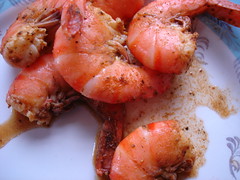
boiled shrimp fig. b: earlier that day we luncheoned on spicy boiled shrimp

Simple Shrimp Boil

1/2 cup water
1/2 cup white vinegar
2 tbsp (+ a little extra) homemade shrimp boil [again, you can find directions here] or Old Bay seasoning
1 lb shrimp, in shells

Combine the first three ingredients in a saucepan and bring them to a boil. Add the shrimp, stir gently, and cover. Cook until tender, about 3-5 minutes, depending on the size of the shrimp. Drain the shrimp, reserving some of the broth for dunking. Sprinkle one teaspoon (or more, if you like them extra spicy) shrimp boil over the shrimp, toss, and serve with crusty bread and a salad for a light lunch.

Serves 2-4.

[recipe adapted slightly from the back of a McCormick Old Bay seasoning tin]

Now that's fast food. And who can deny spicy shrimp? We sure can't.

aj

* I'm definitely one of those "it just ain't a gumbo without a roux" types of people, but it's more than just the taste--it just isn't any fun to make a gumbo without making a roux, regardless of what night of the week it is.

Saturday, November 19, 2005

Louisiana Cajun Special No.1: Gumbo


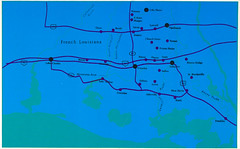
Cajun Country
Originally uploaded by michelle1975.


Jambalay’, crawfish pie, filé gumbo… Son of a gun, we’ll have big fun on the bayou—Hank Williams

My Dad and I have a tradition of making seafood stews (cioppino, chowders, etc.) together that dates back a couple of decades now. From the time he pulled into town this time around we were dead-set on making gumbo. I wasn’t entirely sure why at the time, but once we drew up some plans I started to read up on gumbo (The Joy of Cooking, The Gourmet Cookbook, Saveur Cooks Authentic American, etc., etc.), and the more I read, the more I got fired-up. The point of no return, though, came when I finally got to the sections on Louisiana in John Thorne’s Serious Pig. Thorne devotes a rambling, nearly 100-page section of his book to Louisiana’s cuisine and the diasporic cultures that gave birth to it. In fact, he feels so strongly about this section that he titles it “THERE,” completing the grouping of “HERE,” his opening section on his home state of Maine, and “EVERYWHERE,” his closing section on food miscellany, that he uses to organize Serious Pig. A pull-quote on the back cover of the book has Leo Lerman of Gourmet commenting that, “John Thorne is simply the best writer about food in the country,” and Thorne’s chapters that make up “THERE” are an ideal introduction to just what a fine writer he truly is. Rarely have I come across someone who writes with such passion, honesty, insight, and understanding about a cuisine and its significance to the larger culture that encompasses it, and all this from a man who, at the time that he was writing (1996), claimed that he’d only spent a grand total of 30-odd days in Louisiana, and hadn’t actually set foot in Bayou Country in about a decade (!). My own very modest "Bayou Odyssey" began back when I was 13. That summer we drove across Louisiana as part of a Houston-Ft. Lauderdale road trip and it was the first time I had any exposure to Cajun culture of any sort. The landscape, the nondescript bayou diners that unexpectedly served amazing Cajun boudin, and especially the city of New Orleans--its architecture, its food (jambalaya, po' boy and muffuletta sandwiches, and a wonderfully spicy gumbo), and its incredible mélange of cultures--left quite an impression. Years later I returned to Louisiana and New Orleans on another road trip--this time rolling solo and making my approach from the north, from Memphis and northern Mississippi along Hwy. 61. I couldn't believe how beautiful the scenery was--exotic vines and flowers and birds everywhere you looked--as I crossed into Louisiana and headed towards Baton Rouge, and hours later when I finally arrived in New Orleans it felt like a homecoming of sorts...

As far as I’m concerned, the real attraction of gumbo has nothing to do with the showcase ingredients—the chicken, or seafood, or sausage, or okra, or what have you—it’s all about the roux. I’m attracted by cuisines that make the most of the simplest ingredients, and few cuisines have transformed such a practice into an underlying philosophy with such zest as the Cajuns. As Thorne explains:

Gumbo is the queen of Cajun cuisine, and the heart of gumbo is roux. This is a very touching and revealing thing. It means that the dearest thing to a Cajun cook—more than any other thing, more than crawfish or blue crab or oysters or shrimp or even rice—is a simple amalgam of flour and fat. The two are gently cooked until the raw taste of the flour is gone and the starch is broken down enough to absorb liquid without lumping. It is the first—and easiest—lesson in French sauce making.

Of course, there are some differences. The French make their roux most often with butter and sometimes with the flavorful fat skimmed out of a marmite. The Cajuns prefer lard for flavor or—more recently—vegetable oil for economy. They also claim the French don’t cook roux the way they do, to a burnished mahogany… but, of course, long, careful cooking has always been the way to make a good brown sauce.

What the French don’t do, however, is care as much about their roux as Cajuns do. So few French cooks possess any of the sense that Cajuns have of what a roux can be made to do, or of its fine gradations of texture, odor, and color, running from creamy pale to the smoky-flavored near-coal black (but not burned) roux that Paul Prudhomme claims is essential to perfect gumbo.

Even so—a whole cuisine based on brown sauce! A cuisine in miniature maybe, but still a cuisine…

Maybe my attraction to roux has something to do with the French-Canadian blood in me, because as Thorne explains, Gumbo is the product Acadian influences (roux, lard), African influences (its name, okra), West Indian influences (hot peppers), and Native American influences (gumbo filé, made from sassafras leaves). I love how slow-cooking things over a low heat can bring about transformations that border on the sublime. That’s why I love making things like French Onion Soup; and that’s why I love making a dark Cajun-style roux, letting that whole range of complex flavors (smoky and nutty, among other things) come to full fruition.

Early on, we’d decided that this gumbo of ours was going to be a seafood gumbo, one with shrimp, crab, and either oysters or clams. The problem with this is that Cajun seafood gumbo—like cioppino, clam chowder, bouillabaisse, and any one of a number of other seafood stews—was based on the premise that this seafood was cheap and plentiful (as apparently it still is in Cajun Country), as well as fresh. Following your standard seafood gumbo recipe in a city like Montreal can be cost-prohibitive, to say the least, which is why it’s important to remember that no self-respecting Cajun cook would actually follow a recipe in the first place and that gumbo is a dish that’s meant to be different every time, a dish that’s supposed to highlight the cook’s inventiveness, his or her ability to capitalize on what’s fresh and readily at hand. As Thorne describes things, this is a quality acquired from the very environment in which the Cajuns live, where the landscape, at once lush and forbidding, “has taught them to take nothing for granted, and they are always seeing familiar things freshly anew. A gumbo made one way today will not be made that way tomorrow, because a neighbor has come by with a basket of crabs, or because there is some chaurice to use or a chicken to kill, or simply because the cook is practicing an entirely different spell.” With this lesson in mind, we adapted our seafood gumbo recipe to keep it from getting astronomical in cost, and on day 2 we added some spicy homemade sausages that had been given to us by a friend to the gumbo to give it a different twist, as well as to stretch it out a bit further.

Another consideration had to do with whether or not to add okra to our gumbo. Personally, I really like okra, but the problem with okra is that it’s exceedingly hard to get good okra and I steadfastly refuse to cook with frozen okra. Most everyone who knows anything about gumbo knows that the name is derived from an African (Bantu, actually) word for okra. What many people don’t realize, though, is that the dish gumbo was apparently named after the consistency this dish gets from the addition of either okra or some other green vegetable with similar thickening properties. Many Acadians made a stop in the colony of Saint-Domingue—in many cases, in order to help construct the fortifications that would prove insufficient to stave off the slave revolt that turned Saint-Domingue into Haiti—and there they developed a taste for okra, and other greens of African origin, and hot peppers. When they finally got to la Belle Louisiane they found that okra was harder to come by in the Bayou, but that gumbo filé, a compound made of dried sassafras leaves gleaned from the local Choctaw Indians, gave the stew a very similar finish. Since that time Cajun gumbo has tended to contain okra, gumbo filé, or a combination of the two. That being the case, we opted for the gumbo filé-based version.

The last two considerations had to do with accompaniments. Like French Canada (until recently, in any case), French Louisiana is a beer-drinking culture. Not only is beer a near-essential part of enjoying eating a good gumbo, it’s also a nice way to enjoy preparing a gumbo. In fact, some die-hards make it a part of the very recipe, insisting that the length of time needed to make a proper Cajun roux has more to do with the length of time it takes one to drink 2 beers than it does with any set number of minutes. And secondly, good Cajun food deserves a good soundtrack. I’m not one of those types who’s Draconian about listening to the correct, culture-specific music with my dinners (“El Condor Pasa” with a Peruvian-style ceviche, for instance), but I do think it’s important to accompany your gumbo meal with music that swings, music you can dance to. Cajun culture is not a culture of “dinner music” after all. Myself, I’m pretty fond of old-time Cajun, so I like to listen to things like “Hee Haw Breakdown” by Nolan Cormier & The L.A. Aces, or “Hippy-Ti-Yo” by Joe Bonsall & The Orange Playboys.


Finally, it goes without saying that the effects of Katrina (and the gross mishandling of the emergency response to Katrina) were very much present as we prepared for this meal. And as I read the following passage in Serious Pig, the following words took on a whole new poignancy:

The only string attached to [the bounty that defines the bayou] is that none of it is guaranteed. For this is both a vulnerable and an injured land. It is most palpably vulnerable to weather, especially the hurricanes that sweep across it with terrifying violence and destruction, reshaping the very terrain. Cajuns tend to date their history in terms of hurricanes, rather than in terms of presidents or world events. Hurricanes have far more effect on their lives.

This meal was dedicated to the victims of the Katrina disaster.

Without any further ado...

Seafood Gumbo

3/4 cup vegetable oil
3/4 cup flour
1 medium yellow onion, peeled and finely chopped
1 green bell pepper
2 ribs celery
6 cups hot fish stock
1 tsp salt
1/2 tsp cayenne pepper (or 1/4 tsp cayenne pepper + 1 fresh chili pepper, minced)
1 lb medium shrimp
12 pasta clams
1 lb lump crabmeat
1 scallion
1 tbsp finely chopped fresh parsley leaves
1 tbsp gumbo filé powder

white rice, freshly cooked

Make a mahogany-brown roux over low heat. Thorne offers the following advice in order to get it just so:

Heat the [oil or lard] in a heavy cooking pot or a large cast-iron skillet. When the fat is hot, add the flour all at once, stirring or whisking quickly to combine it with the fat, smoothing out any persistent lumps with the back of a wooden spoon. Lower the flame and cook, stirring or whisking constantly. The roux will bubble and cast off a fine white foam and, after about 15 minutes, begin to caramelize. It takes about 45 minutes to reach a rich butterscotch color and almost an hour to turn deep mahogany—and become true Cajun roux.

It’s important not to hurry the process and to be careful that the stirring or whisking turns over the entire mixture. If any small black flecks appear, the roux is ruined. That batch must be discarded and the process repeated with new ingredients. (If not, the roux, even if the burned bits are removed, will retain a bitter, scorched taste.)


When the roux has just the right color, texture, and flavor, increase the heat to medium and add the onions, bell peppers, and celery to the roux. Cook until the vegetables become soft, about 15 minutes.

Add the stock to the roux and vegetable mixture in a thin, steady stream, making sure to stir constantly. Be sure not to add the stock too quickly or at too low of a temperature or the roux might separate on you. Add the salt and the cayenne and bring to a simmer, stirring frequently. Reduce the heat to low and simmer for 1 hour.

Add the clams and cook until the clams have opened, about 2-3 minutes. Add the shrimp and crab and cook for another 3-5 minutes. Add the gumbo filé, stir, and let sit for 5 minutes. Stir in the scallions and the parsley and serve with cooked rice, bread, salad, and an assortment of hot sauces.

Feel free to improvise in whatever way you see fit, keeping in mind that the essentials here are the Cajun roux, the “holy trinity” of onion/celery/bell pepper, and the gumbo filé.

Serves 6-8 very generously.

[adapted from a recipe in Saveur Cooks Authentic American]


Seafood Gumbo
Originally uploaded by michelle1975.


Laissez bon temps roulez!

aj

Note: Given the New French roots of Cajun cuisine it’s a little surprising that there isn’t more of a Cajun connection here in Montreal. For the most part, Montreal seemed to have missed out on the Cajun fever that swept across other parts of North America in the ‘80s and ‘90s (although I do remember a cute little place on Duluth East called Le Bijou that had a pretty decent repertoire of Cajun, Mexican, and Brazilian dishes back in the day). Gumbo filé and other Cajun spice blends aren’t the easiest thing to find in Montreal, but you can find them in some supermarkets and at some of your better épiceries. We found ours at Gourmet Laurier on Laurier West.