The great wealth of information in the archives of the Journal of the Institute of Brewing has been a source of delight to me, but it also sent me into a temporary depression. I'd recently put some effort into tying up the loose ends of that most vexing question "what is a Goldings hop?", and felt some satisfaction that I now had the definitive answer on all ten of the varieties of Goldings.
Then whilst using the excellent search function in the JIB archive to find more historic hop happiness I came across an unexpected bombshell: a 1943 paper which described Cobbs as a Golding variety. I'm sure you can understand the depression this threw me into. Could the most widely grown variety of Goldings really be a mere Golding variety?*
If this is the case then even buying East Kent Goldings won't guarantee you're getting real Goldings free from any interlopers. After much wailing and gnashing of teeth (I might even have pulled some hair out if I had any to spare) I resolved to investigate this calamitous calumny.
As it happens I should have done this straight away as a quick look at Percival showed Cobbs were selected from a garden of Canterbury whitebines, and so like all true Goldings differ from Farnham whitebines only by mutation and not by breeding. Phewb! I have since had it confirmed by Peter Darby that Cobbs really are a true variety of Goldings.
Quite what caused the terrible travesty that left them languishing in a lower league for long years I couldn't say, but we can at least take comfort that they now reside where they rightfully belong.
* If you don't understand what I'm wittering on about Golding variety is the name for the second division of English hops, not considered as good as the varieties of hops that make up the true Goldings. And for those of you too young to remember the second division think League
Championship
.
Showing posts with label hops. Show all posts
Showing posts with label hops. Show all posts
Sunday, 2 June 2013

Wednesday, 15 May 2013
-. . .-- / .... --- .--.
As I'm sure many of you can appreciate, sometimes brewing full time just isn't enough. The days, evenings and weekends may keep production levels up but I've still been lagging behind with the amount of hop varieties now out there to try.
As the lovely Lisa is also keen to increase her brewing knowledge we've been doing some mini-home brews with different hops and hop combinations.

One hop we used was Endavour, a new English variety with the grapefruit flavoured American hop Cascade as its mother. We've been making four to five gallon batches of wort and boiling up on the hob a gallon or so of each hop or hop combination we want to try. My first attempt at using Endeavour was very disappointing. I'd kept the hopping quite modest and very little flavour came through into the beer. I wasn't sure if this was down to the hop or problems with weighing out on a few grammes on kitchen scales though so I gave it another go with the hopping rate cranked up to 60g for a 4 to 5 litre batch.

This time I got what I was after: a definite black currant smell, tongue coating bitterness, and a citrussy taste but still English in character. Great stuff actually, though hop heads note the flavour intensity is still not up there with modern American varieties, being more at the Bramling Cross or Bobek level. I was impressed with how my second attempt at using Endeavour turned out and it's definitely a hop I'd like to use at work.
As the lovely Lisa is also keen to increase her brewing knowledge we've been doing some mini-home brews with different hops and hop combinations.

One hop we used was Endavour, a new English variety with the grapefruit flavoured American hop Cascade as its mother. We've been making four to five gallon batches of wort and boiling up on the hob a gallon or so of each hop or hop combination we want to try. My first attempt at using Endeavour was very disappointing. I'd kept the hopping quite modest and very little flavour came through into the beer. I wasn't sure if this was down to the hop or problems with weighing out on a few grammes on kitchen scales though so I gave it another go with the hopping rate cranked up to 60g for a 4 to 5 litre batch.

This time I got what I was after: a definite black currant smell, tongue coating bitterness, and a citrussy taste but still English in character. Great stuff actually, though hop heads note the flavour intensity is still not up there with modern American varieties, being more at the Bramling Cross or Bobek level. I was impressed with how my second attempt at using Endeavour turned out and it's definitely a hop I'd like to use at work.
Saturday, 27 April 2013
The return of the Farnham whitebine
For over a century considered the most prized hop in Britain, the Farnham whitebine suffered the ignominy of being grubbed up from the last farms growing it and replaced with Fuggles in 1929. The recently introduce disease downy mildew had proved too much for it.
But this was not extinction, merely exile. Cuttings had long before been taken to Kent and Worcestershire, where they were known as Canterbury whitebines and Mathons. In these much larger hop growing areas it continued to be grown as part of the Goldings group, and when Wye College selected four clones from this group to provide a range of Goldings plants with different maturity dates the Mathon was one of them.
It continues to be grown today, which is handy, as it means it means rhizomes can be easily obtained. The one I planted out the front has now sprouted, and though may not be in Farnham, it's in Surrey, so I think it can revert to being a Farnham whitebine. Just in time for Farnham beerex too. Oh how delighted my friends will be now I've got something else to bore them with about Farnham hops.
But this was not extinction, merely exile. Cuttings had long before been taken to Kent and Worcestershire, where they were known as Canterbury whitebines and Mathons. In these much larger hop growing areas it continued to be grown as part of the Goldings group, and when Wye College selected four clones from this group to provide a range of Goldings plants with different maturity dates the Mathon was one of them.
It continues to be grown today, which is handy, as it means it means rhizomes can be easily obtained. The one I planted out the front has now sprouted, and though may not be in Farnham, it's in Surrey, so I think it can revert to being a Farnham whitebine. Just in time for Farnham beerex too. Oh how delighted my friends will be now I've got something else to bore them with about Farnham hops.
 |
| Could this be even more exciting than a hop pocket with a Farnham Bell? |
Thursday, 28 February 2013
Changing tastes in hops
Having a side line as a hop history bore it is a cause of some amusement for me when I see fellow beer nerds complaining about boring British hops, and wishing British hop breeders could develop something more like awesome American hops.
Little do they know that for the best part of the 20th century breeding out American* flavour was one of the aims of the British hop breeding programme. Recently English hop varieties previous rejected for tasting too American have started being revived in the hope they match modern tastes.
From my research into hop history it would seem the two main goals of hop breeding have been growers calling for more disease resistance, and brewers calling for more bitterness without affecting the taste of their beer. This is quite a different attitude from how many modern brewers and drinkers actively seek out new flavours. Descriptions of new varieties used to be accompanied by notes on what percentage of them you could use before the flavour became unacceptable, and I once spoke to a retired Allied brewer who said he was only allowed to use a maximum of 25% Bramling Cross.
Two of the old varieties currently being revived, Keyworth's Early and Keyworth's Midseason, did have widespread planting at one point, having been rushed in because of their wilt resistance. AH Burgess writing in "Hops" (1964) detailed how they originated and how they were received:
"When progressive Verticillium wilt was threatening the hop-growing industry in parts of Kent, Keyworth, at East Malling Research Station, tested all the ordinary commercial varieties and a large number of Salmon's seedling varieties for their susceptibility to the disease. He found all the ordinary commercial varieties susceptible, but some of the seedlings were 'moderately resistant'.
After further tests had been made on cultural characteristics and brewing values for these resistant varieties, he selected two - OJ47, subsequently released by Salmon, in 1949, 'Keyworth's Early' and OR55 'Keyworth's Midseason'. These were both propagated extensively, under the auspices of the Hop Marketing Board, for planting by growers whose gardens were infected with the disease."
They were descended from a New Mexican wild hop that had been fertilised by "open pollination"
Now being grown again as part of Charles Faram's Hop Development Programme I've recently seen their flavour described as follows:
Keyworth's Early: Lemon, grapefruit
Keyworth's Midseason: Citrus, blackcurrant
These are the sort of flavours associated with modern American varieties and popular with many drinkers today.
They were of a different opinion the first time round. Keyworth's Early was unpopular with brewers "on account of its strong, unpleasant aroma" and farmers didn't like it as it had a marked susceptibility to downy mildew and mould. Keyworth's Midseason fared better, cultivation reaching 573 acres in 1954 but "since then other, more acceptable, wilt-tolerant varieties have been introduced and it is now going out of cultivation."
After their rapid appearance a rapid decline followed. It will be interesting to see how they fare this time.
*I've also heard the word "Manitoban" used, after the Canadian province the wild male hop was used to start the British hop breeding programme came from. And of course "Catty" as some of these hops can smell a bit like cat piss.
Little do they know that for the best part of the 20th century breeding out American* flavour was one of the aims of the British hop breeding programme. Recently English hop varieties previous rejected for tasting too American have started being revived in the hope they match modern tastes.
From my research into hop history it would seem the two main goals of hop breeding have been growers calling for more disease resistance, and brewers calling for more bitterness without affecting the taste of their beer. This is quite a different attitude from how many modern brewers and drinkers actively seek out new flavours. Descriptions of new varieties used to be accompanied by notes on what percentage of them you could use before the flavour became unacceptable, and I once spoke to a retired Allied brewer who said he was only allowed to use a maximum of 25% Bramling Cross.
Two of the old varieties currently being revived, Keyworth's Early and Keyworth's Midseason, did have widespread planting at one point, having been rushed in because of their wilt resistance. AH Burgess writing in "Hops" (1964) detailed how they originated and how they were received:
"When progressive Verticillium wilt was threatening the hop-growing industry in parts of Kent, Keyworth, at East Malling Research Station, tested all the ordinary commercial varieties and a large number of Salmon's seedling varieties for their susceptibility to the disease. He found all the ordinary commercial varieties susceptible, but some of the seedlings were 'moderately resistant'.
After further tests had been made on cultural characteristics and brewing values for these resistant varieties, he selected two - OJ47, subsequently released by Salmon, in 1949, 'Keyworth's Early' and OR55 'Keyworth's Midseason'. These were both propagated extensively, under the auspices of the Hop Marketing Board, for planting by growers whose gardens were infected with the disease."
They were descended from a New Mexican wild hop that had been fertilised by "open pollination"
Now being grown again as part of Charles Faram's Hop Development Programme I've recently seen their flavour described as follows:
Keyworth's Early: Lemon, grapefruit
Keyworth's Midseason: Citrus, blackcurrant
These are the sort of flavours associated with modern American varieties and popular with many drinkers today.
They were of a different opinion the first time round. Keyworth's Early was unpopular with brewers "on account of its strong, unpleasant aroma" and farmers didn't like it as it had a marked susceptibility to downy mildew and mould. Keyworth's Midseason fared better, cultivation reaching 573 acres in 1954 but "since then other, more acceptable, wilt-tolerant varieties have been introduced and it is now going out of cultivation."
After their rapid appearance a rapid decline followed. It will be interesting to see how they fare this time.
*I've also heard the word "Manitoban" used, after the Canadian province the wild male hop was used to start the British hop breeding programme came from. And of course "Catty" as some of these hops can smell a bit like cat piss.
Friday, 18 January 2013
The hop and its constituents by A C Chapman

On the Willingham Nurseries website is a PDF of the 1905 book The Hop and its Constituents by A C Chapman. To my delight it includes a couple of chapters by John Percival, author of the famous article from 1901 The Hop and its English Varieties. Once again he provides details of English hop varieties, but slightly annoyingly in the intervening four years he seems to have become less convinced that the Canterbuy, Farnham and Mathon Whitebines are exactly the same plant. Though to cloud the issue further being grown in different areas and probably harvested at different times would account for some variation.
Here's what he had to say on this fascinating conundrum:
'The main crop sorts cultivated in the best hop-growing districts are the Canterbury, Farnham and Mathon varieties, with the true Golding hop. These are similar to each other in many respects, and in all probability are genetically related. The Canterbury, Farnham and Mathon hops all have pale green or "white" bines, which grow to a great height if allowed.
The Canterbury whitebine is largely grown in East Kent, the Farnham hop around the town of this name in Surrey, while the Mathon is the Worcestershire and Herefordshire representative of this class.
The cones are of medium size, oval in shape, those of the Farnham hop being the least of the trio, the Mathon perhaps the largest, although there is not much difference in size. All have thin pale golden petals, rich in lupulin, and the flavour and aroma are all that is desired.
On account of their delicate constitution they cannot be grown profitably except in the favoured districts where soil and climate are suitable.
The Cobbs' Hop is a main crop variety of recent introduction. It is hardier than the Canterbury type with thin pale petals.It is an excellent cropper where the climate and land are satisfactory, but is generally not rich in lupulin.
The "Golding" Hop resembles the Canterbury and Farnham types. It is often confused with these, and gardens supposed to be pure usually contain both Goldings and Canterbury Whitebines.
The true Golding hop has slightly larger cones not so clustered together as the Canterbury sort, and the bine is not so tall and is more speckled with red blotches and streaks.'
Friday, 2 November 2012
The Goldings Hops: the out takes.
At last here's the final part of series on the history of Goldings hops: the hilarious out-takes. Being the most prized of English hops the term 'Golding' has often been applied to hops that are not in fact true Goldings. The Hop Marketing Board complicated things further by classifying hops into four classes: Golding, Golding Variety, Fuggle and Other Varieties. The Golding class is for the various different clones of the true Goldings. Golding Variety was the class for hops which weren't actually Goldings but were ranked mid-way between Goldings and Fuggles in quality. There were two hops classified as Goldings Varieties, one of which is still grown today:
Whitbread Golding Variety
"Selected, or raised as a seedling, in 1911 (that auspicious year again) from a commercial variety of the time-reputedly Bate's Brewer-by E.A. White, of Paddock Wood. A small acreage of this variety, identified by the code number 1147, was maintained by E. A. White, and later by Messrs. Whitbread & Co., his successors at Beltring, Paddock Wood. Following the outbreak of progressive Verticillium wilt in the early 1930's, it was found to be largely tolerant to the disease. It was later extensively propagated, under the auspices of the Hop Marketing Board, for planting by growers in gardens affected by this destructive disease, which persists for several years in infected soil." (1)
The hop was originally called White's Golding and was a result of the breeding programme of EA White developed with the great Professor ES Salmon of Wye College. (2) Though the male parent of this hop is unknown there is the possibility that it was of American origin, as male American plants had certainly been imported by then as a way of attempting to raise the alpha acid content of English hops.
Tutsham
"Selected by Gerald Warde, of Tutsham Hall, West Farleight. It is grown in the same districts and requires similar treatments to Cobbs, which it closely resembles.
The cones 'hang' better than those of Cobbs, and the plant is somewhat less susceptible to hop mould." (3)
As far as I'm aware this hop is no longer grown.
Styrian Golding
This hop is not a Golding, and it's not Styrian either. Analysis found that the original Styrian Golding was in fact a Fuggle plant. The different soil and climate give it a distinctly different flavour though. And recently googling by me has found that Styria is a region of Austria, though all the Styrian Goldings I've ever used have come from Slovenia.
The story goes that as the term Fuggle-Golding was used by some for Fuggles the continentals got confused as to which hop they had and though it was a type of Golding. The plot thickens further though as the crafty Slovenians have continued to use the term 'Styrian Golding' for hops from their breeding programme, some of which are entirely unrelated to the Fuggle.
The current labels they use are Savinjski Golding, for the Fuggle plants grown in Slovenia, Styrian Golding B for the hop otherwise known as Bobek which is the offspring of Northdown and a seedling of unknown origin, and Styrian Golding C or Celeia for a hybrid of Aurora (a descendant of Northern Brewer) and a wild male. (4)
I've also found mentions of two hops bred by Professor Salmon which he gave the name Golding to:
Norton Court Golding
This hop came from Canterbury Golding crossed with OB21, a seedling of Brewers Gold and an American male OY1. This is the same parents as Northern Brewer, a hop which has had rather more success. (5, 6, 7)
Wye Field Golding
This hop also had the same parents as Northern Brewer. Northing seems to have come of Norton Court or Wye Field Goldings, but ironically another of Ernest Salmon's hops which he didn't give a Golding name to, Early Choice, is now sold as a Golding. (8)
There are also a number of hops which have a "gold" if not "Golding" worked into their names, Brewers Gold has already been mentioned, a dwarf variety is called First Gold, and Bullion and Nugget have the suggestion of Gold about them, though of these Nugget is the only one with Golding in its ancestry.
Whitbread Golding Variety
"Selected, or raised as a seedling, in 1911 (that auspicious year again) from a commercial variety of the time-reputedly Bate's Brewer-by E.A. White, of Paddock Wood. A small acreage of this variety, identified by the code number 1147, was maintained by E. A. White, and later by Messrs. Whitbread & Co., his successors at Beltring, Paddock Wood. Following the outbreak of progressive Verticillium wilt in the early 1930's, it was found to be largely tolerant to the disease. It was later extensively propagated, under the auspices of the Hop Marketing Board, for planting by growers in gardens affected by this destructive disease, which persists for several years in infected soil." (1)
The hop was originally called White's Golding and was a result of the breeding programme of EA White developed with the great Professor ES Salmon of Wye College. (2) Though the male parent of this hop is unknown there is the possibility that it was of American origin, as male American plants had certainly been imported by then as a way of attempting to raise the alpha acid content of English hops.
Tutsham
"Selected by Gerald Warde, of Tutsham Hall, West Farleight. It is grown in the same districts and requires similar treatments to Cobbs, which it closely resembles.
The cones 'hang' better than those of Cobbs, and the plant is somewhat less susceptible to hop mould." (3)
As far as I'm aware this hop is no longer grown.
Styrian Golding
This hop is not a Golding, and it's not Styrian either. Analysis found that the original Styrian Golding was in fact a Fuggle plant. The different soil and climate give it a distinctly different flavour though. And recently googling by me has found that Styria is a region of Austria, though all the Styrian Goldings I've ever used have come from Slovenia.
The story goes that as the term Fuggle-Golding was used by some for Fuggles the continentals got confused as to which hop they had and though it was a type of Golding. The plot thickens further though as the crafty Slovenians have continued to use the term 'Styrian Golding' for hops from their breeding programme, some of which are entirely unrelated to the Fuggle.
The current labels they use are Savinjski Golding, for the Fuggle plants grown in Slovenia, Styrian Golding B for the hop otherwise known as Bobek which is the offspring of Northdown and a seedling of unknown origin, and Styrian Golding C or Celeia for a hybrid of Aurora (a descendant of Northern Brewer) and a wild male. (4)
I've also found mentions of two hops bred by Professor Salmon which he gave the name Golding to:
Norton Court Golding
This hop came from Canterbury Golding crossed with OB21, a seedling of Brewers Gold and an American male OY1. This is the same parents as Northern Brewer, a hop which has had rather more success. (5, 6, 7)
Wye Field Golding
This hop also had the same parents as Northern Brewer. Northing seems to have come of Norton Court or Wye Field Goldings, but ironically another of Ernest Salmon's hops which he didn't give a Golding name to, Early Choice, is now sold as a Golding. (8)
There are also a number of hops which have a "gold" if not "Golding" worked into their names, Brewers Gold has already been mentioned, a dwarf variety is called First Gold, and Bullion and Nugget have the suggestion of Gold about them, though of these Nugget is the only one with Golding in its ancestry.
- Hops. AH Burgess. p43
- The Encircling Hop. M Lawrence. p36
- Hops. AH Burgess p41
- http://www.slohops.com/images/stories/pdf%20files/SlohopsVarieties.pdf
- http://www.cabdirect.org/abstracts/19521602919.html
- Hops, AH Burgess. p46
- http://www.ars.usda.gov/SP2UserFiles/person/2450/hopcultivars/21093.html
- http://www.cabdirect.org/abstracts/19440301221.html
Wednesday, 12 September 2012
How to breed new hop varieties
As any fule kno to get a new hop variety all you need to do is plant a seed. As each hop variety is really just an individual plant that has been replicated from cuttings, and because each seed has two parents and the usual genetic recombination, each plant from seed is a new variety. Hope you're still with me.
But easy though it may be to grow a new hop variety growing a worthwhile new variety is a little trickier. Though some still try Mr Fuggle's method, Peter Darby takes a more scientific approach.
Here's my notes on how it's done at Wye Hops Ltd. :


Wye Hops Ltd have now been going for long enough that the varieties coming through are entirely from work carried out after after they became independent of Wye College.


It also made me happy seeing a particular historic variety.
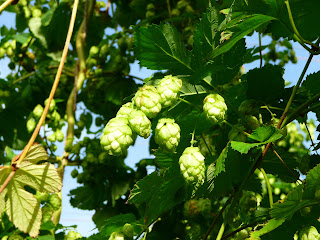

But more on that later.
But easy though it may be to grow a new hop variety growing a worthwhile new variety is a little trickier. Though some still try Mr Fuggle's method, Peter Darby takes a more scientific approach.
Here's my notes on how it's done at Wye Hops Ltd. :

- Decide which plants you want as parents.
- Put a parchment bag over the mother before the flowers open. The parchment bags allow the hops to breath. Timing is crucial as too early with the bag and the flowers could be aborted, too late and the flowers could be pollinated randomly.
- Add pollen from the father to the bag. It's diluted with powder to prevent clumping.
- Have a bag of unpollinated flowers to use as a control. If these grow seeds then you were too late putting the bag on, random pollination has occurred and your crosses might not be what you think they are.
- Gather the seeds from your hop crosses.
- Sow 20,000 seeds each year.
- Expose the plants to downy mildew. This will kill 5 out of 6 of the plants.
- Expose the plants to powdery mildew. This will kill more.
- Select 1400 to 1500 hops to plant in a field.
- Let them grow with irrigation for the first year to ensure good growth.
- On the second year assess the plants on the basis of 40 characteristics
- Pick approximately 100 hops for further analysis each year, this will get narrowed down to around 40.
- Testing for wilt resistance is done abroad.
- By the fifth year selected plants will be ready for farm trials.

Wye Hops Ltd have now been going for long enough that the varieties coming through are entirely from work carried out after after they became independent of Wye College.
 |
| That's not a small hand, it's a big hop. |
The hop plants in the breeding programme looked like a right freak show of hops, with the size, shape and how they hang showing massive variation.

I got to see what hops look like when the cones don't grow in bunches like grapes, as some plants had them spread out along the stem. And I saw a striking example of the variation that hop breeding can bring about. There are two plants in this next picture, which share the same parents, but have very different sized cones:
 |
| Little sister and big sister |
The National Scientific Hop Collection, with varieties going back to at least 1737, provides a wealth of genetic material for breeding. Seedings have been grown from hops selected for spicy and citrus flavours crossed with hops having pest and disease resistance.


It also made me happy seeing a particular historic variety.


But more on that later.
Tuesday, 11 September 2012
A visit to a hop garden
On Thursday the lovely Lisa and I went on a Brewery History Society trip to the National Scientific Hop Collection and China Farm near Canterbury where it's hosted. Farm owner Tony Redsell welcomed us and Peter Darby of Wye Hops Ltd was there to guide us round, explain the hop breeding programme and show us the historic hop collection.
 |
| Tony Redsell talking to Peter Darby |
 |
| These are one of the Goldings varieties |
 |
| Hops about to be stripped from the bines |


 |
| The cluster buster |

 |
| Leaves are lifted up but cones roll back |


 |
| Kiln being filled |

 |
| Dried hops going to be packaged |

 |
| Up to the top of the press |
 |
| About to be pressed |
 |
| Being pressed into 50-60kg bales |
I'll be back to burble about the breeding later.
Sunday, 9 September 2012
How to identify a Fuggle plant
As most of my hop knowledge is book based I've been enjoying seeing the actual plants recently. The other day I picked up a top tip from Peter Darby of Wye Hops Ltd on how to identify Fuggles.
It seems they are the only hop to have green bine and red petioles (leaf stalks) particularly on the upper side.

My new found knowledge didn't stop me failing to identify a Fuggle when presented with a dried bine later in the day, but hey, it's a start.
It seems they are the only hop to have green bine and red petioles (leaf stalks) particularly on the upper side.
 |
| Yup, it's a Fuggle |


My new found knowledge didn't stop me failing to identify a Fuggle when presented with a dried bine later in the day, but hey, it's a start.
Tuesday, 19 June 2012
More on Farnham hops
Which I 'm sure is a moment you've been wating for. Probably. Anyway it’s about time I wrote up some of the information I jotted down when I looked though the archives of Wye Hops Ltd.
Though those of your who’ve been following my series on the history of the Goldings hops closely will have thought that all that’s left is the out takes but in fact we’re going to have to go back to Farnham for some early, pre-whitebine information.
In “The Hop Industry” (1934) Hubert H Parker cites some fascinating facts from William Ellis’ “Modern Husbandman” (1750):
This got me all excited as it shows that before the Farnham Whitebine was selected in 1750 cuttings from the best Farnham hops were already being sent to Kent. With there being Farnham Whitebines and pale Farnham/Surrey bines both going to Kent it does get me thinking that my earlier point that Farnham, Canterbury and Mathon Whitebines are one and the same plant is shaken slightly. On the plus side it gives me a likely ancestor for the Farnham Whitebines, as they could well have originated as a bud sports from the pale Farnham/Surrey bines. That would be the common practice of taking an improved cutting from the best hop available, and is how the Canterbury Golding originated from the Canterbury Whitebine.
So as the pale Farnham/Surrey bines had already been sent elsewhere could the Canterbury and Mathon Whitebines also be descended from these earlier plants and not Peckham William's Farnham Whitebine?
Personally I think not. The Farnham Whitebine was considered the best of the English hops and certainly superseded the pale bines in Surrey so could easily do that elsewhere too. Percival considered Farnham, Canterbury and Mathon Whitebines to be one and the same plant and he's our best source, even if some have now started to question him on another matter.Perhaps though the Goldings group of hops is enlarged by adding the pale Surrey/Farnham hop a possible earlier ancestor? This would put the known history back to before 1737 which is nice.
Another point mentioned that I haven't reallly picked up on before: pale hops were wanted for making pale beer. Nowadays it's only the colour of the malt that's considered important. I wonder how much colour hops can add to pale beers?
But back to my notes. Parker continues:
EDIT:
There's part of the Management of Hops chapter from the Journal of the Royal Agricultural Society of England Volume 9 (1848) I should add considering it's relevance to Parker's later point about Farnham hops:
Though those of your who’ve been following my series on the history of the Goldings hops closely will have thought that all that’s left is the out takes but in fact we’re going to have to go back to Farnham for some early, pre-whitebine information.
In “The Hop Industry” (1934) Hubert H Parker cites some fascinating facts from William Ellis’ “Modern Husbandman” (1750):
“The Farnham hop is pale tender sort, and more delicate but looser that the browner Canterbury hop, which latter however has the merit that it ‘never deceives the buyer’. But in Kent they are beginning to displace the brown Canterbury hop by the Farnham variety. ”
“In 1737 only one acre (in Kent) was planted with the pale Farnham or Surrey bines.” But in 1750 Ellis writes “Within these four years past they have greatly increased the growth of the Surrey or pale hop … since the pale sort of malt liquors are more in esteem throughout our island”
This got me all excited as it shows that before the Farnham Whitebine was selected in 1750 cuttings from the best Farnham hops were already being sent to Kent. With there being Farnham Whitebines and pale Farnham/Surrey bines both going to Kent it does get me thinking that my earlier point that Farnham, Canterbury and Mathon Whitebines are one and the same plant is shaken slightly. On the plus side it gives me a likely ancestor for the Farnham Whitebines, as they could well have originated as a bud sports from the pale Farnham/Surrey bines. That would be the common practice of taking an improved cutting from the best hop available, and is how the Canterbury Golding originated from the Canterbury Whitebine.
So as the pale Farnham/Surrey bines had already been sent elsewhere could the Canterbury and Mathon Whitebines also be descended from these earlier plants and not Peckham William's Farnham Whitebine?
Personally I think not. The Farnham Whitebine was considered the best of the English hops and certainly superseded the pale bines in Surrey so could easily do that elsewhere too. Percival considered Farnham, Canterbury and Mathon Whitebines to be one and the same plant and he's our best source, even if some have now started to question him on another matter.Perhaps though the Goldings group of hops is enlarged by adding the pale Surrey/Farnham hop a possible earlier ancestor? This would put the known history back to before 1737 which is nice.
Another point mentioned that I haven't reallly picked up on before: pale hops were wanted for making pale beer. Nowadays it's only the colour of the malt that's considered important. I wonder how much colour hops can add to pale beers?
But back to my notes. Parker continues:
"Farnham hops maintened the postition of pre-eminence which they enjoyed at the beginning of the eighteenth centruy until 1850 at least, but the select committee of 1890 reported that the best hops were grown in East Kent, next came Farnham hops, then Hereford and Worcester and the Weald of Kent and Sussex last. 1908 East Kents are thought to have declined a little in quality but are still places first; Mid-Kents, Hereford and Worcester, now considered equal are second and the Weald of Kent and Sussex follow. Farnham's are not mentioned. The gradual decline of Farnham as the centre of the production of the finest quality hops is not easy to explain. The Farnham growers had so assured a position for 150 years: soil and climate were suitable to the production of hops of superior quality: cultivation was brought to a fine state of perfection and their methods of marketing graded hops in sealed pockets left little to be desired.
In earlier years Farnham hops had gone principally to brewers in the midlands, who in the later part of the period, were able to find in the Hereford and Worcester districts a class of hop which was very suitable for their business at a price well below that of Farnham's."In my post on the Farnham Whitebines I go into the decline of Farnham hops, which was mainly caused by improved tranportation leading to increased competition. Not a bad run run though, being Britain's best for over 150 years.
EDIT:
There's part of the Management of Hops chapter from the Journal of the Royal Agricultural Society of England Volume 9 (1848) I should add considering it's relevance to Parker's later point about Farnham hops:
"At Farnham they are picked in a superior manner to any other district, being picked quite separate, free from leaves, and the inferior and discoloured hops sorted out and put by themselves, which in some degree accounts for the superiority and higher price of Farnham hops; but since Mid and East Kent Golding hops have been better picked and dried, they have been approached nearer to the price of Farnhams, and there has been an instance of hops grown in Kent making more money than any Farnham hops did the same year."So Farnham practices, as well as Farnham hops, spread to Kent.
Tuesday, 28 February 2012
The Genesis of the Goldings
The origins of the Goldings hop varieties: The Main Event.
‘To a beginner desirous of obtaining definite ideas on the nature of hops, nothing is so puzzling or so annoying as the use of the term "Golding." The inquirer soon learns that it is sometimes employed to denote a particular variety, which every grower in the best districts says, and probably imagines, that he grows; and on other occasions, perhaps more especially in districts suited only to the coarser varieties, the term is extended to include a somewhat heterogeneous mixture of kinds possessing few discoverable characters in common, except that they are hops.’ (1)
 Writing in 1901 John Percival’s observation on the confusion surrounding the term “Golding” still rings true today. Though there’s no doubt the original Golding came from a cutting selected by a gentleman of that name a wide range of hops have been, and still are, sold as Goldings.
The National Hop Collection has ten different varieties of Goldings, and Goldings are also sold on the basis of geographical location irrespective of which particular variety they are. The term ‘Golding’ has also been misapplied to hops that are no relation to true Goldings, no doubt in the hope a little gold will rub off on them. It’s no wonder that even an esteemed and widely respected publication like the Oxford Companion to Beer seems a little muddled!
A H Burgess (2) records that the old Hop Marketing Board sold eight varieties of hops as ‘Goldings’ and Peter Darby of Wye Hops Ltd has kindly informed me about the other Goldings clones in the national hop collection (3). The different varieties have come from clonal selection of bud sports and are very similar plants with differences in ripening times and disease resistance.
Back in the day it was important for hop farmers to grow a range of varieties which had staggered ripening times so they were able to spread the time of picking and drying. Increased disease resistance has obvious benefits and both mutants with different ripening times and disease resistance can be relatively easily selected from a population.
To try and bring some order to the chaos I’ll go through the different Goldings clones in the National Hop Collection chronologically as shown in a picture on Stan Hieronymus’s blog, followed by a brief note on locality.
Canterbury Whitebine
Percvial (1) states that the Canterbury Whitebine, Farnham Whitebine and Mathon Whitebine are so closely related in botanical character that the cannot be distinguished form one another and are, no doubt, one and the same variety. The Farnham White Bine was originally selected from a cutting by Peckham Williams around 1750 as I have detailed earlier. Though it has long been sold as a Golding variety this plant pre-dates Mr Golding’s famous selection as it is, in fact, the parent plant he took his renowned cutting from.
Canterbury Golding
This is the famous variety selected by Mr Golding of East Malling from a garden of Canterbury Whitebines shortly before 1790 (2).
It must have been a bud sport as
Percival (1) records that the Golding hop was:
1. a larger hop than the Canterbury Whitebine varieties, with
2. a bine more speckled with red, of less luxuriant growth, on which
3. the hops hang more singly than is the case with the Canterbury hop.
Growers differed in their views on whether or not it was more finely flavoured than Farnham or Canterbury Whitebines.
Bramling
This was selected by a farm bailiff named Smith on Musgrave Hilton’s farm in Bramling near Canterbury. It was grown extensively by 1865. I don't know what it was selected from but presumably a Canterbury Golding.
Mathon
The picture on Stan Hieronymus’s blog listing various hop varieties in the National Hop Collection shows the Mathon as being something separate from the other whitebines, even though Percival considered them to all be the same variety. As far as hops go “Mathon” is simply a shortening of “Mathon Whitebine” it could be that this is a bud sport with different characteristics from the Canterbury/Farnham/Mathon Whitebine clone already mentioned or possibly it origniated from the earlier Farnham Pale hop. I haven't asked Peter Darby if he can confirm this as it's good to have a bit of mystery in your life.
Mercers or Rodmersham Golding
Selected around 1880 by Robert Mercer of Rodmersham House, Sittingbourne from a hop garden reputed to be of the Golding variety.
Cobbs
Selected by James West, a hop factor from a garden of Canterbury Whitebines on the farm of John Cobb, Sheldwich near Faversham around 1881.
Petham Golding
There is no record of its selection but it was presumably from Petham, near Canterbury. Slightly more vigorous than other Goldings and less mottled with red.
Amos’s Early Bird
Selected in 1887 by Alfred Amos of Spring Grove, Wye from a garden of Bramlings.
Eastwell Golding and Late Eastwell Golding
The Eastwell Golding was originally grown at Eastwell Park near Ashford in Kent before 1889. Similar to Petham and Rodmersham Goldings but slightly later ripening. The variety now sold grown and sold as Eastwell Golding by the Redsell Farms group is however an early season variety so the National Hop Collection maintain two selections with different ripening characteristics. (3)
We can see the classification of Goldings is based around hops propagated from Canterbury Whitebines and Mr Golding’s famous hop, which was itself propagated from a Canterbury Whitebine. It’s clear that there’s something anachronistic going on grouping these hops under the name of ‘Goldings’. Percival notes that Canterbury Whitebine and Goldings were considered quite separate hops initially and it was not until after the middle of the 19th century that they were merged into one group. In 1901 he said it’s “customary to apply the term ‘Goldings’ to the best class of hops, such as the Canterbury and Farnham Whitebines, the Bramling and Mathon hops, with Cobb’s and the Rodmersham varieties, and stretched occasionally to include others of less repute.” This practice was continued by the Hop Marketing Board and carries on to this day.
Classification of hop varieties is complicated by the fact that hops were often sold on the basis of where they were grown, as East Kent Goldings still are today irrespective of which Golding variety they are.
The Encyclopædia Britannica of 1911 (now there’s an auspicious year) states how hops in Kent were sold:
“The hops grown in Kent are classified in the markets as "East Kents," "Bastard East Kents," "Mid Kents" and "Wealds," according to the district of the county in which they are produced. The relative values of these four divisions follow in the same order, East Kents making the highest and Wealds the lowest rates. These divisions agree in the main with those defined by geological formations.”
This regional division affected how well the plants grew, and which varieties were grown, as for example, the chalky soil of East Kent is good for growing Goldings but on the clay and sand of the Weald Goldings won’t grow well so the coarser Fuggles were preferred.
Which hops can now be sold “East Kent Goldings” is now protected under European law with a tightly defined geographical area and the hop varieties required to have the typical essential oil composition of Goldings (4).
I've got in touch with my hop supplies (Charles Farams and Botanix) to find out which of the true Goldings varieties are sold today and they told me Cobbs, Mathons, Early Bird and perhaps a few Canterbury Whitebines, though both companies sell them as 'Goldings' and 'East Kent Goldings'.
Here ends a chapter, but a chapter only in the history of the origins of the Goldings varieties. If you think I've gone on for far too long already at least in part three: the epilogue there will be sex.
References:
1. Percival, John. The Hop and its English varieties, 1901.
2. Burgess, A H. Hops, 1964, p39-44.
3. Personal communication, 4 Jan 2012
4. http://archive.defra.gov.uk/foodfarm/food/industry/regional/foodname/products/documents/east-kent-goldings-pdo-120208.pdf
‘To a beginner desirous of obtaining definite ideas on the nature of hops, nothing is so puzzling or so annoying as the use of the term "Golding." The inquirer soon learns that it is sometimes employed to denote a particular variety, which every grower in the best districts says, and probably imagines, that he grows; and on other occasions, perhaps more especially in districts suited only to the coarser varieties, the term is extended to include a somewhat heterogeneous mixture of kinds possessing few discoverable characters in common, except that they are hops.’ (1)
Writing in 1901 John Percival’s observation on the confusion surrounding the term “Golding” still rings true today. Though there’s no doubt the original Golding came from a cutting selected by a gentleman of that name a wide range of hops have been, and still are, sold as Goldings.The National Hop Collection has ten different varieties of Goldings, and Goldings are also sold on the basis of geographical location irrespective of which particular variety they are. The term ‘Golding’ has also been misapplied to hops that are no relation to true Goldings, no doubt in the hope a little gold will rub off on them. It’s no wonder that even an esteemed and widely respected publication like the Oxford Companion to Beer
seems a little muddled!A H Burgess (2) records that the old Hop Marketing Board sold eight varieties of hops as ‘Goldings’ and Peter Darby of Wye Hops Ltd has kindly informed me about the other Goldings clones in the national hop collection (3). The different varieties have come from clonal selection of bud sports and are very similar plants with differences in ripening times and disease resistance.
Back in the day it was important for hop farmers to grow a range of varieties which had staggered ripening times so they were able to spread the time of picking and drying. Increased disease resistance has obvious benefits and both mutants with different ripening times and disease resistance can be relatively easily selected from a population.
To try and bring some order to the chaos I’ll go through the different Goldings clones in the National Hop Collection chronologically as shown in a picture on Stan Hieronymus’s blog, followed by a brief note on locality.
Canterbury Whitebine
Percvial (1) states that the Canterbury Whitebine, Farnham Whitebine and Mathon Whitebine are so closely related in botanical character that the cannot be distinguished form one another and are, no doubt, one and the same variety. The Farnham White Bine was originally selected from a cutting by Peckham Williams around 1750 as I have detailed earlier. Though it has long been sold as a Golding variety this plant pre-dates Mr Golding’s famous selection as it is, in fact, the parent plant he took his renowned cutting from.
Canterbury Golding
This is the famous variety selected by Mr Golding of East Malling from a garden of Canterbury Whitebines shortly before 1790 (2).
It must have been a bud sport as
Percival (1) records that the Golding hop was:
1. a larger hop than the Canterbury Whitebine varieties, with
2. a bine more speckled with red, of less luxuriant growth, on which
3. the hops hang more singly than is the case with the Canterbury hop.
Growers differed in their views on whether or not it was more finely flavoured than Farnham or Canterbury Whitebines.
Bramling
This was selected by a farm bailiff named Smith on Musgrave Hilton’s farm in Bramling near Canterbury. It was grown extensively by 1865. I don't know what it was selected from but presumably a Canterbury Golding.
Mathon
The picture on Stan Hieronymus’s blog listing various hop varieties in the National Hop Collection shows the Mathon as being something separate from the other whitebines, even though Percival considered them to all be the same variety. As far as hops go “Mathon” is simply a shortening of “Mathon Whitebine” it could be that this is a bud sport with different characteristics from the Canterbury/Farnham/Mathon Whitebine clone already mentioned or possibly it origniated from the earlier Farnham Pale hop. I haven't asked Peter Darby if he can confirm this as it's good to have a bit of mystery in your life.
Mercers or Rodmersham Golding
Selected around 1880 by Robert Mercer of Rodmersham House, Sittingbourne from a hop garden reputed to be of the Golding variety.
Cobbs
Selected by James West, a hop factor from a garden of Canterbury Whitebines on the farm of John Cobb, Sheldwich near Faversham around 1881.
Petham Golding
There is no record of its selection but it was presumably from Petham, near Canterbury. Slightly more vigorous than other Goldings and less mottled with red.
Amos’s Early Bird
Selected in 1887 by Alfred Amos of Spring Grove, Wye from a garden of Bramlings.
Eastwell Golding and Late Eastwell Golding
The Eastwell Golding was originally grown at Eastwell Park near Ashford in Kent before 1889. Similar to Petham and Rodmersham Goldings but slightly later ripening. The variety now sold grown and sold as Eastwell Golding by the Redsell Farms group is however an early season variety so the National Hop Collection maintain two selections with different ripening characteristics. (3)
We can see the classification of Goldings is based around hops propagated from Canterbury Whitebines and Mr Golding’s famous hop, which was itself propagated from a Canterbury Whitebine. It’s clear that there’s something anachronistic going on grouping these hops under the name of ‘Goldings’. Percival notes that Canterbury Whitebine and Goldings were considered quite separate hops initially and it was not until after the middle of the 19th century that they were merged into one group. In 1901 he said it’s “customary to apply the term ‘Goldings’ to the best class of hops, such as the Canterbury and Farnham Whitebines, the Bramling and Mathon hops, with Cobb’s and the Rodmersham varieties, and stretched occasionally to include others of less repute.” This practice was continued by the Hop Marketing Board and carries on to this day.
Classification of hop varieties is complicated by the fact that hops were often sold on the basis of where they were grown, as East Kent Goldings still are today irrespective of which Golding variety they are.
The Encyclopædia Britannica of 1911 (now there’s an auspicious year) states how hops in Kent were sold:
“The hops grown in Kent are classified in the markets as "East Kents," "Bastard East Kents," "Mid Kents" and "Wealds," according to the district of the county in which they are produced. The relative values of these four divisions follow in the same order, East Kents making the highest and Wealds the lowest rates. These divisions agree in the main with those defined by geological formations.”
This regional division affected how well the plants grew, and which varieties were grown, as for example, the chalky soil of East Kent is good for growing Goldings but on the clay and sand of the Weald Goldings won’t grow well so the coarser Fuggles were preferred.
Which hops can now be sold “East Kent Goldings” is now protected under European law with a tightly defined geographical area and the hop varieties required to have the typical essential oil composition of Goldings (4).
I've got in touch with my hop supplies (Charles Farams and Botanix) to find out which of the true Goldings varieties are sold today and they told me Cobbs, Mathons, Early Bird and perhaps a few Canterbury Whitebines, though both companies sell them as 'Goldings' and 'East Kent Goldings'.
Here ends a chapter, but a chapter only in the history of the origins of the Goldings varieties. If you think I've gone on for far too long already at least in part three: the epilogue there will be sex.
References:
1. Percival, John. The Hop and its English varieties, 1901.
2. Burgess, A H. Hops, 1964, p39-44.
3. Personal communication, 4 Jan 2012
4. http://archive.defra.gov.uk/foodfarm/food/industry/regional/foodname/products/documents/east-kent-goldings-pdo-120208.pdf
Sunday, 15 January 2012
The Farnham Whitebine hop
The origins of the Goldings hop varieties: The Prologue.
As I've said before, I've long been interested in the history of Farnham hops and how they were once considered the best of the English hops. I've been even more interested since I found out that plants originally propagated from Farnham hops are still grown as part of the Goldings group.
I've been looking through books, and on the internet, and even going to the Surrey History Centre and I think I've now got a fairly coherent account of this most prized of hops.
Richard Bradley, writing in 1729, shows that Farnham was already an important hop growing area:
"I should have been more particular concerning the building of the hop-kiln but there are so many of them to be seen about Canterbury and Farnham that everyone may be easily satisfied of their structure". (1)
He provides no details of specific hop varieties though, saying instead:
"Most of the hop planters make three sorts of hops, one of them they n
ame the good or master hop, or the manured or garden hop. The other they call the unkindly hop, and some call this the Fryer, others call it the male hop, but without reason. The third sort is that which they call the wild hop, and some likewise call this the savage" (2)
Hops were first named for the character of their cones, e.g. Long White, Oval, Long Square Garlick; or by the colour of their bines, e.g. White Bine, Green Bine, Red Bine. (3)
Early hop varieties will have originated from landraces, and genetic analysis shows that "at least two populations existed in ancient times and the hops cultivated in England originated from or are related to both populations". (4)
Propagating cuttings from the best plants, or plants with desirable characteristics, has for centuries been how most hops are grown commercially. Whether the Farnham White Bine originated as a cutting or a seedling wasn't mentioned in the first account I found of its origins, Valerie O'Rourke's history written in 1973, but it did name the man behind it:
"Around 1750 a new strain of hop was introduced to the Farnham growers by a Mr Peckham-Williams of Badshot Place, Badshot Lea (a small village in the parish of Farnham). This was a White Bine Grape hop, and was to become famous as the Farnham White Bine, which would be grown in the Farnham hop grounds until the disastrous inter-war years, when the blight hit so badly the growers changed to another variety". (5)
This lead me on to further research that says it was grown from a cutting (12):
"Several varieties of hops are here grown; but the best, and that which is cultivated to the greatest extent, is the whitebine grape-hop, which was first raised from a single cutting about fifty years about by Peckham Williams, Esq. of Badshot Place, near Farnham, who whould never suffer any other sort to be grown on his plantation, which is still kept up by that alone."
Unlike Mr Golding or Mr Fuggle it's clear cut who Mr Williams was, and some sources even accord him a similar honour by naming the hop after him: William's White Bine (13). My brief research has revealed he was born 1718 (or 1719) and died in 1785. I'll leave it there though. The lovely Lisa have been very patient with my Farnham White Bine obsession but she started wailing and gnashing her teeth when I began whittering on about Peckham Williams as well.
Farnham White Bines were considered the best hops in Britain and commanded the highest price:
"The Farnham hops generally fetch one-third more, and sometimes double those of other districts." (6)
Quite why this was the case was the cause of much speculation by William Stevenson in 1809:
"It cannot be scribed to the particular variety of hop which is cultivated at Farnham [...] cuttings from the best Farnham hops have been sent into Kent, and if this were really the case, we may be assured it would long before this have produced the same effect there as at Farnham. (7)
Farnham White Bines grown at Canterbury in Kent were called Canterbury White Bines, and white bines grown at Mathon, Worcestershire were called Mathon White Bines or simply Mathons (14). Though the last white bines in Farnham were grubbed up in 1929, Canterbury White Bines and Mathons are still grown to this day, though they're both sold (to brewers, if not to hop merchants) as Goldings.
Farnham hops were particularly prized for their pale colour and delicate flavour. Stevenson doesn't seem overly impressed by this and says Farnham hops are picked before they're ripe adding rather sniffily:
"We shall not examine whether such hops ought to be called more delicate, or weaker than those of other districts." (8) He concludes that the reason Farnham hops get the best price is due to "the name of Farnham hops" (9) i.e. the brand value.
This doesn't really tell us how Farnham hops got to be such a good brand, but fortunately for me a previous researcher looked at this issue in some detail so I shall quote Ashton Booth on this (10):
"In summarising the factors which lead to and maintained their higher price we discover some factors necessary for commercial success in any enterprise.
First, natural advantages, in the case of soil and topography. Secondly, a high quality product, with quality control maintained through all the growing and processing operations. Thirdly a grading system which ensures evenness of the quality. Fourthly, high quality packaging, prestige wrapping and publicity. Fifthly, a monopoly hold on the best selling site; sixthly, the continued existence of the market demand."
The practices of the hops growers in Farnham were quite distinct from those of the growers in Kent, which I may return to later. I'll note at this point that unlike the hop gardens and oast houses of Kent the Farnham growers it seems had hop grounds and hop kilns.
East Kent and Farnham undoubtedly have the right soil and climate for growing hops. The Farnham growers took more care in their picking and packaging than in other hop growing areas and they were dried without sulphur:
"Mr Lance observes, that sulphur is made use of in Kent and Sussex with a view to give a light colour to the hops. The truth is, that this sulphuring is a process of bleaching, an abstraction, and not addition of colour. The slow combustion of sulphur produces sulphurous acid, and that acid (which does not contain a full does of oxygen), acts upon the hops as it does straw in the manufacture of bonnets. It removes the brown tint, and gives brightness in lieu of it. On this subject Mr Lance says, that at Farnham they avoid sulphur "and yet obtain a delicate colour, because they sort out the bruised hops, and pick early before they are injured by the wind. These Farnham hops are found to keep their strength longer than the Kent, because they have not any brimstone in them. In Kent, the most delicate coloured hops are likely to be the most inferior in strength. The oil and flavour of the hops are exceedingly volatile; the atmospheric air will take them away in a short time, and more particularly when sulphur is incorporated with them. In drying them with sulphur much of the aromatic bitter passes off with the fumes of the sulphur" (11)
Farnham hops were carefully graded and only the finest were sent to the fair at Weyhill near Andover. They held pride of place in their exclusive booths on Blissimore Hall Acre, some of which still stand and were particularly prized by West Country brewers and private gentlemen.
With the coming of railways improved transportation diminished the importance of Weyhill fair and increased competition made it harder for Farnham hop growers. Their premium price became eroded, which made it more difficult to recover after bad years as their land rent and other costs were higher.
Extremely bad summers from 1875 to 1884 caused the start of the decline and many hop growers gave up, and the land was used for other crops, housing or quarrying for gravel.
A series of bad attacks from downy mildew in the years 1925 to 1929 spelled the end of the Farnham White Bines and they were grubbed up and replanted mainly with Fuggles (15), a popular English variety but not one that will have commanded a premium price. The last Farnham hop ground at Holt Pound closed in 1976, the owner blaming EEC regulations (16).
References:
As I've said before, I've long been interested in the history of Farnham hops and how they were once considered the best of the English hops. I've been even more interested since I found out that plants originally propagated from Farnham hops are still grown as part of the Goldings group.
I've been looking through books, and on the internet, and even going to the Surrey History Centre and I think I've now got a fairly coherent account of this most prized of hops.
Richard Bradley, writing in 1729, shows that Farnham was already an important hop growing area:
"I should have been more particular concerning the building of the hop-kiln but there are so many of them to be seen about Canterbury and Farnham that everyone may be easily satisfied of their structure". (1)
He provides no details of specific hop varieties though, saying instead:
"Most of the hop planters make three sorts of hops, one of them they n
ame the good or master hop, or the manured or garden hop. The other they call the unkindly hop, and some call this the Fryer, others call it the male hop, but without reason. The third sort is that which they call the wild hop, and some likewise call this the savage" (2)
Hops were first named for the character of their cones, e.g. Long White, Oval, Long Square Garlick; or by the colour of their bines, e.g. White Bine, Green Bine, Red Bine. (3)
Early hop varieties will have originated from landraces, and genetic analysis shows that "at least two populations existed in ancient times and the hops cultivated in England originated from or are related to both populations". (4)
Propagating cuttings from the best plants, or plants with desirable characteristics, has for centuries been how most hops are grown commercially. Whether the Farnham White Bine originated as a cutting or a seedling wasn't mentioned in the first account I found of its origins, Valerie O'Rourke's history written in 1973, but it did name the man behind it:
"Around 1750 a new strain of hop was introduced to the Farnham growers by a Mr Peckham-Williams of Badshot Place, Badshot Lea (a small village in the parish of Farnham). This was a White Bine Grape hop, and was to become famous as the Farnham White Bine, which would be grown in the Farnham hop grounds until the disastrous inter-war years, when the blight hit so badly the growers changed to another variety". (5)
This lead me on to further research that says it was grown from a cutting (12):
"Several varieties of hops are here grown; but the best, and that which is cultivated to the greatest extent, is the whitebine grape-hop, which was first raised from a single cutting about fifty years about by Peckham Williams, Esq. of Badshot Place, near Farnham, who whould never suffer any other sort to be grown on his plantation, which is still kept up by that alone."
Unlike Mr Golding or Mr Fuggle it's clear cut who Mr Williams was, and some sources even accord him a similar honour by naming the hop after him: William's White Bine (13). My brief research has revealed he was born 1718 (or 1719) and died in 1785. I'll leave it there though. The lovely Lisa have been very patient with my Farnham White Bine obsession but she started wailing and gnashing her teeth when I began whittering on about Peckham Williams as well.
Farnham White Bines were considered the best hops in Britain and commanded the highest price:
"The Farnham hops generally fetch one-third more, and sometimes double those of other districts." (6)
Quite why this was the case was the cause of much speculation by William Stevenson in 1809:
"It cannot be scribed to the particular variety of hop which is cultivated at Farnham [...] cuttings from the best Farnham hops have been sent into Kent, and if this were really the case, we may be assured it would long before this have produced the same effect there as at Farnham. (7)
Farnham White Bines grown at Canterbury in Kent were called Canterbury White Bines, and white bines grown at Mathon, Worcestershire were called Mathon White Bines or simply Mathons (14). Though the last white bines in Farnham were grubbed up in 1929, Canterbury White Bines and Mathons are still grown to this day, though they're both sold (to brewers, if not to hop merchants) as Goldings.
Farnham hops were particularly prized for their pale colour and delicate flavour. Stevenson doesn't seem overly impressed by this and says Farnham hops are picked before they're ripe adding rather sniffily:
"We shall not examine whether such hops ought to be called more delicate, or weaker than those of other districts." (8) He concludes that the reason Farnham hops get the best price is due to "the name of Farnham hops" (9) i.e. the brand value.
This doesn't really tell us how Farnham hops got to be such a good brand, but fortunately for me a previous researcher looked at this issue in some detail so I shall quote Ashton Booth on this (10):
"In summarising the factors which lead to and maintained their higher price we discover some factors necessary for commercial success in any enterprise.
First, natural advantages, in the case of soil and topography. Secondly, a high quality product, with quality control maintained through all the growing and processing operations. Thirdly a grading system which ensures evenness of the quality. Fourthly, high quality packaging, prestige wrapping and publicity. Fifthly, a monopoly hold on the best selling site; sixthly, the continued existence of the market demand."
The practices of the hops growers in Farnham were quite distinct from those of the growers in Kent, which I may return to later. I'll note at this point that unlike the hop gardens and oast houses of Kent the Farnham growers it seems had hop grounds and hop kilns.
East Kent and Farnham undoubtedly have the right soil and climate for growing hops. The Farnham growers took more care in their picking and packaging than in other hop growing areas and they were dried without sulphur:
"Mr Lance observes, that sulphur is made use of in Kent and Sussex with a view to give a light colour to the hops. The truth is, that this sulphuring is a process of bleaching, an abstraction, and not addition of colour. The slow combustion of sulphur produces sulphurous acid, and that acid (which does not contain a full does of oxygen), acts upon the hops as it does straw in the manufacture of bonnets. It removes the brown tint, and gives brightness in lieu of it. On this subject Mr Lance says, that at Farnham they avoid sulphur "and yet obtain a delicate colour, because they sort out the bruised hops, and pick early before they are injured by the wind. These Farnham hops are found to keep their strength longer than the Kent, because they have not any brimstone in them. In Kent, the most delicate coloured hops are likely to be the most inferior in strength. The oil and flavour of the hops are exceedingly volatile; the atmospheric air will take them away in a short time, and more particularly when sulphur is incorporated with them. In drying them with sulphur much of the aromatic bitter passes off with the fumes of the sulphur" (11)
Farnham hops were carefully graded and only the finest were sent to the fair at Weyhill near Andover. They held pride of place in their exclusive booths on Blissimore Hall Acre, some of which still stand and were particularly prized by West Country brewers and private gentlemen.
With the coming of railways improved transportation diminished the importance of Weyhill fair and increased competition made it harder for Farnham hop growers. Their premium price became eroded, which made it more difficult to recover after bad years as their land rent and other costs were higher.
Extremely bad summers from 1875 to 1884 caused the start of the decline and many hop growers gave up, and the land was used for other crops, housing or quarrying for gravel.
A series of bad attacks from downy mildew in the years 1925 to 1929 spelled the end of the Farnham White Bines and they were grubbed up and replanted mainly with Fuggles (15), a popular English variety but not one that will have commanded a premium price. The last Farnham hop ground at Holt Pound closed in 1976, the owner blaming EEC regulations (16).
References:
- The Riches of A Hop-Garden Explain'd. Richard Bradley. 1729. p99.
- ibid. p37-38
- Hops. Burgess, AH, 1964. p39.
- Hop Variety Classification Using the Genetic Distance Based on RAPD. A Murakami, Journal of the Institute of Brewing. Volume 106, No. 3 2000. p157-161.
- Hop growing and its decline in the parish of Farnham 1873-1973. Valerie D O'Rourke. 1973. p7
- The Penny Magazine of the Society for the Diffusion of Useful Knowledge, Nov 14th 1835. p445.
- General View of the Agriculture of the County of Surrey. William Stevenson. 1809. p372.
- ibid. p373.
- ibid. p374.
- Farnham and District Museum Society Newsletter. Ashton Booth. Vol 5, Dec 1978.
- The Quarterly Journal of Agriculture. Vol V, March 1834-March 1835. p525-526
- The Beauties of England and Wales. Frederick Shoberl. Vol XIV, p242.
- The farmer's encyclopædia, and dictionary of rural affairs. Cuthber William Johnson. 1844. p632
- Hops. A H Burgess. 1964. p64.
- Valerie D O'Rourke. Op cit. p50
- Ashton Booth. Op cit. p59
Wednesday, 4 January 2012
On the Origin of Hop Varieties by Means of Artificial Selection
Or the Preservation of Favoured Hop Varieties in the Struggle for Life.
My latest beer obsession has been how there came to be ten varieties of Goldings hops in the National Hop Collection. To explain how this came to be I shall not only have to bore you about hop history, but plant physiology and selection methods as well. No whimpering at the back there.
Hops are in the main dioecous, having separate male and female plants. As nothing ever seems to be totally clear cut in biology, occasionally monoecious plants will grow from seeds with flowers of both sexes, though in this case either the male or female flowers are often infertile (1).
It is overwhelmingly the female plants that are of interest to brewers, as it is the hop cones from the female plants that are used in making beer. In some countries it's even illegal to grow male hops.
Outside of breeding programmes hops are grown from cuttings. Even in England, where male hops are grown alongside the females at the rate of approximately 1:400, this is because it helps protect them from mildew and is not because the seeds are used for growing new plants.
The reason for this is that there is great genetic variation in hops, and seedlings are very seldom like the parents. Ian Hornsey (2) writes:"Because the sexes are separate the species is highly heterozygous with the resulting extreme morphological variability of plants that are raised from seeds. This causes problems for the commercial grower who strive for consistency. For this reason, therefore, a commercial grower will propagate the crop vegetatively, there being three major methods:
Though Hornsey has modern science to back him up it's nothing new that hops are grown from cuttings. Burges (3) quotes T Mortimer writing back in 1761:
"Experiments have been made in raising a hop garden by sowing the seeds, but it turns to no account, because it is not only a tedious way, but the hops so produced will be of different kinds, and many of them wild and barren."
More detail is provided by Samuel Rutley (4) writing in 1848:
"I once grew a great many plants from the seeds of the Golding hop; there was nearly an equal number of male and female plants, but there was not one female plant that produced a hop at all like a Golding hop, nor was there a single plant amongst them all that produced a hop that I would have raised a plantation of, or was not very inferior to any hop I ever saw growing in a plantation."
It's interesting to see that in 1848 Rutley talks of male and female plants. The full significance of this was not fully known until 1900 with the re-discovery of Mendel's work on inherited traits and the understanding of genetics that came with it.
Each of the named 'varieties' of hops known to brewers are in fact cultivars, being genetically a single female plant cloned by taking cuttings. Well, not quite all of the 'varieties', as I've already mentioned there are ten different cultivars of Goldings in the National Hop Collection, but more on that later.
Despite the fact hops are commercially grown from cuttings it is still possible for genetic variation to occur through selection of mutants for propagation (7):
"Occasionally a plant will produce a bine which differs somewhat in character from the other bines; this is called a 'bud sport', or 'bud mutation'. The difference may be either in the direction of improvement or depreciation in the quality of the cones, or in the cultural character of the plant. If a cutting from this individual bine is used for propagation, the plant which is obtained, and its vegetative progeny, will retain it characters. In this way, by selecting bines with improved characters, new and better types of hops have been introduced from time to time."
The process of clonal selection is in fact necessary to maintain hop varieties (8):
"The production of bud sports and the intrusion of chance seedlings into gardens from which cuttings are taken for propogation leads, ultimately, to a mixture of types and, in the case of stray seedlings, to different varieties in what should be uniform stock. This has happened to most of the older varieties which are still in cultivation, and has made it necessary to select, from the mixed populations, plants having the desirable characteristics of the variety; than, after observation and testing over a number of years to raise clonal races from the best of them.
Hops can of course be grown from seeds, early varieties will have originated as landraces but are commercially grown from cuttings. Prior to the release of hops from the breeding programme by Wye College only two English varieties in commercial production were known to have been grown from seedlings: Fuggle and Whitbread Golding Variety.
Though my interest in the origin of hop varieties mainly relates to Goldings and the Farnham connection having got this far I'll add a few words on polyploidy for completeness' sake.
Normally hops are diploid, containing two sets of ten chromosomes in their cells, except in their sexual cells (pollen and eggs) which only contain one set and so are haploid. By chemically treating growing buds it is possible to produce cell with four sets of chromosomes in each cell (tetraploids). Why this is of interest to hop breeders is explanied by Burgess (9):
"The sexual cells of the 'tetraploid' form of a plant will, therefore, contain twenty chromosomes, i.e. the full number characteristic of the original diploid variety. If a tetraploid female hop is crossed with a diploid male, the cells of its progeny will contain three sets of chromosomes - two from the tetraploid female and one from the diploid male. They are, therefore, called 'triploids'. As they contain a full complement of chromosomes from the female plant, they will have a very much greater chance of resembling that parent. Dark proposed in this way, by using disease-resistant male plants, to produce disease-resisting varieties closely resembling existing varieties in their other general characters, but, because triploids are usually sterile, containing less seeds."
Burgess was writing when this research was relatively new but in the Barth-Haas Hops Companion published in 2009 there are triploid varieties such as Galaxy and Willamette listed so it seems it's proved a successful way of producing new varieties.
Right, I think I'm ready to get back to Goldings now...
References:
My latest beer obsession has been how there came to be ten varieties of Goldings hops in the National Hop Collection. To explain how this came to be I shall not only have to bore you about hop history, but plant physiology and selection methods as well. No whimpering at the back there.
Hops are in the main dioecous, having separate male and female plants. As nothing ever seems to be totally clear cut in biology, occasionally monoecious plants will grow from seeds with flowers of both sexes, though in this case either the male or female flowers are often infertile (1).
It is overwhelmingly the female plants that are of interest to brewers, as it is the hop cones from the female plants that are used in making beer. In some countries it's even illegal to grow male hops.
Outside of breeding programmes hops are grown from cuttings. Even in England, where male hops are grown alongside the females at the rate of approximately 1:400, this is because it helps protect them from mildew and is not because the seeds are used for growing new plants.
The reason for this is that there is great genetic variation in hops, and seedlings are very seldom like the parents. Ian Hornsey (2) writes:"Because the sexes are separate the species is highly heterozygous with the resulting extreme morphological variability of plants that are raised from seeds. This causes problems for the commercial grower who strive for consistency. For this reason, therefore, a commercial grower will propagate the crop vegetatively, there being three major methods:
- from hardwood cuttings;
- from growing shoots that have been cut up and planted in sterile peat (called mist propagation);
- by 'layering', This latter process involves the laying down of a growing bine and subsequent overlaying with soil. After the growing season the bine is unearthed, cut up and planted out."
Though Hornsey has modern science to back him up it's nothing new that hops are grown from cuttings. Burges (3) quotes T Mortimer writing back in 1761:
"Experiments have been made in raising a hop garden by sowing the seeds, but it turns to no account, because it is not only a tedious way, but the hops so produced will be of different kinds, and many of them wild and barren."
More detail is provided by Samuel Rutley (4) writing in 1848:
"I once grew a great many plants from the seeds of the Golding hop; there was nearly an equal number of male and female plants, but there was not one female plant that produced a hop at all like a Golding hop, nor was there a single plant amongst them all that produced a hop that I would have raised a plantation of, or was not very inferior to any hop I ever saw growing in a plantation."
It's interesting to see that in 1848 Rutley talks of male and female plants. The full significance of this was not fully known until 1900 with the re-discovery of Mendel's work on inherited traits and the understanding of genetics that came with it.
Each of the named 'varieties' of hops known to brewers are in fact cultivars, being genetically a single female plant cloned by taking cuttings. Well, not quite all of the 'varieties', as I've already mentioned there are ten different cultivars of Goldings in the National Hop Collection, but more on that later.
Despite the fact hops are commercially grown from cuttings it is still possible for genetic variation to occur through selection of mutants for propagation (7):
"Occasionally a plant will produce a bine which differs somewhat in character from the other bines; this is called a 'bud sport', or 'bud mutation'. The difference may be either in the direction of improvement or depreciation in the quality of the cones, or in the cultural character of the plant. If a cutting from this individual bine is used for propagation, the plant which is obtained, and its vegetative progeny, will retain it characters. In this way, by selecting bines with improved characters, new and better types of hops have been introduced from time to time."
The process of clonal selection is in fact necessary to maintain hop varieties (8):
"The production of bud sports and the intrusion of chance seedlings into gardens from which cuttings are taken for propogation leads, ultimately, to a mixture of types and, in the case of stray seedlings, to different varieties in what should be uniform stock. This has happened to most of the older varieties which are still in cultivation, and has made it necessary to select, from the mixed populations, plants having the desirable characteristics of the variety; than, after observation and testing over a number of years to raise clonal races from the best of them.
Hops can of course be grown from seeds, early varieties will have originated as landraces but are commercially grown from cuttings. Prior to the release of hops from the breeding programme by Wye College only two English varieties in commercial production were known to have been grown from seedlings: Fuggle and Whitbread Golding Variety.
Though my interest in the origin of hop varieties mainly relates to Goldings and the Farnham connection having got this far I'll add a few words on polyploidy for completeness' sake.
Normally hops are diploid, containing two sets of ten chromosomes in their cells, except in their sexual cells (pollen and eggs) which only contain one set and so are haploid. By chemically treating growing buds it is possible to produce cell with four sets of chromosomes in each cell (tetraploids). Why this is of interest to hop breeders is explanied by Burgess (9):
"The sexual cells of the 'tetraploid' form of a plant will, therefore, contain twenty chromosomes, i.e. the full number characteristic of the original diploid variety. If a tetraploid female hop is crossed with a diploid male, the cells of its progeny will contain three sets of chromosomes - two from the tetraploid female and one from the diploid male. They are, therefore, called 'triploids'. As they contain a full complement of chromosomes from the female plant, they will have a very much greater chance of resembling that parent. Dark proposed in this way, by using disease-resistant male plants, to produce disease-resisting varieties closely resembling existing varieties in their other general characters, but, because triploids are usually sterile, containing less seeds."
Burgess was writing when this research was relatively new but in the Barth-Haas Hops Companion published in 2009 there are triploid varieties such as Galaxy and Willamette listed so it seems it's proved a successful way of producing new varieties.
Right, I think I'm ready to get back to Goldings now...
References:
- Hops, AH Burgess, p19.
- Brewing, Ian S Hornsey, p60
- Hops, AH Burgess, p44.
- Journal of the Royal Agricultural Society of England, Volume 9, pages 545-546. Online here.
- Journal of the Royal Agricultural Society of England, Volume 62, page 87. Online here.
- Hops, AH Burgess, p42
- ibid p38
- ibid p38-39
- ibid p50
Sunday, 18 December 2011
More on hops...
...with a reference this time!
As my previous post on hop history was a severely lacking in references I've gone out and bought a hop book. Sadly the choice of hop books is extremely limited but thanks to a recommendation from Jens Eiken I've bought "Hops" by AH Burgess. The book is getting on for 50 years old and the copy I've got sat for decades on the shelves of Imperial College library, including when I was there, being taken out a total of three times before it was withdrawn.
The book may be old but it's still got a wealth of information. Early on there's a map of hop growing districts with Farnham highlighted, and the first chapter is on the history of hop growing which is just what I need to tidy up my previous post.
The big question of what exactly the prolific varieties grown in the 1900s were is answered. I'd got the wrong end of the stick thinking it was a group of hops, in fact Prolific was the name of a variety introduced in 1852. When I get a moment I'll go back and airbrush out of history my misunderstanding.
As to the date of when hops were first grown commercially in England Burgess is more circumspect than Darby:
"During the fifteenth century, beer, i.e. hopped ale, was still considered in England to be a foreign drink. No doubt, as their value became more widely known, small plots of hops were grown for home brewing, but most of the hops used were imported from the Continent. Their cultivation on a commercial scale was not seriously undertaken until the sixteenth century, about 1524, the enclosure of common lands having made the growing of such a crop more feasible. Hop gardens were first established in Kent, and there is a record of hop gardens in Norfolk in 1533."
There's also plenty more on the origin of English hop varieties, including how there came to be so many varieties of Goldings despite the fact they're grown from cuttings but I'll be coming back to that later.
Monday, 21 November 2011
A brief history of cultivated hops in England
 I heard hop expert Peter Darby give a talk on the history of cultivated hops in England the other day. As he poured out distilled essence of hop history I mopped it up as best I could, furiously scribbling down notes.
 I'm no expert botanist or geneticist but to help make sense of it bear in mind that hops have male and female plants, only the cones from the females are used in brewing and each hop ‘varieties’ used in brewing is essentially a single female plant that has been cloned by vegetative reproduction. Males are of importance when making new ‘varieties’ though as sexual reproduction is used to make new plants. I hope this account is of interest:
Surprisingly for something going back that far Peter started with the exact year that hops were first cultivated in England for use in brewing: 1524. He said this was a documented date when Flemish religious refugees started growing hops. I think he even mentioned the heresy they adhered to but I couldn’t make it out. I bet it wasn’t neo-kegism though! The hop they grew was the Flemish Red Bine, but they can’t have done that well as in 1560 they had to call over a consultant, Peter de Wolf from Flanders to tell them how to do it properly.
The hops hybridised with indigenous English hops and by the end of the 1600s there were three types:
Flemish Red Bine, which was easy to grow and quite disease resistant but coarse and not good for brewing.
Green Bines, which were better for brewing and
White Bines which were difficult to grow but the most prized for brewing.
By the early 1700s White Bines predominated and the best were grown in Farnham: Farnham White Bines. Hops were named by their shape, their grower or the place they were grown in. So when Farnham White Bines spread to the Midlands and over to East Kent they became known by different names, such as Canterbury White Bines.
By the end of the 1700s one White Bine was selected out by Mr Golding.
In the 1800s a number of Goldings were grown, for example Bramling, Amos’ Early Bird and Mercer. East Kent Golding is a marketing term as hops grown in East Kent were now considered the best and does not refer to any particular selection of Goldings hops. During the 1800s various clones proliferated. Around 1875 the Fuggle was released, though Percival’s often repeated account of how it originated from a seed found by Richard Fuggle which had been thrown out with some crumbs from a hop picking basket is simply not true. He would either have been three at the time or have emigrated to Canada four years previously!
When we reach the 1900s there are various varieties have been selected:
Flemish Red Bines, such as Tolhurst and Canterbury Jack (the Shepherd Neame beer of this name does not contain any Canterbury Jack hops)
Green Bines such as Colgates and Prolific.
White Bines, including Fuggles and ten types of Goldings. The Mathon Golding is the same plant that had also been known as Farnham White Bines and Cantebury White Bines. These plants will have some differences as the soil they are grown in will alter the character of the hops and epigenetic effects can lead to differences in disease resistance even in genetically identical plants.
In 1906 Wye College in Kent appointed a mycologist, EF Salmon, who had experience in working with powdery mildew, a common hop disease. He started a hop breeding programme. Looking for marketable varieties he noticed that brewers were looking for resin content, as they gave more bitterness and preservative properties but still preferred British flavours. In 1917 he took the unusual step of using wild American hop plants from Oregon in the USA and Manitoba in Canada to make crosses. This greatly increased the genetic diversity. Seedlings from these crosses were planted out in 1919 and one of them became Brewers Gold. This hop had double the alpha acid (potential bitterness) content of the other hops available at the time and is in the pedigree of every high alpha hop in the world today!
Hops evolved in Southern China 6.5 million years ago and the population separated 1.5 million years ago, spreading West and eventually reaching Europe and East over to North America. When these divergent populations were reunited in breeding programmes increases in alpha acid content, mildew resistance, dwarf varieties and new aroma possibilites were opened up.
In 1978 Ray Neve rescued the Wye hop collection from a wilt stricken field and replanted the hops in two separate areas. Peter Darby took over in 1981 and by 2006 the collection had 1500 plants, including 120 named varieties with 70 of these English (including 10 different clones of the Golding variety). Some of these plants had a history going back to 1737. Funding from the government stopped in 2006 and the terms of the lease said the fields had to be returned to arable land: all the hops would be grubbed up unless funding could be found. The National Hop Association decided they couldn't allow this and rapidly raised money.
The hop collection was rationalised: varieties that could be obtained elsewhere, duplicates (plants that had different names but where identical in character and genetics to other varieties) and hops that had been superseded were removed.
This got the collection down to 784 accessions, including the 120 named varieties and 361 males. In 2007 they were planted in a new hop garden and in 2008 the core (including all the English varieties) were also planted in a second site as a precaution against disease.
In 2009 the paperwork was submitted to a body that now goes under the name of Plant Heritage and in 2010 these plants were declared the National Hop Collection, which gives the collection more prestige and should help secure its future.
The plants in the collection are still actively used for crosses and from next year the collection will be open to the public through the Shepherd Neame visitors centre.
Pervious hop selections were made using the judgement of the researchers but using modern scientific techniques the collection is now being analysed more systematically and the brewing characteristics analysed.
Wye hops have recently developed two new varieties: Endeavor which has a Cascade like flavour and Aramis which is grown in France. Some older varieties which were previously rejected are also being looked at again to see if they are suitable for modern tastes.
I think I’ve got the details down correctly, but sadly I have no references, only the notes I scribbled down.
A talk about Australian hops followed, and on leaving we were given a goody bag of small samples of various new, old and Australian hop varieties which I will no doubt return to at some point soon.
Friday, 18 November 2011
The plot thickens in Farnham
I was a very interesting meeting put on by Simply Hops last night. Amongst the wealth of information I got from the gathered hop experts was the fact Farnham hops are still grown today as Mathon Goldings. More details when I get a moment.
Tuesday, 1 November 2011
Historic Hops
Many years ago when I got "Old British Beers And How To Make Them" I was fascinated to see Farnham mentioned in the hops section:
"In 1750 there were six well established varieties: Farnham Pale, Canterbury Brown, Long White, Oval, Long Square Garlic and Flemish. Farnham Pale was regarded as the best quality hop but with the introduction of Golding in 1795 it became just another hop that was eventually superseded by Fuggles"
Farnham's not far from where I live, and has an excellent beer festival and some cracking pubs. Beer nerd that I am I have wondered if the hops are still around anywhere, and much to my delight I now know they are. On the last page of Beer magazine Jody Scheckter of the Laverstoke Park Farm says of their beers: "I also insisted we use heritage hops not in wide commercial use, such as Fuggles, Farnham White Bine and White Grape".
So the hops still exist, all I need to do now is find some...
"In 1750 there were six well established varieties: Farnham Pale, Canterbury Brown, Long White, Oval, Long Square Garlic and Flemish. Farnham Pale was regarded as the best quality hop but with the introduction of Golding in 1795 it became just another hop that was eventually superseded by Fuggles"
Farnham's not far from where I live, and has an excellent beer festival and some cracking pubs. Beer nerd that I am I have wondered if the hops are still around anywhere, and much to my delight I now know they are. On the last page of Beer magazine Jody Scheckter of the Laverstoke Park Farm says of their beers: "I also insisted we use heritage hops not in wide commercial use, such as Fuggles, Farnham White Bine and White Grape".
So the hops still exist, all I need to do now is find some...
Friday, 20 May 2011
Not the bore worms
The hops looked like they could do with a bit of feeding up so I've given them some worm juice from our can-o-worms.

I'm sure they'll soon be shooting up the string.
Tuesday, 7 September 2010
A day at a hop farm
 Hop merchants Charles Faram organised a 'hop walk open day' today at Pridewood Farm in Herefordshire. I'd never been to a hop farm before so I couldn't miss this.
 It started with a buffet lunch at which I bumped into Martin Dickie from Brewdog and had a brief chat with him. The bad news is it will be 18 months until their new brewery is built. The good news is he'd brought some beers with him for the free bar!
There were a couple of talks after lunch. Peter Darby of Wye Hops Ltd. sounded quite upbeat about the development of new hop varieties, but Jonathon Arnold from Robing Appel Ltd. put a bit of a downer on things by telling us that malt prices are going to rise hugely.
 Then it was time for a tour with various experts scattered round the farm. The first person I got to was an 80 year old retired hop farmer demonstrating how to string up hop bines. The pole he's using is called a monkey by those in the know.
Further on there were some hops being harvested, which I have to say looks like a shit job.

Peter Darby was waxing lyrical about hops elsewhere in the field. He explained how hops are grown vegetatively, not from seeds, so all hops of a variety are genetically identical clones. This lead to me asking why male hops are gown in Britain and he was kind enough to answer in great detail.

For those of you that aren't aware of such things hop plants can be male or female but only the females will grow the hop cones we need for brewing. Outside of Britain only the females plants are grown so the hops aren't fertilised and so are unseeded.
The reason things differ in Britain is due to an early example of biological pest control. Britain is the place where hops are most affected by powdery mildew and researchers found that unfertilised hop flowers remained open and susceptible for longer than fertilised flowers. So it was decided in 1904 that in Britain hops would be grown with males present to reduce the effects of mildew. Approximately one male plant is grown for every 400 females and several varieties of males will be used so that pollen is released over a range of time. The female varieties that brewers know and love have names like Fuggles, Goldings or Cascade. The males the hop growers also plant have more functional names like 'early' or 'late' denoting when they release their pollen.
I moved on to the picking shed next, where the hop bines are loaded on to the picking machine.

When the hops are picked from the bines they trundle down a conveyor belt where debris is removed before the move on to the kiln.


The hops are dried in the kiln for about eight hours before some cold air is blown through, which moistens them slightly making them less brittle before packaging.

Hops...thousands of them.
Subscribe to:
Posts (Atom)