Remembering the Triangle Fire, 100 Years Later
By JOSEPH BERGER
The New York Times
In the arts and academia, on television and on a Greenwich Village street, the 146 victims of the Triangle shirtwaist factory fire will be remembered over the next few weeks in an outpouring of events marking the centennial of the workplace tragedy.
The events, which started last month — roughly 100 in New York City and another 100 elsewhere in the nation — seem on a scale unmatched in New York since the nation’s bicentennial in 1976 or the Statue of Liberty’s 100th birthday party in 1986. And those were celebrations. This commemoration will have a more mournful, reflective tone.
“It’s amazing, the passion that has come out for this,” said Sherry Kane, a spokesman for Workers United, the union that today represents garment workers. “I think it speaks to people because it’s about immigrant issues, women’s issues, workers’ issues, so it’s all these communities and it feels very important to them.”
The lineup of events planned around the anniversary on March 25 include documentary films, art exhibits, plays, dance recitals, a requiem, a soliloquy, a slide show, an oratorio and lectures and panel discussions.
To Read the Rest of the Article
Art * Memory * Place: Commemorating the Triangle Shirtwaist Fire
http://www.nyu.edu/greyart/">Grey Art Gallery (New York University)
One hundred years ago, on March 25, 1911, 146 people, mostly young women from Jewish and Italian immigrant families, perished in a tragic and avoidable fire at the Triangle Shirtwaist Factory, which was located on the top three floors of the Asch Building (now NYU’s Brown Building), on the corner of Washington Place and Greene Street. The fire broke out on the 8th floor and quickly spread to the 9th and 10th floors. With many of the stairways blocked, only some of the workers managed to escape; others climbed out the windows, leaping to their deaths, or perished on the factory floor. Although it was extinguished in less than half an hour, the Triangle Fire was New York City’s largest workplace disaster before 9/11.
The exhibition results from an innovative collaboration between the Grey Art Gallery and graduate students in NYU’s Programs in Museum Studies and Public History. Divided into four sections, it begins with the ladies’ garment workers’ strike of 1909, then chronicles the fire itself, the display of bodies at the morgue, press coverage, and funeral processions and other memorials, including legislative action. Section two records the fire’s legacy during the New Deal era, noting the rise of the International Ladies’ Garment Workers’ Union (ILGWU) and examining its representations in journalism and mural painting. The third section explores activities surrounding the fire’s fiftieth anniversary in 1961, including commemorative ceremonies, scholarly publications, interviews with survivors, and landmarking.Demonstrating renewed interest in the fire’s legacy today, the final section investigates contemporary memorial activities, both on site and in the form of visual representations in community projects and performance art—along with works of scholarship, film, music, and literature, including children’s books.
Art ● Memory ● Place concludes with a call for continuing vigilance and political action to protect the rights of garment workers, both in the U.S. and worldwide. The exhibition is dedicated to the fire’s victims and survivors, and their descendants. Documenting a century of commemorations, it traces the many social and political advances inspired by the tragedy, and the myriad ways in which its memory has been claimed, contested and re-invigorated.
To Access the Online Archives/Histories
Triangle Shirtwaist Factory Fire (1911)
The New York Times
It was Saturday, March 25, 1911. The work week was ending at the Triangle Waist Company factory in Lower Manhattan, and the men and women who operated the sewing machines and cut the cloth were pushing away from their tables, with some anticipating a night on the town and all looking toward their one day of rest.
On the 8th floor, flames suddenly leaped from a wastebasket under a table in the cutters’ area.
While workers frantically struggled with pails of water to douse it, the fire hopscotched to other waste bins and snared the paper patterns hanging from strings overhead.
The fire spread quickly — so quickly that in a half hour it was over, having consumed all it could in the large, airy lofts on the 8th, 9th and 10th floors of the Asch Building, a half block east of Washington Square Park.
In its wake, the smoldering floors and wet streets were strewn with 146 bodies, all but 23 of them young women.
The Triangle shirtwaist factory fire, as it is commonly recorded in history books, was one of the nation’s landmark disasters, a tragedy that enveloped the city in grief and remorse but eventually inspired important shifts in the nation’s laws, particularly those protecting the rights of workers and the safety of buildings.
The tragedy galvanized Americans, who were shaken by the stories of Jewish and Italian strivers who had been toiling long hours inside an overcrowded factory only to find themselves trapped in a firestorm inside a building’s top floors where exit doors may have been locked. At least 50 workers concluded that the better option was simply to jump.
To Access Original News Reports, Retrospective Historical Pieces, and Photo Archives
Showing posts with label Memory. Show all posts
Showing posts with label Memory. Show all posts
Wednesday, March 23, 2011

Sunday, February 20, 2011
Taylor Sparrow: Thinking More Than The State Allows -- Radical Politics In These Troublingly Quiet Times
Thinking More Than The State Allows: Radical Politics In These Troublingly Quiet Times
by Taylor Sparrow
People of Color Organize!
What is in a life?
How can a life be understood, as you continue to make meaning along the way?
Stories. Hints. Scraps.
Little bits of evidence that lead in possible directions.
Our lives are made up of all the choices that we make, or do not make. Choices made visible, but not chosen. Choices made, but not understood, or not re-evaluated later, or regretted and carried like a weight.
The work of studying history is – whatever else historians might claim — quite simply the study of human choices. We learn from other people’s life choices so that we can choose how to live.
Our lives are quite messy, and perhaps even more so if we are living in opposition to an established order, against armies and ideas that try and constrain us. We do not really live our lives ‘in order,’ so the attempt to make a clean chronology from the outside is futile and pointless. We live our lives more in the form of a collage — or multiple collages layered on top of each other — rather than in a simple linear progression from birth to death. We are constantly connected to ideas and people and places and memories and dreams and plans, in an endless web that has a coherent logic only if enough of the connecting threads are visible at once.
To Read the Rest of the Essay
by Taylor Sparrow
People of Color Organize!
What is in a life?
How can a life be understood, as you continue to make meaning along the way?
Stories. Hints. Scraps.
Little bits of evidence that lead in possible directions.
Our lives are made up of all the choices that we make, or do not make. Choices made visible, but not chosen. Choices made, but not understood, or not re-evaluated later, or regretted and carried like a weight.
The work of studying history is – whatever else historians might claim — quite simply the study of human choices. We learn from other people’s life choices so that we can choose how to live.
Our lives are quite messy, and perhaps even more so if we are living in opposition to an established order, against armies and ideas that try and constrain us. We do not really live our lives ‘in order,’ so the attempt to make a clean chronology from the outside is futile and pointless. We live our lives more in the form of a collage — or multiple collages layered on top of each other — rather than in a simple linear progression from birth to death. We are constantly connected to ideas and people and places and memories and dreams and plans, in an endless web that has a coherent logic only if enough of the connecting threads are visible at once.
To Read the Rest of the Essay
Saturday, January 22, 2011
Seung-hoon Jeong: Gaze, Suture, Interface: The Suicide Scene in Michael Haneke’s Caché
(If you have not seen this excellent film, wait to read this until after watching it because it will ruin the film for you. ENG 282 students, we will be watching this in class.)
Gaze, Suture, Interface: The Suicide Scene in Michael Haneke’s Caché
Seung-hoon Jeong
Cinephile (The University of British Columbia)
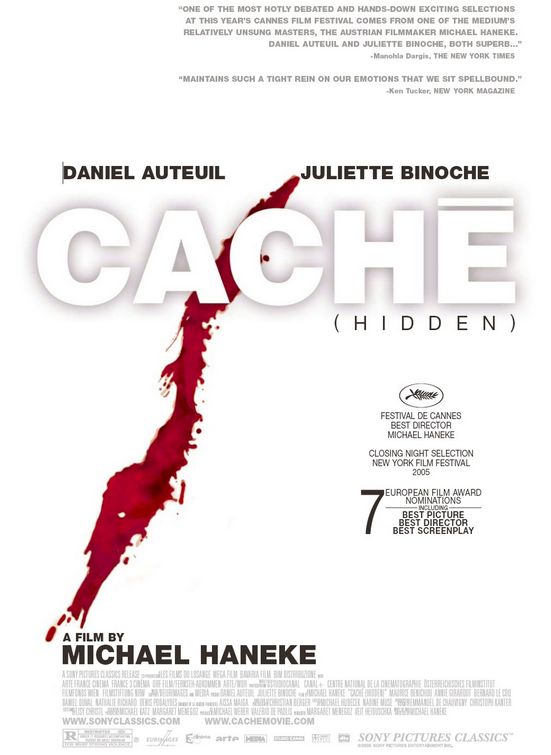
Georges (Daniel Auteuil), a host of a high-brow talk show, receives suspicious videotapes that display the peaceful façade of his upper middle class house. Nothing is clear in this CCTV footage in which there is ostensibly ‘nothing happening’: who has been watching his family, and why? Subsequent clips lead him to his childhood home and to an unknown apartment, which turns out to be the dingy place of his adopted, then abandoned, Algerian brother Majid (Maurice Bénichou). This forgotten ‘other’ confronts Georges with an uncomfortable truth from the past: young Georges’s jealousy forced Majid to be sent off to an orphanage, whereafter Majid had to survive without the educational and social benefits given to Georges. The nature of the video thus changes from provocation to evocation, from surveillance to reminiscence. Michael Haneke’s Caché [Hidden] (2005) uncannily uncovers this hidden trauma that resurfaces in the present. But my primary question is simple: why video?
Let me call this video an ‘interface’. Technically meaning the contact surface between image and spectator, the notion can be applied to the camera, the filmstrip, and the screen. That such a cinematic interface appears onscreen might not merit discussion in many cases, but it can play a central role in the narrative, whose unity is often thwarted and destabilized by the interface image. The subjectivity of characters or spectators can also be shaped or shaken through their encounters with the interface-within-the-film. A diegetic interface may then affect the ‘perception’ and ‘memory’ chain along which ‘image’ and ‘subjectivity’ are interconnected. Caché seems ideal for a case study in this regard, not only because of its video insertions, but because of the consequent revelation of perceptual and mnemonic mechanisms. What follows begins with a close analysis of a scene that exposes these mechanisms and thereby inspires us to explore, even expand the theoretical implications of the interface.
Among many significant scenes, I take Georges’s second visit to Majid’s flat as a kernel of the film’s structure. Its impressiveness, of course, bursts out of Majid’s sudden suicide; Majid lets Georges in, talks for a second, takes out a knife as Georges slightly falters, and slits his own throat, leaving no room for anticipation. The abruptness of this action marks the abruption of Majid’s emotion: a remarkable calmness and gentleness, not usually found in revenge suspects. It is rather Georges, the white Parisian intellectual, who has always lost his temper in front of his lower class, dark-skinned brother (and later, in front of Majid’s son, too); this Algerian outcast has reversed the standard image of the brutal invader of the bourgeois family like the De Niro figure in Cape Fear (Martin Scorsese, 1991). By killing himself, Majid releases something repressed beneath his tranquil face and fractures the peace of both his banlieue home and Georges’s bourgeois life. The flash of his blood sprayed onto the wall visualizes this fracture like an unstitched slash; the blood slowly exuding from his head onto the floor insinuates that this trauma will only grow like a nightmare in Georges’s memory.
In view of other scenes, Majid’s bloodstain on the wall triggers a déjà-vu that allows us to retroactively recognize the drawings sent to Georges (of a child vomiting blood) as forewarnings of this suicide. And through the same logic of ‘deferred action’ (Freudian Nachträglichkeit), this bloody event serves to repeat the film’s first instant flashback, prompted by a reverse-action tape, of young Majid coughing tubercular blood by a window, and the childhood trauma staged in Georges’s nightmare: Majid kills a cockerel, which also leaves a sharp blood mark, and he approaches Georges with the bloody hatchet. This killing was in fact orchestrated by Georges, but he told his parents that Majid had wanted to scare him, a joking lie that, along with Majid’s tuberculosis, ultimately resulted in Majid’s expulsion. However, only through recurrent visual traces after the fact does that original scene manifest its latent meaning as Georges’s original sin. The question would be how guilty and responsible the child and/or adult Georges is for that tiny ‘twisted joke’ that had lifelong repercussions/consequences for Majid. One may conclude: “Georges’s refusal as an adult to acknowledge the effects of his earlier actions suggests a parallel with the postcolonial metropolitan who is neither wholly responsible for, nor wholly untainted by, past events from which he or she has benefited” (Ezra and Sillars 219).1 Or, Majid’s suicide might bring a deep, if guilty, pleasure to a deeply ‘twisted’ xenophobe European: “the comforting idea that the colonial native can be made to disappear in an instant through the auto-combustive agency of their own violence” (Gilroy 234).
To See the Video of the Scene and Read the Rest of the Analysis
Gaze, Suture, Interface: The Suicide Scene in Michael Haneke’s Caché
Seung-hoon Jeong
Cinephile (The University of British Columbia)
Georges (Daniel Auteuil), a host of a high-brow talk show, receives suspicious videotapes that display the peaceful façade of his upper middle class house. Nothing is clear in this CCTV footage in which there is ostensibly ‘nothing happening’: who has been watching his family, and why? Subsequent clips lead him to his childhood home and to an unknown apartment, which turns out to be the dingy place of his adopted, then abandoned, Algerian brother Majid (Maurice Bénichou). This forgotten ‘other’ confronts Georges with an uncomfortable truth from the past: young Georges’s jealousy forced Majid to be sent off to an orphanage, whereafter Majid had to survive without the educational and social benefits given to Georges. The nature of the video thus changes from provocation to evocation, from surveillance to reminiscence. Michael Haneke’s Caché [Hidden] (2005) uncannily uncovers this hidden trauma that resurfaces in the present. But my primary question is simple: why video?
Let me call this video an ‘interface’. Technically meaning the contact surface between image and spectator, the notion can be applied to the camera, the filmstrip, and the screen. That such a cinematic interface appears onscreen might not merit discussion in many cases, but it can play a central role in the narrative, whose unity is often thwarted and destabilized by the interface image. The subjectivity of characters or spectators can also be shaped or shaken through their encounters with the interface-within-the-film. A diegetic interface may then affect the ‘perception’ and ‘memory’ chain along which ‘image’ and ‘subjectivity’ are interconnected. Caché seems ideal for a case study in this regard, not only because of its video insertions, but because of the consequent revelation of perceptual and mnemonic mechanisms. What follows begins with a close analysis of a scene that exposes these mechanisms and thereby inspires us to explore, even expand the theoretical implications of the interface.
Among many significant scenes, I take Georges’s second visit to Majid’s flat as a kernel of the film’s structure. Its impressiveness, of course, bursts out of Majid’s sudden suicide; Majid lets Georges in, talks for a second, takes out a knife as Georges slightly falters, and slits his own throat, leaving no room for anticipation. The abruptness of this action marks the abruption of Majid’s emotion: a remarkable calmness and gentleness, not usually found in revenge suspects. It is rather Georges, the white Parisian intellectual, who has always lost his temper in front of his lower class, dark-skinned brother (and later, in front of Majid’s son, too); this Algerian outcast has reversed the standard image of the brutal invader of the bourgeois family like the De Niro figure in Cape Fear (Martin Scorsese, 1991). By killing himself, Majid releases something repressed beneath his tranquil face and fractures the peace of both his banlieue home and Georges’s bourgeois life. The flash of his blood sprayed onto the wall visualizes this fracture like an unstitched slash; the blood slowly exuding from his head onto the floor insinuates that this trauma will only grow like a nightmare in Georges’s memory.
In view of other scenes, Majid’s bloodstain on the wall triggers a déjà-vu that allows us to retroactively recognize the drawings sent to Georges (of a child vomiting blood) as forewarnings of this suicide. And through the same logic of ‘deferred action’ (Freudian Nachträglichkeit), this bloody event serves to repeat the film’s first instant flashback, prompted by a reverse-action tape, of young Majid coughing tubercular blood by a window, and the childhood trauma staged in Georges’s nightmare: Majid kills a cockerel, which also leaves a sharp blood mark, and he approaches Georges with the bloody hatchet. This killing was in fact orchestrated by Georges, but he told his parents that Majid had wanted to scare him, a joking lie that, along with Majid’s tuberculosis, ultimately resulted in Majid’s expulsion. However, only through recurrent visual traces after the fact does that original scene manifest its latent meaning as Georges’s original sin. The question would be how guilty and responsible the child and/or adult Georges is for that tiny ‘twisted joke’ that had lifelong repercussions/consequences for Majid. One may conclude: “Georges’s refusal as an adult to acknowledge the effects of his earlier actions suggests a parallel with the postcolonial metropolitan who is neither wholly responsible for, nor wholly untainted by, past events from which he or she has benefited” (Ezra and Sillars 219).1 Or, Majid’s suicide might bring a deep, if guilty, pleasure to a deeply ‘twisted’ xenophobe European: “the comforting idea that the colonial native can be made to disappear in an instant through the auto-combustive agency of their own violence” (Gilroy 234).
To See the Video of the Scene and Read the Rest of the Analysis
Saturday, January 15, 2011
Brian Fauteux: Television, Live Transmission -- Control and the Televised Performance Scene
Television, Live Transmission: Control and the Televised Performance Scene
by Brian Fauteux
Cinephile

A performance scene is a critical component of the music biopic, establishing links between the past and present, and between viewers and their memories of a particular band or (more often than not deceased) artist. Performances-whether revered or criticized-highlight memorable moments of a musical career and can motivate and structure the narrative of a music biopic. Gary R. Edgerton cites television as an especially influential medium for delivering music performances to viewers, arguing that it has “transformed the way tens of millions of viewers think about historical figures and events” through numerous nonfictional and fictional portrayals (1). This essay considers the televised performance of “Transmission” by Joy Division in Anton Corbijn’s Control (2007) to highlight the ways in which the performance scene, as a signature event in the band’s popular memory, bridges the past and present by integrating aspects of the original televised performances into contemporary popular culture. Moreover, the performance of “Transmission” marks a critical point in Joy Division’s career. The band generates attention and popularity through the exposure granted by the power of television-an increasingly prominent medium in the promotion of popular music at the time of the original performances. Corbijn’s representation of the “Transmission” performance advances both the represented and popular historic narrative of the band, illustrating the significant contribution of both television and film to the collective and popular history and memory of Joy Division.
Control recalls the life of the late Ian Curtis (Sam Riley), from his time as a young David Bowie fan and student in Macclesfield, England, to his years as the lead singer of Joy Division. The film ends with Curtis’s suicide on May 18, 1980, succeeding emotional hardships stemming from his difficulties in balancing his marriage to Deborah Woodruff (Samantha Morton), and time spent on the road with his band and girlfriend, Annik Honoré (Alexandra Maria Lara). Control is Corbijn’s first feature film, following a directorial career that includes many music videos, such as Nirvana’s “Heart-Shaped Box” (1993), multiple videos for Depeche Mode (e.g. “Personal Jesus” in 1989 and “In Your Room” in 1994), and the video for Joy Division’s “Atmosphere” (1988 reissue). Corbijn’s relationship to Joy Division precedes his direction of “Atmosphere,” as he photographed the band in the late 1970s. As Corbijn notes in a recent interview, “I had moved to England to be close to that music at the time, and I was very into Joy Division. I worked with them, took pictures of them that became synonymous with their music, and I was forever linked” (Tewksbury). The framing, composition and aesthetics of the places and spaces seen and heard in Control are often reflective of Corbijn’s iconic black-and-white images from that time.
Corbijn’s transition from photographing Joy Division to directing a feature film about the band is important to consider within the context of the music biopic. Certainly, Corbijn’s extensive role as a shaper of Joy Division’s mediated image factors into the way in which Control’s aesthetics and narrative are represented. The high-contrast black and white scenes in Control recall this relationship between Corbijn and Joy Division-that of the mediator and the mediated-emphasizing the camera’s place in representing, re-imagining, and transmitting music history. It seems fitting then, that Corbijn should choose to amalgamate two memorable live televised performances into his “Transmission” scene: the September 1978 performance of “Shadowplay” on Tony Wilson’s Granada Reports, and the September 1979 performance of “Transmission,” Unknown Pleasure’s non-album single, on BBC2’s Something Else. “Transmission” is the only full-length, complete performance in the film, recorded and played in actuality by Riley and the other actors who play the band.
Control’s “Transmission” performance begins in similar fashion to the 1978 performance of “Shadowplay” (with some slight differences in Wilson’s introduction of the band). Riley, like Curtis, stands to the left of Craig Parkinson (playing Wilson), with his head bowed as the band is introduced: “Seeing as how this is the first television program which brought you the first appearances from everyone from The Beatles to The Buzzcocks, we like to think we bring you the most new and interesting sounds in the Northwest. They’re called Joy Division…” The band of actors is positioned on individual cylindrical podiums (aside from the drummer, Harry Treadaway, playing Stephen Morris), just as Joy Division is on the original Granada Reports performance of “Shadowplay.” After this introduction, the scene cuts to a shot of the performance framed by a television set in the Curtis family homes (that of Ian’s parents’ and of Ian and Deborah’s), followed then by the performance of “Transmission,” which, for the most part, mirrors the 1979 BBC2 performance. The iconic shots of Peter Hook with his Rickenbacker bass are recreated with actor Joe Anderson in Hook’s place, and the low-angle shots from the original broadcast looking up at Bernard Sumner (James Anthony Pearson), who glares downward at his guitar neck while playing the song’s riff, also make their way into Corbijn’s representation of “Transmission.” The performance effectively joins the most compelling parts from the original two broadcasts: that of Wilson’s introduction of “Shadowplay,” and the more proficient performance of “Transmission” that takes place later in the band’s career. The result is a new performance scene that draws upon memorable moments from Joy Division’s popular history.
To Read the Rest of the Essay and View the Clip of the Scene
by Brian Fauteux
Cinephile
A performance scene is a critical component of the music biopic, establishing links between the past and present, and between viewers and their memories of a particular band or (more often than not deceased) artist. Performances-whether revered or criticized-highlight memorable moments of a musical career and can motivate and structure the narrative of a music biopic. Gary R. Edgerton cites television as an especially influential medium for delivering music performances to viewers, arguing that it has “transformed the way tens of millions of viewers think about historical figures and events” through numerous nonfictional and fictional portrayals (1). This essay considers the televised performance of “Transmission” by Joy Division in Anton Corbijn’s Control (2007) to highlight the ways in which the performance scene, as a signature event in the band’s popular memory, bridges the past and present by integrating aspects of the original televised performances into contemporary popular culture. Moreover, the performance of “Transmission” marks a critical point in Joy Division’s career. The band generates attention and popularity through the exposure granted by the power of television-an increasingly prominent medium in the promotion of popular music at the time of the original performances. Corbijn’s representation of the “Transmission” performance advances both the represented and popular historic narrative of the band, illustrating the significant contribution of both television and film to the collective and popular history and memory of Joy Division.
Control recalls the life of the late Ian Curtis (Sam Riley), from his time as a young David Bowie fan and student in Macclesfield, England, to his years as the lead singer of Joy Division. The film ends with Curtis’s suicide on May 18, 1980, succeeding emotional hardships stemming from his difficulties in balancing his marriage to Deborah Woodruff (Samantha Morton), and time spent on the road with his band and girlfriend, Annik Honoré (Alexandra Maria Lara). Control is Corbijn’s first feature film, following a directorial career that includes many music videos, such as Nirvana’s “Heart-Shaped Box” (1993), multiple videos for Depeche Mode (e.g. “Personal Jesus” in 1989 and “In Your Room” in 1994), and the video for Joy Division’s “Atmosphere” (1988 reissue). Corbijn’s relationship to Joy Division precedes his direction of “Atmosphere,” as he photographed the band in the late 1970s. As Corbijn notes in a recent interview, “I had moved to England to be close to that music at the time, and I was very into Joy Division. I worked with them, took pictures of them that became synonymous with their music, and I was forever linked” (Tewksbury). The framing, composition and aesthetics of the places and spaces seen and heard in Control are often reflective of Corbijn’s iconic black-and-white images from that time.
Corbijn’s transition from photographing Joy Division to directing a feature film about the band is important to consider within the context of the music biopic. Certainly, Corbijn’s extensive role as a shaper of Joy Division’s mediated image factors into the way in which Control’s aesthetics and narrative are represented. The high-contrast black and white scenes in Control recall this relationship between Corbijn and Joy Division-that of the mediator and the mediated-emphasizing the camera’s place in representing, re-imagining, and transmitting music history. It seems fitting then, that Corbijn should choose to amalgamate two memorable live televised performances into his “Transmission” scene: the September 1978 performance of “Shadowplay” on Tony Wilson’s Granada Reports, and the September 1979 performance of “Transmission,” Unknown Pleasure’s non-album single, on BBC2’s Something Else. “Transmission” is the only full-length, complete performance in the film, recorded and played in actuality by Riley and the other actors who play the band.
Control’s “Transmission” performance begins in similar fashion to the 1978 performance of “Shadowplay” (with some slight differences in Wilson’s introduction of the band). Riley, like Curtis, stands to the left of Craig Parkinson (playing Wilson), with his head bowed as the band is introduced: “Seeing as how this is the first television program which brought you the first appearances from everyone from The Beatles to The Buzzcocks, we like to think we bring you the most new and interesting sounds in the Northwest. They’re called Joy Division…” The band of actors is positioned on individual cylindrical podiums (aside from the drummer, Harry Treadaway, playing Stephen Morris), just as Joy Division is on the original Granada Reports performance of “Shadowplay.” After this introduction, the scene cuts to a shot of the performance framed by a television set in the Curtis family homes (that of Ian’s parents’ and of Ian and Deborah’s), followed then by the performance of “Transmission,” which, for the most part, mirrors the 1979 BBC2 performance. The iconic shots of Peter Hook with his Rickenbacker bass are recreated with actor Joe Anderson in Hook’s place, and the low-angle shots from the original broadcast looking up at Bernard Sumner (James Anthony Pearson), who glares downward at his guitar neck while playing the song’s riff, also make their way into Corbijn’s representation of “Transmission.” The performance effectively joins the most compelling parts from the original two broadcasts: that of Wilson’s introduction of “Shadowplay,” and the more proficient performance of “Transmission” that takes place later in the band’s career. The result is a new performance scene that draws upon memorable moments from Joy Division’s popular history.
To Read the Rest of the Essay and View the Clip of the Scene
Thursday, January 06, 2011
Adi Kuntsman: Online Memories, Digital Conflicts and the Cybertouch of War
Online Memories, Digital Conflicts and the Cybertouch of War
by Adi Kuntsman
Digital Icons
Wars, conflicts and commemoration occupy the minds of today’s users of new media across the globe; and those in Russia, Eurasia and Central Europe are no exception. Digital reporting of military actions and virtual museums of past wars and genocides; hacker attacks against websites and databases and computer war games; online antiwar organising and digital performances of postwar trauma; flashmobs of political protest or racist incitement and digitalised personal memories and family histories – these are only some of the examples of the ways in which war, conflict and commemoration are narrated, experienced and performed in contemporary digital media. Thus, the aim of the special issue entitled ’War, Conflict and Commemoration in the Age of Digital Reproduction’ is to explore these and other phenomena, by looking at various forms and segments of digital media: Internet sites, blogs and forums, online news and discussions, social networks, commemoration sites and virtual museums, digital games, video performance and computer crimes.
The issue brings together ten authors, working in a variety of formats – articles, essays, reports, ethnographic film and digital performance – and reflecting on the following questions:
What is the role of new media in understanding, representing, negotiating and remembering (or forgetting) war and genocide?
What is the status of testimony, evidence and reportage in the age of digital reproduction?
What practices of memory do new information and communication technologies entail?
What structures of feeling operate in online reports and debates around military operations and human suffering?
How can digital mediations of conflict bring people and communities together, while tearing others apart?
And lastly, how can the embodied, physical violence intensify in digital interactions, and how can it be diffused, resisted and remembered?
This special issue was born out of a sense of political and intellectual necessity, posed by recent developments in digital media and its use. Digital media is fundamentally changing the terrain of politics, due to its reach and speed, and its function in the lives of civilian populations and states alike. For example, together with ‘citizen journalism’, enabled by blogs, the Internet has given a platform to political extremism, racism and neo-Nazism. (While Web 2.0 technologies allow non-hierarchical participation,
they also, at times, turn the Internet into a digital war zone (Karatzogianni 2006, 2009).
In today’s ‘global matrix of war’ (Kaplan 2009), digital technologies are used by both state and non-state actors, often blurring the line between military and entertainment and between control and resistance. Attacks on the ground and in the air now go hand in hand with information warfare, propaganda and racist attacks in blogs and YouTube vlogs; conflicts between states or stateless groups reverberate in cyberattacks by hackers from each side; and testimonies of atrocities are captured on mobile phones and circulated on Facebook, irrevocably changing our modes of witnessing, feeling and remembering violent and traumatic events (Ibrahim 2009; Kaplan 2009; Reading 2009).
Politically, then, the topic of war and conflict and of their relations with digital media is clearly an urgent one. In that respect, Central and Eastern Europe is not unique. The region, however, has its own, very particular, record of past wars and conflicts that scar social and mnemonic fabrics of today’s life: World War II, German occupation and the Holocaust, decades under communism, twenty years of post-communist transformation, and waves of conflicts and bloodshed they brought.
More recently, the region has witnessed a rise in the right wing nationalism and extremist racism, struggles for sovereignty and independence, ‘wars on terror’ and localised armed conflicts. Addressing all these together, through the lens of shared political conditions, while remaining attentive to each country’s unique culture and
circumstances, is what encouraged me to assemble this collection.
The special issue is also motivated by an intellectual need to shed light on the role of digital media in these processes across the region. With the growing integration of digital media into most aspects of our lives, we witness an explosion of scholarly interest in the subject, cutting across many disciplines. Similarly, the topic of war, conflict and memory is widely explored. The two, however, only recently began to intersect, for example in the special issue of Journal of Computer Mediated Communication (2006), ‘War Coverage in Cyberspace’ (2006) or in edited collections such as Digital War Reporting (Matheson and Stuart 2009) or Save As… Digital Memories (Garde-Hansen et.al. 2009).1 But even when the two fields are explored in conjunction, they mostly concentrate on one narrow aspect – such as war coverage and reportage, or memories – rather than a complex examination of how digital media and computer technologies affect the warfare itself, its social perception and the ways of remembrance and commemoration. Such complex approach is precisely what unites the papers in this special issue, when they examine how war and conflicts of past and present are negotiated, performed and remembered on the Internet and in other digital media tools.
To Read the Rest of the Introduction to the Special Issue and to Access the Issue's Essays
by Adi Kuntsman
Digital Icons
Wars, conflicts and commemoration occupy the minds of today’s users of new media across the globe; and those in Russia, Eurasia and Central Europe are no exception. Digital reporting of military actions and virtual museums of past wars and genocides; hacker attacks against websites and databases and computer war games; online antiwar organising and digital performances of postwar trauma; flashmobs of political protest or racist incitement and digitalised personal memories and family histories – these are only some of the examples of the ways in which war, conflict and commemoration are narrated, experienced and performed in contemporary digital media. Thus, the aim of the special issue entitled ’War, Conflict and Commemoration in the Age of Digital Reproduction’ is to explore these and other phenomena, by looking at various forms and segments of digital media: Internet sites, blogs and forums, online news and discussions, social networks, commemoration sites and virtual museums, digital games, video performance and computer crimes.
The issue brings together ten authors, working in a variety of formats – articles, essays, reports, ethnographic film and digital performance – and reflecting on the following questions:
What is the role of new media in understanding, representing, negotiating and remembering (or forgetting) war and genocide?
What is the status of testimony, evidence and reportage in the age of digital reproduction?
What practices of memory do new information and communication technologies entail?
What structures of feeling operate in online reports and debates around military operations and human suffering?
How can digital mediations of conflict bring people and communities together, while tearing others apart?
And lastly, how can the embodied, physical violence intensify in digital interactions, and how can it be diffused, resisted and remembered?
This special issue was born out of a sense of political and intellectual necessity, posed by recent developments in digital media and its use. Digital media is fundamentally changing the terrain of politics, due to its reach and speed, and its function in the lives of civilian populations and states alike. For example, together with ‘citizen journalism’, enabled by blogs, the Internet has given a platform to political extremism, racism and neo-Nazism. (While Web 2.0 technologies allow non-hierarchical participation,
they also, at times, turn the Internet into a digital war zone (Karatzogianni 2006, 2009).
In today’s ‘global matrix of war’ (Kaplan 2009), digital technologies are used by both state and non-state actors, often blurring the line between military and entertainment and between control and resistance. Attacks on the ground and in the air now go hand in hand with information warfare, propaganda and racist attacks in blogs and YouTube vlogs; conflicts between states or stateless groups reverberate in cyberattacks by hackers from each side; and testimonies of atrocities are captured on mobile phones and circulated on Facebook, irrevocably changing our modes of witnessing, feeling and remembering violent and traumatic events (Ibrahim 2009; Kaplan 2009; Reading 2009).
Politically, then, the topic of war and conflict and of their relations with digital media is clearly an urgent one. In that respect, Central and Eastern Europe is not unique. The region, however, has its own, very particular, record of past wars and conflicts that scar social and mnemonic fabrics of today’s life: World War II, German occupation and the Holocaust, decades under communism, twenty years of post-communist transformation, and waves of conflicts and bloodshed they brought.
More recently, the region has witnessed a rise in the right wing nationalism and extremist racism, struggles for sovereignty and independence, ‘wars on terror’ and localised armed conflicts. Addressing all these together, through the lens of shared political conditions, while remaining attentive to each country’s unique culture and
circumstances, is what encouraged me to assemble this collection.
The special issue is also motivated by an intellectual need to shed light on the role of digital media in these processes across the region. With the growing integration of digital media into most aspects of our lives, we witness an explosion of scholarly interest in the subject, cutting across many disciplines. Similarly, the topic of war, conflict and memory is widely explored. The two, however, only recently began to intersect, for example in the special issue of Journal of Computer Mediated Communication (2006), ‘War Coverage in Cyberspace’ (2006) or in edited collections such as Digital War Reporting (Matheson and Stuart 2009) or Save As… Digital Memories (Garde-Hansen et.al. 2009).1 But even when the two fields are explored in conjunction, they mostly concentrate on one narrow aspect – such as war coverage and reportage, or memories – rather than a complex examination of how digital media and computer technologies affect the warfare itself, its social perception and the ways of remembrance and commemoration. Such complex approach is precisely what unites the papers in this special issue, when they examine how war and conflicts of past and present are negotiated, performed and remembered on the Internet and in other digital media tools.
To Read the Rest of the Introduction to the Special Issue and to Access the Issue's Essays
Saturday, November 20, 2010
Left Field Cinema: Memento in Relation to Reception Theory
Analysis: Memento in Relation to Reception Theory
by Mike Dawson
Left Field Cinema

Based on a short story, Memento Mori, by Jonah Nolan, Memento is structurally a very different kind film, a film which attempts a type of narrative very few directors had employed before. Guy Pierce plays an insurance investigator Leonard Shelby who is wounded during an attack on him and his wife and now suffers a rare and memory disorder called anterograde memory loss. This means that he has no short-term memory. He remembers everything from before the attack, but after that he won’t remember anything more than about five minutes at a time. The last thing he recalls is his wife dying and as a result has been on a quest for revenge ever since. He isn’t a hero, more of a delusional anti hero. Leonard’s vendetta is the only driving force left in his life now. There are problems with Leonard’s revenge lead search however. He can never be sure whom to trust, he relies on notes that he makes to himself on Polaroid pictures of people, and a series of tattoos across his body for very serious information which he can’t afford to forget. He believes that he can achieve his goal with out memory because it’s unreliable. “Memory can change the shape of a room or the colour of a car. It’s interpretation not a record.” Another problem with Leonard’s revenge is that he’ll never remember it. He’ll never know the satisfaction beyond the few minutes he retains the memory. He maybe able to take a picture to document it but he won’t remember it. This problem Leonard counters by arguing that just because he can’t remember doesn’t mean that his actions don’t have meaning or that what he does in his life isn’t important. However when Leonard avenges his wife, the last thing he’ll remember will still be her death. Towards the end of the film it is revealed that Leonard has already avenged his wife over a year earlier, and didn’t remember doing it. Since then has been manipulated into being an unwitting patsy by everyone around him including most interestingly - himself. In the startling final scene it is revealed that he has been removing and manipulating evidence to give himself a bigger puzzle to solve, and to steer himself towards killing Teddy who has also been manipulating him. It is through this plot twist that the one of the central messages of Memento is revealed. Revenge is a pointless exercise; vengeance begets vengeance. Leonard can’t remember his revenge and so he keeps on going. He wrongfully kills Jimmy Grantz because he was manipulated by Teddy, as a result Natalie uses him as well sleeping with him and playing games with his mind; games he won’t remember. Sight and Sound had this to say about the film in their November 2000 issue “Drawing from the rich metafictional possibilities inherent in the detective genre, Memento delivers, in Leonard Shelby, a character who, while he considers himself an investigator, is actually - and all at once - a proficient killer and the perfect patsy: fuelled by his lust for revenge, he’ll take out anybody with the initials that fit; dependent on others to provide clues to the identity of his wife’s killer, he’s also the victim of countless set-ups, the seemingly unwitting cog in the duplicitous maneuverings of those around him."
People manipulate themselves. People can make themselves remember what they want to remember, or make themselves believe what they want to believe. An individual’s recollection is not restricted to what was physically seen, heard, felt, tasted or smelt; memory can be moulded by those who own it. Like prolific liars who often begin to believe their own lies in order to sustain an illusion to those around them. Throughout the film there is a prolonged flash back sequence where Leonard explains the story of Sammy Jankis a man with a similar condition as himself who he investigated before he lost his memory. Sammy didn’t get any insurance money because Leonard felt that his condition was psychological not physical. Sammy’s wife was a diabetic and Sammy could give her an insulin injection with no problem. Sammy’s wife eventually tested him, getting him to give her the same insulin jab over and over again until she fell into a coma. The second revelation in the final scene is that Sammy’s story is actually Leonard’s, that he conditioned himself to remember Sammy’s fictional case, because he didn’t want to remember the truth. That it was his wife had diabetes and she survived the assault and she tested Leonard and misled him to give her and overdose of insulin.
“Memento, delves into the dark black side of the soul brining us face to face with the part of man which no one talks about; our delusions. The lies we tell ourselves, although never out loud, which allow us to go on with the daily routine. Leaving us to wonder, is it our own manipulation which silently drives our motives pulling us towards the eventual outcome like a strong undertow in waist deep water.” (Karten, 2000)
“Ultimately, Memento stands on its own as a thriller, but it also works as a profound tragedy, stunning in its portrayal of a man teetering on the edge, though he doesn’t even know it. It asks some serious questions about how we know what to believe, since our senses and our memory all lie to us. And in the end, Memento gives us our answer: We simply believe what we choose to.” (Null, 2001)
Leonard conditions himself to remember the story. He simply believes what he wants to believe. Remembers what he wants to remember. It is a comment on how people manipulate themselves, and choose to remember what they want to remember.
To Read the Rest of the Analysis
To Listen to the Analysis
by Mike Dawson
Left Field Cinema
Based on a short story, Memento Mori, by Jonah Nolan, Memento is structurally a very different kind film, a film which attempts a type of narrative very few directors had employed before. Guy Pierce plays an insurance investigator Leonard Shelby who is wounded during an attack on him and his wife and now suffers a rare and memory disorder called anterograde memory loss. This means that he has no short-term memory. He remembers everything from before the attack, but after that he won’t remember anything more than about five minutes at a time. The last thing he recalls is his wife dying and as a result has been on a quest for revenge ever since. He isn’t a hero, more of a delusional anti hero. Leonard’s vendetta is the only driving force left in his life now. There are problems with Leonard’s revenge lead search however. He can never be sure whom to trust, he relies on notes that he makes to himself on Polaroid pictures of people, and a series of tattoos across his body for very serious information which he can’t afford to forget. He believes that he can achieve his goal with out memory because it’s unreliable. “Memory can change the shape of a room or the colour of a car. It’s interpretation not a record.” Another problem with Leonard’s revenge is that he’ll never remember it. He’ll never know the satisfaction beyond the few minutes he retains the memory. He maybe able to take a picture to document it but he won’t remember it. This problem Leonard counters by arguing that just because he can’t remember doesn’t mean that his actions don’t have meaning or that what he does in his life isn’t important. However when Leonard avenges his wife, the last thing he’ll remember will still be her death. Towards the end of the film it is revealed that Leonard has already avenged his wife over a year earlier, and didn’t remember doing it. Since then has been manipulated into being an unwitting patsy by everyone around him including most interestingly - himself. In the startling final scene it is revealed that he has been removing and manipulating evidence to give himself a bigger puzzle to solve, and to steer himself towards killing Teddy who has also been manipulating him. It is through this plot twist that the one of the central messages of Memento is revealed. Revenge is a pointless exercise; vengeance begets vengeance. Leonard can’t remember his revenge and so he keeps on going. He wrongfully kills Jimmy Grantz because he was manipulated by Teddy, as a result Natalie uses him as well sleeping with him and playing games with his mind; games he won’t remember. Sight and Sound had this to say about the film in their November 2000 issue “Drawing from the rich metafictional possibilities inherent in the detective genre, Memento delivers, in Leonard Shelby, a character who, while he considers himself an investigator, is actually - and all at once - a proficient killer and the perfect patsy: fuelled by his lust for revenge, he’ll take out anybody with the initials that fit; dependent on others to provide clues to the identity of his wife’s killer, he’s also the victim of countless set-ups, the seemingly unwitting cog in the duplicitous maneuverings of those around him."
People manipulate themselves. People can make themselves remember what they want to remember, or make themselves believe what they want to believe. An individual’s recollection is not restricted to what was physically seen, heard, felt, tasted or smelt; memory can be moulded by those who own it. Like prolific liars who often begin to believe their own lies in order to sustain an illusion to those around them. Throughout the film there is a prolonged flash back sequence where Leonard explains the story of Sammy Jankis a man with a similar condition as himself who he investigated before he lost his memory. Sammy didn’t get any insurance money because Leonard felt that his condition was psychological not physical. Sammy’s wife was a diabetic and Sammy could give her an insulin injection with no problem. Sammy’s wife eventually tested him, getting him to give her the same insulin jab over and over again until she fell into a coma. The second revelation in the final scene is that Sammy’s story is actually Leonard’s, that he conditioned himself to remember Sammy’s fictional case, because he didn’t want to remember the truth. That it was his wife had diabetes and she survived the assault and she tested Leonard and misled him to give her and overdose of insulin.
“Memento, delves into the dark black side of the soul brining us face to face with the part of man which no one talks about; our delusions. The lies we tell ourselves, although never out loud, which allow us to go on with the daily routine. Leaving us to wonder, is it our own manipulation which silently drives our motives pulling us towards the eventual outcome like a strong undertow in waist deep water.” (Karten, 2000)
“Ultimately, Memento stands on its own as a thriller, but it also works as a profound tragedy, stunning in its portrayal of a man teetering on the edge, though he doesn’t even know it. It asks some serious questions about how we know what to believe, since our senses and our memory all lie to us. And in the end, Memento gives us our answer: We simply believe what we choose to.” (Null, 2001)
Leonard conditions himself to remember the story. He simply believes what he wants to believe. Remembers what he wants to remember. It is a comment on how people manipulate themselves, and choose to remember what they want to remember.
To Read the Rest of the Analysis
To Listen to the Analysis
Monday, December 28, 2009
Wendell Berry: The Work of Local Culture
Berry, Wendell. “The Work of Local Culture.” What Are People For? San Francisco: North Point Press, 1990: 153-169.
A human community, too, must collect leaves and stories, and turn them to account. It must build soil, and build that memory of itself—in lore and story and song—that will be its culture. These two kinds of accumulation, of local soil and local culture, are intimately related. (Berry, 154)
A human community, then, if it is to last long, must exert a sort of centripetal force, holding local soil and local memory in place. (Berry, 155)
This loss of local knowledge and local memory—that is, of local culture—has been ignored, or written off as one of the cheaper “prices of progress,” or made the business of folklorists. Nevertheless, local culture has a value, and part of its value is economic. This can be demonstrated readily enough. (Berry, 157)
... when a community loses its memory, its members no longer know one another. How can they know one another if they have forgotten or have never learned one another’s stories? If they do not know one another’s stories, how can they know whether or not to trust one another? People who do not trust one another do not help one another, and moreover they fear one another. And this is our predicament now. Because of a general distrust and suspicion, we not only lose one another’s help and companionship, but we are all now living in jeopardy of being sued. (Berry, 157-158)
... most people of the present can only marvel to think of neighbors entertaining themselves for a whole evening without a single imported pleasure and without listening to a single minute of sales talk. (Berry, 159)
But if, for example, there should occur a forty-eight-hour power failure, we would find ourselves in much more backward circumstances than our ancestors. (Berry, 159)
Professionalism means more interest in salaries and less interest in what used to be known as disciplines. And so we arrive at the idea, endlessly reiterated in the news media, that education can be improved by bigger salaries for teachers—which may be true, but education cannot be improved, as the proponents too often imply, by bigger salaries alone. There must also be love of learning and of the cultural tradition and of excellence—and this love cannot exist, because it makes no sense, apart from the love of a place and a community. Without this love, education is only the importation into a local community of centrally prescribed “career preparation” designed to facilitate the export of young careerists. (Berry, 164)
Our children are educated, then, to leave home, not to stay home, and the costs of this education have been far too little acknowledged. One of the costs is psychological, and the other is at once cultural and ecological. (Berry, 164)
The natural or normal course of human growing up must begin with some sort of rebellion against one’s parents, for it is clearly impossible to grow up if one remains a child. But the child, in the process of rebellion and of achieving the emotional and economic independence that rebellion ought to lead to, finally comes to understand the parents as fellow humans and fellow sufferers, and in some manner returns to them as their friend, forgiven and forgiving the inevitable wrongs of family life. That is the old norm. (Berry, 164-165)
The new norm, according to which the child leaves home as a student and never lives at home again, interrupts the old course of coming of age at the point of rebellion, so that the child is apt to remain stalled in adolescence, never achieving any kind of reconciliation or friendship with the parents. Of course, such a return and reconciliation cannot be achieved without the recognition of mutual practical need. In the present economy, however, where individual dependences are so much exterior to both household and community, family members often have no practical need or use for one another. Hence the frequent futility of attempts at a purely psychological or emotional reconciliation. (Berry, 165)
The loss of local culture is, in part, a practical loss and an economic one. For one thing, such a culture contains, and conveys to succeeding generations, the history of the use of the place and the knowledge of how the place may be lived in and used. For another, the pattern of reminding implies affection for the place and respect for it, and so, finally, the local culture will carry the knowledge of how the place may be well and lovingly used, and also the implicit command to use it only well and lovingly. The only true and effective “operator’s manual for spaceship earth” is not a book that any human will ever write, it is hundreds of thousands of local cultures. (Berry, 166)
Lacking an authentic local culture, a place is open to exploitation, and ultimately to destruction, from the center. (Berry, 166)
A human community, too, must collect leaves and stories, and turn them to account. It must build soil, and build that memory of itself—in lore and story and song—that will be its culture. These two kinds of accumulation, of local soil and local culture, are intimately related. (Berry, 154)
A human community, then, if it is to last long, must exert a sort of centripetal force, holding local soil and local memory in place. (Berry, 155)
This loss of local knowledge and local memory—that is, of local culture—has been ignored, or written off as one of the cheaper “prices of progress,” or made the business of folklorists. Nevertheless, local culture has a value, and part of its value is economic. This can be demonstrated readily enough. (Berry, 157)
... when a community loses its memory, its members no longer know one another. How can they know one another if they have forgotten or have never learned one another’s stories? If they do not know one another’s stories, how can they know whether or not to trust one another? People who do not trust one another do not help one another, and moreover they fear one another. And this is our predicament now. Because of a general distrust and suspicion, we not only lose one another’s help and companionship, but we are all now living in jeopardy of being sued. (Berry, 157-158)
... most people of the present can only marvel to think of neighbors entertaining themselves for a whole evening without a single imported pleasure and without listening to a single minute of sales talk. (Berry, 159)
But if, for example, there should occur a forty-eight-hour power failure, we would find ourselves in much more backward circumstances than our ancestors. (Berry, 159)
Professionalism means more interest in salaries and less interest in what used to be known as disciplines. And so we arrive at the idea, endlessly reiterated in the news media, that education can be improved by bigger salaries for teachers—which may be true, but education cannot be improved, as the proponents too often imply, by bigger salaries alone. There must also be love of learning and of the cultural tradition and of excellence—and this love cannot exist, because it makes no sense, apart from the love of a place and a community. Without this love, education is only the importation into a local community of centrally prescribed “career preparation” designed to facilitate the export of young careerists. (Berry, 164)
Our children are educated, then, to leave home, not to stay home, and the costs of this education have been far too little acknowledged. One of the costs is psychological, and the other is at once cultural and ecological. (Berry, 164)
The natural or normal course of human growing up must begin with some sort of rebellion against one’s parents, for it is clearly impossible to grow up if one remains a child. But the child, in the process of rebellion and of achieving the emotional and economic independence that rebellion ought to lead to, finally comes to understand the parents as fellow humans and fellow sufferers, and in some manner returns to them as their friend, forgiven and forgiving the inevitable wrongs of family life. That is the old norm. (Berry, 164-165)
The new norm, according to which the child leaves home as a student and never lives at home again, interrupts the old course of coming of age at the point of rebellion, so that the child is apt to remain stalled in adolescence, never achieving any kind of reconciliation or friendship with the parents. Of course, such a return and reconciliation cannot be achieved without the recognition of mutual practical need. In the present economy, however, where individual dependences are so much exterior to both household and community, family members often have no practical need or use for one another. Hence the frequent futility of attempts at a purely psychological or emotional reconciliation. (Berry, 165)
The loss of local culture is, in part, a practical loss and an economic one. For one thing, such a culture contains, and conveys to succeeding generations, the history of the use of the place and the knowledge of how the place may be lived in and used. For another, the pattern of reminding implies affection for the place and respect for it, and so, finally, the local culture will carry the knowledge of how the place may be well and lovingly used, and also the implicit command to use it only well and lovingly. The only true and effective “operator’s manual for spaceship earth” is not a book that any human will ever write, it is hundreds of thousands of local cultures. (Berry, 166)
Lacking an authentic local culture, a place is open to exploitation, and ultimately to destruction, from the center. (Berry, 166)
Wednesday, December 02, 2009
Film Studies: Dreams, Memory and Chaos
(Migrating some things from my film studies course--please feel free to provide comments about more films or articles/essays/bibliographies that fit this category)
Dreams, Memory and Chaos

General Readings:
Eig, Jonathan. “A Beautiful Mind(Fuck): Hollywood Structures of Identity.” Jump Cut 46 (Summer 2003)
Gaggi, Silvio. “Navigating Chaos.” New Punk Cinema. Ed. Nicholas Rombes. Edinburgh: Edinburgh University Press, 2005: 113-125.
Isaacs, Bruce. "Non-Linear Narrative." New Punk Cinema Ed. Nicholas Rombes. Edinburgh: Edinburgh University Press, 2005: 126-138.
Plate, S. Brent. “Filmmaking, Mythmaking, Culturemaking.” Representing Religion in World Cinema. Ed. S. Brent Plate. NY: Palgrave MacMillan, 2003: 1-15.
Readings of Mulholland Drive
Mulholland Dr. (France/USA: David Lynch, 2001)

Cain, Maximillian Le. “In Dreams: A Review of Mulholland Drive.” Senses of Cinema 19 (March-April 2002)
Ebert, Roger. “Review of Mulholland Drive.” Chicago Sun Times (October 12, 2001)
Falsetto, Mario. “There is No Band at Club Silencio: Thoughts on David Lynch and Mulholland Drive.” Synoptique 6 (Dec 6, 2004)
Frazer, Bryant. “Fast Friends: Mulholland Drive.” (2001)
Gessler, Nicholas. “Mulholland Drive: An Independent Analysis.” (September 29, 2002)
Koresky, Michael. “Altered Beast: Tropical Malady Meets Mulholland Drive.” Reverse Shot (Summer 2005)
Macaulay, Scott. “The Dream Factory.” Filmmaker Magazine (Fall 2001)
McGinn, Colin. "Dreams on Film."; "Reviewing the Dream Theory."; "How To Make a Dream." The Power of Movies: How Screen and Mind Interact NY: Pantheon Books, 2005": 100-157; 158-177; and 178-191. {For those that want to investigate more the theory of film and dreams.--the book is in our library.}
Ostherr, Kirsten and Arash Abizadeh. “Amnesia, Obsession, Cinematic U-Turns: On Mulholland Drive.” Senses of Cinema 19 (March-April 2002)
Rapfogel, Jared. “David Lynch.” Senses of Cinema 19 (March-April 2002)
Ruch, Allen B. “’No Hay Banda’: A Long, Strange Trip Down David Lynch’s Mulholland Drive.” The Modern Word (April 23, 2002)
Sinnerbrink, Robert. “Cinematic Ideas: David Lynch’s Mulholland Drive.” Film Philosophy 9.34 (July 2005)
Thill, Scott. “The Not-So-Straight Story: It’s Just Lynch Being Lynch. And That’s a Good Thing.” Bright Lights Film Journal 34 (October 2001)
Wyman, Bill, Max Garrone and Andy Klein. “Everything You Wanted to Know About Mulholland Drive.” Salon (October 23, 2001)
Zacharek, Stephanie. “David Lynch’s Latest Tour de Force.” Salon (October 12, 2001)
More Films:
Being John Malkovich (USA: Spike Jonze, 1999)
A completely unique story announced Spike Jonze (director) and Charlie Kaufman (screenwriter) as bold filmmakers. It is great to walk away from a film that you enjoyed and were provoked by and to think, I have never seen anything like this.... A great film.
The Big Lebowski (USA/UK: The Coen Brothers, 1998: 117 mins)
"The dude abides." A classic by the Coen Bros, that while not as mystifying as some of these films, still explores along the same lines who and what we are... has developed a cult following that has led to an annual conference/party in Louisville bowling alleys.
Blade Runner (USA/Hong Kong: Ridley Scott, 1982/1991)
Landmark, visionary science fiction film that at its essence is about what it means to be human. Hugely influential in the field of science fiction and has roots in the tradition of film noir. I would also consider it to be a profound (drawing from the root questions of its source author Philip K. Dick) meditation on human consciousness. Through the struggle of the rebel androids we are reminded of human hubris in believing that only they are self-reflectively conscious (a preposterous and arrogant assumption).
The Company Of Wolves (United Kingdom: Neil Jordan, 1984)
Neil Jordan's cinematic adaptation of Angela Carter's feminist reworking of traditional patriarchal fairy tales in the werewolf stories in the collection The Bloody Chamber (1979: "The Company of Wolves", "Wolf-Alice" and "The Werewolf") is structured through the symbolic dreams of a young girl. Rich, vivid, surreal film.
Dead Man (USA/Germany/Japan: Jim Jarmusch, 1995)
Johnny Depp plays the lead character in this acid-western dipped in the American (and European) Myth of the West filtered (or juxtaposed) through Native-American counter mythos.
Donnie Darko (USA: Richard Kelley, 2001: director’s cut)
Ignored when originally released in the theaters this film picked-up an audience through rentals and was later re-released with a new director's cut. Jake Gyllenhal and a stellar cast (one of my favorite on-screen families) plumb some philosophical/scientific concepts, while exposing a range of social hypocrisies.
Eternal Sunshine of the Spotless Mind (USA: Michel Gondry, 2004: 108 mins)
As always Charlie Kaufman writes about memory and identity. Great production design, the stunning Kate Winslet accompanying Jim Carrey in a tale of lost love and memories. What would you do to forget the pain of a lost love. Is it better to have loved and lost, than to never have loved at all?
Human Nature (France/USA: Michel Gondry, 2001: 91 mins)
Rowdy/Bawdy comedy that delves into and around some deep human/identity issues.
I Heart Huckabees (USA/Germany: David O. Russell, 2004: 106 mins)
One of my all-time favorite philosophical comedies with a great cast and intelligent writing. One of the few films that I went and watched a second time while it was in the theaters.
Jacob’s Ladder (USA: Adrian Lyne, 1990: 115 mins)
After-effects of war on the returned, damaged soldier. What is reality? What isn't? Who can you trust?
Kontrol (Hungary: Nimrod Antal, 2003)
Filmed entirely in the Budapest underground railway system. What could have been a typical workplace comedy, slowly builds through absurd events and surreal atmosphere into something much more complex. Alternating between slapstick, mystery and romance, but never falling into simplicity.
Lost Highway (France/USA: David Lynch, 1997)
If you thought Mulholland Drive was confusing, try this earlier effort. I've seen it four times and each time I came up with a different interpretation.
Memento (USA: Christopher Nolan, 2000)
A man searching for his wife's murderer deals with daily memory loss--a bold, memorable film.
Pi (USA: Darren Aronofsky, 1998)
An amazing blend of science, philosophy, math, religion and conspiracy theories--set to a unique visual style. Aronofsky's (Requiem for a Dream) first feature film. A startling, mind-blowing original look into the mystifying patterns of life (as viewed by the skewed person who is recognizing them)--should be studied by all beginning filmmakers to give them an idea of how an excellent screenplay and unique visual style can overcome a low budget. Minimalistic, yet complex. On my DVD copy there is a featurette on the making of the film--check it out if you watch it, great depiction of collective filmmaking and the independent spirit (of course always much more uplifting when it turns out a film like this).
Pulse (Japan: Kiyoshi Kurasowa: 2001: 118 mins)
What effect does our increasing relationship to technology and media have on us? A dark, foreboding, haunting, mysterious film.
Run, Lola, Run (Germany: Tom Tykwer, 1998)
How do the smallest choices change the direction of our lives? Chaos theory inflected thriller.
Save the Green Planet (South Korea: Joon-Hwan Jang, 2003)
Like Being John Malkovich and Pi, unlike any film I have seen before--I can't give anything away and would like to hear what others have to say about it.
The Science of Sleep (France/Italy: Michel Gondry, 2006)
Told through the protagonist Stephane's creative dreams and distorted reality this is a creative film that explores the nature of love, friendship, and relationships.
The Usual Suspects (USA/Germany: Bryan Singer, 1995)
Nothing like a good mystery with a surprise ending--a favorite of many. A must for detective/mystery/crime buffs.
Videodrome (Canada: David Cronenberg, 1983)
I first saw this in the theater as a teen and it literally freaked me out! It repulsed me and attracted me at the same time. Despite its low budget, it is a stunning meditation on the power of media to influence our memories and inform our dreams. In an increasingly media(tized) reality this film is even more important today.

Dreams, Memory and Chaos
General Readings:
Eig, Jonathan. “A Beautiful Mind(Fuck): Hollywood Structures of Identity.” Jump Cut 46 (Summer 2003)
Gaggi, Silvio. “Navigating Chaos.” New Punk Cinema. Ed. Nicholas Rombes. Edinburgh: Edinburgh University Press, 2005: 113-125.
Isaacs, Bruce. "Non-Linear Narrative." New Punk Cinema Ed. Nicholas Rombes. Edinburgh: Edinburgh University Press, 2005: 126-138.
Plate, S. Brent. “Filmmaking, Mythmaking, Culturemaking.” Representing Religion in World Cinema. Ed. S. Brent Plate. NY: Palgrave MacMillan, 2003: 1-15.
Readings of Mulholland Drive
Mulholland Dr. (France/USA: David Lynch, 2001)
Cain, Maximillian Le. “In Dreams: A Review of Mulholland Drive.” Senses of Cinema 19 (March-April 2002)
Ebert, Roger. “Review of Mulholland Drive.” Chicago Sun Times (October 12, 2001)
Falsetto, Mario. “There is No Band at Club Silencio: Thoughts on David Lynch and Mulholland Drive.” Synoptique 6 (Dec 6, 2004)
Frazer, Bryant. “Fast Friends: Mulholland Drive.” (2001)
Gessler, Nicholas. “Mulholland Drive: An Independent Analysis.” (September 29, 2002)
Koresky, Michael. “Altered Beast: Tropical Malady Meets Mulholland Drive.” Reverse Shot (Summer 2005)
Macaulay, Scott. “The Dream Factory.” Filmmaker Magazine (Fall 2001)
McGinn, Colin. "Dreams on Film."; "Reviewing the Dream Theory."; "How To Make a Dream." The Power of Movies: How Screen and Mind Interact NY: Pantheon Books, 2005": 100-157; 158-177; and 178-191. {For those that want to investigate more the theory of film and dreams.--the book is in our library.}
Ostherr, Kirsten and Arash Abizadeh. “Amnesia, Obsession, Cinematic U-Turns: On Mulholland Drive.” Senses of Cinema 19 (March-April 2002)
Rapfogel, Jared. “David Lynch.” Senses of Cinema 19 (March-April 2002)
Ruch, Allen B. “’No Hay Banda’: A Long, Strange Trip Down David Lynch’s Mulholland Drive.” The Modern Word (April 23, 2002)
Sinnerbrink, Robert. “Cinematic Ideas: David Lynch’s Mulholland Drive.” Film Philosophy 9.34 (July 2005)
Thill, Scott. “The Not-So-Straight Story: It’s Just Lynch Being Lynch. And That’s a Good Thing.” Bright Lights Film Journal 34 (October 2001)
Wyman, Bill, Max Garrone and Andy Klein. “Everything You Wanted to Know About Mulholland Drive.” Salon (October 23, 2001)
Zacharek, Stephanie. “David Lynch’s Latest Tour de Force.” Salon (October 12, 2001)
More Films:
Being John Malkovich (USA: Spike Jonze, 1999)
A completely unique story announced Spike Jonze (director) and Charlie Kaufman (screenwriter) as bold filmmakers. It is great to walk away from a film that you enjoyed and were provoked by and to think, I have never seen anything like this.... A great film.
The Big Lebowski (USA/UK: The Coen Brothers, 1998: 117 mins)
"The dude abides." A classic by the Coen Bros, that while not as mystifying as some of these films, still explores along the same lines who and what we are... has developed a cult following that has led to an annual conference/party in Louisville bowling alleys.
Blade Runner (USA/Hong Kong: Ridley Scott, 1982/1991)
Landmark, visionary science fiction film that at its essence is about what it means to be human. Hugely influential in the field of science fiction and has roots in the tradition of film noir. I would also consider it to be a profound (drawing from the root questions of its source author Philip K. Dick) meditation on human consciousness. Through the struggle of the rebel androids we are reminded of human hubris in believing that only they are self-reflectively conscious (a preposterous and arrogant assumption).
The Company Of Wolves (United Kingdom: Neil Jordan, 1984)
Neil Jordan's cinematic adaptation of Angela Carter's feminist reworking of traditional patriarchal fairy tales in the werewolf stories in the collection The Bloody Chamber (1979: "The Company of Wolves", "Wolf-Alice" and "The Werewolf") is structured through the symbolic dreams of a young girl. Rich, vivid, surreal film.
Dead Man (USA/Germany/Japan: Jim Jarmusch, 1995)
Johnny Depp plays the lead character in this acid-western dipped in the American (and European) Myth of the West filtered (or juxtaposed) through Native-American counter mythos.
Donnie Darko (USA: Richard Kelley, 2001: director’s cut)
Ignored when originally released in the theaters this film picked-up an audience through rentals and was later re-released with a new director's cut. Jake Gyllenhal and a stellar cast (one of my favorite on-screen families) plumb some philosophical/scientific concepts, while exposing a range of social hypocrisies.
Eternal Sunshine of the Spotless Mind (USA: Michel Gondry, 2004: 108 mins)
As always Charlie Kaufman writes about memory and identity. Great production design, the stunning Kate Winslet accompanying Jim Carrey in a tale of lost love and memories. What would you do to forget the pain of a lost love. Is it better to have loved and lost, than to never have loved at all?
Human Nature (France/USA: Michel Gondry, 2001: 91 mins)
Rowdy/Bawdy comedy that delves into and around some deep human/identity issues.
I Heart Huckabees (USA/Germany: David O. Russell, 2004: 106 mins)
One of my all-time favorite philosophical comedies with a great cast and intelligent writing. One of the few films that I went and watched a second time while it was in the theaters.
Jacob’s Ladder (USA: Adrian Lyne, 1990: 115 mins)
After-effects of war on the returned, damaged soldier. What is reality? What isn't? Who can you trust?
Kontrol (Hungary: Nimrod Antal, 2003)
Filmed entirely in the Budapest underground railway system. What could have been a typical workplace comedy, slowly builds through absurd events and surreal atmosphere into something much more complex. Alternating between slapstick, mystery and romance, but never falling into simplicity.
Lost Highway (France/USA: David Lynch, 1997)
If you thought Mulholland Drive was confusing, try this earlier effort. I've seen it four times and each time I came up with a different interpretation.
Memento (USA: Christopher Nolan, 2000)
A man searching for his wife's murderer deals with daily memory loss--a bold, memorable film.
Pi (USA: Darren Aronofsky, 1998)
An amazing blend of science, philosophy, math, religion and conspiracy theories--set to a unique visual style. Aronofsky's (Requiem for a Dream) first feature film. A startling, mind-blowing original look into the mystifying patterns of life (as viewed by the skewed person who is recognizing them)--should be studied by all beginning filmmakers to give them an idea of how an excellent screenplay and unique visual style can overcome a low budget. Minimalistic, yet complex. On my DVD copy there is a featurette on the making of the film--check it out if you watch it, great depiction of collective filmmaking and the independent spirit (of course always much more uplifting when it turns out a film like this).
Pulse (Japan: Kiyoshi Kurasowa: 2001: 118 mins)
What effect does our increasing relationship to technology and media have on us? A dark, foreboding, haunting, mysterious film.
Run, Lola, Run (Germany: Tom Tykwer, 1998)
How do the smallest choices change the direction of our lives? Chaos theory inflected thriller.
Save the Green Planet (South Korea: Joon-Hwan Jang, 2003)
Like Being John Malkovich and Pi, unlike any film I have seen before--I can't give anything away and would like to hear what others have to say about it.
The Science of Sleep (France/Italy: Michel Gondry, 2006)
Told through the protagonist Stephane's creative dreams and distorted reality this is a creative film that explores the nature of love, friendship, and relationships.
The Usual Suspects (USA/Germany: Bryan Singer, 1995)
Nothing like a good mystery with a surprise ending--a favorite of many. A must for detective/mystery/crime buffs.
Videodrome (Canada: David Cronenberg, 1983)
I first saw this in the theater as a teen and it literally freaked me out! It repulsed me and attracted me at the same time. Despite its low budget, it is a stunning meditation on the power of media to influence our memories and inform our dreams. In an increasingly media(tized) reality this film is even more important today.
Subscribe to:
Posts (Atom)