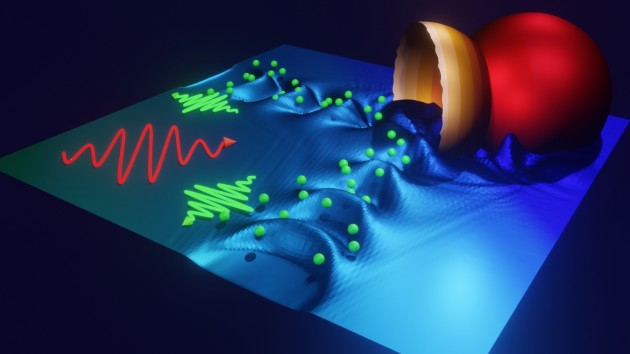
THz quantum cascade laser

Free-space optical communications at 4 Gbit/s data rate with a terahertz laser

  • Jayaprasath Elumalai
  • Mohammed Salih
  • Joshua R. Freeman
Article

Announcements

  • bring together research from diverse aspects of physical biology, focusing on the interplay of physical laws and bacterial behaviour and physiology.

    We welcome submissions of original research, perspectives, and review articles highlighting the growing toolbox where simulations, high-precision experiments, and data-driven models converge on measurable, designable odd responses in soft systems.

    Open for submissions
  • Carlo Vittorio Cannistraci's headshot

    Dr. Cannistraci is a theoretical engineer and computational innovator. He is a Chair Professor in the Tsinghua Laboratory of Brain and Intelligence (THBI) and adjunct professor in the Department of Computer Science and in the School of Biomedical Engineering at Tsinghua University.

  • Image credit: © imageBROKER/Hulya Koca/imageBROKER/Gettyimages

    With this cross-journal Collection, the editors at Nature Communications, Communications Physics, npj Complexity and npj Systems Biology and Applications invite manuscripts that focus on approaches that use nonlinear dynamical systems to uncover organizing principles in living systems, together with experiments that are explicitly interpreted through such frameworks.

    Open for submissions
  • metrics

    Communications Physics has a 2-year impact factor of 5.8 (2024), a median decision times of 7 days to first editorial decision and 158 days from submission to acceptance.

Advertisement

  • Contextuality is a fundamental resource for quantum information processing, underpinning quantum entanglement. Here, the authors experimentally demonstrate the asymmetrical relationship between contextuality and entanglement using polarization-entangled photons, revealing the noninjective nature of their mapping and advancing methods to explore quantum properties.

    • Xingyan Fan
    • An-Ning Zhang
    • Jungang Li
    ArticleOpen Access
  • Ecosystems in the Anthropocene exhibit complex dynamics that traditional ecological networks with pairwise interactions only partially capture. Here, the authors review hypergraphs as a framework for modeling higher-order interactions, showing how they clarify how ecological structures form and reorganize, with implications for conservation strategies including rewilding and habitat restoration aimed at sustaining biodiversity under rapid environmental change.

    • Blai Vidiella
    • Salva Duran-Nebreda
    • Sergi Valverde
    PerspectiveOpen Access
  • Efficient heat management in nanoscale electronics depends on the precise control of vibrational waves known as phonons. This research reveals that while periodic layered materials allow these waves to travel coherently, structural disorder triggers Anderson localization, trapping the waves and significantly reducing heat flow.

    • Anass Sebbar
    • Shubham Tyagi
    • Marc Bescond
    ArticleOpen Access
  • Astrophysical models underproduce the element Sr in intermediate neutron density environments (the so called i-process). The authors investigate the nuclear reactions that produce Sr and find that the new experimental reaction rates help to bridge the gap between models and observations.

    • Caley M. Harris
    • Artemis Spyrou
    • Mathis Wiedeking
    ArticleOpen Access
  • Fluids lack positional order, which limits their ability to reshape objects and function as soft mechanical materials. Here, the authors show that a ferroelectric smectic-A liquid crystal can exert micronewton-scale forces and rotate and reshape embedded soft inclusions much more strongly than non-lamellar fluids.

    • Yu Zou
    • Jiantao Liang
    • Satoshi Aya
    ArticleOpen Access
  • Estimating nonlinear functions of quantum states is essential for quantum information processing but often computationally expensive. The quantum state function framework estimates a degree-n polynomial of a quantum state with \({{{\mathcal{O}}}}(n/{\varepsilon }^{2})\) copies without purified query access, enabling practical entropy, fidelity, and eigenvalue estimation.

    • Hongshun Yao
    • Yingjian Liu
    • Xin Wang
    ArticleOpen Access
  • Early-warning indicators such as increased variance, autocorrelation, and dimensional reduction are often interpreted as signs that complex systems in ecology, neuroscience, finance, or climate are approaching a tipping point at which a stable state loses stability or disappears. Here, the authors demonstrate, using brain dynamics during epileptic seizures as an example case, that the same statistical signatures can arise from pseudo-bifurcations in stochastic non-normal systems, showing that these widely used indicators are not uniquely diagnostic of tipping points.

    • Virgile Troude
    • Sandro Claudio Lera
    • Didier Sornette
    ArticleOpen Access
  • Ultracold polar molecular gases provide a powerful platform for exploring quantum many-body physics with strong, long-range, and anisotropic interactions. Here, the authors explore quantum phases via beyond mean-field theory and path-integral Monte Carlo simulations, unveiling rich many-body behaviour.

    • Tiziano Arnone Cardinale
    • Thomas Bland
    • Stephanie M. Reimann
    ArticleOpen Access
  • AI applications in science often face limitations due to device-specific training and opaque “black-box” methods, hindering cross-system generalization. Here, the authors demonstrate a neural network trained on one tokamak’s turbulence data can predict edge localized mode onsets in another without retraining, showcasing potential for tokamak-agnostic AI systems.

    • Semin Joung
    • Jaewook Kim
    • E. Kolemen
    ArticleOpen Access

Advertisement

Nature Careers

Science jobs

Advertisement