
Load balancing is a fundamental aspect of modern network and application architecture, designed to distribute incoming network traffic across multiple servers or resources. This distribution ensures that no single server becomes overwhelmed, improving the availability, reliability, and performance of applications.
Load balancers come in two main varieties: stateless and stateful.
Stateless Load Balancing
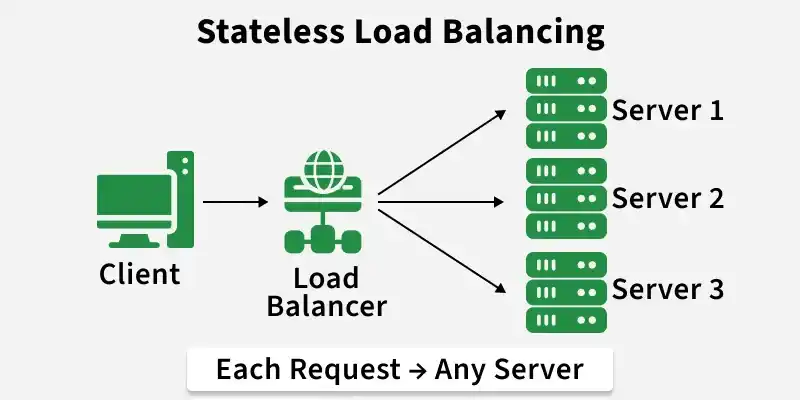
Stateless load balancing refers to the practice of distributing incoming requests to servers without considering the state or context of previous interactions. In this model, each request is treated independently, and no information about previous requests is maintained.
- Each request is handled independently without maintaining session state, making the system simpler to implement and manage.
- Easily scales horizontally since new servers can be added without needing to track or share session information.
- Pros: Highly scalable, simple, better fault tolerance
- Cons: No session persistence; not suitable for user-dependent applications
Use Cases
The use cases of stateless load balancing are:
- RESTful APIs: APIs that do not require session management can benefit from stateless load balancing, allowing requests to be routed to any server without maintaining session continuity.
- Microservices: Stateless microservices architectures can leverage stateless load balancing for efficient scaling and flexibility in managing service requests.
- Content Delivery Networks (CDNs): CDNs that deliver static content or data can use stateless load balancing to distribute traffic efficiently without needing session context.
- Search Engines: Stateless load balancing is ideal for search engines and other applications that process independent queries without needing to remember previous interactions.
Stateful Load Balancing
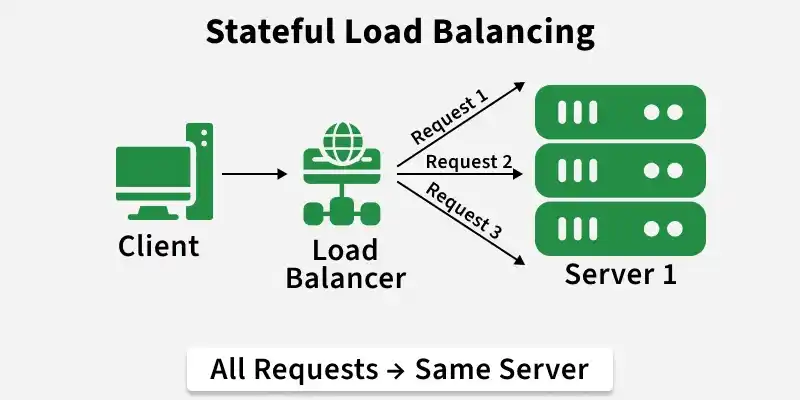
Stateful load balancing, in contrast, involves distributing requests based on the state or context of the ongoing session. This means that the load balancer keeps track of the session state and ensures that all requests from a particular session are routed to the same server.
- Routes requests from the same user/session to the same server, ensuring continuity by maintaining session information.
- More complex to manage since it requires storing and handling session state across the system.
- Pros: Maintains session consistency, better user experience.
- Cons: Complex to manage, harder to scale, risk of session loss.
Use Cases
The use cases of stateful load balancing are:
- E-Commerce Platforms: Shopping carts and user sessions need to be consistently managed, requiring stateful load balancing to ensure that users' shopping carts are maintained across requests.
- Online Banking: Financial applications often require session persistence to ensure that user interactions are consistently managed throughout their session.
- Gaming Servers: Multiplayer online games where players' sessions and interactions need to be consistent can benefit from stateful load balancing to maintain game state and player data.
- Collaboration Tools: Applications such as real-time collaboration tools and chat platforms require session consistency to manage ongoing interactions and data synchronization.
Stateless Vs Stateful Load Balancing
To provide a clearer comparison, here is a table outlining the key differences between stateless and stateful load balancing:
| Stateless Load Balancing | Stateful Load Balancing |
|---|---|
| Distributes requests without maintaining any session information. | Maintains session information across multiple requests. |
| Does not retain information about client sessions. | Retains and manages client session information. |
| Requests are distributed based on current load, without considering previous interactions. | Requests are directed to the same server to maintain session continuity. |
| Generally more scalable because there is no session management overhead. | May have scalability limitations due to session tracking. |
| If a server fails, requests are redistributed without losing session data. | Session loss can occur if the server fails and the session is not replicated. |
| Easier to implement since there is no need for session tracking. | More complex because session persistence or replication is required. |
| Suitable for stateless applications like APIs and web services. | Suitable for applications requiring session persistence like shopping carts. |
| Typically faster due to lower overhead. | May have performance overhead due to session management. |
| Each request is independent, reducing state-related issues. | Ensures consistent handling of requests from the same client. |