
Maintainability refers to how easily a software system can be modified, updated, or improved over time. It ensures developers can fix issues, add features, and enhance components with minimal disruption to the system.
- The system is structured into smaller modules so individual parts can be changed without affecting the entire application.
- Clear, readable code along with version control and automated testing helps track changes and quickly detect issues.
Example: In a large web application, developers organize the system into separate modules such as authentication, payment, and user management. This allows teams to update one module without impacting the rest of the application.
Measuring Maintainability
While measuring maintainability is subjective, here are some metrics to measure it:
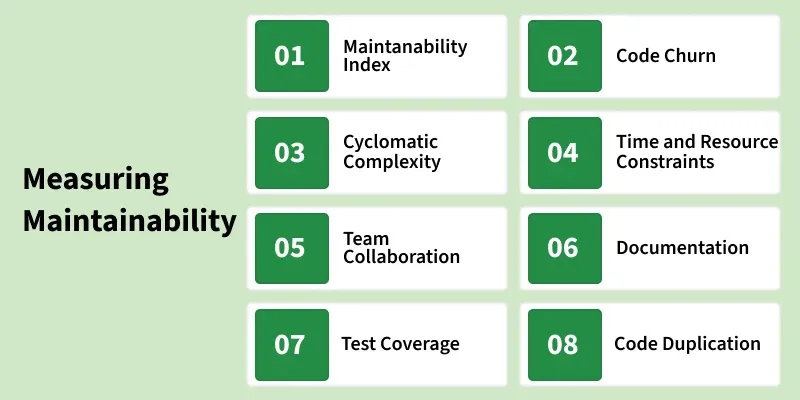
1. Maintainability Index
It gives a score to measure how maintainable a code module or system is. It considers factors like complexity and duplication, and may vary by IDE. A higher score means better maintainability and easier code improvements.
2. Code Churn
It tracks how often a code module is modified over time using version control data. High churn can indicate instability, while monitoring it helps identify areas needing extra testing and attention.
3. Cyclomatic Complexity
It measures the complexity of a code module. Higher complexity is an indication that the code is more complicated to understand and there may be potential easier ways available to break the complexity of a particular code module.
4. Time and Resource constraints
It's important to balance between speed of development as well as speed of maintainability. A rush by the development team to complete a tight deadline without considering maintainability can lead to complicated future maintenance efforts.
5. Team Collaboration
A strong collaborative culture within the development team helps them share knowledge with each other, perform Knowledge Transfer programs (KT), mentor newcomers, and work together on maintenance tasks, it helps team members grow together and makes sure someone won't struggle in doing a particular task.
6. Documentation
A Good documentation is the one, which makes a newcomer understand the project and also covers not only code comments but also architectural decisions, System design, API references, as well.
7. Test Coverage
It measures the extent to which automated tests cover the codebase, It helps prevent regressions from being introduced. Test coverage tools assess the extent of code exercised by automated tests, expressed as a percentage.
8. Code Duplication
It measures how much repeated code exists in a system. High duplication increases maintenance effort because changes must be updated in multiple places. It is detected using static analysis tools that find similar code segments.
Hidden Costs of Poor Maintainability
Poor maintainability makes systems harder to understand and modify, reducing efficiency and stability. It increases development time and complexity, slowing down the delivery of new features.
- Increase in Technical Debt: Quick fixes and temporary solutions accumulate over time, making the codebase more complex and harder to manage.
- Slower Bug Fixing: Developers may spend significant time understanding complicated code before resolving issues.
- Difficult Test Maintenance: Automated tests may frequently break when the underlying code is poorly structured or tightly coupled.
- Delayed Development Cycles: Poor maintainability can slow down feature development and make meeting project deadlines challenging.
- Unreliable Testing: Poorly organized code makes it difficult to create stable and effective test cases.
Ways to achieve high Maintainability
Designing a highly maintainable system requires a proactive approach during the development process. Here are some strategies to achieve and improve maintainability in system design:
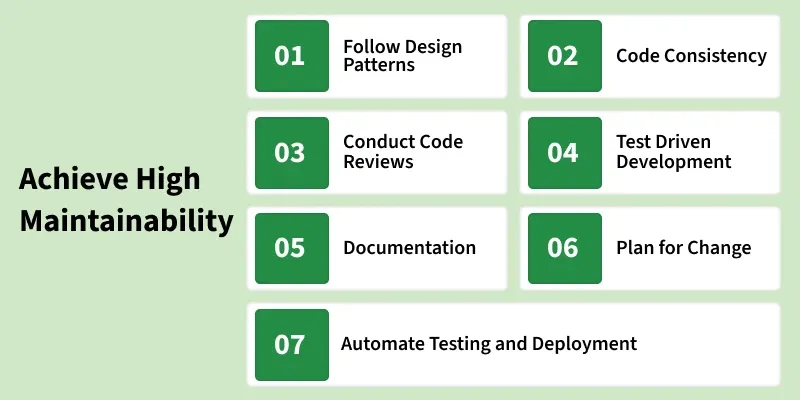
1. Follow Design Patterns
Design patterns, such as Model-View-Controller and SOLID principles, promote modularity, and flexibility. Following these patterns enhances overall architecture while making it easier to maintain.
2. Code Consistency
Well-written, readable code with meaningful variables, comments, and documentation makes maintenance tasks even smoother. So, as much as possible while writing code or documentation make it simple in design and implementation.
3. Conduct Code Reviews
Code reviews by peers and maintainers help identify potential issues early while ensuring that code adheres to maintainability standards and coding style guidelines.
4. Test-Driven Development (TDD)
Adopting TDD ensures that test cases are written before the code implementation, helping developers understand the codebase easily while troubleshooting an issue.
5. Documentation
Good documentation reduces the learning curve for new Devs and helps the existing team understand it better during maintenance. Maintain thorough documentation of the system's architecture, APIs, modules, and dependencies.
6. Plan for Change
Design the system in such a way, that makes it easier to add new features and adapt to evolving requirements of daily enhancements.
7. Automate Testing and Deployment
Automating testing and deployment reduces the chance of human error and helps maintain system stability during updates, while also saving time and effort for the team.
Challenges in Maintainability
Maintaining a large software system can become difficult as the system grows in size and complexity. Various technical and organizational factors can reduce maintainability and make updates or bug fixes more time-consuming.
• Complex Code Structure: Highly complex or tightly coupled code makes it difficult for developers to understand and modify the system.
• Poor Documentation: Lack of proper documentation makes it harder for new developers to understand system architecture and functionality.
• Frequent Requirement Changes: Continuous changes in requirements can make the system harder to maintain if the design is not flexible.
• Code Duplication: Repeated code across different modules increases maintenance effort because changes must be applied in multiple places.
• Lack of Automated Testing: Without proper testing, even small changes may introduce new bugs, making maintenance risky.
• Technical Debt: Quick fixes or temporary solutions added over time can make the system harder to manage and update.