
Amazon Route 53 is a highly available and scalable cloud Domain Name System (DNS) service. It allows customization of DNS routing policies to reduce latency. In simple terms, cloud computing refers to storing and accessing data and programs on remote servers hosted on the internet, rather than on a local computer’s hard drive or server. It is also known as Internet-based computing.
Features of Cloud Computing
Below are the features of cloud computing:
- No Up-Front Investment: Cloud computing eliminates the need for significant initial capital expenditure.
- Lower Operating Costs: It reduces operational costs by offering pay-as-you-go pricing models.
- Highly Scalable: Resources can be scaled up or down based on demand.
- Easy Access: Data and applications can be accessed from anywhere with an internet connection.
- Reducing Business Risks and Maintenance Expenses: Cloud computing minimizes risks and maintenance costs.
- No Need to Guess the Capacity: Resources can be adjusted according to actual usage, eliminating the need for capacity planning.
- Flexible: Offers various services that can be adapted to different needs.
Amazon Web Services (AWS) is a subsidiary of Amazon.com that provides on-demand cloud computing platforms to individuals, companies, and governments, based on a paid subscription model.
Amazon Route 53
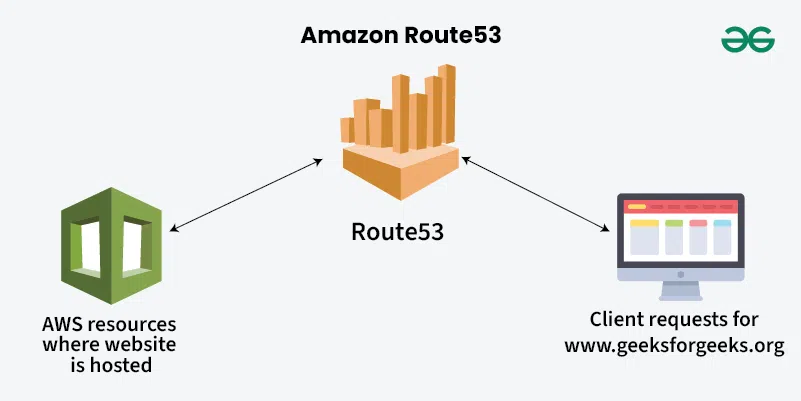
Amazon Route 53 is a highly available and scalable cloud DNS web service. It is designed for developers and corporations to route end users to internet applications by translating human-readable names like www.geeksforgeeks.org into numeric IP addresses like 192.0.1.1 that computers use to connect. Amazon Route 53 cannot be used to connect an on-premises network with the AWS Cloud.
Functions of Route53
Below are the functions of route53:
- Domain Name Registration: Route 53 helps register domain names for websites.
- User Connection: Connects users to websites based on domain names.
- Health Monitoring: Automatically routes users to healthy resources if any failures are detected.
Route 53 is cost-effective, secure, scalable, flexible, highly available, and reliable.
Methodologies Related to Route 53
Below are the methodologies related to Route53:
- Records: Objects in a hosted zone that determine how to route internet traffic for a domain name.
- Hosted Zone: Created when a domain name is registered, containing records for routing traffic for the domain and subdomains.
- DNS Query: A request for information sent from a DNS client to a DNS server.
- Alias Records: Route internet traffic to AWS resources like S3 buckets and CloudFront, created at the top node of the DNS namespace.
- Name Servers: Translate domain names into IP addresses to route internet traffic to resources.
- DNS Failover: Routes traffic from unhealthy resources to healthy ones.
Routing Policies
Below are some routing policies:
- Simple Routing Policy: Routes traffic to a single resource, with multiple values possible in the same record.
- Failover Routing Policy: Routes traffic from unhealthy resources to healthy ones.
- Geolocation Routing Policy: Routes traffic based on the geographic location of the user, providing location-specific content.
- Geoproximity Routing Policy: Routes traffic based on the geographical location of the user and the type of content, allowing traffic shifting between locations.
- Latency Routing Policy: Routes requests to the AWS region with the lowest latency, improving performance for users.
- Multivalue Routing Policy: Returns multiple values in response to DNS queries, checking resource health before returning values.
- Weighted Routing Policy: Routes traffic to multiple resources based on user-defined proportions.
Benefits of Route53
Below are the benefits of Route53:
- Highly Reliable: Built on AWS’s reliable infrastructure, ensuring consistent routing of end users to web applications.
- Scalable: Automatically scales resources to handle large traffic and queries without user intervention.
- Easy to Use: User-friendly configuration for DNS settings, answering queries within minutes.
- Health Check: Monitors application health and redirects users to healthy resources if issues are detected.
- Flexible: Allows for the selection of different routing policies as needed.
- Simple: Manages global traffic with various routing types.
- Cost-Effective: Charges are based on the services used.
- Secure: Integration with IAM ensures access is secured by authorizing only permitted users.
- Mapped with Various AWS Services: Can map domain names to AWS resources such as EC2 instances and S3 buckets.

