Inheritance is an important feature of object-oriented programming that allows a contract to extend the functionality of another contract. In Solidity, contracts can inherit properties and functions from other contracts, improving code reusability and modularity. The contract providing features is called the base (parent) contract, while the one inheriting them is called the derived (child) contract.
- A derived contract can access all public and internal members of the base contract except private ones.
- It helps reduce code duplication and promotes better code organization.
- Function overriding is allowed if the function signature remains the same.
- A parent contract’s function can be called using the super keyword or the contract name.
- In multiple inheritance, super follows the inheritance order and calls the most derived implementation first.
Solidity provides different types of inheritance.
1. Single Inheritance
In Single or single level inheritance the functions and variables of one base contract are inherited to only one derived contract.
Example: In the below example, the contract parent is inherited by the contract child, to demonstrate Single Inheritance.
// Solidity program to
// demonstrate
// Single Inheritance
pragma solidity >=0.4.22 <0.6.0;

// Defining contract
contract parent{

    // Declaring internal
    // state variable
    uint internal sum;

    // Defining external function
    // to set value of internal
    // state variable sum
    function setValue() external {
        uint a = 10;
        uint b = 20;
        sum = a + b;
    }
}

// Defining child contract
contract child is parent{

    // Defining external function
    // to return value of
    // internal state variable sum
    function getValue(
    ) external view returns(uint) {
        return sum;
    }
}

// Defining calling contract
contract caller {

    // Creating child contract object
    child cc = new child();

    // Defining function to call
    // setValue and getValue functions
    function testInheritance(
    ) public returns (uint) {
        cc.setValue();
        return cc.getValue();
    }
}
Output :

2. Multi-level Inheritance
It is very similar to single inheritance, but the difference is that it has levels of the relationship between the parent and the child. The child contract derived from a parent also acts as a parent for the contract which is derived from it.
Example: In the below example, contract A is inherited by contract B, contract B is inherited by contract C, to demonstrate Multi-level Inheritance.
// Solidity program to
// demonstrate Multi-Level
//  Inheritance
pragma solidity >=0.4.22 <0.6.0;

// Defining parent contract A
contract A {

     // Declaring state variables
     string internal x;
     string a = "Geeks" ;
     string b = "For";

    // Defining external function
    // to return concatenated string
    function getA() external{
        x = string(abi.encodePacked(a, b));
    }
}

// Defining child contract B
// inheriting parent contract A
contract B is A {

      // Declaring state variables
      // of child contract B
      string public y;
      string c = "Geeks";

    // Defining external function to
    // return concatenated string
    function getB() external payable returns(
      string memory){
        y = string(abi.encodePacked(x, c));
    }
}

// Defining child contract C
// inheriting parent contract A
contract C is B {

    // Defining external function
    // returning concatenated string
    // generated in child contract B
    function getC() external view returns(
      string memory){
        return y;
    }
}

// Defining calling contract
contract caller {

    // Creating object of child C
    C cc = new C();

    // Defining public function to
    // return final concatenated string
    function testInheritance(
    ) public returns (
      string memory) {
        cc.getA();
        cc.getB();
        return cc.getC();
    }
}
Output :
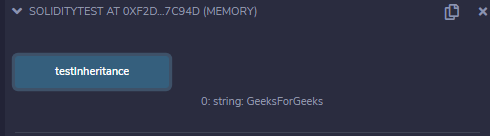
3. Hierarchical Inheritance
In Hierarchical inheritance, a parent contract has more than one child contracts. It is mostly used when a common functionality is to be used in different places.
Example: In the below example, contract A is inherited by contract B, contract A is inherited by contract C, thus demonstrating Hierarchical Inheritance.
// Solidity program to demonstrate
// Hierarchical Inheritance
pragma solidity >=0.4.22 <0.6.0;

// Defining parent contract A
contract A {

    // Declaring internal
    // state variable
    string internal x;

    // Defining external function
    // to set value of
    // internalstate variable
    function getA() external {
        x = "GeeksForGeeks";
    }

    // Declaring internal
    // state variable
    uint internal sum;

    // Defining external function
    // to set the value of
    // internal state variable sum
    function setA() external {
        uint a = 10;
        uint b = 20;
        sum = a + b;
    }
}

// Defining child contract B
// inheriting parent contract A
contract B is A {

    // Defining external function to
    // return state variable x
    function getAstr(
    ) external view returns(string memory){
        return x;
    }

}


// Defining child contract C
// inheriting parent contract A
contract C is A {

      // Defining external function to
      // return state variable sum
      function getAValue(
      ) external view returns(uint){
        return sum;
    }
}

// Defining calling contract
contract caller {

    // Creating object of contract B
    B contractB = new B();

    // Creating object of contract C
    C contractC = new C();

    // Defining public function to
    // return values of state variables
    // x and sum
    function testInheritance(
    ) public returns (
      string memory, uint) {
        return (
          contractB.getAstr(), contractC.getAValue());
    }
}
Output :
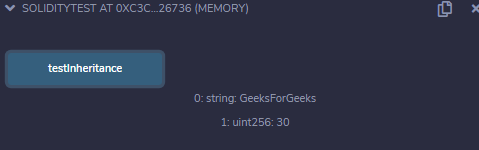
4. Multiple Inheritance
In Multiple Inheritance, a single contract can be inherited from many contracts. A parent contract can have more than one child while a child contract can have more than one parent.
Example: In the below example, contract C inherits from both contract A and contract B, demonstrating Multiple Inheritance.
// Solidity program to
// demonstrate
// Multiple Inheritance
pragma solidity >=0.4.22 <0.6.0;

// Defining contract A
contract A {

    // Declaring internal
    // state variable
    string internal x;

    // Defining external function
    // to set value of
    // internal state variable x
    function setA() external {
        x = "GeeksForGeeks";
    }
}

// Defining contract B
contract B {

    // Declaring internal
   // state variable
    uint internal pow;

    // Defining external function
    // to set value of internal
    // state variable pow
    function setB() external {
        uint a = 2;
        uint b = 20;
        pow = a ** b;

    }
}

// Defining child contract C
// inheriting parent contract
// A and B
contract C is A, B {

  // Defining external function
  // to return state variable x
  function getStr(
  ) external returns(string memory) {
        return x;
    }

    // Defining external function
    // to return state variable pow
    function getPow(
    ) external returns(uint) {
        return pow;
    }
}

// Defining calling contract
contract caller {

    // Creating object of contract C
    C contractC = new C();

    // Defining public function to
    // return values from functions
   // getStr and getPow
    function testInheritance(
    ) public returns(string memory, uint) {
        contractC.setA();
        contractC.setB();
        return (
          contractC.getStr(), contractC.getPow());
    }
}
Output :