Binomial distribution is a probability distribution that summarises the likelihood that a variable will take one of two independent values under a given set of parameters. The distribution is obtained by performing a number of Bernoulli trials.
A Bernoulli trial is assumed to meet each of these criteria :
p^r * (1-p)^{n-r}
\frac{n!}{(n-r)!\ *\ r!}
\frac{n!}{(n-r)!\ *\ r!}\ *\ p^r * (1-p)^{n-r}
This distribution has a mean equal to np and a variance of np(1-p).
Using Python to obtain the distribution :
Now, we will use Python to analyse the distribution(using SciPy) and plot the graph(using Matplotlib).
Modules required :
python3 python3
- There must be only 2 possible outcomes.
- Each outcome has a fixed probability of occurring. A success has the probability of p, and a failure has the probability of 1 - p.
- Each trial is completely independent of all others.
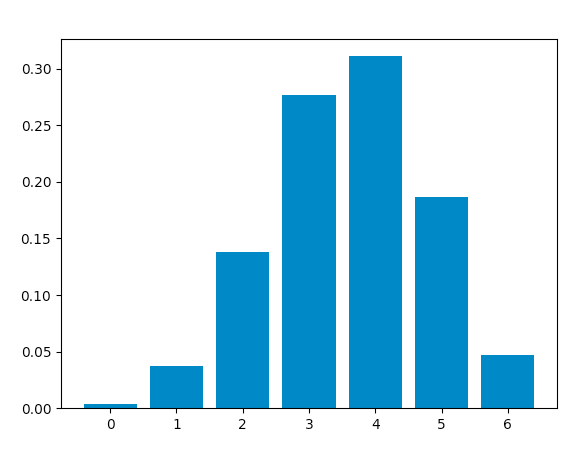
| r | 0 | 1 | 2 | 3 | 4 | 5 | 6 |
| P(r) | 0.004096 | 0.036864 | 0.138240 | 0.276480 | 0.311040 | 0.186624 | 0.046656 |
- SciPy:
SciPy is an Open Source Python library, used in mathematics, engineering, scientific and technical computing.
Installation :
pip install scipy
- Matplotlib:
Matplotlib is a comprehensive Python library for plotting static and interactive graphs and visualisations.
Installation :
pip install matplotlib
Syntax : scipy.stats.binom.stats(n, p)It returns a tuple containing the mean and variance of the distribution in that order. scipy.stats.binom.pmf() function is used to obtain the probability mass function for a certain value of r, n and p. We can obtain the distribution by passing all possible values of r(0 to n).
Syntax : scipy.stats.binom.pmf(r, n, p)Calculating distribution table : Approach :
- Define n and p.
- Define a list of values of r from 0 to n.
- Get mean and variance.
- For each r, calculate the pmf and store in a list.
from scipy.stats import binom
# setting the values
# of n and p
n = 6
p = 0.6
# defining the list of r values
r_values = list(range(n + 1))
# obtaining the mean and variance
mean, var = binom.stats(n, p)
# list of pmf values
dist = [binom.pmf(r, n, p) for r in r_values ]
# printing the table
print("r\tp(r)")
for i in range(n + 1):
    print(str(r_values[i]) + "\t" + str(dist[i]))
# printing mean and variance
print("mean = "+str(mean))
print("variance = "+str(var))
r    p(r)
0    0.004096000000000002
1    0.03686400000000005
2    0.13824000000000003
3    0.2764800000000001
4    0.31104
5    0.18662400000000007
6    0.04665599999999999
mean = 3.5999999999999996
variance = 1.44
Code: Plotting the graph using matplotlib.pyplot.bar() function to plot vertical bars.
from scipy.stats import binom
import matplotlib.pyplot as plt
# setting the values
# of n and p
n = 6
p = 0.6
# defining list of r values
r_values = list(range(n + 1))
# list of pmf values
dist = [binom.pmf(r, n, p) for r in r_values ]
# plotting the graph
plt.bar(r_values, dist)
plt.show()
Output :
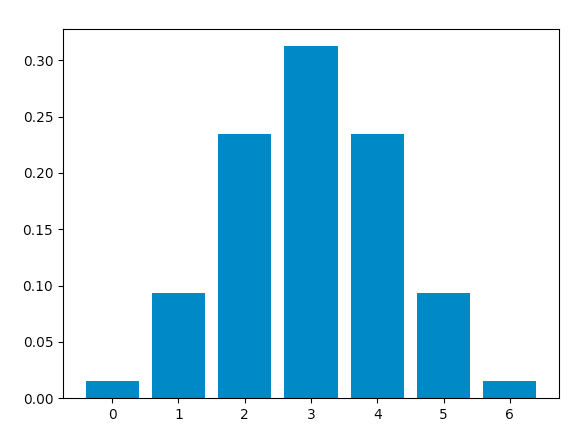
When success and failure are equally likely, the binomial distribution is a normal distribution. Hence, changing the value of p to 0.5, we obtain this graph, which is identical to a normal distribution plot :